Articles (2020)

Two in One Boat: A Photo and Video Essay from Montana’s Jefferson River

Father and son float trip in the lowlands. Experience Ryan Jordan’s wild ride through skeeters and heat exhaustion, including running low on key supplies. Or… not.


High Water Philosophy Class

In June 2009, my son Chase and I embarked on our first outing with our new Boy Scout troop: a float of the Jefferson River during high water season. Our entire gear list seemed centered around our boat selection: the Alpacka Double Duck, a sort-of-two-person packraft that weighs only six pounds.

However, once we hit the water, our gear became less of a concern, and we relished in the joy of floating such a big river (6000 cfs) in such a tiny boat.

The experience is hard to convey with media, but impossible without, so I hope you enjoy the photos and video and that they will inspire you to consider what going light might mean for you outside the realm of trail corridors (be sure to check out the related gear list, too!).

Two in One Boat: A Photo and Video Essay from Montanas Jefferson River - 1
Getting ready to launch at Limespur, me (Ryan) and my son (Chase) wondered if the enthusiasm would wane after long days in a very small boat.

Two in One Boat: A Photo and Video Essay from Montanas Jefferson River - 2
OK, so I’m not exactly Captain William Clark, but I have one thing he didn’t – the Sawyer Packraft Paddle (28 oz).

Two in One Boat: A Photo and Video Essay from Montanas Jefferson River - 3
Big river, little boat.

Two in One Boat: A Photo and Video Essay from Montanas Jefferson River - 4
Paddling in tandem as we ferry across the current. Tandem paddling in the Alpacka Double Duck, we were able to achieve speeds (with help from the current) of up to nine miles an hour (as measured by a GPS).

Two in One Boat: A Photo and Video Essay from Montanas Jefferson River - 5
We paddled with the “raft flotilla.” The canoeists, being faster, floated in their own group.

Two in One Boat: A Photo and Video Essay from Montanas Jefferson River - 6
Our Mountain Laurel Designs SuperMid (22 oz) seemed a lonely outcast among more conventional tents.

Two in One Boat: A Photo and Video Essay from Montanas Jefferson River - 7
Mosquitoes!

Two in One Boat: A Photo and Video Essay from Montanas Jefferson River - 8
It’s not often I paddle wearing a headnet, but we sure appreciated them in June on the Jefferson. In fact, I turned down at least one offer for $50 in exchange for my stellar skeeter protection.

Two in One Boat: A Photo and Video Essay from Montanas Jefferson River - 9
Mutiny on the HMS Double Duck?

Two in One Boat: A Photo and Video Essay from Montanas Jefferson River - 10
The Alpacka Ultralight Paddle is perfect for kids (and calmwater adult paddlers) at only 23 oz.

Two in One Boat: A Photo and Video Essay from Montanas Jefferson River - 11
The Jefferson is lined with big cliffs and thick willows. Chase keeps his eye out for rattlesnakes, a common critter here.

Two in One Boat: A Photo and Video Essay from Montanas Jefferson River - 12
This is how you enjoy river life when you live on the dark side (non-portage-able boats that carry all the accoutrements of modern civilization)!

Two in One Boat: Sharing a Packraft on a River Trip

With 40 lbs from skin out for both father and son, would our contingency plan of “snuggling for warmth” come into play?

Preface

As the rear of the boat was sucked back into the eddy fence, I felt water rushing down my back. "Paddle! Hard! Now!" I yelled to my little companion in the front of the boat. In tandem, we gave it all we had and managed to eke back into the current, leaving the foot-high eddy boils behind us.

Such is life in a packraft, which is more sensitive to load:boat weight ratios than other boats, making the consideration of weight even more critical when there are two people sharing a single six-pound packraft.

Two in One Boat: Sharing a Packraft on a River Trip (Gear List) - 1
Fully decked out – two people in one boat, with a fully skinned out gear and supply of weight of 40 pounds, including the boat.

Introduction

We graduated from Webelos in April (me as Den Leader, Chase with his Arrow of Light) and immediately crossed over into our new Boy Scout troop, particularly enthused about our first outing: canoeing the Jefferson River in June. Because this was a family trek, we weren’t confined to the constraints (and some of the freedoms) of camping and cooking using the Patrol Method (the BSA philosophy by which groups of boys camp and cook as a single unit of 4-8 people). Instead, we’d camp and cook together as father and son.

When we saw the trek on the calendar, we looked at each other and smirked: the obvious message that neither of us needed to communicate was that this would be a great opportunity to try out the new Alpacka Double Duck, a two-person packraft designed for calm water.

Along with the packraft – which, once occupied by two inhabitants, doesn’t have much room remaining – we’d share a bunch of other stuff too: first aid kit, cook kit, shelter, firestarting supplies, and go pretty thin on the rest. We would eliminate a shelter floor, sleeping pads, and gas stove; we’d both bring hoodless down mummy bags that weighed 17-19 ounces each (snuggling for warmth if we needed to), leave home that extra "insurance layer" (snuggling for warmth if we needed to), employ multiple use items as much as possible, and eliminate some food weight (snuggling for warmth if we needed to).

We didn’t actually have to employ our contingency strategy (snuggling) and fared rather comfortably on the trip, traveling down the river fully skinned out with about 40 pounds of gear and food for the two of us. That 40 pounds included all of our gear, supplies, clothing worn, boating gear, and of course, boats.

Two in One Boat: Sharing a Packraft on a River Trip (Gear List) - 2
The big platform of the Double Duck makes it a very stable boat, allowing Chase to paddle on his knees, one of the more comfortable positions he found.

Boating Gear

It’s no surprise that I’m a fan of Alpacka rafts (www.alpackaraft.com). I’ve enjoyed "two-in-one boat" trips before, in what was formerly known as the Alpacka Dory (now called the Fjord Explorer). The Dory/Explorer benefited two people in rough water conditions with an upturned bow and stern that helped to spill waves to the side without filling the boat. However, interior room was pretty cramped, especially for longer floats. For this trip, we used an Alpacka Double Duck, the company’s newest model.

At less than six pounds, it’s remarkably light for a boat that accommodates two occupants in comfort. Neither bow nor stern is upturned on the Double Duck, so it’s intended for flatwater paddling only, thus making it the perfect choice for a river like the Class I Jefferson. However, at 6,000 cfs, the diversion dam we’d have to cross would be too much for the Double Duck, so we’d portage around. Also, because we’d be a package of 300 pounds (including boat, gear, food, water, and people), we’d be pretty cautious negotiating the Jefferson’s gigantic eddies, which form during the snowmelt season and have been known to swamp canoes, rafts, and drift boats alike.

In addition to the raft, we’d each take a kayak paddle – the powerful Sawyer Packraft Paddle for me and the easier-to-paddle Alpacka Ultralight Paddle for Chase. Together, we could forward- or backferry around obstacles quickly, and double paddling would be essential for us to make it into the tiny, hidden side channel that led to our campsite – at a right angle to the Jefferson’s 6 mph current. Hitting that side channel meant that we would avoid a half-hour of hip-deep swamp portaging to our campsite.

My paddle would serve a dual use – as our shelter’s center pole (without the blades), while remaining paddle parts would be distributed around the mesh skirt of the shelter to seal it to the ground for mosquito protection. PFDs and the inflatable seats from our boats would serve as pillows and footrests while sleeping, and, in case snuggling wore itself out, as insulation if worn under our rain jackets. Finally, the packraft would provide ground protection and padding, since we weren’t bringing sleeping pads or ground cloths.

Shelter and Sleeping

We wanted a shelter that provided full-perimeter protection with the ability to create a sealed floor with our remaining gear. Ron Bell makes a silnylon pyramid shelter that may be my favorite river shelter. It can accommodate two packrafters sleeping on their boats with plenty of room for additional gear; it has a low peak for good wind-shedding ability, a noseeum mesh bug skirt, and reinforcements at the peak for using a packraft paddle (stub or blade) in the apex. The result is a roomy shelter with zippered entry for only 22 ounces (see Gear List).

We’d use the packraft, our two dry bags (50L and 65L), our rain jackets and pants, and two pack liners to completely seal the floor of the shelter. This proved an important strategy, since mosquitoes were settled into the grass when we pitched our camp, only to come alive as the sun went down.

Two in One Boat: Sharing a Packraft on a River Trip (Gear List) - 3
We packed our gear in three dry bags – a 65L bag lashed to the bow and a 50L bag that Chase used for a seat. The little dry bag is for our lunch and cameras, and we kept water bottles in the floor of the boat.

We each used hoodless sleeping bags made of down – a Feathered Friends Vireo (17 oz) for me and a Western Mountaineering Tamarack (19 oz) for Chase. The bags provided plenty of warmth for the 40-something-degree nights, and we relied on the full perimeter shelter to keep the wind at bay. Headnets took care of renegade mosquitoes that somehow managed to penetrate our other defenses.

We didn’t bring sleeping pads. I’d love to tell you that we created comfortable and warm beds from forest duff, a skill borne of years of practice and experience, but a Scout is Trustworthy as they say, and we must confess to committing a cardinal sin of lightweight backpacking: we brought camp chairs that unfolded into beds. In our defense, they were light! While the Crazy Creek HexaLite chairs (high back for me, standard model for Chase) were not as comfortable as an inflatable pad, they were comfortable enough, especially when combined with the natural sponge bed of grassy… ahem… swamp we stumbled upon inside our shelter after we had pitched it. The chairs served multiple uses, of course – they weren’t just a sleeping pad. They were cooking seats, talking seats, writing seats, and sittin’ seats, both inside and outside the shelter.

Cooking

Limited volume and the desire to minimize weight were not considered when we were dreaming about relaxing in a camp chair, but somehow, these concepts were at the forefront of our decision to select a cooking kit. We opted to leave stove and fuel at home, though we didn’t want to build fires on the grassy island, and we most certainly wanted hot food and, more importantly, hot coffee (as much a benefit to Chase as to me). After deliberating a number of options, we settled on a BushBuddy Ultra cook kit that included an 1100-ml titanium pot (my eating bowl), a 550-ml titanium mug (Chase’s eating bowl), two folding titanium spoons, and two 400-ml titanium mugs (for Chase’s cocoa and Ryan’s coffee).

Our meals were simple, one-pot style and included both hot and cold cereals, potatoes, noodles, and lots of easy snacks. Remember, we brought camp chairs, so we wanted to spend our time relaxing in them instead of cooking, eating, and fussing with recipes. Plus, our previous experience has found that the most dismal campsites (this one certainly qualified, being a swamped island inhabited by blood-sucking monsters – ticks, mosquitoes, and leeches) can be cheered up with a crackling BushBuddy keeping warm brews going.

Two in One Boat: Sharing a Packraft on a River Trip (Gear List) - 4
With time and care, a floorless shelter can be made bug-proof even in the worst mosquito conditions. This one has a noseeum mesh perimeter and we used extra gear as a “floor.”

Water

The Jefferson has one of the highest silt loads of any river in Montana during snowmelt. The silt load was so high on our trip that we could hear the silt particles colliding with the side of the packraft – a sound imperceptible when only one or a hundred particles smacks the boat – a hair-bristling hiss when the particle collisions run into the millions at any instant of time. The result is that preparing treatable water from the Jefferson this time of year is a chore. Normal water filters clog instantly, and the silt load is not only unpalatable, it reduces the efficacy of most chemical methods.

To combat this scenario, we used a combination of carrying enough fresh water to guarantee that we wouldn’t die of dehydration before the end of the trip (about 8 liters between the two of us), and sort of an experimental system that I wasn’t sure would work: a little baggie of water dope (I used my own personal mixture of iron salts as a coagulant and calcium hypochlorite for a little first stage sterilization, but a similar process can be accomplished with Reliance Pur packets).

After adding the water dope and mixing rapidly to induce coagulation (I did this in a 15L dry bag), I slowly stirred the soup with a big stick for a few minutes to induce flocculation. Then, I let the bag sit for ten minutes (by hanging in a tree) to settle the floc. Finally, I decanted the clarified water from the top of the bag into water bottles through several layers of cotton bandana, and polished the whole bit off by treating with chlorine dioxide tablets. The end result was water that looked and tasted nothing like its parent sludge direct from the Jefferson (full disclosure: I did not actually sample the parent sludge before making this comparison).

For a long trip with big groups, this type of water treatment is ideal, but I found the process laborious for two people on a short journey. I also found a little trickle of a side channel that flowed through the swamp, exiting a bit tea-colored, but clear of sediments. I filtered this through the bandana to remove the rough organics, treated with chlorine dioxide, and was happy with the results.

Conclusion

This trip effectively served as sort of a shakedown for us. We were only paddling thirty miles of the Jefferson River, and it was to be our first prep trip for a much grander adventure that we’re planning in 2010 – completion of the 149-mile Upper Missouri National Wild and Scenic River. With this gear list, we felt well-prepared, and in spite of high water, hordes of bloodthirsty companions, and the short preparation time that comes from being hyper-involved in multiple activities at once (running a business, Scouting, Little League, and the demands of spring yardwork), we enjoyed a rather posh level of comfort.

The Gear List

PERSONAL GEAR        
FUNCTION MODEL (RYAN) WEIGHT (RYAN) MODEL (CHASE) WEIGHT (CHASE)
Dry Bag Pacific Outdoor Equipment Pneumo LT 65L 10.0 Pacific Outdoor Equipment Pneumo LT 50L 8.0
Pack Liner BPL XXL Pack Liner 2.7 BPL XL Pack Liner 2.1
Sleeping Bag Feathered Friends Vireo 17.0 Western Mountaineering Tamarack 19.0
Camp Chair Crazy Creek HexaLite Chair (Long Back) 18.5 Crazy Creek HexaLite Chair 14.8
Ground Cloth none none
Sleeping Pad none none
Paddle Sawyer Packraft Paddle 28.0 Alpacka Ultralight Paddle 23.0
PFD NRS Clearwater Mesh 34.0 Cabela’s Type III Ski Vest (Generic) 11.0
Mug Evernew 400 Mug 1.2 Evernew 400 Mug 1.2
Spoon FireLite SUL Folding Ti Spoon 0.4 FireLite SUL Folding Ti Spoon 0.4
Water Bottle 1L Platypus 1.2 Evernew 600 Bottle 0.8
Underwear Beartooth Merino Short 3.5 Spandex Short 2.1
Shirt Thorofare Shirt 3.7 Lightweight Polyester L/S Shirt 3.2
Pants Thorofare Pants 3.8 Supplex Convertible Pants 5.8
Wet Socks Smartwool Liner Socks 1.6 Smartwool Trekking Socks 2.1
Paddling Hat Bandana 1.0 Supplex Hat with Wide Brim 2.8
Sunglasses ZRE Racing Shields 0.7 Prescription Transition Glasses 1.2
Rain Jacket NRS Endurance Splash Top 12.0 Red Ledge Jacket 6.1
Rain Pants NRS Endurance Splash Pants 13.0 Red Ledge Pants 4.2
Warm Shirt Beartooth Merino Hoody 8.6 Midweight Capilene L/S Crew 5.4
Warm Pant Beartooth Merino UL Long John Pant 3.9 Midweight Capilene Pant 4.9
Insulating Top BPL Cocoon SUL Hoody (PL1) 7.1 Polartec 150 Pullover 7.5
Shoes Salomon Tech Amphibs 22.5 Adidas Mesh Something or Others 13.2
Dry Socks Smartwool Expedition Socks 4.5 Smartwool Trekking Socks 2.1
Warm Hat none Polartec 150 Balaclava 1.9
Gloves none none
Headnet BPL Mosquito Headnet 0.3 BPL Noseeum Headnet 0.7
Toiletries Toothbrush, Meds 1.0 Toothbrush, Meds 0.4
Knife NRS River Knife 4.0 Buck Whittling Knife 0.9
Whistle ACR Whistle (attached to PFD) 0.7 ACR Whistle (worn around lanyard on neck) 0.7
Light Fenix L0D 0.8 Petzl e-Lite 0.9
Camera Ricoh GRD 5.0 Pentax Optio WP 5.5
Journal Mini Moleskine + Pen 0.9 Small Spiral Notebook + Pen 0.8
Total Personal Gear    211.6 oz
(13.2 lbs)
  152.7 oz
(9.5 lbs)


SHARED GEAR    
FUNCTION MODEL WEIGHT
Toiletries Toothpaste, Purell, Sunscreen, DEET 2.5
Shelter Mountain Laurel Designs Packrastafaramid 22.1
Stakes BPL Hi-Vis Lazr Ti Skewer x 8 2.1
Packraft Alpacka Double Duck (weight includes bow line) 93.1
Lashing 5mm Cord, 18" Shockle, 2 S-Biners 5.8
Throw Bag NRS Pro Compact 9.3
Inflation Bag Alpacka, Large Volume 2.9
Small Dry Bag Pacific Outdoor Equipment Pneumo LT 5L 3.1
Stove Bushbuddy Ultra 5.0
Cookpot FireLite SUL 1100 3.0
Firestarting Kit Sparkie, Wetfire, Esbit Tablets, Tinder-Quik, in 5×4 Aloksak 1.1
Water Bags MSR DromLite, 6L + Pacific Outdoor Equipment Pneumo LT 15L 8.9
Water Treatment ClO2 Tablets, Ryan’s Homebrew Water Dope 3.5
First Aid Bandaids, Butterflies, Krazy Glue, Leukotape, Pills 1.2
Repair Tyvek Tape, Aquaseal, Heavy Sewing Kit 1.4
Food Storage BPL UrsaLite Bear Bag Hanging Kit 2.1
Total Shared Gear   167.1 oz
(10.4 lbs)

Total Gear, From Skin Out: 33.1 lbs (average 16.6 lbs/person)

Lightweight Pertex Shield Rainwear Hitting the Market (Outdoor Retailer Summer Market 2009)

Pertex Shield rainwear is more breathable than polyurethane laminates and similar in weight and price.

Editor’s Note: This article was opened to the public on July 22, 2010. To subscribe and see Outdoor Retailer Summer Market 2010 articles as they are published, click here.

Pertex Shield is a new family of durable waterproof-breathable fabrics from Mitsui (who purchased the Pertex technology from Perseverance Mills in 2006). It is based on a polyurethane membrane technology from Mitsui laminated to Pertex face fabrics. The constructions are Shield 02 (2-layer), Shield DS (2.5-layer), and Shield 03 (3-layer), all waterproof-breathable fabrics with very good breathability that cost less than either eVENT or Gore-Tex Pro Shell. The two- and three-layer fabrics will provide about 20,000 g/m2/day breathability levels (according to the JIS 1099 B1 standard). That’s pretty respectable compared to eVENT (~27,000 g/m2/day), Gore-Tex XCR (~21,000 g/m2/day), Entrant (about 21,000 g/m2/day), and most polyurethane coatings (5,000 to 15,000 g/m2/day). The lightest versions of Shield weigh about 2.0 oz/yd2 (2-layer) and 3.0 oz/yd2 (3-layer). Pertex Shield is not the lightest, most breathable, or cheapest of the waterproof breathable fabrics, but it is the right balance of breathability, light weight, and price to win a solid position in the market.

We found several lightweight rain jackets and pants made of Pertex Shield that will hit the market in spring 2010, from different manufacturers.

Lightweight Pertex Shield Rainwear Hitting the Market (Outdoor Retailer Summer Market 2009) - 1
The Outdoor Research Helium Jacket (6.8 oz, $140) is made of 2.5-layer 20 denier Pertex Shield DS ripstop fabric. It has a single pull hood adjustment, water-resistant full front zipper, one zippered Napoleon pocket, elastic cuffs, and single drawcord hem adjustment. The women’s version weighs 6.1 ounces.

Lightweight Pertex Shield Rainwear Hitting the Market (Outdoor Retailer Summer Market 2009) - 2
The Rab Positron Pullover (left, 7 oz, $130) is made of 2.5-layer Pertex Shield DS. It has a water-resistant half-height front zipper, fixed hood with external drawcord adjustor, one internal mesh pocket, and elastic cuffs The Kinetic Jacket (9 oz, $140) has a full-front water-resistant zipper, helmet compatible hood with wire brim and external drawcord adjustor, two side pockets, Velcro cuff tabs, and hem drawcord.

Lightweight Pertex Shield Rainwear Hitting the Market (Outdoor Retailer Summer Market 2009) - 3
Rab also has a very light Pertex Shield DS 2.5L rain pant called the Off Limits Pant (7 oz, $100). They have an elastic waistcord, calf-high leg zips, and stretch fabric on seat and knees.

Lightweight Pertex Shield Rainwear Hitting the Market (Outdoor Retailer Summer Market 2009) - 4
GoLite representative Ashley Devery models the new GoLite Tumalo jacket (8.6 oz, $150) made of 100 g/m2 Pertex Shield 2.5 DS. It has an attached hood with cordlock adjustors, water-resistant two-way front zipper with storm flap, two side pockets with water-resistant zippers, pit zips, drawcord hem, and elastic cuffs. The Tumalo Pant (not shown, 6.7 oz, $100) has an elastic waistcord, rear cargo pocket, calf-high zips, and Velcro cuff tabs. The combination gives a rainwear set that weighs less than one pound.

Sugar Coma: Days 4 & 5 (Outdoor Retailer Summer Market 2009)

After five glorious days of all the sweet new stuff retailers can offer, we’re home and recovering from the high. Our last blog blizzard of some standouts.

Editor’s Note: This article was opened to the public on July 22, 2010. To subscribe and see Outdoor Retailer Summer Market 2010 articles as they are published, click here.

Sugar Coma: Days 4 & 5 (Outdoor Retailer Summer Market 2009) - 1
Tired of zip baggies that quickly wear out (failed zips, punctured plastic and blown seams), only to be thrown into the trash? Pacific Outdoor Equipment introduces Pneumo ZIP bags. These reusable bags are far more durable, lightening the load on the environment, depending on how many baggies you go through. They are also more reliable at keeping your gear safe and dry. Pneumo ZIP bags are constructed of light waterproof fabric with a strong zip seal. A clear TPU fabric window allows you to see contents while keeping weight down. They come in four sizes and four colors (orange, green, blue and red). POE also makes a Map Case using the same construction, but with the front TPU window the entire size of the bag, 35.5 x 40.6 cm, 74 g (2.6 oz).

Pneumo ZIP Specifications
Volume Size (cm) Weight
0.5 L 20 x 16.5 14 g (0.5 oz)
1.0 L 20 x 24 26 g (0.9 oz)
3.75 L 28 x 30.5 43 g (1.5 oz)
7.5 L 35.5 x 40.6 51 g (1.8 oz)

Sugar Coma: Days 4 & 5 (Outdoor Retailer Summer Market 2009) - 2
ZipVac has a line of reusable, self-vacuum-pack bags. The bags are a very light triple-layer material with an industrial double-zip and a vacuum valve. They are microwaveable, dishwasher safe, and should stand up to many uses. A kit comes with an assortment of bag sizes and a small pump (at 1.4 oz, it is light enough to carry into the field to re-vacuum-pack the bags after use). Oxygen impermeable, ZipVac bags keep food fresher and transmit no odor (a help to keep from attracting rodents, birds, and bears to your food). We tested this with a smelly curry backpacking dinner and didn’t notice any odor-transfer to our other meals (or our pack). We see value in the vacuum bags for keeping food much fresher in the backcountry, especially for cured meats, cheeses, and breads (they have a dedicated bread/fillet bag). We usually take a full loaf of bread backpacking and are excited to see how much longer it will keep moist and fresh.

ZipVac Specifications
Volume Size (in) Weight (oz)
Quart 7 x 7.5 0.3
Gallon 10.5 x 11 0.6
Fillet 9 x 18.5 0.7
Jumbo 13.5 x 13.5 0.9
Vacuum Pump   1.4

Sugar Coma: Days 4 & 5 (Outdoor Retailer Summer Market 2009) - 3
Finally, an easy way to keep those fuel canisters out of landfills and hazardous waste centers! JetBoil displayed a small stainless tool that looked a lot like a modified can opener of old. The tool threads onto the valve of a fuel canister and releases the unused propane/butane. Press down on the tool, and it punctures the canister just like a can opener. The canister is now safe and ready to be recycled.

Sugar Coma: Days 4 & 5 (Outdoor Retailer Summer Market 2009) - 4
JetBoil introduced a slight re-design of their Personal Cooking System (PCS); it has a new burner, a temperature indicator gel on the pot sleeve (the curved strips to the right of “JETBOIL,” a stabilizer stand (orange), and comes in a lot of cool colors.

Sugar Coma: Days 4 & 5 (Outdoor Retailer Summer Market 2009) - 5

Sugar Coma: Days 4 & 5 (Outdoor Retailer Summer Market 2009) - 6

Pacific Outdoor Equipment introduced an insulated, three-season, lightweight air mattress/pad, the Ether Elite 6. This appears to be a competing technology to the Cascade Designs Neo-Air pads. On paper, the Ether Elite 6 and Neo-Air have similar thickness, weights, and insulating values. Their technologies to achieve a high R Value for an air mattress differ significantly. It will be hard to compare them directly until both are available side-by-side for lab controlled R Value testing. The Ether Elite is 2.5 inches thick, comes in two sizes (20 x 48 inches at 10.75 ounces or 20 x 72 inches at 14.0 ounces), with an estimated R value range from 2.0 to 4.0. It’s made of 33 denier fabric on the top and bottom and has a light layer of thermal insulation, “Zonal Air Loft Thermo insulation,” strategically located in the torso area just under the surface of the top fabric layer of the pad (right photo).
 

Sugar Coma: Days 4 & 5 (Outdoor Retailer Summer Market 2009) - 7

Sugar Coma: Days 4 & 5 (Outdoor Retailer Summer Market 2009) - 8

The new Western Mountaineering Flash Pants (left) weigh approximately 6 ounces and have no side zips. Based on comments received at the show, WM will probably put a reinforced material on the seat rather than on the knees (as is pictured) but the weight will remain the same, and MSRP is $140.00. The Flight Pants (right) weigh approximately 11 ounces and have full side zips with Gore Windstopper in the seat and forward legs from the knee down. They have an adjustable hook and loop closure at the bottom, and MSRP is $175.00. Both pants are scheduled to be available in October 2009.

Sugar Coma: Days 4 & 5 (Outdoor Retailer Summer Market 2009) - 9

Sugar Coma: Days 4 & 5 (Outdoor Retailer Summer Market 2009) - 10

The standard Western Mountaineering Down Booties (left) weigh about 6 ounces per pair and offer more warmth to weight compared to many other down booties the market. A 30 denier nylon shell fabric is treated with a DWR finish. The bottom is a Tough-Tex material outer sole with a good insulation layer in the sole for years of use without compression damage. MSRP is $65.00. The Expedition Booties (right) weigh about 7.25 ounces per pair and have a Gore Windstopper shell material that extends above the insulated bootie to just below the knee. The insulation stops at the same place on the leg as the standard bootie, and the heel has an extended cup of the sole insulation material. Tough-Tex is on the sole of this bootie as well, and they will be available in red and black. MSRP is $90.00. Both booties are scheduled to be available in October 2009.

Sugar Coma: Days 4 & 5 (Outdoor Retailer Summer Market 2009) - 11

Sugar Coma: Days 4 & 5 (Outdoor Retailer Summer Market 2009) - 12

I have jammed and broken just about every make and design of trekking pole locks. I’ve come to expect poles to misbehave in the field. One of the most frustrating things is that the lock is inside the pole. If it jams, you cannot easily (if ever) open the pole to access the locking mechanism. This makes them extremely difficult, if not impossible, to repair in the field. Leki introduces their new Speedlock external lever locking system, which they claim is “the most powerful external [locking] system in the world.” What I like most is that all parts of the mechanism are externally accessible and adjustable. The system is simple in design and easily understood. Even if the locking system jams or gets out of adjustment, it should be fairly simple to repair or adjust in the field. The Speedlock system adds about 1.8 oz over Leki’s internal pole locks, increasing the standard Carbonlite AERGON poles from 12.8 oz/pair to 14.6 oz/pair once equipped. There is no increase in price, so MSRP for the poles with external lock remains $180.

Sugar Coma: Days 4 & 5 (Outdoor Retailer Summer Market 2009) - 13
At the Open Air Demo, we saw a New Balance (NB) employee wearing a pair of bright orange trail running shoes that looked very light. They turned out to be prototypes of a new super light, unconstructed trail shoe, the NB 100. NB is developing the shoe in conjunction with a couple of ultra runners. The shoe design is not final, but the NB employee said to expect a shoe weight between 8.0 to 9.5 ounces per shoe. If so, they would compete with Inov-8 and END in extremely light trail footwear. Expected availability: late 2009.

(no photo available)

Natural High has new packets of organic, freeze dried fruit snacks. There are five fruits: Apple, Blueberry, Banana, Strawberry, and Mango. We hope this will create some competition with JustTomatoes.com in freeze dried fruits. The price for this stuff has always seemed incredibly high, although 1 oz of freeze dried blueberries is made from over 6 ounces of fresh blueberries. MSRP: $4.50 per 1.0 oz packet.

Trail Designs Caldera Keg-H (Outdoor Retailer Summer Market 2009)

Heineken beer can based Caldera system capable of cooking for two people.

Editor’s Note: This article was opened to the public on July 22, 2010. To subscribe and see Outdoor Retailer Summer Market 2010 articles as they are published, click here.

Trail Designs Caldera Keg-H (Outdoor Retailer Summer Market 2009) - 1
5.9-ounce Trail Designs Caldera Keg-H System as field-tested.

One of the new products Trail Designs showed at us was their Caldera Keg-H cooking system:

  • Light: At 3 ounces per person and capable of boiling 2.5 to 2.75 cups of water, the Keg-H may be the lightest complete two-person-capable alcohol cooking system on the market. It is almost half the weight of the similar boil capacity Trail Designs/Anti Gravity Gear 3-cup Caldera Kitchen (approx 5.7 ounces per person).
  • Fuel efficient: We cooked for two people (5 days, 4 nights) on 8 fluid ounces of fuel.
  • Compact: The whole Keg-H system is just slightly larger than a standard 24-ounce Heineken beer can.
  • Easy to use: We found the Keg-H system as easy to use as the AGG 3-cup Caldera Kitchen; possibly easier, since it requires no pot holder.

After the Show, Alison and I had an opportunity to field test the Keg-H system on a five-day backpacking trip at 11,000 feet. While a smidge less fuel efficient than the AGG 3-cup Caldera (our reference standard for an alcohol system), it did quite well. We cooked for two people, 5 days and 4 nights, on 8 fluid ounces of alcohol; with the weight savings over the AGG 3-cup Caldera system, you can easily carry more fuel and come out ahead on boils per trip. The Keg-H will probably be our couple’s cooking system in the future, and may well be Alan’s solo cooking system as well. It retails for $60.00.

System Weight as Field Tested – Caldera Keg-H for Two People
Item g oz
Trail Designs Caldera Cone 26 0.92
Trail Designs Stove 15 0.53
Self-supplied 8 fl oz fuel bottle + fuel measure 31 1.09
TD Heineken pot w/bands (cup for one person) 41 1.45
Lid 6 0.21
Self-supplied Glad 14-oz bowl (cup for second person) 38 1.34
Bag 10 0.35
Total Weight 167 5.89
Weight per person 84 2.95
Fuel Consumption per day 11,000 feet (50-60s F evening, 40s F morning)
19 ml PM boil 2 cups for two-person freeze dried meal
15 ml PM heat 2.75 cups treated water for two-person hot chocolate
26 ml AM boil 2.5 to 2.75 cups hot water for two-person tea
60 ml Total ml alcohol per hiking day (2 fluid ounces)

Trail Designs Caldera Keg-H (Outdoor Retailer Summer Market 2009) - 2

 Keg-H System Weight as purchased from Anti Gravity Gear
Item g oz
Standard Caldera Cone 26 0.92
Stove 15 0.53
5 fl oz capacity Fuel Bottle (note smaller capacity) 18 0.63
TD Heineken pot w bands (cup for one person) 41 1.45
Lid 6 0.21
Anti Gravity Gear Cozy 18 0.63
Anti Gravity Gear Cup (cup/bowl for second person) 38 1.34
Anti Gravity Gear Bag 10 0.35
Total Weight 172 6.07

Trail Designs Caldera Keg-H (Outdoor Retailer Summer Market 2009) - 3
The Caldera Keg-H system packed.

Ultralight Multi-Fuel (Alcohol/Esbit/Wood) Cooking Systems from Evernew and Trail Designs (Outdoor Retailer Summer Market 2009)

New cooking systems allow a hiker to use wood fuel when conditions are right and use alcohol or Esbit fuels as a backup.

Editor’s Note: This article was opened to the public on July 22, 2010. To subscribe and see Outdoor Retailer Summer Market 2010 articles as they are published, click here.

We discovered two new ultralight multi-fuel (alcohol/Esbit/wood) cooking systems from Evernew and Trail Designs. The systems are quite different, as detailed below.

Evernew System

At the Evernew booth we were shown a prototype of their new titanium multi-fuel cooking system. It will be available in spring 2010 in four different configurations, as shown in the photos. Note: this system is brand new and has received very little testing. We have no information on how well it works. Following intensive testing, the final design could be significantly different and prices could change.

Two New Ultralight Multi-Fuel (Alcohol-Esbit-Wood) Cooking Systems From Evernew and Trail Designs (Outdoor Retailer Summer Market 2009) - 1
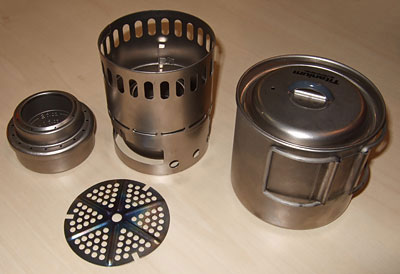
Titanium alcohol stove. This is the burner only (1.2 oz, $45). It looks a lot like a Trangia stove and has rather large holes. Note that there are holes at two levels; the smaller holes in the upper rim are barely visible.

Two New Ultralight Multi-Fuel (Alcohol-Esbit-Wood) Cooking Systems From Evernew and Trail Designs (Outdoor Retailer Summer Market 2009) - 2
Titanium stove and pot stand (left, 2.7 oz, $55); the 500 ml pot is included in the photo for scale and is not included in the price. The pot stand is constructed of titanium strips with holes in them to increase air circulation. It’s cross-shaped when assembled and placed on top of the burner.

Two New Ultralight Multi-Fuel (Alcohol-Esbit-Wood) Cooking Systems From Evernew and Trail Designs (Outdoor Retailer Summer Market 2009) - 3
Minimalist Set (5.6 oz, $130). This is a complete system consisting of the burner, pot stand/windscreen, turbo plate, and 500 ml pot with lid. The turbo plate is for winter use; it increases pressure to create a larger flame (which also uses more fuel). The 500 ml cook pot included may be too small for many hikers; I personally prefer a cook pot around 850-900 milliliters.

Two New Ultralight Multi-Fuel (Alcohol-Esbit-Wood) Cooking Systems From Evernew and Trail Designs (Outdoor Retailer Summer Market 2009) - 4
Wood Burning Stove Set (3 oz, $47). The price does not include the 500 ml cook pot shown, which we included in the photo for scale. In this configuration, the turbo plate is used as a grate in the bottom to hold the wood while it burns, and a pot of any size can be placed on top of the windscreen. Because of its very small size, this wood burning stove will require tiny pieces of wood and a lot of feeding.

Trail Designs Ti-Tri Titanium Stove System

This system is essentially a Caldera Cone system made of titanium sheet so it can also burn wood. The Caldera Cone used needs to be specific to the cook pot used. For cooking with alcohol, the Trail Designs 12-10 burner is placed on the ground and the pot is supported at its top lip by the cone, so the pot is enclosed by the cone. The same configuration is used for cooking with Esbit tabs, using a simple holder included with the system. For cooking with wood, two titanium tent stakes are passed through holes near the top of the cone, and the pot is supported by these stakes.

Two New Ultralight Multi-Fuel (Alcohol-Esbit-Wood) Cooking Systems From Evernew and Trail Designs (Outdoor Retailer Summer Market 2009) - 5
Trail Designs Ti-Tri Titanium Stove System for a MSR 0.85 liter titanium cook pot.

The Ti-Tri system costs $80 and includes a titanium Caldera Cone for the user’s cook pot, two titanium stakes, fuel bottle kit, 12-10 stove, and the Gram Cracker. Trail Designs offers an optional titanium floor (0.9 oz, $15) to place under the cone to protect the ground in wood burning mode. The Ti-Tri setup for burning wood using an MSR 0.85 liter pot weighs 5.4 ounces (Caldera Cone, titanium floor, two titanium stakes, caddy).

When using this system, wood is fed through the hole under the pot. There are vents at the bottom of the cone for combustion air to flow in and vents at the top for smoke to flow out. In my opinion, the Trail Designs Ti-Tri is a more realistic size for cooking with wood fuel; it will handle larger pieces of wood and generate more BTUs.

I have been using the Trail Designs alcohol stove since it was introduced and really love it. Trail Designs has advanced the alcohol stove to the convenience and reliability level of a canister stove; the only thing it lacks is flame control. The new Ti-Tri system seems to be the best of two worlds: cook with wood when possible, and carry an alcohol burner (0.5) and a little alcohol to use as a backup when it’s raining. Some alcohol can also be used to start the fire when using it as a wood stove.

Klymit Kinetic Vest (Outdoor Retailer Summer Market 2009)

Klymit launches their first products based on their noble gas inflation technology.

Editor’s Note: This article was opened to the public on July 22, 2010. To subscribe and see Outdoor Retailer Summer Market 2010 articles as they are published, click here.

Klymit Kinetic Vest (Outdoor Retailer Summer Market 2008) - 1
Aimed at backpackers, the Red Rock variant of the Kinetic vest uses a 40 denier Nylon Dobby shell to minimize weight and packed size (shown inflated).

I first reported on the Klymit inflatable insulation technology a year ago at Outdoor Retailer Summer Market, 2008. They were developing an apparel insulation technology based on filling a flexible bladder with noble gas, such as Argon. Klymit claims the system to be more compressible and provides a higher warmth-per-thickness ratio than conventional fiber insulations, while allowing the user to adjust the volume of insulation – and therefore warmth – on the fly. At the time, Klymit was still developing their noble gas technology, seeking partners, and showing prototypes. This year, they are launching their first product… and it’s targeted at lightweight backpackers and packrafters.

In addition to the actual garment, a Klymit system also includes a “Klymitizer” inflator, and one or more “HotShot Kanisters” of Argon gas. The Klymitizer weighs 1.6 ounces (45 grams) and each HotShot cartridge contains 8 grams of Argon and weighs 2.0 ounces (58 grams) when full. Each cartridge is said to provide five inflations of the Kinetic vest in size medium. In some applications, the vest could be pre-inflated and the inflator plus cartridges could conceivably be left at the trailhead and not affect packed weight. However, you’d then lose the ability to adjust the amount of insulation on the fly, and the packed size of the fully inflated vest would increase dramatically.

Klymit Kinetic Vest (Outdoor Retailer Summer Market 2008) - 2
The 45-gram “Klymitizer” inflator.

Klymit Kinetic Vest (Outdoor Retailer Summer Market 2008) - 3
The 58-gram Argon cartridge contains 8 grams of gas and provides 5 inflations.

The all-inclusive weight of the system is 260 grams for a medium Red Rock vest, 45 grams for the inflator, and 58 grams for a cartridge. This totals 363 grams (12.8 ounces). A weight-conscious backpacker certainly has many conventional synthetic and down-filled alternative garments available at or below this weight. It’s the unique ability to adjust the Klymit insulation on the fly to match conditions and exertion levels that may justify its weight penalty, allowing it to be used both in camp and on the move. Also, bear in mind that unlike fiberfill and especially goose down, the Klymit system is not affected by moisture. A hiker wearing a Red Rock vest could potentially improve his overall efficiency by reducing or eliminating layering changes in cold rain or snow.

For packrafters, Klymit is also launching the Amphibian version of the Kinetic vest. The Amphibian features a non-absorbent 40×50 denier shell fabric that dries quickly once out of the water. Klymit does not market the Kinetic vest towards, nor is it USCG certified as, nor even designed to be, a Personal Floatation Device (PFD). Nevertheless, a size medium Kinetic vest contains approximately three liters of gas when fully inflated, which provides almost seven pounds of buoyancy. For comparison, a foam USCG Type III PFD provides a minimum of 15.5 pounds of buoyancy. Still, perhaps the Kinetic vest could provide supplemental floatation when used with an appropriately certified PFD for watersports. Lacking an appropriate PFD, packrafters on flat water, who might otherwise consider stuffing a sleeping pad inside their clothing for floatation, may want to take a hard look at the Amphibian as an alternative.

[Note: neither the author nor Backpacking Light advocate operating any watercraft without wearing an appropriately certified Personal Floatation Device.]

Klymit Kinetic Vest (Outdoor Retailer Summer Market 2008) - 4
The Amphibian version of the Kinetic vest features a quick-drying shell for watersports use (shown deflated).

Specifications

  Color:

Red (Red Rock), Blue (Amphibian)

  Weight of Vest, size Medium (claimed):

9.2 oz (260 g)

  Weight of Inflator (claimed):

1.6oz (45 g)

  Weight of Argon Cartridge (claimed):

2.1 oz (58 g)

  Inflated Gas Volume:

approx. 3 Liters

  Fills Per Cartridge:

approx. 5

  Available:

August 2009

  MSRP:

$199 (Includes vest, inflator, and three gas cartridges)

Rab Neutrino Sleeping Bags (Outdoor Retailer Summer Market 2009)

Rab updates their line of lightweight sleeping bags.

Editor’s Note: This article was opened to the public on July 22, 2010. To subscribe and see Outdoor Retailer Summer Market 2010 articles as they are published, click here.

Rab Neutrino Sleeping Bags (Outdoor Retailer Summer Market 2009) - 1
Will Rietveld and Todd Walton inspect Rab’s newly revised line of sleeping bags

UK-based Rab showed their improved Neutrino series of sleeping bags at Outdoor Retailer. Featuring Pertex Quantum shell and liner fabric, 800+ fill power down, and half- to three-quarter-length #5 YKK zippers, the new line of bags is available in six gender-specific mummy styles as well as a top-bag.

The Neutrino mummy bag is available in the following variants:

Name Fill Weight (Claimed) Total Weight (Claimed) Temperature Rating MSRP
Neutrino 200 200g 650g 43F $250
Neutrino 400 400g 850g 28F $310
Neutrino 400XL 450g 900g 28F $360
Women’s Neutrino 400 400g 850g 28F $310
Neutrino 600 600g 1050g 14F $420
Women’s Neutrino 600 600g 1050g 14F $420

In addition to these mummy-style Neutrino bags, Rab changed their Neutrino SL top bag. The Neutrino SL features 800+ fill power down on the top and hood, combined with 100 g Primaloft Sport insulation on the base of the lower legs – presumably to improve warmth in that area where the insulation is compressed by the user’s legs. The bottom of the torso area has no insulation and is designed instead to fasten to a sleeping pad with an integrated pad sleeve. The Neutrino SL features 200 g of fill, an overall claimed weight of 600 g, and a 32F temperature rating for an MSRP of $240.

Ultralight Tent, Sleep System, and Tarps from Brooks-Range Mountaineering (Outdoor Retailer Summer Market 2009)

Brooks-Range introduces some truly lightweight gear equally suited to winter camping or summer ultralight backpacking.

Editor’s Note: This article was opened to the public on July 22, 2010. To subscribe and see Outdoor Retailer Summer Market 2010 articles as they are published, click here.

When Brooks-Range contacted us to make an appointment to see their new gear, I was thinking “survival gear.” What a surprise when we arrived at their booth and there before us was some of the lightest gear we have ever seen! Brooks-Range is primarily focused on winter mountaineering, but all of these items can be used for summertime pursuits by adventure racers, fastpackers, and ultralight backpackers.

The Rocket Tent

When used with ski poles and an avalanche probe for support, this two-person single-wall tent weighs just 22 ounces! The summer weight with poles (DAC 8.5 mm NSL) is 36 ounces.

Ultralight Tent, Sleep System, and Tarps from Brooks-Range Mountaineering (Outdoor Retailer Summer Market 2009) - 1
The Brooks-Range Rocket tent is made of Cuben fiber with an aluminized face and weighs just 22 ounces in winter mode using ski poles and an avalanche probe for support. It’s big enough for two or roomy for one person plus gear.

It’s made of strong and light CT3 fabric, otherwise known as Cuben fiber. The tent has three zippered vents for ventilation. Entry is from the front through a vestibule. The floor area is 25.2 square feet, vestibule area is 7 square feet, and peak height is 38 inches, so it’s a rather snug two-person tent. MSRP is $600.

System of a Down

Consisting of a down jacket (Mountain Sweater, 8.3 oz, $249) and half bag (Elephant Foot Sleeping Bag, 13.6 oz, $249), this sleep system provides maximum versatility. Of course, the jacket can be purchased separately, or you can use one you already have with the half bag, but it wouldn’t match as well for those late night backpacking fashion shows.

Ultralight Tent, Sleep System, and Tarps from Brooks-Range Mountaineering (Outdoor Retailer Summer Market 2009) - 2

The hoodless Mountain Sweater (top of photo) is a pullover style insulated with 800 fill down and rated at 15 F. The shell fabric is very light (about 0.85 oz/yd2). A unique feature is two side zippers that can be opened for extra ventilation when needed or closed to retain body heat. The Elephant Foot Sleeping Bag (bottom of photo) is waist high and meant to be paired with the Mountain Sweater or other jacket to create a warm sleeping system. It’s also insulated with 800 fill down, has the same extremely light shell, and is rated to 15 F, all just like the Mountain Sweater.

Ultralight Tarps

Ultralight Tent, Sleep System, and Tarps from Brooks-Range Mountaineering (Outdoor Retailer Summer Market 2009) - 3

These tarps are constructed of 0.85-ounce micro-ripstop nylon with a DWR finish and are the lightest we know of short of Cuben fiber. There are four sizes available (5 x 8, 6.75 x 9, 8 x 10, 10 x 10) to accommodate one to four people. The 5 x 8 feet size weighs 6.7 ounces and costs $75, and the 10 x 10 size weighs 15.4 ounces and costs $179.

Gear Treasure Hunting: Day 3 (Outdoor Retailer Summer Market 2009)

Lots of good stuff in our day 3 roundup: a 2.4-ounce day pack, a new integrated canister fuel cooking system, new 3-pound internal frame backpacks, and 11-ounce mid-height hikers, to mention a few.

Editor’s Note: This article was opened to the public on July 22, 2010. To subscribe and see Outdoor Retailer Summer Market 2010 articles as they are published, click here.

Thursday, July 23, 2009

We finished another full day at the trade show and came up with another batch of interesting gear and technologies. Its much akin to a treasure hunt – we need to know where to look and be able recognize something interesting or truly innovative when we see it. There is something of interest to most everyone here, and as usual, we present it in no particular order. All items are new for spring 2010 unless stated otherwise.

Gear Treasure Hunting: Day 3 (Outdoor Retailer Summer Market 2009) - 1
The GoLite booth is always a good place to look for lightweight, exciting new gear, and the good folks there came through as expected. GoLite will add a second quilt called the Ultralite 1+ Season Quilt (left, 20 ounces, three lengths, $200-$240) to their Ultralite sleeping bag line. It’s insulated with 800-fill down and rated at 40F. The current quilt will be packed with a little more down to drop its rating to 20F and will be renamed the Ultralight 3-Season Quilt (right, 25 ounces, three lengths, $255-$295).

Gear Treasure Hunting: Day 3 (Outdoor Retailer Summer Market 2009) - 2
GoLite will also be adding the Peak Backpack (2318 cubic inches for size M, 27 oz, $125) to their Ultralite backpack series. The new Peak is a smaller version of the Jam (2857 cubic inches, 31 oz, $150), and both packs feature a new recycled nylon fabric (still with Dyneema gridstop), revised padding in the backpanel, and a new hipbelt that wraps around the hips better. Note it will be called the Jam, rather than the Jam2. With the new Peak, the frameless Ultralite pack series will offer three pack sizes (Pinnacle, Jam, Peak) to meet the needs of most hikers.

Gear Treasure Hunting: Day 3 (Outdoor Retailer Summer Market 2009) - 3
At this OR, we decided to concentrate more on really lightweight mid-height footwear for a possible future article for Backpacking Light. Salomon has several shoes in this category. We reported on the Salomon 3D Fastpacker Mid GTX (left, 15.2 oz/shoe, $150) in our coverage of summer 2008 Outdoor Retailer. This time we found the new Salomon XA Pro 3D Mid GTX Ultra (center, 13.2 oz/shoe, $160) and the Salomon Wings Sky GTX (right, 18.7 oz/shoe, $200). The latter appears heavy, but the weight is actually not bad for a full-height boot. All of these shoes are based on trail running platforms to minimize weight while adding cushioning and support. Salomon knows that many buyers prefer Gore-Tex shoes so their feet won’t get wet (!), but we would prefer a more breathable shoe rather than a waterproof one that traps moisture inside. Many footwear manufacturers (including Salomon) offer two versions for that very reason.

Gear Treasure Hunting: Day 3 (Outdoor Retailer Summer Market 2009) - 4
First we had the Jetboil, then the MSR Reactor, and soon we will have the Primus Eta-Solo. It looks quite similar to the Jetboil. Jetboil’s stove used the Primus Micron burner for a long time, which was very reliable. Then they switched to a burner from a different source and ended up having a lot of problems, which led to a recall. Now, ironically, Primus is introducing their own integrated canister fuel solo cooking system utilizing the Micron burner. The Eta-Solo has a 0.9 liter pot with a flux ring attached to the bottom, similar to the Jetboil and MSR. The pot cozy is made of a durable fabric with a Velcro closure. The unit shown is still a prototype, subject to change, and an MSRP is not yet available. They hope to have it ready by spring 2010. (Didn’t MSR say something like that about the Reactor?)

Gear Treasure Hunting: Day 3 (Outdoor Retailer Summer Market 2009) - 5
***(PHOTO TO BE PROVIDED ON MONDAY, JULY 27)*** REI is an exhibitor at Outdoor Retailer, and we always enjoy meeting with their talented product development team and seeing their new REI-branded gear. A standout from our visit this time is the updated Half Dome Tent (4 pounds 14 ounces trail weight, $179). Yes, the weight is a little high by our standards, but you have to consider what you get: a downright spacious double-wall tent with two doors and two vestibules for $179. And the updated Half Dome is roomier, lighter, and stronger than ever. Most of the sub-4 pound tents with the same configuration that we find elsewhere are tight – minimal floor space, interior height, and vestibule space. The Half Dome is a wonderful design, roomy, and value priced. The Half Dome 2 Plus ($209) is 10 inches longer and 4 inches wider.

Gear Treasure Hunting: Day 3 (Outdoor Retailer Summer Market 2009) - 6
How about a 2.4 ounce day pack? At the Sea to Summit booth we found the UltraSil Day Pack (1200 cubic inches, $28). The arrow points to the pack stuffed into its stuff sack. It’s made of a very lightweight proprietary high tenacity Cordura ripstop silnylon and has a zippered opening on top and unpadded fabric shoulder straps. This pack would really work well as both a stuff sack and a day pack for sojourns from camp.

Gear Treasure Hunting: Day 3 (Outdoor Retailer Summer Market 2009) - 7
Sea to Summit also has a new range of TPU Map Cases and Accessory Cases coming out (0.07 to 3.6 oz, three sizes of each, $15 to $35). TPU stands for Thermo Plastic Urethane, which is very strong, clear, flexible, and foldable (even in cold temperatures). Their new map cases have a zip-lock closure and are definitely the lightest to be found (0.07 to 1.2 ounces), and the accessory cases (1.8 to 3.6 ounces) have a clip closure and protect things like cell phones, i-Pods, and GPS units.

Gear Treasure Hunting: Day 3 (Outdoor Retailer Summer Market 2009) - 8
END Footwear is a new company that makes a range of very light trail runners and hikers. The name stands for Environmentally Neutral Design. In our search for really light mid-height hikers we found the END LT-365 (left, 11.6 ounces/shoe, $110, available December 2009) which is built on a trail running platform and has an Ion Mask treatment making it water-resistant. The END Stumptown LT (right, 11 ounces/shoe, $95, available now) is the same shoe without Ion Mask treatment. These mid-height shoes are designed for lightweight hiking, with a midsole TPU plate to provide rock protection and moderate stiffness.

Gear Treasure Hunting: Day 3 (Outdoor Retailer Summer Market 2009) - 9
Black Diamond reinvented their larger pack line and developed their ErgoActiv Suspension System, which provides both fore and aft and side to side flexibility of motion. Fore and aft freedom is allowed by a bike cable system connected to the shoulder straps, and side to side freedom is allowed by means of a large hub on the backside of the hipbelt (shown in left photo). New backpacks based on this new technology are the Infinity 50 and 60 (3 pounds 8 ounces/3 pounds 15 ounces, $179.95), which are respectably light. The main story in these new packs is their innovative suspension system, beyond that, the packs are a traditional top loading design with durable fabrics.

Gear Treasure Hunting: Day 3 (Outdoor Retailer Summer Market 2009) - 10
At noon, yours truly was honored to be a judge at the Jetboil Cookoff, where three contestants combined their choice of twelve ingredients to create a camp meal. It was really fun – like a camp cookery version of Iron Chef – and the audience was really into it. All of the creations were very good, but a tasty curry dish by Allison Woods (foreground) had the edge. The other competitors, from left, were Jeremy Collins and Malcolm Daily.

Gear Treasure Hunting: Day 3 (Outdoor Retailer Summer Market 2009) - 11
Would you believe a miniature crank light that weighs just 0.5 ounce? The eGear Dynamo Dyno-Mite Keychain Light has two LEDs and no battery; one minute of winding produces five minutes of bright light. Measurements are 1.6 x 1.2 x 0.6 inches. MSRP is $8.95, and it’s available from essentialgear.com.

Gear Treasure Hunting: Day 3 (Outdoor Retailer Summer Market 2009) - 12
3M Thinsulate, the company that provides “warmth without bulk” insulation for many insulated boots, has developed the Thinsulate Thermal Insoles(3.2 ounces/pair, about $20) to provide underfoot warmth. The insoles are a sandwich of four layers: 1) an abrasion-resistant top layer containing an antimicrobial treatment to reduce odors and wicking technology to help keep feet drier; 2) a comfort layer of memory foam; 3) a Thinsulate insulation developed for underfoot applications; and 4) a bottom foam layer that absorbs shock, suppresses odors, and wicks moisture. 3M Thinsulate will likely OEM the insoles to various footwear manufactures for use in their insulated boots.

Gear Treasure Hunting: Day 3 (Outdoor Retailer Summer Market 2009) - 13
Therm-a-Rest will be introducing a new sleep system called the Haven Top Bag (22 ounces, $240 size regular). The Haven has a mummy-style hood, no zipper, and the center underside is not insulated; the shell and lining are 20 denier nylon. It’s insulated with 700-fill down and rated at 20F. Entry is through the hole in the bottomside. Simply attach the bag to a sleeping bag with two straps on the lower part of the bag, slide your legs into the foot of the bag as far as they will go, then pull the hood over your head like donning a sweater. A thinner pad can be put inside the bag for a tighter seal on the bottom.

Gear Treasure Hunting: Day 3 (Outdoor Retailer Summer Market 2009) - 14
At Granite Gear we found their new Uberlight CTF3 Drysacks. They look exactly like Cuben fiber, but Granite Gear calls the material “high strength composite.” The bags will be available in 7L, 10L, 13L, and 18L sizes. All have glued seams and a drybag closure. The MSRPs (are you sitting down?) are $39 to $49 each. Amazingly, Granite Gear omitted the weights in their brochure on an “uberlight” product, but their representative said the weights are “slightly less than one-half the weight of their eVENT Sil-Drysacks,” which means they are pretty darn light. However, they should float on air for that price!

Gear Treasure Hunting: Day 3 (Outdoor Retailer Summer Market 2009) - 15
We also discovered two new lightweight internal frame backpacks at Granite Gear. The 52L Vapor Flash (3 pounds 1 ounce, $180, available now) is based on the Vapor suspension with fixed shoulder straps, two body and harness sizes, and four hipbelt sizes. All suspension components have soft padding that is wonderfully comfortable. The women’s version is the 48L Vapor Flash Ki. The second new pack is the Escape 60 (60 liters, 2 pounds 15 ounces, $200) featuring a new Escape suspension, which is a next generation of the Vapor suspension. The Escape has vertical shoulder strap adjustment and is distinguished by a large zippered stretch pocket on the front of the pack and LineLoc compression straps. A women’s Escape 60 Ki will also be available. Both of these new packs are really sweet, and it’s especially gratifying to see the increasing number of three-pound 60L internal frame packs that are hitting the market in recognition of the growing interest in lightweight backpacking.

Gear Treasure Hunting: Day 3 (Outdoor Retailer Summer Market 2009) - 16
The new Jacks ‘R’ Better Mt. Washington 3 Under Quilt works on any hammock; it’s shown here under a JRB Bear Mountain Bridge Hammock. It attaches to a hammock in under a minute with the included JRB Suspension System. The shell is 1.1-ounce rip-stop nylon with a DWR treatment. Constant height radial cut baffles are filled with 800+ fill power down. The Mt. Washington weighs 22 ounces and comes with a JRB silnylon compression sack that allows it to be stuffed to 7 x 7 x 8 inches.

This is our last blog dispatch on our summer Outdoor Retailer findings. Janet and I covered a lot of ground and found a lot of great gear, but of course we couldn’t be everywhere and undoubtedly we missed some good things. It was a lot of fun – OR is exhilarating because of all the positive energy everywhere – but at the end we feel drained. Several nights with only five hours of sleep will tend to do that. We hope you enjoyed our coverage and the format we used; it enabled us to cover more items faster. Give us your comments below!

Gossamer Gear Gorilla Backpack (Outdoor Retailer Summer Market 2009)

The Gorilla is a refined internal frame or frameless pack – the outcome of years of ultralight backpack evolution.

Editor’s Note: Backpacking Light is including new products from small online businesses in our Outdoor Retailer coverage. Most can’t afford a booth at OR, but their new products are just as important to our readers as those from the big companies.

Technically, Gossamer Gear has already introduced the Gorilla pack, but supplies have been limited, until now. The Gorilla pack has a removable frame, so it can be used either frameless or internal frame. It’s sized for ultralight backpacking at 2800 cubic inches and is both durable and light. With the Gorilla, Gossamer Gear is introducing their new curved tubular aluminum frame (3.4 ounces), which can be retrofitted to the Mariposa Plus pack. Another nice feature is its removable hipbelt and sternum strap. The Gorilla pack is available in three sizes, and three hipbelt sizes are also available.

Gossamer Gear Gorilla Backpack (Outdoor Retailer Summer Market 2008) - 1
The Gossamer Gear Gorilla is a durable pack for ultralight backpacking (or day hiking). It has a removable aluminum frame, weighs just 23.2 ounces (size M), and costs $165.

Gossamer Gear Gorilla Backpack (Outdoor Retailer Summer Market 2009) - 2
The pack body is made of durable 210 denier urethane-coated double wall ripstop nylon.

Gossamer Gear Gorilla Backpack (Outdoor Retailer Summer Market 2009) - 3
Front and side pockets of power stretch nylon, which is much more durable than previous mesh used in Gossamer Gear packs.

Gossamer Gear Gorilla Backpack (Outdoor Retailer Summer Market 2009) - 4
Gossamer Gear’s new curved stay slips into two sleeves on the inside of the backpanel and makes a huge difference in the pack’s fit compared to the old straight stays.

Gossamer Gear Gorilla Backpack (Outdoor Retailer Summer Market 2009) - 7
There are two mesh compression straps on the sides of the pack, plus a top compression strap.

Gossamer Gear Gorilla Backpack (Outdoor Retailer Summer Market 2009) - 6
The shoulder straps on the Gorilla (and other Gossamer Gear packs) are a full 3+ inches wide; the underside of the straps is padded with 3D mesh.

Gossamer Gear Gorilla Backpack (Outdoor Retailer Summer Market 2009) - 5
A pad sleeve on the backpanel is made of 3D wicking mesh. Gossamer Gear supplies a SitLight pad for the sleeve, which pads the backpanel.

Overall, the Gorilla shows the outcome of a lot of evolution in ultralight backpacks. Earlier packs were constructed of much lighter fabrics and mesh and had a limited lifespan as a result. Pack manufacturers have found that going to heavier fabrics and mesh do not add that much to a pack’s weight, but they add a huge increment of durability and longevity. The Gorilla is a very refined pack, showing the outcome of this evolution. This could easily become my favorite backpack; look for an upcoming review in Backpacking Light.

Specifications and Features

  Manufacturer

Gossamer Gear (www.gossamergear.com)

  Product

Gorilla Backpack

  Style

Removable stays allows use as a frameless or internal frame pack

  Capacity

2800 ci total, including pockets and extension collar

  Weight

23.2 oz (size M)

  Sizes

S,M,L

  Materials

210d PU-coated nylon ripstop body; power stretch nylon pockets
3D mesh shoulder straps, pad sleeve, and hipbelt, anatomically curved aluminum stay unit

  Features

Large mesh front pocket, two mesh side pockets, extension collar, drawcord and rolltop closure with top compression strap, two side compression straps, sleeping pad serves as padded backpanel, removable sternum strap with whistle, removable hipbelt, three hipbelt sizes available, removable foam inserts for shoulder straps and hip belts, hydration bladder pocket with dual drinking tube ports, haul loop, ice axe loop

  MSRP

US$165

GoLite Eden Series Tents (Outdoor Retailer Summer Market 2009)

GoLite wants to give people a backcountry bedroom (with the emphasis on “room”) in their new Eden tent line. These hoop-style tents boast fast set-up, big vestibules, and lots of space for living.

Editor’s Note: This article was opened to the public on July 22, 2010. To subscribe and see Outdoor Retailer Summer Market 2010 articles as they are published, click here.

Overview

GoLite (www.golite.com) wants to give people a backcountry bedroom (with the emphasis on “room”) in their new Eden tent line. These hoop-style tents boast fast set-up, big vestibules, and lots of space for living.

GoLite Eden Series Tents (Outdoor Retailer Summer Market 2009) - 1
The single-person Eden 1 boasts a 45-inch peak height and just under 32 square feet of protected space. Added bonus:it looks like a rocket car.

The Eden 1 is a single-person tent that uses three poles for support and can be set up with just two stakes, one at each end. Should you want to make it a bit more secure, five more stakes will hold down the corners and vestibule. Since GoLite generously sends fourteen stakes with each tent, you will have plenty for any further guy-line work that makes your heart beat faster.

A large center pole arches over the Eden, giving it a healthy peak height of 45 inches. The domed space created by the pole is dissected by a full mesh wall that contains the large L-shaped door. The zipper features a snag-guard plus Velcro and snap closures.

The rest of the space becomes the roomy vestibule, which has an opening that runs alongside the center pole and can be rolled up all the way to the other end to allow maximum air flow. The green triangle section in the photo above is a large vent that does double-duty as a “visor” over the door. Because it uses the fly as part of the body, (top, ends, and one side in the case of the Eden 1) it is kind of a hybrid single-wall tent.

GoLite Eden Series Tents (Outdoor Retailer Summer Market 2009) - 2
The two-person Eden 2 ups the ante with a 48-inch peak height and 51 square feet of total protected space to let you bring a friend. Play nice.

Make Mine a Double

“Double what, buddy? Double doors, double vestibules, double vents, double sleeping spots?”

Yeah, all that.”

“OK, pal. You got it. Here’s your Eden 2.”

The Eden 2 has all the same features of the Eden 1 times two, to let you bring a friend along. Added bonus: it can be a tall friend, since the Eden 2 boosts the peak height to 48 inches for some serious card-playing room on rainy afternoons. A vestibule and entrance door on each side keep the peace once the cards are put away and you hit the hay.

Both tents also feature a tensioned-sleeve integrated flysheet and body to enhance stability. Adjustable tension is provided by impact-resistant ladder-lock buckles at each end. The tents come with the seams factory taped for instant weather readiness. The reflective guy points come with pre-attached guy-lines too. Bring on the storm.

It is hard to compare the Eden to other shelters, mostly because I haven’t used it yet, but I would venture that the Eden series is a lot like the Tarptent Scarp series and the Hilleberg Atko. While both are lower weight offerings, the Eden tents have much more room. However, the others are true double-wall tents, able to set up the parts independent of each other.

GoLite Eden Series Tents (Outdoor Retailer Summer Market 2009) - 3

Specifications and Features

  Product

GoLite Eden 1

  Style

One-person single-wall tent with floor, side entry with vestibule

  Poles and Stakes

Three color-coded, variable-diameter DAC Featherlight NSL poles
Fourteen stakes provided

  Fabric

15d ripstop nylon w/ sil/PU 1200mm W/P F/R coating, body and vestibule, 70d 190T nylon taffeta floor w/ 3000mm W/P F/R coating, 20d polyester no-see-um mesh entry wall and vents

  Area

Floor 23 sq ft, vestibule 8.7 sq ft

  Dimensions

Length 100 in, width 38 in, height 45 in

  Weight
(total)

3 lb 7 oz (1048 g)

  MSRP

US $300.00

Specifications and Features

  Product

GoLite Eden 2

  Style

Two-person single-wall tent with floor, side entry with vestibule

  Poles and Stakes

Three color-coded, variable-diameter DAC Featherlight NSL poles
Fourteen stakes provided

  Fabric

15d ripstop nylon w/ sil/PU 1200mm W/P F/R coating, body and vestibule, 70d 190T nylon taffeta floor w/ 3000mm W/P F/R coating, 20d polyester no-see-um mesh entry wall and vents.

  Area

Floor 39 sq ft, vestibule 12 sq ft

  Dimensions

Length 104 in, width 54 in, height 48 in

  Weight
(total)

5 lb 1 oz (2295 g)

  MSRP

US $425.00

Big Agnes Fly Creek UL2 (Outdoor Retailer Summer Market 2009)

While boaters know that there is nothing worse than being up a creek without a paddle, backpackers might find it just as upsetting to be up a Creek without a Fly. Thankfully, the Fly comes with the Creek in Big Agnes’ lightest two-person tent ever: the Fly Creek 2.

Editor’s Note: This article was opened to the public on July 22, 2010. To subscribe and see Outdoor Retailer Summer Market 2010 articles as they are published, click here.

Big Agnes Fly Creek UL2 (Outdoor Retailer Summer Market 2009) - 1
The new Big Agnes Fly Creek UL2 is their lightest two-person tent ever. Those two people should expect to be pretty cozy inside.

I Am Not a Shill!

Anybody that knows me from my writing or backpacking forums knows of my love for Big Agnes’ (www.bigagnes.com) lightweight tents, though, to be fair, I have been harsh when needed. I had a Seedhouse SL2 from one of the first shipments, and I still use a modified newer version when testing obligations permit. So I said “Ooh, ooh, pick me!” when this dispatch needed to be written up. (Maybe I will put it through its paces down the road too. Stay tuned.)

The two-person Fly Creek UL2 is the newest addition to the company’s UltraLight line, joining last year’s Fly Creek UL1, a single-person version. As with all of their tents, the Fly Creek uses a hub and pole system to shave weight. Three sections of poles meet in a hub to form a Y, the short ends of which go to either side of the door. The long part curves over the tent to anchor in a grommet centered in the back. While it theoretically can be called a free-standing tent, the back corners need to be staked to take full advantage of all the space.

The tent body attaches to the poles with DAC Swift Clips. These newer clips are much faster to deploy and remove than the old style clips. One departure from the common style of BA tents is the use of lightweight breathable nylon on the lower sections of the body, only using the trademark mesh on the top third or so. This change should help reduce blown in debris a lot while hopefully not cutting down on the ability to fight condensation by hindering air movement and ventilation.

A large D-shaped mesh door in the front gives access to the Fly Creek. Inside the tent we find three gear pockets and loops to attach the optional Triangle Gear Loft.

The fully seam-taped fly goes over the poles and body to keep rough conditions at bay. A small vestibule pulls away from the front of the tent, held in place by two stakes. Since Big Agnes sends eleven stakes, there should be plenty to guy the tent out securely with the included, pre-tied reflective guy-lines.

When it comes to weight, the Fly Creek competes with Big Agnes’ own offerings quite well, coming in at 42 ounces total. This beats their Seedhouse SL2 by 12 ounces, yet the Fly Creek has more floor space, as it is two inches longer. It is only 4 ounces heavier than the Seedhouse SL1, yet boasts 27% more floor space. And how about outside competition?

The MSR Carbon Reflex 2 is probably the closest comparison. With its 2-inch higher peak height and 1 square foot more floor space, it is slightly roomier than the Fly Creek, though it also weighs 6 ounces more.

Specifications and Features

  Product

Big Agnes Fly Creek UL2

  Style

Two-person double-wall tent with floor, front entry with vestibule

  Poles and Stakes

DAC Featherlite NSL pole system with press fit connectors and lightweight hubs. Eleven Superlight aluminum J stakes included

  Fabric

Fly and floor: silicone treated nylon rip-stop with a 1200mm waterproof polyurethane coating.
Body: ultralight breathable nylon rip-stop and polyester mesh.

  Area

Floor 28 sq ft, vestibule 7 sq ft

  Dimensions

Length 86 in, head width 52 in, end width 42 in, height 38 in

  Weight

42 oz (1191 g)

  MSRP

US $349.95

Black Diamond Sprinter Rechargeable Headlamp (Outdoor Retailer Summer Market 2009)

Internal rechargeable lithium polymer battery, 60 lumen output, three main beam modes, IPX7 (1 meter, 30 minutes) waterproof rating, 3.5 ounces, strobing rear red “taillight,” all for $80.00.

Editor’s Note: This article was opened to the public on July 22, 2010. To subscribe and see Outdoor Retailer Summer Market 2010 articles as they are published, click here.

Black Diamond Sprinter Rechargeable Headlamp (Outdoor Retailer Summer Market 2009) - 1

Overview

Key Features: Internal rechargeable lithium polymer battery, 60 lumen output, three main beam modes, IPX7 (1 meter, 30 minutes) waterproof rating, 3.5 ounces, strobing rear red “taillight.” Price: $80.00.

Designed primarily for nighttime runners, the Sprinter headlamp is rechargeable and has both a headlight and rear-facing red, strobing taillight. Urban runners will surely appreciate that last feature, as might trail runners who’re pursued by a pack of speedy humans. Tip: if pursued by wolves, consider turning the taillight off.

The Sprinter has a single white main, lensed LED with three modes (full, dimmed, and strobe); a bucket-style strap arrangement with top strap; and a remote rear battery compartment with strobing red taillight. The main beam does not appear to be focusable, and it’s unclear from the specifications how many dimming levels the Sprinter offers. The remote battery and top strap will balance and anchor the light – important for keeping the light stable and aimed predictably while pounding pavement or path.

Rechargeable Performance

A major attraction of a rechargeable light is that it’s always fully charged and ready to go back home – no partially discharged batteries to fret over (how much life remains; should I carry spares?). Rechargeables are far cheaper than disposable batteries over the long haul, and the Sprinter’s Li-poly cell should outperform equivalent NiMH cells handily. The flip side is the lack of field-rechargeability, meaning the spent light is dead weight until you’re back home and reunited with the charger. However, the BPL readership includes a number of trail runners who might very well benefit from a light just like the sprinter, and day hikers and weekenders are potential beneficiaries as well.

Unanswered (as yet) Questions

The limited preliminary Sprinter specifications leave several key questions unanswered: What is the run time? What is the recharge time? What are the brightness, beam pattern, and color temperature? What is the cold-weather performance? Is the top strap removable? Is the beam angle adjustable and if so, is does the adjustment stay in place regardless of roadshock? Could you recharge it in the field using a PV panel? Are bears attracted to, or repelled by flashing red taillights?

Without runtime specifications, it’s impossible to determine how well the Sprinter might fit backpackers’ needs. As noted, dayhikers and overnighters could likely use it routinely, but past a night or two, would it provide enough run time? Only time and testing can tell.

The Bounty Continues: Day 2 (Outdoor Retailer Summer Market 2009)

Wednesday’s standouts and goodies – we continue to find lots of interesting gear and technology stories on the floor of the Salt Palace.

Editor’s Note: This article was opened to the public on July 22, 2010. To subscribe and see Outdoor Retailer Summer Market 2010 articles as they are published, click here.

The Bounty Continues: Day 2 (Outdoor Retailer Summer Market 2009) - 1
Gore-Tex Extended Comfort Range Footwear Sounds like a new Gore-Tex product (i.e. membrane) right? Wrong! Extended Comfort Range simply means that the Gore-Tex XCR footwear bootie is optimized with other construction materials in the shoe to achieve more breathability, as shown in the photo above. In other words, if you want more breathability in a Gore-Tex shoe, construct it with a breathable material over the bootie, not something like solid leather that blocks breathability. Duhhh! There are actually some changes in the bootie itself: rather than a completely enveloping bootie, the bottom of the bootie is open and is bonded directly to the midsole of the shoe so it’s still sealed on the bottom. This change in construction is claimed to allow easier manufacturing, a better fit, and provide more “three dimensionality,” whatever that means. The bottom line is they found a more efficient way to construct Gore-Tex shoes, and by combining it with the common sense recommendation to cover the membrane with breathable materials to optimize breathability, they have a new marketing spin called Extended Comfort Range Footwear. Go figure.

The Bounty Continues: Day 2 (Outdoor Retailer Summer Market 2009) - 2
The AquaClip Water Bottle Attachment (0.4 ounce, $2) is a head slapper of “why didn’t I think of that?” proportions. This little piece of plastic is amazing – simply snap the rounded end (cap wrench) around the neck of any small mouth water bottle and slip the angled end under a hipbelt or into a shoulder strap loop, and you have a simple and effective water bottle attachment. A 20-ounce disposable water bottle is probably best for shoulder strap mounting because the bottle itself is very light and the total weight (about 1 pound) is about right. No problem removing the bottle cap while the clip is attached. www.aquaclip.com

The Bounty Continues: Day 2 (Outdoor Retailer Summer Market 2009) - 3
The Integral Designs SilTunnel Shelter (3 pounds 5 ounces, $500) is a four-person silnylon floorless tunnel tent. It’s supported by three lateral aluminum hoop poles, and there is a vestibule-protected door on each end. This baby is big – 150 inches long from end to end. The floor width is 83 inches and height is 52 inches. It’s designed specifically as a winter shelter for large groups, but of course it can be used in any season, and it’s light enough to by used by a pair of hikers. The steep sidewalls of the tunnel design provide maximum interior space. It can be set up quickly with only two stakes at the ends, but it’s advisable to anchor all eight staking points. Digging down in the snow and digging a lengthwise trench really helps to provide enough height to stand up and sit comfortably. For ventilation, the SilTunnel has vents on either end created by a unique upsidedown V at the top of the door zippers.

The Bounty Continues: Day 2 (Outdoor Retailer Summer Market 2009) - 4
Osprey continues to add to their large and diverse backpack line. I asked them how many packs they have now, and they said they have 575 SKUs, which includes all packs, sizes, and colors. Clearly they don’t have enough yet, because they have added the Talon 44 (44 liters, $159) to the Talon series. Unlike the other Talon packs, the Talon 44 has a peripheral aluminum frame, so it’s an internal frame backpack about the right size for lightweight backpacking, coming in at about 2.5 pounds. It’s a top loader with an extension collar, top compression strap, and top pocket. There is also a large stretch nylon shovit pocket on the front, two side pockets, two hipbelt pockets, and a sleeping bag compartment on the bottom. It has Osprey’s Airspeed ventilated backpanel. The only real competition for this pack is Osprey’s own Exos 46, which has slightly larger volume and is about the same weight.

The Bounty Continues: Day 2 (Outdoor Retailer Summer Market 2009) - 5
The really big news from Osprey is their new line of hydration packs, which they call Osprey Hydraulics. The unique features of Osprey’s hydration packs are: the hydration reservoir is actually a structural member of the pack, providing backpanel curvature and support (left photos); their HydraLock system effectively puts positive pressure on the reservoir to deliver water with minimal sucking; Osprey has integrated many of their proven backpack technologies (AirScape suspension, BioStretch hipbelt and harness, roomy hipbelt pockets)… the list of features goes on and on! There are two series within the line: the Manta series intended for trail/day hiking/multi-sport, and the Raptor series (right photos) targeted to mountain biking/running. Both series have a range of pack sizes with specific features. These packs are indeed impressive; Osprey has worked their magic once again to integrate their expertise in design, comfort, and fit into a complete line of truly innovative hydration packs.

The Bounty Continues: Day 2 (Outdoor Retailer Summer Market 2009) - 6
I had the pleasure of meeting Grant Sible and Glen Van Peski of Gossamer Gear, both of whom were also attending the trade show. They brought along a pair of their new Lightrek 4 adjustable carbon fiber trekking poles (3.4 oz/pole, $150, new camo color shown) to show me. They have a simple single connection in the middle to enable adjustment from 90 to 140 centimeters and are quite stiff and strong. These poles are absolutely wonderful! I have used quite a few different CF trekking poles, and (in my opinion) these are simply the best. I use trekking poles a lot in my off-trail hiking, and use them with a variety of shelters, so adjustable poles are preferred and Gossamer Gear offers them with no weight penalty. They are available in regular and short sizes, with or without straps, and in black or camo.

The Bounty Continues: Day 2 (Outdoor Retailer Summer Market 2009) - 7
In fall 2009 Tubbs will introduce their new Flex Series snowshoes. This series is a complete departure from their traditional aluminum frame snowshoes – they are made of injection molded plastic that is thin enough and strong enough to give the snowshoes a distinct flex to roll naturally from heel to toe. Note that these snowshoes are optimized for walking on firm snow, not for floating on fluffy snow. The topside has an easy to attach step-in binding, and the bottomside has serious lateral and toe crampons. The toe crampon rotates on a hardened steel clevis pin. There are three models in the series: the Flex ALP for backcountry use is the largest and most aggressively treaded, the Flex NRG for day hiking is intermediate, and the Flex TRK for trail walking is smaller and has less aggressive traction. The weight of the ALP shoes is just over 4 pounds/pair, so the story here is not on light weight but on pure raw traction and flexibility, and the new Flex series delivers. MSR’s are $180 for the NRG and $220 for the ALP.

The Bounty Continues: Day 2 (Outdoor Retailer Summer Market 2009) - 8
At the Sierra Designs booth we found the new LT Strike 2 Tent (3 pounds 6 ounces trail weight, $398), a sub-four-pound two-person double-wall tent with two doors and two vestibules. Tent weight is kept low through the use of lightweight fabrics and a minimalist pole design. It’s supported by lightweight diagonal eye-poles with a hub on each end. Floor area is 29 square feet, and the vestibules add 18 square feet; interior height is 37 inches. Overall, the LT Strike 2 has adequate, but not abundant, interior space, and the height is adequate for shorter people. It is not free-standing.

Nemo Espri Series Tents (Outdoor Retailer Summer Market 2009)

Nemo Equipment Inc. is busy at this year’s OR show, introducing two new lines of tents, including the Espri series of lightweight double-wall that offer fast set-up, good protection from the elements, and a plethora of entry options.

Editor’s Note: This article was opened to the public on July 22, 2010. To subscribe and see Outdoor Retailer Summer Market 2010 articles as they are published, click here.

Nemo Espri Series Tents (Outdoor Retailer Summer Market 2008) - 1
The Nemo Espri 2P saves weight by cutting the fly in an arc above the high floor sides. Weight (and a lot of vestibule room) can be added back with the optional Trekking Pole Vestibule.

Overview

The Espri 2P and 3P are double-wall tents that set up using two poles that cross each other in an X from corner to corner; the body attaches to these poles with a clip system. The body has very high sides of 30d PU nylon that angle sharply up towards the back, then changes to nylon mesh the rest of the way up. It’s essentially a mesh body with a really tall bath tub floor.

The reason for the high PU nylon sides is to allow the rain fly to be aggressively cut in an arc to come down just past the mesh at the sides and back of the tent. This serves to cut weight and allows the tents to be ventilated by pulling the fly away from the body to get maximum air circulation. In blowing rain, the fly may be allowed to lay more tightly against the inner wall for more protection. The fly also features a high vent for additional air flow.

The Espri has a large single door at the front, sitting in the mostly-mesh face. The door uses a curving 360° zipper that allows the door to be opened to either side or removed completely. With a claimed trail-weight of 3.5 lb (1.6 kg) for the Espri 2P and 4.2 lb (1.8 kg) for the Espri 3P and a lot of room in both, these tents look like a nice option for the weight conscious backpacker.

Would You Like Fries with That?

Speaking of options, Nemo has plenty for the entry/vestibule end of these tents. In good weather, the tents may be used with the included Ultralight Fly Door, a door that simply closes off the opening at the same plane as the body. It offers no protection from rain falling into the tent when the door is opened. If precipitation is in the forecast, the included Standard Vestibule will allow protection for the entry and some gear storage too.

Another interesting option (as in “pay more for it”) is the Trekking Pole Vestibule, which gives a lot of protection from the elements, a roomy entry, a lot of extra gear storage, and a window to boot. Of course it will add to the total weight, though how much is unknown at this time. You do need a trekking pole along to set it up (see the top picture, upper left corner).

More choices to go with a new Espri include Nemo’s Footprints and Pawprints and two types of Gear Lofts. One is a true loft sitting above the users near the top of the tent. The other is a huge collection of pockets that sits against the back wall. The tents also come with a roll-up style stuff sack, stakes, and a repair kit.

The Espri series, with their front entry, most closely resemble the Seedhouse series from Big Agnes or the Vapor Light from Sierra Designs, but both of those examples use a hub and pole system to keep their weight lower than the Nemo Espri, and both are much smaller inside. The Espri’s crossed pole design gives it more interior space up high (move-around room) and should be more comfortable when tent-bound in bad conditions.

Nemo Espri Series Tents (Outdoor Retailer Summer Market 2008) - 2
Optional suspended horizontal Gear Loft and vertical Great Wall of Storage (my name) Gear Loft help keep things organized inside.

Specifications and Features  
Product Nemo Espri 2P
Style Two-person double-wall tent with floor, front entry with vestibule
Poles and stakes Two DAC 8.5 mm Featherlite NSL poles. Stakes provided (number not specified).
Fabric 30d PU nylon floor and lower sides, no-see-um mesh wall
30d sil-PU nylon fly and vestibule
Area Floor 28 ft2, vestibule 8 ft2, trekking pole vestibule 17.6 ft2
Dimensions Length 86 in, width 52 in, height 40 in
Weight (total) 4.2 lb (1.9 kg)
MSRP US $299.95
   
Product Nemo Espri 3P
Style Three-person double-wall tent with floor, front entry with vestibule
Poles and stakes Two DAC 8.5 mm Featherlite NSL poles. Stakes provided (number not specified).
Fabric 30d PU nylon floor and lower sides, no-see-um mesh wall
30d sil-PU nylon fly and vestibule
Area Floor 34 ft2, vestibule 9.7 ft2, trekking pole vestibule 21.5 ft2
Dimensions Length 84 in, width 63 in, height 40 in
Weight (total) 5.2 lb (2.4 kg)
MSRP US $369.95

Nemo Meta Series Tents (Outdoor Retailer Summer Market 2009)

Nemo Equipment Inc. throws their hat in the trekking-pole-supported-shelter ring with the Meta series of single-wall tents.

Editor’s Note: This article was opened to the public on July 22, 2010. To subscribe and see Outdoor Retailer Summer Market 2010 articles as they are published, click here.

Nemo Meta Series Tents (Outdoor Retailer Summer Market 2009) - 1
The single-wall, single-pole set-up, single-door Meta 1P holds… a single person.Well, it could hold a married person too, but only one at a time.

The first is the Meta 1P, a one-person side-entry tent that utilizes one trekking pole and five stakes for set-up. The tent is said to weigh only 1.8 lb (0.8 kg) with body and stakes alone.

An affixed grommet keeps the tip of the trekking pole in place to keep it from being accidentally pushed away while entering or exiting the tent. A stake at each corner keeps the tent in place while a fifth stake pulls the vestibule out. (More stakes are needed to pull out the vent and secure added guy-lines if desired.)

Ventilation is provided by a long covered vent that runs along the lower back wall and a good-sized hooded vent at the peak. Add in the fact that the entire door face is mesh, and there’s lots of potential for air flow. Entry is gained by way of a D-shaped zipper that allows the door to be gathered to the side and out of the way.

Nemo Meta Series Tents (Outdoor Retailer Summer Market 2009) - 2
Double the poles and double the fun. The Meta 2P has two of everything, entry vestibules, high and low vents and sleeping spaces.

Its big brother is the two-person Meta 2P. Sharing the same design as the 1P, it uses a second trekking pole at the other side of the tent to create a single-wall A-frame tent with dual doors and vestibules. The claimed 2.9 lb (1.3 kg) trail-weight Meta 2P also doubles up on the venting options with hooded vents at the top of both vestibules and a lower shingled vent along each side of the body. The tents come with a water-tight stuff sack, stakes, and a repair kit.

Nemo Meta Series Tents (Outdoor Retailer Summer Market 2009) - 3
The vestibules for both tents run along a line that is attached to a ground strap running from the trekking pole tip grommet.

The Meta series closely resemble the Six Moon Designs Lunar Solo and Duo, although at first glance the Meta may be less affected by blowing rain because of the way its walls go all the way to the ground. Of course, this same feature means that the Metas may not be as well ventilated as the Lunar shelters.

Nemo Meta Series Tents (Outdoor Retailer Summer Market 2009) - 4
Hooded top vents adorn each tent, one for the Meta 1P, two for the Meta 2P.

Specifications  
Product Nemo Meta 1P
Style One-person single-wall tent with floor, side entry with vestibule
Poles and stakes One trekking pole (not included) needed. Stakes provided (number not specified).
Fabric 20d sil-PU nylon body and vestibule, 30 D sil-PU nylon floor,
20d nylon mesh entry wall and vents.
Area Floor 25.5 ft2, vestibule 12.7 ft2
Dimensions Length 102 in, width 36 in, height 50 in
Weight (total) 2.5 lb (1.1 kg)
MSRP US $289.95
   
Product Nemo Meta 2P
Style Two-person single-wall tent with floor, dual side entry with vestibules
Poles and stakes Two trekking poles (not included) needed. Stakes provided (number not specified).
Fabric 20 D sil-PU nylon body and vestibule, 30 D sil-PU nylon floor,
20 D nylon mesh entry wall and vents.
Area Floor 36 ft2, vestibule 25 ft2
Dimensions Length 86 in, width 53 in, height 43 in
Weight (total) 3.4 lb (1.5 kg)
MSRP US $349.95

ACR SARLink 406 MHz GPS Personal Locator Beacon (Outdoor Retailer Summer Market 2009)

ACR’s newest and lightest PLB includes a high performance GPS receiver, 5 Watt 406 MHz distress signal transmission, 121.5 MHz homing capability, and a high intensity LED strobe.

Editor’s Note: This article was opened to the public on July 22, 2010. To subscribe and see Outdoor Retailer Summer Market 2010 articles as they are published, click here.

Summary of Improvements over the 10 oz ACR Microfix PL:

  • Weighs 8.9 oz with lanyard.
  • Weight and size reduced by going from 6 to 4 batteries.
  • Operation time still increased by more efficient circuitry (typically 35 hours @ -20 degrees C).
  • New high performance 66 channel GPS receiver with its own GPS antenna.
  • 5 watt transmission for 406 MHz signal with a dedicated transmission antenna: flat, stainless steel, it wraps compactly around the unit for easy stowage and is ready for rapid deployment.
  • In addition to full functional self testing of internal circuitry, battery voltage and power, the SARLink allows for an increased number of long GPS acquisition tests, up to twelve times per life of battery.
  • Clear cover and built-in, super bright LED strobe light increases visibility to Search and Rescue (some of the most difficult locating can occur in the last few thousand feet, and a strobe can help to ease this).

MSRP: $650 (a less expensive model without GPS capabilities, the TrekLink, is $500)

Availability: Unknown. ACR expects qualification tests for the SARLink to be successfully completed in the next few weeks. Until then, “This device has not been authorized as required by the Rules of the FCC. This device is not and may not be, offered for sale or lease, or sold or leased, until authorization is obtained.”

McMurdo Fastfind 210 PLB (Outdoor Retailer Summer Market 2009)

McMurdo offers tried and true 406Mhz band Personal Locator Beacon performance in a 5.3-ounce package. How will it compare against the current crop of personal signaling devices?

Editor’s Note: This article was opened to the public on July 22, 2010. To subscribe and see Outdoor Retailer Summer Market 2010 articles as they are published, click here.

McMurdo Fastfind 210 PLB (Outdoor Retailer Summer Market 2009) - 1
The McMurdo Fastfind 210 Personal Location Beacon packs most of the features of a traditional PLB into a much smaller and lighter package.

Overview

UK-based McMurdo released their Fastfind 210 PLB to the US market in February 2009. Unlike personal signaling products such as the SPOT Satellite Messenger, the Fastfind is a single-purpose device whose sole purpose is to alert rescuers to your location in “situations of grave and imminent danger.” It accomplishes this via the standard 406 MHz band of the COSPAS-SARSAT satellite system that has been operational since 1979.

Like the SPOT Satellite Messenger, the Fastfind sends a signal with your GPS coordinates to a satellite network, which is then relayed to a ground station to alert authorities to your emergency. But, unlike SPOT, which transmits “911” messages at five-minute intervals with nominally 400 milliwatts of power to a commercial satellite network, the Fastfind transmits at fifty-second intervals with nominally 5 watts of power to a government-run, dedicated Search and Rescue satellite network (LEOSAR and GEOSAR). In addition, the Fastfind broadcasts a secondary signal on the 121.5 MHz internationally recognized aviation guard channel. When overflying aircraft or SAR teams get close they can “home in” on this signal, using direction finding techniques, even in situations that may prevent the user from acquiring a GPS fix.

Are these important differences? Both the transmit interval and transmit power affect the reliability of message reception. As neither SPOT nor traditional PLB’s have the ability to receive an acknowledgment signal indicating that its message has been received by the satellite, all these devices are dependent on transmitting their “help” message repeatedly and with sufficient power to achieve a high probability of reception by the satellite. In open terrain with a clear sky view, it’s not likely much of an issue. In a heavily forested slot canyon…well, I’d want as much power as I could get.

The Tradeoffs

To achieve the functionality of a traditional PLB in such a small, light package, the Fastfind does make some compromises. First, as mentioned above, it is a single-purpose device and lacks the non-emergency communications features of SPOT. However, it doesn’t require a paid service subscription like SPOT, which is a plus. However, even compared with other larger, heavier 406 MHz PLB’s, the Fastfind has some limitations.

To achieve its small size and weight, a proprietary battery pack is used, limiting the transmit time once activated to 24 hours, rather than the more common 48 hours of other PLBs. Also, the battery is rated for a five-year shelf life, after which it must be sent to a McMurdo dealer for replacement.

The Fastfind itself will not float, but is claimed to be waterproof to ten meters for short periods. For marine use, this could be an important limitation, though McMurdo offers a floating neoprene case for the unit. For backpackers, floatation is likely not a big issue.

To activate the unit, a one-time-use protective cover must be removed and a coiled antenna deployed. Tearing off the cover prevents it from being securely attached again. After activation, the Fastfind can be used again, but it requires dealer service to affix a new cover.

McMurdo Fastfind 210 PLB (Outdoor Retailer Summer Market 2009) - 2

McMurdo Fastfind 210 PLB (Outdoor Retailer Summer Market 2009) - 3

The Fastfind is activated by pulling the orange tab to the right, tearing off the cover, unfurling the coiled antenna, and pressing the “ON” button.

A lower-cost version, the Fastfind 200, is available without GPS for those who value initial cost more than being able to be located quickly and precisely in an emergency. Though in all seriousness, GPS capability is one of the best features of the current generation of PLBs and should not be lightly dismissed.

Conclusion

The personal signaling device market now offers products that were unheard of two years ago. In another two years, we will likely see further size and weight reduction, as well as integration of more advanced messaging features like text messaging and two-way communications. In deciding between a “messenger” like SPOT or a PLB like the Fastfind, the prospective buyer must weigh costs, features, and reliability in an emergency. If that’s too much to consider, it may come down to which company spokesman you prefer – Les Stroud for SPOT, or Bear Grylls for Fastfind.

Specifications

Water Resistance 10 meters
Floatation Not without optional neoprene case
Battery 5 year, 6V lithium, dealer serviced
Transmit Time 24 hours
Subscription Fee None
Size (depth x width x length) 1.34 x 1.85 x 4.17 in (34 x 47 x 106 mm)
MSRP US $299
Claimed Weight 5.3 oz (150 g)
Registration Must register with relevant national authority

CamelBak All Clear Microbiological UV Water Purifier (Outdoor Retailer Summer Market 2009)

CamelBak introduces a complete and easy to use UV water purification system, marking the adoption of this proven technology by a big company.

Editor’s Note: This article was opened to the public on July 22, 2010. To subscribe and see Outdoor Retailer Summer Market 2010 articles as they are published, click here.

CamelBak, the hydration folks, break into the water treatment business with the All Clear Ultraviolet water purifier. The All Clear design (9.2 oz/$99) combines a UV-C discharge lamp into a screw-thread bottle cap that contains the electronics and batteries. The cap is threaded for the familiar 63 mm wide-mouth bottles and water containers known to backpackers everywhere. Powered by two CR123 cells, the All Clear has an 80-second cycle time for 0.9 liters of water. An LCD display communicates treatment time, battery health, etc. The All Clear is due in stores in October 2009.

CamelBak All Clear Microbiological UV Water Purifier (Outdoor Retailer Summer Market 2009) - 1
The basic CamelBak All Clear UV Water Purification system (right) uses two CR123 batteries; the deluxe system (left) uses a rechargeable battery pack and comes with a USB cable.

Operation is simple: Fill a 1L or .750L bottle, screw in the purifier, press and hold the start button, and wait for the timer to count down while agitating the bottle. Batteries are accessed via the top-mounted battery compartment.

CamelBak claims a set of CR123s will treat 70 to 90 liters and the optional rechargeable Li-Ion battery pack can treat 32 to 36 liters between charges. No mention is made of cold water’s effect on battery life (a common portable UV purifier hurdle). Lamp life is claimed to be 8,000 or more cycles.

The All Clear will be offered in two versions: standard ($99 for CR123 battery operation) and deluxe ($129 for rechargeable Li-ion battery operation). Both include a bottle imprinted with instructions, and the Li-ion battery pack can be purchased separately for $30.

Ultraviolet light inactivates viruses, bacteria, and cysts, qualifying the All Clear as a purifier under the EPA’s definition, as compared to most filters and chemical treatments, which are less effective against viruses and cysts, respectively. UV has no effect on water’s taste and does not treat chemical contamination. Besides cold water, UV’s other Achilles heel is turbid water. The CamelBak All Clear literature does not address it; presumably, filtering or settling will be required for cloudy source water. There’s no mention whether CamelBak supplies a prefilter for straining debris out of the source water.

Beyond some cosmetic differences and the LED display, the All Clear looks remarkably similar to the Meridian Design UV Aquastar, a proven design I’ve been using with success for several years (success is defined as me not getting sick). If they are indeed similar, the All Clear will offer hikers a simple, relatively quick way to treat water, both in camp and on the go. UV’s ability to scoop, treat, and drink quickly and easily while on the go is matched only by filter bottles, and filter bottles don’t lend themselves as well to treating large volumes in camp.

UV is still a niche outdoor product, and it’s gratifying to see a company Camelbak’s size jump in. If their design has improved cold water performance of UV units, and if they can really wring out 80 or 90 liters from a single battery set, they’ll provide a welcome option for hikers.