


You don’t have access to view this content.
Insulation Measurement
A method for measuring insulation in quilts, sleeping bags, and other gear.
A method for measuring insulation in quilts, sleeping bags, and other gear.
You don’t have access to view this content.
Review of Timberland’s new waterproof lightweight hiking boot. Do they belong in the lightweight backpacker’s quiver?

One of the most conspicuous differences between the stereotypical ultralight hiker and the traditional backpacker is footwear. Tall leather boots to protect the feet and ankles are still the conventional recommendation for the latter, while most ultralight hikers favor trail runners of some sort, low cut shoes with soles that are typically much more flexible. One need look no further than the BPL forums to see that while this generalization may not be true for every individual, the zeitgeist of traditional, heavier backpacking sees boots as necessary and proper. The threads, which appears at least fortnightly, invariable ask some variation of the following: will my feet and ankles be ok if I give up my big boots?
For this review I will stand this question on its head – assuming that light and flexible trail shoes are best for the de facto hiker, largely irrespective of pack weight, and from this ask rather under what circumstances might a waterproof boot be useful. There are actually two questions here, for the utility of boots and the utility of waterproof footwear for hiking should be addressed separately. After these questions are examined, I will in conclusion discuss the virtues of the Timberland LiteTrace, how the boot does and does not fit into the conclusions concerning the utility of boots for lightweight wilderness travel, and compare the LiteTrace to the closest currently available competitors.


The LiteTrace, which in the shown men’s 11.5 (European size 45) weighed in at 14.8 oz per boot on my scale.
One piece of backcountry dogma that is as inexorable, and quite coextensive with, the need for protective boots is the need for dry feet. Ultralight backpacking at its best questions such assumptions, with the result being new systems which enhance safety and enjoyment. The role of waterproof footwear is one such example, with the majority of ultralight backpackers having discovered the acute limitations of shoes and boots with waterproofing built in. I discuss the reasons for this in detail in my Fast and Light Shoulder Season Footwear, as well as my own preferences insofar as shoe fit and performance are concerned.
As the aforementioned article shows, I’m not the most likely candidate to review a waterproof boot. When the LiteTrace arrived I did my best to suspend prejudice and disbelief, and focus on the areas in which a waterproof shoe might be useful. My feet and I were pleasantly surprised, and while I still hold to the opinions expressed in my other article, I now think that there are circumstances under which a waterproof shoe is quite handy for lightweight wilderness travel.

Arrow Lake, Glacier National Park, winter.
Those circumstances are, in short, winter. To be more exact, moderately cold conditions (say, 40-0 F) with modest amounts of snow, where a mix of hiking, snowshoeing, and perhaps the use of crampons or other traction devices might be efficacious. Where I live in northwest Montana, we had just such a start to the winter of 2011-2012, with few nights below zero (F) and so little snow that lower elevation backpacking trips (without the need for skis or snowshoes) were possible well into January. With flowing water largely absent, the concern for stream crossings soaking the shoes disappeared, and the ability of the LiteTrace when coupled with high gaiters to keep snow out and my feet dry meant warm feet all the time. The Hydroskin sock system mentioned above works in below freezing conditions, but is entirely dependent on movement to generate heat. With the LiteTrace and wool socks, I was able to hike all day in the snow, and have dry enough feet to take a 45 minute coffee break at a particularly inspiring vista and still have warm feet by the time I set off hiking again. This enhanced ability to keep heat in would be especially beneficial for folks with cold feet and poor circulation. It’s also useful for slower-paced endeavors. I wore the LiteTraces during a snowy, backcountry hunt, where the slow pace of still hunting removed the source of heat upon which my usual hiking footwear is dependent. With a thin wool liner, vapor barrier sock, and wool insulating sock my feet were quite warm. Hikers who enjoy birding, photography, or simply prefer to walk in a leisurely fashion might, under certain conditions, benefit from the warmth inherent in a waterproof shoe or boot.
It would seem that during colder conditions, especially when snow is present and flowing water is not, that a light waterproof shoe or boot has significant advantages which might justify a place in some hikers quivers.

Packing up to packraft back to the truck after a backcountry deer hunt. Waterproof footwear helps preserve foot warmth during slower activities which generate less heat.
Hiking boots and hiking shoes (the latter being usually but not always the same as trail runners) have two attributes which often distinguish one category from the other: height of the boot itself, and stiffness of the sole. While these two influence each other and typically work towards the same end, it is worth discussing them separately.
Having uppers which cover and even go above the ankles serve to provide additional support and stability, acting as low grade ankle braces, as well as protecting the ankles from rocks and other sources of abrasion. The traditional justification for the first purpose is that carrying a heavy pack puts enough stress on the ankles that the support of boots is necessary. A light pack removes much of the integrity from this reasoning, and my personal experience has shown that proper conditioning makes carrying a heavy pack (by this I mean 40 pounds or more) with low cut trail runners no more arduous or hazardous than with the beefiest of boots. Indeed, a central tenant of lightweight backpacking is that carrying a heavy load is almost inherently problematic, and that safety and pleasure can be greatly enhanced by judicious equipment selection. For those circumstances, when carrying a heavy load is unavoidable (when climbing, packrafting, doing serious photography, or carrying gear for family members), prudence still dictates that all reasonable steps be taken to lighten up, and that proper physical preparation be considered essential. I am in short still very skeptical that tall uppers have much to offer the lightweight hiker.
It should be said that the uppers of the LiteTrace are neither particularly high nor especially supportive or rigid. I eschewed the top set of lace holes most of the time and largely forgot the uppers existed. They do provide a bit more waterproof protection, which makes sense in such a boot.
The issue of sole stiffness in a boot or shoe is a more nuanced one, particularly now that the minimalist shoe movement has given the lightweight hiker a full spectrum of choices in this regard. The key here seems to be matching personal physiology, preference, and style with the most suitable balance of flex and protection. Stereotypically smoother terrain will lend itself better to more flexible shoes, while stiffer shoes will better smooth out sharp rocks and thus ensure healthy feet. Of course, very thin and flexible shoes can and have been used in very rough terrain, an approach which generally demands more strength and care from the user. I tend to favor this approach myself, thinking that stronger feet and legs are safer. Less protective shoes also tend to be lighter. In any case, sole rigidity is a very personal choice.
Additional factors come into play in the debate over sole stiffness which are peculiar to the wintery use to which the LiteTrace seems likely to be predisposed. Many hikers find snowshoes and crampons easier to use and more comfortable with stiffer footwear, given the pressure those bindings and straps often place on the feet when fitted properly. The sole of the LiteTrace is on the stiff side when compared to contemporary trail runners, and thus well suited to use with winter traction and flotation devices. While I’m not at all swayed in my stance that traditional boots are largely inappropriate for hiking, I do think that the stiffer (by some standards) sole and modest upper of the LiteTrace do offer advantages for the likely use of winter hiking.

The sole stiffness and rand structure of the LiteTrace was well matched to the flexible, ten point steel crampons I often find useful for winter hiking in the mountains (Camp Magix 10s). Such crampons can be used on flexible shoes, but provide a bit more security on steep slopes and in peculiar snow conditions than products such a Microspikes.
| Specifications | |
| Manufacturer | Timberland |
| Model | LiteTrace Mid Waterproof Hiker |
| Size Tested | US Mens 11.5 (EU 45) |
| Manufacturer Weight | 23.8 oz (675 g) per pair |
| Measured Weight | 29.6 oz (839 g) per pair for US11.5 |
| MSRP | $170 |
The LiteTrace then seems to be a well-considered boot. The primary features, namely the stiffer sole, taller upper, and waterproof membrane, come together in a coherent fashion to produce a product which is well suited to lightweight hiking in colder, snowy environments. Other design elements seem to fit in line with this end. The sole features minimal rubber, presumably to save weight, and the resultant widely spaced lugs provides good traction in loose snow and mud. The necessary downside is that the hard rubber compound and minimal rubber contact makes friction minimal, and thus traction of wet rocks and damp logs is decidedly sketchy. The rest of the boot is well put together, testing revealed no weak points or significant problems, save one.
Unfortunately, that problem is rather huge. The stock toe rand includes a piece of rubber which runs back across the top of the toes to the base of the lacing. This flexes harshly downward in one big fold, and in initial strolls around town gave me nasty abrasions on the top of my middle toes within a matter of a few miles. Left as is this would have made the boots unusable. In the interest of testing I removed this piece of rubber by cutting across where it met the toe rand and then gently heating it with a lighter, which softened the glue enough to make removal fairly easy. The problem still existed after this modification, due I would speculate to the presence of glue still on the fabric. After some use this stiffness broke in, leaving the boot useable, though the problem still existed enough to leave gentle abrasions in the aforementioned areas, but only after around a day and a half of hiking. A workable, but far from optimal state of affairs, which prevented me from using the boots as much as I would have otherwise (I was unwilling to take them on my most serious trips this past fall/winter). For this reason, I did not use the boots enough to report meaningfully on the issue of durability. A cursory survey of online feedback reveals that a significant percentage of users report a similar issue with the toe rand. Until Timberland changes this on the next iteration of the boot (which I expect they will), buyers would do well to break in cautiously, and buy from a retailer with a good return policy.

A modification to the toe rand which I found essential before serious use could take place.
Lastly, fit, that most crucial aspect of a shoe. I have peculiar feet, with long toes, very narrow heels, medium width toes and midfeet, and very low volume feet all around. I’ve favored LaSportiva and Inov8 shoes in the last few years because many other brands are too big. More often than not the size which fits me length-wise can be laced entirely shut without beginning to grip my feet. I find any manner of arch support to be intolerable, and often replace stock insoles with others which are entirely flat through the arch. Others have the opposite issue with regard to width, and those seeking good testimony from hikers whose feet have seemingly been replaced with miniature barrels need look no further than Rietveld and Caffin’s State of the Market Report on Mid-Height Trail Shoes. As I mentioned in my Shoulder Season Footwear article, fit should not be compromised with hiking footwear. Better to get a heavier shoe with less-than-ideal features but perfect fit than the opposite.
I found the LiteTrace to be rather long for its size, a good ½ to ⅔ of a standard size bigger than my same size shoes from Inov8 and LaSportiva. The toe box is voluminous, the midfoot thoroughly middling in width, and the heel fit about the same. I was able to get a good fit with a bit of room left in the laces for further tightening. There was no noticeable arch support, a welcome surprise in a boot. While the overall fit was not ideal, with the heel a bit loose, but not enough to cause blisters. For a boot which is I contend ideally suited to winter hiking, being oversized is not a bad thing. I had plenty of room for thick socks and VBL layering, and the roomy toe box made it easy to keep digits warm. Overall the fit seems middle of the road, and likely to please most folks with average feet.
There are several other mid-height boots which are both waterproof and fairly lightweight. One is the Salomon XA Pro 3D GTX Ultra, discussed in the aforementioned State of the Market Report. The Salomon has a comparable height and weight, and might provide a good alternative for those whom the LiteTrace does not fit. Other options, especially ones suited to the block-footed, are outlined in that report. Another light, waterproof boot is the Inov8 Roclite 286 GTX. Substantially lighter than the LiteTrace or other options mentioned here, the Roclite is also likely more flexible and narrow than anything else here discussed. For those hikers who see a place for a light, waterproof boot in their gear closet, several options exist which should allow for a good fit. Once Timberland sorts out the toe rand issue, the LiteTrace should compare favorably to the extent options.
Disclosure: The manufacturer provided this product to the author and/or Backpacking Light at no charge and is owned by the author/BPL. The author/Backpacking Light has no obligation to the manufacturer to review this product under the terms of this agreement.
Part 1 in a two part series analyzing some of the claims made by stove manufacturers about pressure regulation technologies. Marketing spin or proven performance? ***Updated with Addendum on 6/12/12***
You don’t have access to view this content.
A critical look at seven lightweight rain pants to keep you dry this spring.
You don’t have access to view this content.
Reviews of the Revelate Designs Viscacha and Porcelain Rocket Booster Rocket
You don’t have access to view this content.
In Part 2 of our exploration of Lightweight Bikepacking, Dave reviews some notable packs and examines their utility for bikepacking.
You don’t have access to view this content.
This lightweight mountaineering pack from Russia provides large volume, simplicity, and durability.

The Light 69 pack, photo by Bask
This pack was sent to me from Russia at the instigation of a BPL member. The review of it has been sadly delayed by a system crash that wiped all my disks. Some recovery was eventually possible, six months later.
Bask is a Russian company and has a very high reputation for its sleeping bags. So, I was happy to field test their Light 69 pack when it was offered. This is a single compartment mountaineering pack, and the design shows it. The exterior has a very clean design, but with adequate anchorages for ice axes and rope. Yes, it does have small side pockets at the bottom for catching the bottom end of poles, etc.
This is a single compartment pack of traditional design: straight sides, side compression straps, a short throat, conventional lid with single pocket, and webbing attachment points running up two sides. It is quoted at 69 L capacity, and mine weighed 1.18 kg. The lid pocket is quite large.

First, I took the pack on a local day trip, just to make sure it was comfortable. The load was lumpy but not heavy.

Next, I took the pack on a 5-day, rather fast trip in the Australia Alps to climb the Big Dargal.
The photo to the left shows Mt Jagungal and the pack in front. It was a bit cold and misty: I had a windshirt on over my normal shirt. The photo on the right shows morning tea on the second last day, in gorgeous sun. The pack is on the right, opened up so I could get the stove out. A bit of gear spread around – it was, after all, fine weather.
We woke up the next day on top of the Great Dividing Range to find a foot of snow on the ground. Fortunately, we didn’t have too far to go as we were both wearing light joggers for this trip. But that sort of turn-around is quite common in our mountains.
I was quite pleased with how the pack performed on this trip. I probably had about 12 kg in it all told, and it rode well with no sway and no pressure points.

Via Alpina route in Europe for 2 months.
I was sufficiently happy with the pack at this stage that I took it to Europe to walk the Red Route of the Via Alpina for two months. I would normally take my external H-frame pack for such a trip, but handing the very light H-frame over to the airport baggage handlers for an international flight has always worried me. So, I went with this pack instead.
I started with 14 kg total in the pack. That is probably just a bit high for the design, although it was quite manageable. If the majority of weight were food, it would soon sort itself out. I reduced the load to about 11.5 kg halfway through the trip by posting some gear that we were not using back home. That did seem to make a lot of difference in comfort.
In the composite here we have, from top left clockwise:
Okay, some spectacular photos (in some spectacular country), but the pack performed very well for the whole trip.
The body fabric is a light but quite strong proofed nylon, easily as good as anything available elsewhere in the world. The base fabric is strong, although a slightly tighter weave would be nice if that was possible, as I could see spots of light through the weave. However, many tough pack fabrics are like that. The buckles are by National Molding, one of the two major USA brands (ie not Chinese). The nylon webbing is, well, standard stuff.

It has a couple of interesting features, as well. The lid can float if you wish. There are two webbing straps by the shoulder to adjust its position, or to detach it. Normally when this feature is offered (and I don’t like detaching lids) you end up with a gap between the lid and the pack above the shoulders which lets rain in. Well, in this pack they have added a storm shield to handle that. It is the rectangle of fabric marked with a blue cross. It works very well except that the fabric used has a sad tendency to lose the coating after a lot of heavy use. The ‘white’ areas show where that is starting to happen. The throat fabric is similar. A better fabric for the two would be nice, but remember that I gave this pack a lot of use.
If you remove the lid, you can still use this flap as a sort of lid. The two buckles marked by green lines can be secured to the conventional straps on the outer face of the pack to cover the throat. I haven’t used this feature myself.
There are no straps over the throat under the lid. As I often carry a tent on top of the throat and under the lid, this concerned me a bit. So, I added two straps as marked in red. They proved to be essential in the field for me.
Between these two added straps, you can see a little loop of yellow cord. There are a few of these scattered around the pack. You can use them as anchors for extra cords to attach gear if needed. They are quite strong but very unobtrusive. I thought they were clever.

Lunch near Falken Hutte
The throat is made of a medium-weight fabric – no silnylon here. It was adequate. I would have preferred it to be slightly longer, but never had a problem as the lid covered the throat very well. In the photo here, the throat is open and only partly covered by the lid, and the sides of the lid are tucked up inside. When walking there is a complete seal.
The buckle at the waist did tend to slide very slowly: I would have to readjust it every couple of hours. To add some friction I added a bit of soft webbing to the main webbing and doubled the excess webbing back through the buckle. That worked. The problem lies with the design of the buckle: some have a more aggressive bite on the webbing than others.
There is a single pocket in the lid. I added a small security pocket inside the lid pocket to hold money and passport. Some packs have a security pocket under the lid, which is a very good idea.
The D-rings on the shoulder straps worked very well as anchor points for my camera case. The sternum strap is not long, but it was adequate.

The internal frame sheet.
This is an internal frame pack. The frame consists of a sheet of stiff plastic foam tucked into a sleeve on the back panel, as shown here sticking out a bit. This foam is light but served well to add strength and shape and protect my back from hard lumps. It had an unfortunate curl about the horizontal axis in it, which made the pack curl up a bit when empty. Perhaps if they had oriented the roll of plastic foam the other way when cutting the sheet out it might have been beneficial. Once I got some gear into the pack, this ceased to matter. Even after the two months of continuous walking in Europe, the foam showed no particular signs of wear, just a faint curl in the corners.
The back has two padded strips down the full height: they sit on either side of your spine. That seemed to work fine, although it did get a little warm in very sunny weather. But, in the mountains, sunny weather is unreliable!
Bask makes good packs. This one gave me no trouble at all. I liked it. This might sound like ‘faint praise’, but praise it is, and I don’t give praise easily. It handled our 2-month European walk just fine.
| Specifications | |
| Outer fabric | 210D DuPont Cordura 2000 PU coated |
| Reinforcing | 1000D DuPont Cordura |
| Frame | high-density 3 mm foam sheet |
| Volume (quoted) | 69 Litres |
| Weight (measured) | 1.18 kg |
| Hipbelt and sternum strap | adjustable |
| Lid pocket | large |
| External pockets | none (good) |
| Security pocket | no |
| Side compression straps | 2 each side |
| Attachment points | two vertical webbing chains on back |
| Ice axe attachments | 2 |
| Buckles and fitting: | Duraflex |
Disclosure: The manufacturer provided this product to the author and/or Backpacking Light at no charge and is owned by the author/BPL. The author/Backpacking Light has no obligation to the manufacturer to review this product under the terms of this agreement.
“This kind of cycling actually brings you closer to the land than hiking… because you must read the landscape so closely in order to ride across it.” -Drew Walker, “The Talkeetna Traverse” Adventure Cyclist (Jan/Feb 2001)
You don’t have access to view this content.
Waterproof shells with a minimalist design and four-way stretch fabric

The OMM Kamleika Race lineup: Smock, Jacket and Pants. Photo courtesy of OMM.
OMM is a British company that has been hosting adventure races since 1968, hence the name OMM, which stands for the Original Mountain Marathon. OMM also makes a full line of adventure racing gear and clothing, tailored towards that activity and the weather conditions typical in the UK: cool, wet, and windy. The products are equally appropriate for runners and ultralight backpackers, even though OMM designed them with adventure racers in mind.
OMM created the Kamleika shells to handle rain and wind at a minimal weight. OMM calls these their waterproof breathable soft shells, due to the soft, stretchy nature of the Gelanots fabric. The fabric alone makes the shells stand out, but our testing shows that these shells are well designed racing suits.
| Manufacturer | OMM (www.theomm.com) |
| Year/Model | 2011 Kamleika Race |
| Fabric | Gelanots waterproof/breathable with four-way stretch |
| Features | All garments use Gelanots fabric throughout with taped seams, have water resistant zipper with zipper garages, and reflective detailing on front and back. |
| Pants | Knee-to-ankle side zippers, zippered pocket on right side only, elastic waist with draw cord, elastic ankles with draw cord |
| Smock | Elastic cuffs, thumb loops, rollaway hood with small brim, two-way front zipper, one externally laminated chest pocket, elastic draw cord on waist |
| Jacket | Velcro cuffs, rollaway hood with small brim and adjustable hood cord, double-ended zipper, two large externally laminated hand pockets, elastic draw cord on waist |
| Manufacturer Weight Size Medium |
BPL Measured Weight Size Medium |
Sizes Available | UK Retail Price | Cost in US* | |
| Men’s Pants | 6.7 oz / 190 g | 7.7 oz / 218 g | S-XL | £95 | $129 |
| Men’s Smock | 9.2 oz / 260 g | 8.9 oz / 251 g | XS-XL | £110 | $155 |
| Men’s Jacket | 10.6 oz / 300 g | 10.7 oz / 304 g | S-XL | £140 | $180 |
| Women’s Jacket | 9.5 oz / 268 g | Not Tested | XS-L | £140 | NA |
* US prices include shipping from the UK, and are based on the lowest prices available, which at the time of writing was with internet retailer wiggle.co.uk
The most distinguishing aspect of the Kamleika clothing is the four-way stretch fabric, Gelanots. The fabric was developed in 1993 and is owned by Toyota Tsusho Corporation. There are a handful of other companies that use Gelanots, including Trew (USA), Earth Sea Sky (New Zealand), and Milo (Poland: see Winter ISPO 2011: Day 1). According to OMM’s website, Gelanots is a “polyester knit face fabric laminated to a 100% PU hydrophillic membrane” that weighs 109 g/m2. In terms of waterproofness, the fabric has a hydrostatic head of 20,000 mm. Breathability scores slightly lower than Gore-Tex, at 15,000 gsm/24hr.

The front, side, and rear views show the trim fit and minimalist design of the Smock and Pants.
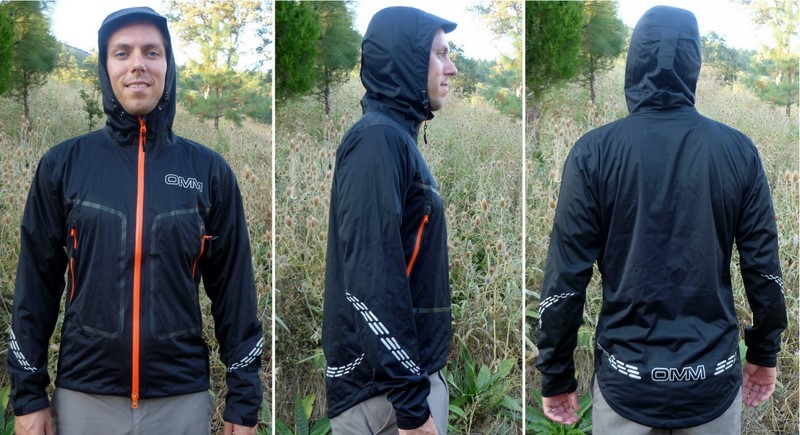
Front, side, and rear views of the Jacket, which has a full front zipper and two large pockets.

The front zipper on the Smock is 17 inches (42 cm), which is very long for a pullover. OMM uses a two-way zipper that enables venting of the torso while the neck area is still covered (left). The Smock has one 6.5 x 9.5 inch (17 x 24 cm) pocket on the left chest, accessed through a 6-inch (15 cm) zipper.

The Smock’s front zipper stops just above a backpack’s hipbelt, highlighting an advantage of the pullover design: no zipper and less fabric bulk underneath the hipbelt (left). The Jacket and the Smock have an elastic waistband that can be tightened with a cord-lock on the interior of each hip (right).

Smock and Jacket: The hood has an elastic draw cord and small brim. Note that the front zipper ends below the chin (left). A Velcro tab enables the hood to be rolled away so that the hood does not flap in the wind (center). The Jacket gains fore/aft hood adjustment with the addition of a second Velcro tab (right).

The Smock has thin elastic cuffs and thumb loops (left). The Jacket loses the thumb loops in favor of adjustable Velcro cuffs, but maintains the long sleeve length (right).

The Jacket steps up to the larger sized two-way YKK #5 front zipper that is 25 inches (63.5 cm) long (left). The large torso pockets on the Jacket are 8 x 10 inches (20.3 x 25.4 cm), accessed via 7-inch (17.8 cm) zippers (right).

The Pants have one pocket, on the right side, that is 5 inches (12.7 cm) wide and 11 inches (28 cm) deep with a 7-inch (17.8 cm) zipper (left). The side ankle zipper is 18 inches (45.7 cm) long, reaching up all the way to the knee (right).

In the front of the Pants, a small draw-cord cinches the elastic waist (left). A slightly larger draw-cord tightens the elastic band around each ankle (right).
I used the Kamleika Race shells in the spring and summer of 2011. My testing grounds included Norway, Scotland, Ireland, Minnesota, and the Rockies of Montana and Canada.
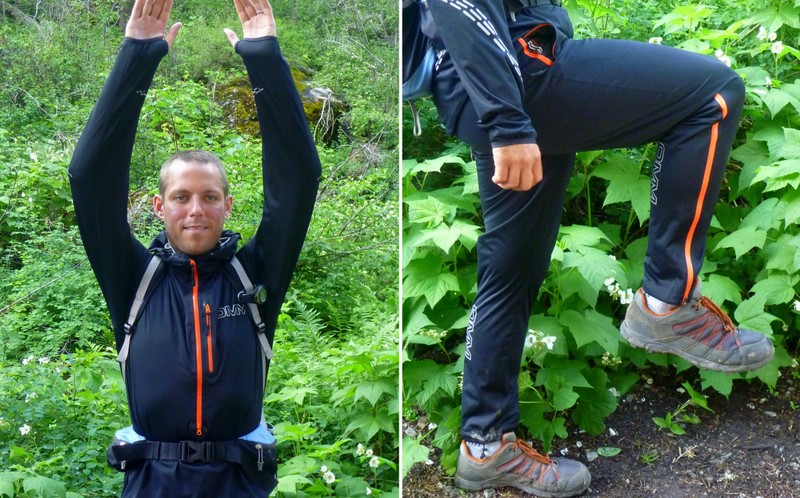
The benefits of four-way stretch fabric: my arms had complete freedom of movement even when wearing a backpack (left), and pant legs did not ride up when taking big steps (right).
The first thing that struck me is that the Kamleika Race kit is very snug fitting for a men’s medium, which is my standard size. It took me a while to get accustomed to the trim cut, but eventually I grew to appreciate it. I did not find it to be restrictive or especially tight in any one area. The leg, arm, and torso lengths were still plenty long for my 6’0” (183-cm) frame. The Kamleika clothing is snug all around, but long enough to cover the wrist, waist and ankles, and loose enough to fit enough insulating layers for three-season use. I could wear a medium-weight baselayer under the Pants. Under the Smock or Jacket, I could fit a thin baselayer and MontBell Thermawrap Parka and nothing more. This is generally all the insulation I need outside of winter alpine conditions. If conditions got really cold at night at camp, I could layer a down jacket over the Kamleika Smock. Finally, the fabric is very soft to the touch. It is very comfortable to wear: more like a track suit than a race shell.

A minor gripe is that the wrist on the Smock is a bit tight, and the thumb loop is even tighter. This likely led to the development of the small hole adjacent to one thumb loop.
One advantage of the stretchy Gelanots fabric is that it allows for snug fitting clothing without restricting mobility. This helps to reduce flapping and noise in windy conditions. I most appreciated this when I changed into other jackets and realized how much they flapped in the wind when the Kamleika did not.
OMM claims that the close fit helps with breathability as there is reduced air volume between the user and the shell. The idea is that with less air volume, humidity from perspiration has nowhere to go but out. I could not do any laboratory testing to verify this claim. However, I found the shells to have better than expected breathability in the field, so there may be some validity to this design. Breathability felt at least as good as Gore-Tex and other brands of proprietary fabric of similar waterproof technology. That being said, do not count on it being quite as good as eVent or the newest waterproof/breathable fabrics on the market: Polartec Neoshell or Gore-Tex Active.
The zippers all worked well: no precipitation leaked through and the zippers never got stuck on the fabric. OMM uses #3 YKK zippers on all of garments, except the Jacket’s front zipper, which is a #5 YKK.
I really liked the two-way zipper on the Smock and wish more pullovers would come with this feature. The Smock’s front zipper is quite deep, which allows excellent venting. The two-way zipper enables venting to be maintained while keeping the hood snug and secure, and the chin covered. For me, this is a small improvement that makes a big difference, and is one way that makes the Smock unique.
The Jacket has a two-way front zipper and therefore has the ability to do the same type of torso-venting while protecting the neck and head. I seldom, if ever, used this feature on the Jacket because the zipper starts below the hipbelt. To unzip from the bottom of the Jacket would require releasing the hipbelt, which is not always easy, safe, or practical to do while hiking. However, one advantage of the Jacket’s full front zip is it can vent the entire front of the torso and some hikers might prefer this over the Smock. Additionally, this was not an issue when I wore a backpack without a hipbelt, or didn’t wear a pack at all. In this case, the Jacket has the clear advantage in venting capability.
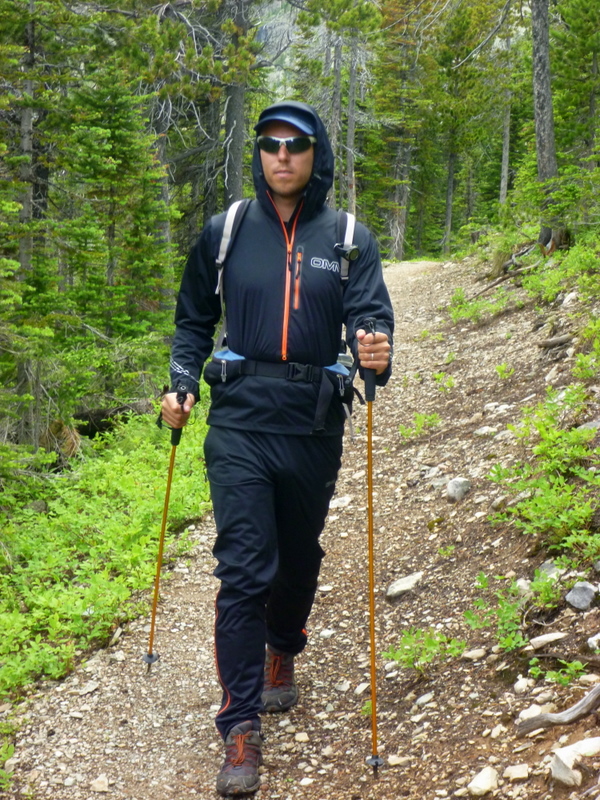
I often wear a sports cap while hiking, and the basic hood of the Kamleika Smock compliments this nicely. Note: I did not intentionally color coordinate my outfit with the Inov-8 RocLites and CAMP Xenon 4 poles!
The hood is relatively snug: there is room for an insulation layer, like a thick beanie or a mid-layer hood, but nothing more. I didn’t need to tighten the elastic drawcord as I have a rather large head for my clothing size. The hood’s brim is fairly small, so I found it was best to wear a billed cap underneath to keep the rain off of my face. It is easy to use the Velcro tab and roll away the hood, which keeps it from flapping in the wind.
The Kamleika Pants fit more snugly than the tops and are definitely tapered toward bottom. The generous ankle zips make it is easy to put on and take off the pants while wearing shoes. Of course is is possible to unzip the legs to help ventilate or just relax the fit around camp. Since the Pants taper significantly, it would be best to use them with shortie gaiters to prevent water from running down the pants into the shoes. I found that having only one pocket is generally fine since most UL packs have hipbelts to keep things accessible. I occasionally missed having a second pocket around camp, when my left hand was left out in the cold. However, when weight is concerned, one pocket was just fine. It is a really deep pocket that can swallow maps, P&S cameras, energy bars, and more. The pocket zips closed, ensuring that nothing will fall out.
The Kamleika kit is available in a light blue or black fabric with orange highlights. The women’s version will be available in red.
In a market crowded with lightweight waterproof/breathable clothing, the Kamleika Race line stands out. A few design elements and the fabric choice, which leads to the particular fit, are what’s so unique about the clothing. It was an adjustment to get used to the snug fit. However, my mobility was never limited, thanks to the excellent stretch-properties of the Gelanots fabric. I appreciated the lack of extra fabric that would have flapped noisily in the wind. The narrow seam taping and simple design (few pockets, few seams) minimize barriers to breathability, thereby maximizing the fabric’s ability to transport moisture. Fabric durability seems good, but not the best, as one hole showed up in thumb loop. Only long term use will show whether this is an issue of concern. The soon-to-be-available women’s line is a very welcome addition.

Hiking in Banff National Park, Canada.
The feature set is well thought-out for three-season use in windy and rainy weather. The arms, torso and legs are all long enough to cover the wrists, waist and ankles. The hood is quite basic, but functions well enough. Some may be satisfied with the smallish brim, but those of us that typically wear a sports cap will appreciate the lack of redundancy of having a full brim and sports cap. OMM did not skimp on zipper length to save weight, but focused on functionality with the long ankle zippers on the Pants and the long front zipper on the Smock. There are only four pockets in all three garments combined, but they are all zippered, very large, and very accommodating due to the stretchy fabric.
Finally, the Kamleika shells represent an exceptional value. At the time of writing, OMM does not have direct distribution in the US. However, several UK-based internet retailers are willing to ship internationally. Due to tax differences, it is usually cheaper to have products shipped to the US as compared to buying it in the UK (as is often the case). As such, the price point for American customers is fairly low (see the table above).
The Kamleika pieces are all very light, but there are other shells available that weigh 1-2 ounces (28-57 grams) less. The Pants weighed one ounce (28 grams) more on my scales than the manufacture’s stated weight. There are also several new technologies that are far more breathable than Gelanots. While I learned to like the very snug fit, others might not be so comfortable with it and could consider buying one size larger. The small, minimal hood and lack of face coverage limits these shells to three-season usage. The shells worked really well in cold-to-cool temperatures, but I don’t think I’d be as comfortable in warmer weather, especially if the sun comes out or if there is no chance of wind. Nor would I be comfortable in really cold weather, as I would not be able to fit enough warm layers underneath the shells.
I would like to thank Kristin Tennessen for providing the photographs and editorial capabilities for this article.
Disclosure: The manufacturer provided this product to the author and/or Backpacking Light at no charge, and it is owned by the author/BPL. The author/Backpacking Light has no obligation to the manufacturer to review this product under the terms of this agreement.
Will it light the trails on fire?
The Blaze A.C. 60 is not born of blazon fireworks or Las Vegas-style, in-your-face theatrics. Its appearance is relatively unassuming, though not unattractive… techy enough to look like a contemporary pack, but without standing out, the Blaze reminds me of a good spy’s ability to blend in. It performs well in the field, too, and looks its role: solid, light, utilitarian.
| Manufacturer | Granite Gear |
| Model | Blaze A.C. 60 |
| Sizes Available | Short, Regular (Torso) Small, Medium, Large, X-Large (Hipbelt) |
| Fabrics | 100D Ripstop, 210D Nylon Cordura, Stretch Mesh Fabric |
| Features | Full-height stretch mesh front pocket, Lineloc compression system, two stretch mesh side pockets, zippered bladder sleeve, two ice axe loops, interchangeable hipbelt, adjustable torso length, optional lid |
| Volume | 60 liters / 3660 cubic inches |
| Weight Manufacturer | 2 lbs 14 oz / 1.3 kg |
| Weight BPL | 2 lbs 14.4 oz / 1.3 kg |
| Maximum Comfortable Carrying Capacity | 35 lbs / 16 kg |
| MSRP | $229.95 |
The Blaze A.C. 60’s identity is clearly Granite Gear, with the twin vertical “fins” of robustly nubby nylon. Between those familiar fins is a new feature, however – a stretch mesh pocket running the full height, constrained by a Lineloc compression system in place of the familiar webbing. In fact, the whole pack compression uses Linelocs and cordage in place of traditional webbing and “Fastexery.” It is clean and streamlined, with paracord-esque cordage joining panels via compression points. There is a matching pair of stretch mesh side pockets of conventional depth as well, and a small quick-release Lineloc to allow compressing over or under/through the pocket.

The trademark vertical “fins” and overall arrangement of the pack.
From the factory, the Blaze comes lid-less, a roll-topper with a sleeve that extends about a foot above the frame and main body of the pack. An optional top pocket is available for those of you who just have to have a lid, but I was quite happy with the pack sans lid. One compression strap crosses laterally over the top of the pack, and one crosses front to back. For a 12-inch extension above the frame, my initial impression was that the two straps wouldn’t provide enough load control, but field trials showed otherwise.
My torso length is 17.5 inches; given that most Regular (or Medium) frames start around an 18-inch torso length, I trial-fitted both a short and a regular frame. I found that the regular frame fit me better. I generally wear a 33- or 34-inch waist pant, and found that the size medium hipbelt fit me well. Actually, it seems like the Blaze A.C. 60 belt wraps around more than many other manufacturers, to the point that I briefly toyed with a size small hipbelt, but the medium was clearly the way to go for me. The only difference in the women’s Ki model is a women’s-specific hipbelt; both genders get the same shoulder harness (and rest of the pack). In all honesty, “back in the day” we used to make packs gender-specific by swapping the shoulder harness and hipbelt, and generally by selecting a shorter-torsoed pack for women. My point is that prior experience has shown it to be a practical way to fit and manufacture packs, with equal comfort and performance, and I openly embrace any such endeavors of simplification.

Business-side fitment; note hipbelt wrap, shoulder harness, load lifters.
The shoulder harness worked well for me and proved extremely comfortable under a variety of loads and miles, but my decade or so of experience as a professional packfitter prompted some thoughts about the harness that I would recommend you consider when fitting the pack. The harness, while of excellent construction and state-of-the-market in finish quality, is not as curved as other harnesses on the more ‘traditional’ market, and the straps are perhaps a touch longer in use. As I said, I found the pack and harness quite comfortable, however, there is little strap curvature around the neck, and some people might experience a bit of rubbing there. This is of particular note because the way we typically adjust that neck opening during a fit is to raise or lower the harness. In fitting many, many people, I have found that the Granite Gear harness tends to fit a little too close, borderline pinching on some people, even when the straps cannot be lowered/the torso made shorter. Also, I’ve found that the clearance of the shoulder harness isn’t ideal for the exceptional variety of people Granite Gear intends to fit with their packs. I strongly encourage Granite Gear to consider developing slightly more anatomical and more sizes of harnesses. End soapbox.
The frame of the Blaze seems to provide a good amount of support for an ultralight pack. The back panel is a serpentine-ish molded foam sheet that inserts into a stretch mesh back panel. I’ll admit, I thought the air channels looked pretty gimmicky. I mean, c’mon. How well can they work? But on an early prototype I was testing, which was trial-fitted with stacked and glued foam, a few of the foam blocks shifted and on some stretches of trail I absentmindedly found myself thinking that my back seemed a bit hotter and wetter. The production model is rock-solid, one-piece construction that performs well and feels comfortable.

The back panel proved to be quite comfortable, both in terms of physical contact and airflow.
I noticed the lighter main-body fabric of the pack the first time I touched it. While distinctly nylon in feel, the material has a more substantial canvas kind of feel, too. I haven’t researched the materials science on this one, folks! But it feels like a more robust, inspiring material than Granite Gear’s ‘legacy’ packs. The next two things I noticed were tactile as well. The stretch mesh feels like it has an excellent balance of stretch, durability, breathability, retainability (of stuff in pockets), and weight. The Lineloc compression cords pull through somewhat stiffly, though they release easily with upward thumb pressure on the device. At first blush, it seems like the cordage has a bit too much bite when tightening, but with use it becomes apparent that it’s just right.

The Lineloc compression system is secure, easy to use, and effective. Nope, it doesn’t adjust exactly like your familiar webbing system, but it should be an easy adjustment to make.
There is a zippered full-length, full-width sleeve if you are so inclined to carry a bladder inside the pack, along with two corresponding simple slash pass-throughs. I find it a lot less of a hassle to just strap the bladder on top of the pack. The top and bottom straps of each shoulder pad, and the crossing top compression straps, have ‘neat-freak bundlers,’ little plastic toggle and shock-cord thingies so you can roll up and secure your excess straps. I find the bundlers extraneous, and I’m not sure that many people would actually take the time to use them in the field. Mine will no doubt end up cut off.
Features-wise, however, the Granite Gear team did a delightful job of eliminating most of the usual excess. Aside from those features mentioned, there are two ice axe loops and, yep, that’s about it. (I consider a sternum strap standard on a shoulder harness, and personally wouldn’t consider removing one.)
This pack’s not gonna start any fires on me! Time after time the pack just rode along, not particularly announcing its presence. That is a remarkable feat for a pack – quite a compliment. If you can just about forget the fact that you’re wearing a backpack, well, kudos to the pack! I am not a thru-hiker or an ultra-runner or a mile-monger of any kind, really, but even after 14-mile days, I was in no rush to ditch the pack.
I think the firm, comfortable, full-wrap hipbelt contributes significantly to the comfort. It seems to bear the weight of the frame quite well without developing hot spots. The frame proved plenty supportive for UL loads, and allowed for enough adjustment with load lifters to prevent shoulder soreness. My typical three-season baseweight is somewhere around ten pounds, but on one long weekend trip I brought all sorts of extra “fun” stuff… a chair, hammock, extra tarp, sparklers, a string of LED lights… and after my 13-year old pup decided she’d had enough of her dog pack, I piled her pack of food, pad, line, and doggie sundries into the extension sleeve. Even laden like the proverbial pack mule, I found that the pack not only handled the weight, but was comfortable. I’d guess that my heaviest carry has been around 30 pounds with this pack.
Given the height of the extension sleeve above the frame, I was pleasantly surprised by how secure and non-wobbly the pack was when stuffed to the brim. I anticipated having a giant lump bouncing on the back of my head with each step, but it stayed where it should, above the pack and away from me. Another pleasant surprise was the center stretch pocket. I’ve never been a fan of mesh pockets on the back of a pack, in large part because there is usually a lack of load control over the contents, but also because of the coarseness of the mesh we see in the UL world and, frankly, I’ve just had no need for them. My stuff is all organized in a few dry sacks, the tent or tarp generally just shoved into the corners of the pack. However, I found myself shoving rain gear in this front center pocket. Tossing in the sunglasses. Maybe a foam sit pad or a baggie of GORP. All this stuff is normally just right under the collar of my pack, or in the lid, but I found the slide-in stash convenient. The full height of the pocket offered good trail ‘security,’ and I still had good load control (even when I stuffed in the chair, etc.) with the three Lineloc compressors passing over the pocket. At one point, I shoved a 10×12 sil tarp in the pocket and cinched everything down… only to have the tarp balloon out from between the compression cords. It kind of made me wish for a wispy fabric panel to hold better compression along the length of the pocket, but for an object with as little mass as the tarp, such an alteration would be purely cosmetic.
The Blaze A.C. 60 is an excellent pack for those playing along the borders of ultralight – the majority of us. I found it adapted well to a wide variety of loads, those ranging from small daypack size (and weight) to consuming all available pack space. It provides plenty of support and weight transfer through a comfortable and efficient fit. The pack has necessary features, but few (if any) extraneous bits. The breathability of the back panel was a noticeable benefit. In all, I’ve come to think of the Blaze A.C. 60 as my ultralight workhorse and jack of all trades.
While I, and many others, find the fit to be comfortable, those who find the fit less than ideal will likely find the pack to be a bit more of a generic fit, perhaps reminiscent of a one size fits all tube sock. The analogy might not be particularly apt, but, like those socks, this pack will fit most people well. I would like to see the Granite Gear designers turn some of their efforts away from packbag design to harness and hipbelt design. It seems like the shape of the harness, in particular, needs to catch up with the increasingly contemporary designs and construction of the packs themselves. I hope that part of their consideration will include the relation of curvature as related to where the straps attach to the pack, and any effects on overall torso length. One other nitpicky aspect of design I would like to see the Granite Gear team approach is slightly longer framesheets. When carrying heavier loads, a longer (and correspondingly stiffer, thus likely heavier) framesheet would help with more efficient weight transfer. I think the design of the A.C. 60 is probably just ducky the way it is, but I would be interested in trying out the same thing with a slightly longer frame… I’d be surprised if it didn’t carry even more comfortably.

Nice shot of the suspension… you can just see the edge of the framesheet, back panel vents, and harness wrap, load lifter angle, etc.
So how about it? What’s the bottom line on this pack? I like it. It carries remarkably well while remaining unobtrusive. Its minimalist but (mostly) functional features seem ideal for most ultralight to light backpackers, and I think the pack strikes an excellent balance between “rugged durability” and ultralight. I suspect that most readers would find this a good pack on the trail.
Disclosure: The manufacturer provided this product to the author and/or Backpacking Light at no charge and is owned by the author/BPL. The author/Backpacking Light has no obligation to the manufacturer to review this product under the terms of this agreement.
Planning like crazy to do a thru-hike doesn’t quiet the fears: “Can I do this? Will my gear work? Will I stay motivated? Do I have the right food?” Only time on the trail would answer.
You don’t have access to view this content.
“I’ve never been lost, but I was once a mite bewildered for a few days.” – Daniel Boone
You don’t have access to view this content.
A lightweight ski day pack with a handy, hands-free ski carrying system.
CAMP is known for making some very lightweight ski mountaineering and climbing gear. In fact, a number of their competitive ski mountaineering equipment is some of the lightest on the market, like a 195-gram harness (6.9-oz), 290-gram (10.2-oz) pair of crampons, and 260-gram (9.2-oz) Rapid ski pack.
The X3 600 does not fall into that category of super specialised ultralight equipment. Rather, this pack is a fairly simple, stripped-down ski touring pack. It is the lightest of the X3 line, which includes the X3 Light ($170, 17.3 oz/790 g) and X3 ($160, 35 oz/990 g). These other two packs have tougher fabric, more padding, an aluminum frame, and back-panel access. In an effort to go lighter, has CAMP found a good mix of weight and durability with the X3 600? Or, have they gone too far and made a pack that just doesn’t hold up to the inherent abuse of ski touring?
| Manufacturer | CAMP (www.camp-usa.com or www.camp.it) |
| Year and Model | 2011 X3 600 |
| Style | Ski day pack with frame |
| Volume | 1830 cubic inches (30 liters) |
| Weight | Manufacturer 21.2 oz (600 g), BPL Measured 22.9 oz (649 g) |
| Stripped Weight | Manufacturer 17 oz (490 g), BPL Measured 19.5 oz (552 g) (removing stay 1.7 oz (49 g), hipbelt 0.8 oz (24 g), and 6 gear loops 0.14 oz (4 g) each) |
| Sizes Available | one size |
| Fabric | HyperGrid SN44 |
| Features | removable fiberglass stay, attached lid with external zippered pocket, two side mesh pockets, removable hipbelt pocket on right side, mesh back panel, sternum strap, four removable ice axe/gear cords, Xpress Evo Carrying System for skis, perforated foam shoulder straps with load lifters, mesh pocket on right shoulder strap, haul loop, internal straps for avalanche gear and hydration bladder |
| Volume to Weight Ratio | 80 cu.in/oz (46 L/kg) |
| Maximum Comfortable Load Carrying Capacity | 25 lbs (11.4 kg) |
| Carry Load to Pack Weight Ratio | 17.5 |
| MSRP | $99.95 |
The X3 600 is a fairly straightforward pack with a few minor twists. The pack is made of HyperGrid SN44 fabric and has a tall mesh pocket on each side. There is a single straight fiberglass stay that is removable. The back panel, hipbelt, and shoulder straps are all well padded. The attached lid has one zippered pocket. There is also a hipbelt pocket and chest pocket, both on the right side. Finally, there is a quick attachment system for skis, with a nylon loop on the left hip and a nylon leash on the right side.

The pack’s mesh side pockets are big enough to swallow a 2-liter water bottle or a pair of thin climbing skins (left). The pack’s only compression is the single front strap that tightens from the bottom of the pack to the lid. There are four stretchy orange gear loops, all removable (right).

The right shoulder strap has a stretchy mesh open pocket; the plastic ring above that is part of the Xpress Evo Carrying System (left). Both shoulder straps have thick perforated foam padding and a nylon band for holding a hydration tube (right).

The shoulder straps attach just behind where the hipbelt is sewn into the pack, and there is also a tiny buckle for removing the hipbelt (left). The hipbelt pocket is on the right side, the ski carrying strap tucks into the left side hip, and the front buckle is off-center, anchored to the left side (right).

The Xpress Evo Carrying System is composed of two parts: a two-foot (61-cm) leash with a brass hook on one end, which tucks into a sleeve on the back of the right shoulder (left), and a nylon loop that is stored in a sleeve on the left hipbelt (right).

The four removable gear loops are doubled over and adjustable to accommodate different equipment sizes (left). The lid’s side trim is stretchy, and underneath has one more loop on each side to help secure a rope being carried between the main compartment and the lid (right).
Kristin and I tested this pack over four months of backcountry skiing and day hikes in Europe, during the winter and spring of 2011.

Kristin and our Italian friends, Piero and Bepi, skinning uphill on a bluebird day in the Dolomites.
The fabric, HyperGrid SN44, is CAMP’s name for a lightweight gridstop nylon. It is not as tough as Dyneema or other similar fabrics in the 200 denier range. After three months of use, the front face of the fabric was showing areas of abrasion with a few pin holes. The pack saw a lot of snow use, but no abuse: I never sat on it or glissaded with it, nor did I take any significant falls on hard snow pack. The visible signs of wear and tear are disconcerting considering the duration and type of use.
A 30-liter capacity is generally a good size for a ski day pack. I can fit a lot of gear in there – a down jacket, extra layers, food, water, shovel, probe, and so on. However, the X3 600 lacks sufficient compression capability to reduce volume. The single compression strap, from the lid to the bottom of the pack, does not compress enough, which equates to a less comfortable fit and more space for items to shift around internally. Additionally, the items tended to “sink” to the bottom of the pack as they are not really secured in place. Sometimes this could be avoided by repacking, but not always. It was very uncomfortable as hard items rubbed against my backside with each stride. The torso size is a bit too small for my 6′ (183 cm) frame, but good for Kristin (5’7”/173 cm) and there are no torso adjustments.

Hard items, particularly my shovel blade, liked to fall to the bottom of the pack and poke me in the back (left). The frame is a fiberglass stay surrounded by a swath of thin white padding and mesh, which frayed quickly due to the poor design (center). Eventually, the stay poked through the fabric (right).
The frame is not meant to increase carrying weight so much as to keep the pack from collapsing under the weight of gear, especially skis. However, the fiberglass stay goes straight along the spine (no ergonomic curvature) and ends on the tail bone (no padding). Unsurprisingly, the bottom of the frame rubbed against my tailbone when I carried more than 15 pounds (6.8 kg). This tended to be most noticeable when skinning uphill, as I was wearing less clothing (padding) and carrying a heavier load, with lots of clothing and food. Where the fiberglass strut ends at the bottom of the pack is a focal point of pressure and sees a lot of wear, but this area is not reinforced. Naturally, the fabric wore out and the pole poked through. The pack continued to function fairly well despite this, because it was designed to add back panel stiffness and continued to do so. Besides the frame issue, this pack was comfortable to wear while skiing and hiking. The hipbelt, back, and shoulder strap padding was very good. In this regard, everything functioned as it should have.

CAMP’s Xpress Evo Carrying System: the loop on the hip carries the bulk of the weight, while a leash wraps around the skis and back to the shoulder strap to hold them steady (left). The biggest disadvantage of this system is that the weight is unevenly distributed to the left side, and so the straps are pulled tightly in that direction (right).
The Xpress Evo Carrying System worked well, but is not without faults. There are two general ski carrying set-ups: the A-frame, whereby a ski is held by straps on each side of the pack and then are strapped together at the top to form an A; and the diagonal strap, where the skis are held diagonally across the front of the pack, with a loop on the bottom left corner, to catch on the bindings, and a buckled strap on the top right, to hold the skis vertically. CAMP’s system is similar to the latter. The difference is that CAMP’s pack allows the skis to be strapped in and out without having to take off the pack. The skis are slotted into the loop on the left hip. Holding the skis vertically with my left hand, my right hand passed the strap around the skis and hooked it into the plastic loop on my right shoulder. The skis can be attached in a matter of seconds. As an added bonus, the weight of the skis is kept close to my back, helping with my center of gravity, and does not crush the contents of the pack.

In Norway, we often had to carry our skis for a short, steep pitch to the summit. In this photo Kristin’s skis are attached to her GoLite Jam2 using the A-frame method. As I always had the camera, Kristin never got a picture of me climbing and carrying my skis on the X3 600. In situations like this, I really appreciated the speed and safety of Xpress Evo Carrying System.
There are two times when this set-up is really handy. The first is obvious – approaches where I needed to hike to find snow. I was always the fastest to put my skis on my pack because of this. The second instance where the system is worth its weight in gold (well, maybe not with today’s gold prices): when a slope becomes too steep to continue skinning up, then the only way to continue upward is by carrying the skis and walking. If the slope is that steep, then there is also a decent chance of a bad fall or dropping a piece of gear. CAMP’s system allowed me to put my skis on my pack without having to take off my pack. With either of the other two systems, I would have to take my pack off and put it on the snow to attach my skis, and then hoist the combo onto my back. CAMP’s set-up is faster, which reduced my time exposed to any risk, and much safer, as my pack couldn’t possibly slide down the mountain. I also felt it was easier to keep my balance, as I wasn’t trying to maneuver the pack and skis from the ground to my back. Note while CAMP calls this the Xpress Evo Carrying System, other manufacturers, like Dynafit, also have similar set-ups.
Because of the small pack size and small frame, the added weight of carrying skis was noticeable but bearable. I think it carries better on a person with a smaller torso, like Kristin. I carried the skis for up to an hour at a time during long approaches in late spring conditions and was comfortable. Every once in a while I banged my elbow against my Black Diamond Fritschi bindings. This would not be an issue if I had smaller, lighter tech-fit bindings (which nearly everyone in Italy does).

View of the inside of the pack: an elastic loop on each side secures a shovel handle and probe, two additional Velcro straps are meant to hang a hydration bladder, and the fiberglass frame is visible in the middle (left). The side pockets fit my Black Diamond Glidelight skins (right).
The side mesh pockets are good sized and can accommodate climbing skins, jacket, or 2-liter water bottle. It is nice to stash wet skins on the outside of the pack to dry out, or conversely, to keep things on the inside from getting wet. The pockets are not designed to be for on-ski convenience, as the tall mesh makes the pockets inaccessible while the pack is being worn. The pockets are tall enough so that things didn’t fall out if I took a tumble. However, it is still possible to lose items from an open pocket, which is why most ski packs have zippered pockets. Plus, mesh pockets tend to collect snow and are generally weaker than fabric.

The hipbelt pocket is big enough to fit a few goodies, and without getting in the way of arm movement.
The hipbelt pocket is large but not unwieldy. I kept my camera in there, plus a snack or pair of liner gloves. The pocket is removable, but I would not remove it as I prefer the convenience over the 0.8-ounce (24-gram) weight saving. Being removable, however, meant that the pocket jostled around a lot and could bang into my hip given the right (or wrong?) conditions. This wasn’t noticeable when I was skiing, nor when the pocket was filled with soft items. However, it was painful when I had my camera in there on a day hike and ran downhill. The pocket also banged around when carrying my skis and hiking downhill.
The gear loops are simple, light and removable. They are easy to use and can be tightened sufficiently to secure gear like trekking poles, helmet (via the helmet straps), and supposedly, ice axes. I was a little leery of carrying an ice axe on it. Most packs use a stronger gear loop for the bottom, which is where the axe’s head would be secured. The CAMP pack’s loops are stretchy here, which means the pick and adze could move around too much. While this probably wouldn’t be an issue for a small axe or mellow tour, it is not a risk I would want to take. There is no place to attach crampons, but perhaps something could be rigged up with the gear loops. Compact crampons, like CAMP’s Race 290, could fit in the side mesh pockets.

It’s all downhill from here…
The CAMP X3 600 has a few design flaws that make it unsuitable for light ski mountaineering, yet the pack is not light enough for competitive racing, nor is it access-friendly enough for general winter use like snowshoeing. The fabric started to wear through in one season. The frame broke, in the sense that the fiberglass stay poked through the bottom fabric. On BPL scales, the pack weighed 10% more than the manufacturer’s specs. The availability of one pack size and with no torso adjustment limits the fit range for consumers.
However, the pack wasn’t all bad. I really liked the Xpress Evo Carrying System. It was simple, lightweight, efficient, and safe. The big pockets were a blessing on spring days when I could dry out my skins. The MSRP of $100 is fairly low for a ski pack. CAMP could easily alter the frame design, which would be a big improvement. The hipbelt pocket should just be permanently attached, which would save weight while improving performance. More robust ice axe loops would only add a few grams. These few changes would definitely make the pack more attractive to a wider audience.
Disclosure: The manufacturer provided this product to the author and/or Backpacking Light at no charge, and it is owned by the author/BPL. The author/Backpacking Light has no obligation to the manufacturer to review this product under the terms of this agreement.
Part 3 of this tutorial gives the details on the seven tunnel tents included in this report.
You don’t have access to view this content.
Making decisions based on incorrect information negates stellar gear and knowledge, leading to trouble. It can happen far more easily than many of us would care to admit.
It is the weekend before rifle deer hunting season opens in Michigan. The mid-morning weather is bright, crisp, and clear. Leaves from the oak and maple trees completely cover the ground. Here and there you can spot a patch of snow clinging on, though it is unlikely to last as the temperature is creeping up to a high in the lower 50s. I am going for a day hike on the North Country Trail with several friends; we’re walking a section of trail many of us have hiked before, though it has been a few years. We are all expecting to have a thoroughly enjoyable hike on trail that should pose no real problem during an autumn day that promises to be as close to perfect as one could wish.
Walking through the woods, we passed a charming little cabin that we knew was occupied, as a hint of wood smoke filled the air. We noticed that we were, unfortunately I thought, spending a fair bit of time walking into the sun. Then we came to the Big Sable River and the Vince Smith Memorial Bridge. This is a lovely clear river that has nice camping spots nearby. Our group slowly spread out as faster hikers took the lead and those of us who wanted to take photos or do other things, like gather detailed trail distance measurements, lagged behind. There was no need to rush, as the trail is fairly gentle the whole way, and we had well over five hours until sunset to hike the entire 13-mile section.
Time passed and I found myself hiking with one other person, also an experienced and knowledgeable backpacker. We were having a grand time and were not too concerned that the rest of the group was out of sight and earshot. Perhaps we were having too much fun, because not long after cresting a gentle hill, we made a mistake: we stepped off the trail and onto a two-track. The NCT uses two-tracks now and again, but that wasn’t the case this time. We followed the two-track until it reached a Forest Service road, a good third of a mile, before realizing our error. We thought we may have made a mistake, since we had not seen any blazes in a while, but coming to the road was the clincher. Oh well, things like that happen to everyone. Turn around, walk back, find a blue blaze and continue on. No harm done.
We figured our little detour probably cost us 15 minutes, but we didn’t feel we had to rush. We had plenty of time, had headlamps, warm clothing if it got cold, rain gear, snacks and lunch, fire-starter, emergency shelters, and of course a map and compasses. We also knew the others would stop at McCarthy Lake for lunch, and we could catch up there. We walked on, enjoying the early afternoon. We noticed that the sun wasn’t in our faces anymore, but we put that down to the changing direction of the trail and the fact that it was later in the day. Then we came to a sturdy bridge that spanned a nice little river: the Vince Smith Memorial Bridge. We both had the same thought: Mr. Smith must have been quite the person to have more than one bridge named for him. We continued on and passed a little cabin with a hint of wood smoke issuing forth. We reached a road which we learned was 5-Mile Road. We wondered why there was a road walk where we knew one shouldn’t be. Only then did it dawn on us that we had not made a small detour after all. We had made a miles-long detour. We had returned to our starting point at 5-Mile Road! We were shocked. After all, we were certain we had been going the right way all along. We had been positive. We were, of course, completely wrong.

The Big Sable, taken from the Vince Smith Memorial Bridge on our first of three passes…
At this point some of you are no doubt saying we should have checked our map sooner or taken a compass reading sooner. Maybe we should have. But even had we done those things, that is no guarantee we would not have made the mistake we did. The trail meanders, so a single compass reading is not adequate for being sure that you are going in the right or wrong direction. You have to look at the overall trend of direction travelled to get a more accurate reading, and that is something we did not do. Our real problem, however, had deeper roots than a mere failure to take a compass reading or carefully examine the map. After all, we had clues about our direction of travel as we walked. Remember the sun was shining in our eyes on the outbound trip. It wasn’t as we continued. We noted the fact as something to remark on but that was all we did. Then we reached the Vince Smith Memorial Bridge. We honestly thought that Mr. Smith had received the honor of getting more than one bridge named for him. Never mind that we couldn’t recall, though we did not check the map, another river requiring a bridge. We needed to have our faces really rubbed in the reality of things when we reached 5-Mile Road before we understood what had happened to us.
The lesson to learn here is that what really matters most, beyond having the right gear and knowledge of how to use it, is that that some decisions are based on assumptions. Some of these may be true and some you may merely believe to be true. Those assumptions, especially those that you are absolutely sure of, form the basis of your thought processes, and if they are flawed, then your actions are bound to be flawed too. That was our real problem. We ignored the facts that were presented to us because we were sure we knew what we were doing. Once we had our comeuppance on the return to 5-Mile Road we revised our plan and got the word to others in the group. Had worse come to worst, we both had the gear with us to get through the night.
When you next go out trail-walking remember, especially if it is an area you feel you know, that it is always good to question yourself. Don’t ignore facts as they come to your attention. If you have an unusual event, as we clearly did when we both thought Vince Smith had two memorial bridges, pause, take a breath, and consider the likelihood of the occurrence and the possibility that something is wrong. Remember that the real enemy is the over-confidence that can give you a false sense of security.
Tunnel Tents Tutorial and State of the Market Report – Mini Reviews
This is a mini-review to go with our series on tunnel tents. It reviews the MSR Dragontail. Some of the illustrations are from the manufacturer’s web site, used here with acknowledgement.

The MSR Dragontail is one of two tunnels we know of that are made in America. First, the specifications.
| Brand | MSR |
| Model | Dragontail |
| Poles | 3, DAC |
| Skins | 1 |
| Fly Fabric | 40 denier PU/silicone nylon, 1.5 m head for fly, 10 m for groundsheet |
| Entries | 1 |
| Vestibules | 1 |
| Persons | 2 |
| Listed Weight | 2.53 kg (5 lb 9 oz) |
| Tent Weight | 1.64 kg (3 lb 10 oz) |
| Pole Weight | 0.65 kg (1 lb 7 oz) |
| Stakes Weight | 11, 0.19 kg (6.8 oz) |
| Stuff Sacks | 175 g (6.2 oz) |
| MSRP | ~US$450 |
Extras include guy ropes, a spare guy rope toggle, and a pole repair sleeve. It should be noted that MSR has not been able to resist the massive overkill syndrome on the stuff sacks, especially on the tent bag. This can be pruned down of course.
This is a single-skin tunnel designed for winter use. There is an inherent contradiction in this claim of course, and users have reported that the inside surface does get a lot of frozen condensation on it which can be brushed off onto the occupants. The tent is well made, but is not without some deficiencies.

There is an ingenious ventilation arrangement visible in the first photo: there is a sort of tunnel through the tent at the top. It can be closed off with zippered flaps at each end.
If you have both ends open, there is a mesh floor to the tunnel that prevents insects from getting in. There are zips in both ends of the mesh tunnel floor to allow you to access the zippered exterior flap – in case the weather changes. There are also mesh doors inside the tent to keep out insects. However, the zip on the mesh front door goes down one side and then turns a sharp corner at the bottom before running across at floor level. In sub-zero conditions, that tight corner in the zipper may present real problems if the zip gets wet, then freezes.
The way the rear end can be closed up does present one unexpected problem. If you follow my recommendation to roll the tent up from the entry end to the rear end, there can be a bit of an issue with getting the air out of the rear end of the tent at the end of the rolling. You need to make sure there is not much air left in the tent before you start rolling. However, the stuff sack they supply is huge, far bigger than needed, so I guess you could pack the air away too. Or make a smaller stuff sack for field use.

Somewhere along the line, MSR changed the design of the Dragontail and how the poles are fitted. The early versions (see below) had the poles threaded into sleeves, making the tent fairly robust and making the fabric quite smooth when the tent is properly pitched. But, on later versions, (see above) the poles are not threaded into the fly; rather they are connected to the fly with a small number of clips. Was this change to make it easier to pitch the tent, or to reduce the cost of manufacture? I fear the latter, as the effect of the clips is to make the fabric surface look quite crinkled, as shown above. I could not get rid of this crinkling. I think someone at MSR lost sight of what a tunnel tent is meant for. I far prefer the threaded pole version, but you can no longer buy it.

My thanks to Ray Estrella and his friend Dave for this excellent photo of his tent in a storm.
On both versions, (old and new) there are a couple of fabric loops at mid-height and the top of each seam. These loops are of a length that could take the poles. When I first erected the clip version of the tent I automatically threaded the poles through these loops, but the official MSR photos show them lying unused. I think I misunderstood these loops, and that they are really meant to be guy rope attachment points. In the photo above you can see that Ray put a guy rope onto one of these loops on the far side of the tent, because of the wind direction.
However, all the official MSR photos show the tent without any guy ropes attached. I find this amazing. Does it mean that MSR does not expect the tent to be used under high wind conditions? Or was there a disconnect between the designers and the marketing team? I did find that the tent sways sideways quite a bit in a light side-on wind when there are no guy ropes. I also noted that the fabric does belly a bit in a side wind. I am quite sure the tent will need guy ropes in bad weather. Anyhow, the tent I received had four 3 mm guy ropes with plastic Nite Ize Figure 9 toggles – all with MSR logos as well. Since I can see not four but eight guy line attachment points, I was a bit disappointed by this shortfall. I would add that 3 mm cord is awfully heavy for guy lines (gross overkill actually), and that you don’t need any toggles on string this thick, just use a taut line hitch.
The tent comes with a handful of ‘groundhog’ stakes. These are the common Y-stake, but they have nicely rounded corners. I find these Y-stakes rather hard to insert compared to a tubular stake, and much harder than a Ti wire, but at least they didn’t hurt my hand. Each stake has a loop of the 3 mm guy rope cord to help you extract it. A lighter cord would have been adequate.
I had better add here that the tent supplied came with no guy ropes at all, which seemed strange. I inquired about this and was told that the designer had played with it, and he had forgotten to replace the guy ropes in the bag! Also I received only 11 stakes, although the specs say 12. They did send some guy ropes later, but I don’t know whether they sent the full compliment. These things happen.

There is only one vestibule on the tent.
The ‘vestibule’ space at the rear of the tent forms part of the groundsheet space. The front vestibule is not large, but it is adequate for gear and cooking with a little squeeze. It has only one access zip however: you need to make sure you’re not facing the wind on that side of the tent. Curiously, the zipper has two sliders. Exactly what one uses the top slider for is not clear to me. (I suspect a manufacturing mistake myself.) Once the door has been opened (unzipped) it can be held out of the way with a toggle at the pole seam. This is good. There is a matching toggle at the other side of the tent, and it seems to be totally useless to me (there is no zipper there).

The interior of the tent has reasonable floor space for two, and very reasonable headroom. The ends of the tent do not slope down to a useless tapered region. The sides go straight up. There are pockets at the sides for light gear during the night. This makes the tent quite livable. The vestibule has enough room for cooking, although two packs would be a squeeze at the same time.

The ground anchor points provide both a neat fabric loop and a cord tightener. I am not sure one needs both, but they are there. The method of attachment looks strong enough too.
The fittings at ends of the poles are called ‘feet.’ On most tents, the feet are designed to slip into a grommet or something similar. That applies here too, but (like some other companies) MSR has done something silly with the feet: they have knobs on the end. The usual explanation is that the knob helps keep the foot in the grommet, but that is not a sensible explanation. The pole foot is going to stay in the grommet regardless of any knob. What the knob usually does is to jam the pole foot in the grommet if there is any mud and grit around, and that did happen here. I had trouble getting the pole foot out during testing. I normally slim all the knobs down on a lathe before taking such a tent out. It makes life so much easier.
The poles fold up into a tidy bundle provided you get the bend at the top right. I am not going to explain how to do this: you need to have the poles in your hand. Anyhow, some neat design work here.
Despite the deficiencies listed, this remains a well-made tent that will serve nicely in the snow when not subject to extreme conditions (like really bad weather above the tree line). Add some permanent guy ropes to it for sure. Do up the windward ventilation window and it should take a fair bit of wind, although, being a single-skin, condensation (water or frost) then becomes a bigger problem than normal. The vestibule is not large, but one can cook in there.
Disclosure: The manufacturer provided this product to the author and/or Backpacking Light at no charge, and it is owned by the author/BPL. The author/Backpacking Light has no obligation to the manufacturer to review this product under the terms of this agreement.
Tunnel Tents Tutorial and State of the Market Report – Mini Reviews
This is a mini-review to go with our series on tunnel tents. It reviews the Wilderness Equipment First Arrow. Some of the illustrations are from the manufacturer’s web site, used here with acknowledgement.

The Wilderness Equipment First Arrow is a tapered three-pole two-man double-skin tunnel. It is described on the company web site as a ‘5-season 2/3-person tent,’ but this is marketing spin. First, the specifications.
| Brand | Wilderness Equipment |
| Model | First Arrow |
| Poles | 3, Scandium Air Hercules FC |
| Skins | 2 |
| Fly Fabric | 30D polyester, silicone/PU coating |
| Entries | 1 |
| Vestibules | 1 |
| Persons | 2 |
| Listed Weight | 3.39 kg (7 lb 8 oz) |
| Tent Weight | 2.54 kg (5 lb 9.5 oz) |
| Pole Weight | 500 g (17.6 oz) |
| Stakes, Weight | 9, 0.15 kg (5.3 oz) |
| Stuff Sacks | 164 g (5.8 oz) |
| MSRP | AU$715 |
Spare parts include two pole repair sleeves and two spare zipper sliders. The 150 mm long stakes have an X crosssection and loops of 2.5 mm guy rope cord.
This is a three-pole two-man double-skin tunnel tent. Despite having a modern silicone/PU polyester fly, it is rather heavy, which reflects two things. The first is that the basic design is now almost 30 years old. Nothing the matter there, but it brings a bit of heritage. The second – the heritage bit, is that it was, and still is, designed to be used by novices. That means that some components are designed to be misused, mishandled, and generally beaten up by novices. In fact, there is a heavier version available, with a 75 denier PU-coated polyester fly. That adds about 150 g (5.3 oz) to the tent weight – which tells you that the rest of this tent is made from even heavier fabrics. I should add here that I know the owner of the company and have argued this issue of fabrics with him. I understand the constraints of his market and of his retailers.

The design has a single vestibule as seen here.
Entry is from either side, but not from the end. In the photo here it looks as though the string from the end-bell corner goes to the corner of the bathtub groundsheet but that is not so: it goes to the foot of the pole. The groundsheet is clipped to that string via bungee cord and a hook. If it is pouring rain when you set this tent up, you will have to unclip the corner of the groundsheet before opening the door, or you will fill the groundsheet with rain. This approach makes the overall length of the tent shorter, but it imposes some inconveniences.

Looking at the tent from the rear shows how much of a taper there is in both height and width. There is enough floor space for two air mats and some gear when two people are sleeping in this tent, but there is a bit of a problem during meals in bad weather. If one person is cooking up front, where does the second person sit? The answer is that the second person has to be lying down on one side, or seriously scrunched up. This is reflected in the much-reduced ‘Sitting Space’ listed in Part 2 of this series.

The company web site lists this tent as a ‘5-season, 2/3-Person tent’. I will stick my neck out and call this marketing spin. I have never seen the fifth season – what is that? And while you could get three people into this tent, I don’t want to be one of them. It just is not that big! Okay, maybe you could sleep three in a pinch, in good weather. To their credit, the web site does admit ‘Despite the incredible versatility of the First Arrow, if you must have a tent that three or more people can sit around in comfort take a look at the Cirque model.’ I am all for a bit of comfort.

The tent itself is quite rugged. (Photo courtesy Grant Dixon and WE.)
The pole sleeves are very heavy fabric, far heavier than I would ever use myself. I was told that this has been necessitated by the way some novices try to poke the poles through the side of the pole sleeve. However, since I know that it is quite possible to thread poles through the length of a silnylon sleeve for years on end without damage, I am inclined to say that any novice who does that should pay for the repairs themself! My experience with these pole sleeves has been that the heavy fabric is its own problem: I had some trouble getting the poles into and out of the sleeves because the fabric was so heavy. When the fabric is icy, it gets even more difficult. Let’s just say I disagree with the company’s logic.
The groundsheet material is also rugged – similar logic. The guy ropes are ‘only’ 2.5 mm cord, but they still seem a bit heavy. However, the weight of the guys is not high, so it is a secondary matter. On the other hand, the First Arrow has been taken to the Indian Himalayas and used there successfully, as shown here. Okay, there are times when ‘rugged’ has a value! I will add that the rather heavy side-entry stuff sack provided with the tent does have a large (and rather superfluous) flap of groundsheet material: groundsheet repairs are definitely possible. Me, I would quickly make a lighter and smaller stuff sack. I think the company will also provide patches of the fly material if needed: they do carry some spare.

This tent does have something I haven’t seen on other tunnels, and it is a clever solution to a structural problem.
You can adjust the tension at the top of the tunnel using two end guys, visible in the photo here and in the next photo. On most tents, you set the tension by relying on the seams in the end bell. In addition, the guys can allow you to alter the curvature at the top of the pole – to reduce it, actually. This does protect the pole from being over-bent in the middle. But their real value is structural and is illustrated in the next photo.

The photo here shows the rear end of the tent with it wide open for ventilation. When you do this, the tent would collapse if it weren’t for the end guys. Since the market this tent is aiming at is ‘all-seasons’ in the Australian climate, lots of ventilation is needed. You can get it if you want it, or you can close the end right up for snow use.
The rear end does come to a point, so there is only one ‘end’ stake on this tent, but that does not mean the safety of the tent relies on that one end stake. As may be seen in two of the photos, there are two end guys as well to support the rear pole. The rear end is well braced.
There is little doubt this is a rugged tunnel tent, but you pay for it with extra weight, and the floor space and height are not great. That said, there is plenty of room for two people sleeping. There is adequate ventilation from the rear end for all-season use. You will need to be careful threading the poles into and out of the stiff sleeves (especially in the cold), and when opening the door in heavy rain. If you can handle all of that, it should last a long time.
Disclosure: The manufacturer provided this product to the author and/or Backpacking Light at no charge, and the author/BPL has returned or will return this product to the manufacturer upon completion of the review. The author/Backpacking Light has no obligation to the manufacturer to review this product under the terms of this agreement.
Tunnel Tents Tutorial and State of the Market Report – Mini Reviews
This is a mini-review to go with our series on tunnel tents. It reviews the Vango Tempest 200 tent. Some of the illustrations are from the manufacturer’s web site, used here with acknowledgement.

The Vango Tempest 200 is a straight two-pole two-man double-skin tunnel. First, the specifications.
| Brand | Vango (UK) |
| Model | Tempest 200 |
| Poles | 2.5 |
| Skins | 2 |
| Fly Fabric | 68 denier taffeta polyester, 65 gsm |
| Entries | 1 |
| Vestibules | 1 |
| Persons | 2 |
| Listed Weight | 2.8 kg (6 lb 3 oz) |
| Tent Weight | 2.75 kg (6 lb 1 oz) |
| Pole Weight | 485 g (17.1 oz) |
| Stakes, Weight | 16, 234 g (8.3 oz) |
| Stuff Sacks | 102 g (3.6 oz) |
| MSRP | UKP130 |
This is a fairly standard slightly tapered two-pole two-man double-skin tunnel tent. It is not light, but since it has been approved for Duke of Edinburgh Award students, one suspects a major market is likely to be high school kids in the UK. It is built accordingly – but there were some little trivial funnies nonetheless. It comes with a repair kit and 16 rather massive stakes. You could comfortably leave some of those behind.
The tent is listed as having 2.5 poles, which is a bit unusual, but you can see the half-pole holding up the vestibule over the entry. This is actually a rather clever solution to several problems. First, the half pole makes extra space in the vestibule without increasing the footprint. Second, the roof from the main pole to the half pole covers a very large ventilation hole (covered with mesh of course), providing quite good ventilation while really keeping the rain out. Third, half a pole is lighter than a whole pole.

Of course, that means the tent really only has two poles for the main fly fabric, so it is not quite as storm-worthy as, say, a Macpac Olympus. One is tempted to suggest that the British are perhaps a bit more concerned with rain in their country. This idea is boosted by the fabric water pressure ratings: 5,000 mm water pressure for the fly and 6,000 m for the groundsheet. Incidentally, the fabric is a plain weave (I fully approve) with a distinctive honeycomb embossing – done with heat. The reinforcing at the corners is also done very well.

The interior of the tent has reasonable floor space for two and moderate headroom.
The rear end of the tent slopes down a bit, making the very rear less useful for sitting, but there seems to be a fair bit of floor space in the middle with adequate headroom. The sides go straight up fairly straight, and the front end is a lot wider than most. It might be possible for two people to almost sit side by side near the front end. You would certainly be able to pack a lot of gear down the sides of your mats.

You can see the vents at the rear end of the tent in the previous photo. In this photo you can see the vent in the rear end bell.
There is no cover for this exterior vent, but the hood does cover it quite well. The rear end hood is the bit of fabric thrown back in this photo: normally it comes forward and holds two storm-worthy end guys. Combined with the front vent, this tent has quite a bit of ventilation.

The tent poles go through sleeves in the fly for the centre section, clip into eyelets at the pole feet, and have a clip attachment a short distance up from the ground. I prefer a full sleeve, but this arrangement may be a lot easier for novices to handle, and it does not detract from the stability of the poles very much. The front pole is shown here with the half-pole in place; the rear pole is similar. The sleeve tension is adjusted with webbing.

The guy ropes are a very soft weave about 3.5 mm diameter.
The guy rope arrangement is a bit novel: there is a fixed loop of cord attached to the tent and an adjustable guy rope with toggle running off the middle of the loop, as shown here. The idea works fine. As delivered all the knots were some really queer thing which had me scratching my head a bit: I doubt the knots would have held in a storm. I retied all of them: a good exercise for some novice campers to go through before they leave home.

This photo shows two features of the Vango Tempest which I have not seen on any other tents except for mine.
The first is the groundsheet, which extends from the inner tent door outwards to cover the vestibule floor. It is detachable via bungee cord loops. This has several good uses. The first is that you now have somewhere to sit inside the vestibule while getting out of very wet clothing – even if the ground is rather muddy. Trust me, it is nice to have. The second benefit is that by covering the vestibule area you limit the evaporation of water off the wet ground – reducing the amount of condensation inside the tent. The third is that you now have somewhere a little more pleasant than gooey mud to prepare dinner. Ah yes – it rains a lot in the UK!
The second thing to see in this photo is the two diagonal bits of webbing. They are inner tent guys, reinforcing the main pole. There are similar guys for the rear pole. Having these here will limit sideways sway if the wind should come from the side. They are adjustable, to conform to the vagaries of the ground, but they manage to be just clear of the inner tent. I have used a similar device on a dome tent with some success.
The photo also shows how the inner tent is attached to the fly and the poles – with bungee loops and little hooks. This works fine. However, when the tent was delivered it came in two parts, and I did find it a shade complex getting the two parts mated properly. This is something you need to do just once, but before you leave home!
This tent shows its heritage and intended market. It is fairly robust, very waterproof, and not too difficult to set up. It may not be ideal for a howling blizzard on a snowy col at 4,000 m, but it is not meant for that, after all.
Disclosure: The manufacturer provided this product to the author and/or Backpacking Light at no charge, and it is owned by the author/BPL. The author/Backpacking Light has no obligation to the manufacturer to review this product under the terms of this agreement.
Tunnel Tents Tutorial and State of the Market Report – Mini Reviews

The Stephensons Warmlite 2R is a tapered two-pole two-man double-skin tunnel. First, the specifications.
| Brand | Stephensons |
| Model | Warmlite 2R |
| Poles | 2, custom |
| Skins | 2 |
| Fly Fabric | 30d ripstop nylon, silicone |
| Entries | 1 |
| Vestibules | 0 |
| Persons | 2 |
| Listed Weight | ? – see below |
| Tent Weight | 1.41 kg (3 lb 2 oz) |
| Pole Weight | 268 g (9.5 oz) |
| Stakes, Weight | not supplied |
| Stuff Sacks | 19 g (0.7 oz) |
| MSRP | US$560 |
The web site lists the weight of the 2R as 2.75 lbs (1.25 kg), but that is considerably less than the weight of the tent tested. It may refer to the weight of the tent without the poles, or it may be that the zips on the tent tested were extra.
This is a rather small tapered two-pole two-man double-skin tunnel tent deriving from the mid-2000s. The brand was created by Jack Stephenson, and the company is now run by his son Bill. The brand was famous (legendary? notorious?) for the scantily clad ladies in the early catalogs. Stephensons were very early users of lightweight materials and VBL materials. This tent would seem to be made from standard silnylon – in almost any of the wide range of colours available.

The interior of the tent has reasonable floor space for two as shown here.
The sides are moderately wide, so you have plenty of storage space for gear at your sides. However, the rear end of the tent both tapers in and slopes down, so that it is only useful for your feet while sleeping.

There is an entry end bell, but it does not provide any vestibule space.
The rear end, of course, has none either. That means you have no space to store your packs or shoes, and no space to cook during bad weather. We list the sitting space in Part 2 – that area where there is at least 80 cm of head room as being a scant 70 cm x 40 cm. One person might sit at the entrance, but the second person (and this is a two-man tent) will have to lie down the whole time.
Can one fit shoes outside the groundsheet but under the fly? No, because that narrow gap is covered in mesh to keep all the insects out. This mesh is visible in the photo here.
The entrance to the tent is a little strange. There is a single door on the end bell (no inner mesh door to keep out insects), but this door is secured by two sets of zips. There is an inner zip that runs from the pole arch down the side and across the bottom, making a sharp turn at the corner. It meets another zip coming down the other side. These are visible in the photo. But then there is a second zip running all the way down from the pole arch, in parallel with the first. It may be that this is meant to serve as a rain-flap over the first, but the design is extremely complex.

Unfortunately, it gets worse. The outer zip then extends beyond the end bell to form part of the ground anchor system for this tent. Just how strong the zipper is would be questionable. In addition, the zipper leaves the end bell at a bit of an angle, putting a very high load on the silnylon fabric at the point of departure. Fortunately, there is also a webbing anchor in parallel with the zipper. It is possible to tighten the webbing so it takes most of the load. However, half that tension goes to the groundsheet, which is also a strange decision. I find allowing a little slack in the groundsheet is essential on rough ground. The design also means that only half the tension in the webbing is applied to the roof of the tunnel, and this tension is crucial to the tent staying erect in bad weather.

The tent poles are totally custom. The small rear pole is 9.5 mm OD and has a very high curvature built in. There is no way you could get this curvature in the field. The larger pole has a nominal OD of 16 mm – huge! It too has most of the curvature built in. These poles are quite short and very stiff: they will not buckle in the field.
By way of comparison, the vertical yellow tube is an Easton 344 (8.50 mm) pole. There are only two poles: Stephenson asserts that you don’t need a middle pole, although they will fit mid-point guy rope anchors to the fly at an extra cost.
However, considerable care needs to be taken with these poles as the walls are very, very thin, and the ferrules are very thin-walled. I measured the larger pole as having a 0.3 mm wall thickness; the Easton 344 pole has a wall thickness of 0.48 mm. What this means is that although the poles will be very stiff in the field, they will also be very susceptible to damage: dents will easily occur, and inadequate insertion will be disastrous.

The ends of the poles are captured inside the sleeves at both ends. You insert the pole all the way into the sleeve and push the near end inside as shown here.
It’s a rather ingenious arrangement. It is also a bit hard to find the first time you pitch the tent! There is no provision with this sort of design for tensioning the sleeve, but the sleeves seem to come out reasonably tensioned by design.

Now, guy ropes and anchoring. Well, there is no provision for guy ropes. None at all (unless you opt for the extra-cost mid-point ‘Wind Stabilisers’). Saves weight I guess. In truth, the rear end is probably small enough that it simply does not need any guy ropes, and the pole at the entry end is huge, so maybe it does not need any guy ropes either. Maybe. But that means the tent must be staked out with a very high lengthwise tension: far higher than normal. All that tension, plus the wind loading from the rear end, goes on one solitary staking point, shown here. Do you feel lucky? You may note that I chose to put two stakes (orange Ti wires) into the ground in the photo, and I had reservations about how well they would hold tension. I imagine a well-sunk ice axe might be a good idea in the mountains.

For a small tent like this ventilation can be very important.
The rear end of the tent is blocked by mesh, with an ingenious silnylon cover flap. You pull the top end of the string and the flap comes up to block the mesh. No zip at the sides, but I think the idea is that the wind will push the silnylon flap against the mesh and block it that way. To get inwards ventilation, you pull the lower end of the cord. The main door has a mesh-covered vent as well. It can be zipped shut to keep the rain out. When open there is a bit of light elastic that keep the silnylon cover away from the mesh, to let the air through. However, there is no hood over the vent, so in bad weather you won’t get much ventilation.

The inner tent (if specified) is aluminised silnylon, not a breathable fabric. Not a lot of ventilation (or even fresh air) there. However, for extra cost you can have one or two awnings put in the side of your tent, as shown here. They supply guy ropes for the corners of the awning and you get mesh screens as well. Yes, you can open the mesh screen to shut the awning in the fly from inside, but you have to deal with the guy ropes somehow. Alternately, you can specify the tent with no inner lining. I find the concept of the side openings a little strange in a tent designed for the mountains, but if you also want to use this tent in the lowlands in fine weather, the openings are probably essential for comfort.

I must express considerable dissatisfaction over the quality of manufacture.
The sewing is rough and very amateur, and so are some design features. Seen here is a major seam: it is single-stitched, with no hemming at all. Now it may be that a single line of stitches is strong enough in this position, but it looks terrible. This style of construction was found all over the tent. See also my comments about the main door zippers for instance, and look at the photos of the pole sleeve end and the loose bungee cord sticking out of the pole end cap. In our previous review of the Warmlite down air mat, the same problems with construction were found and commented on. For a tent priced at over $500, this is just not good enough. It pains me to say so, but the Chinese tents I own show a much higher quality of manufacture.
If you are looking for an ultralight survival tent for two people in the mountains, this might be just the thing. Expect it to function as a reasonable bivy bag for two and it will do that. Mind you, I would skip the side awnings and add the ‘wind stabilisers’ to the order. But if you want a bit more comfort, room for getting changed, sheltering for your gear, and room for cooking in bad weather, plus the ability to sit up in the tent, look elsewhere.
Disclosure: The manufacturer provided this product to the author and/or Backpacking Light at no charge, and the author/BPL has returned or will return this product to the manufacturer upon completion of the review. The author/Backpacking Light has no obligation to the manufacturer to review this product under the terms of this agreement.
Tunnel Tents Tutorial and State of the Market Report – Mini Reviews
This is a mini-review to go with our series on tunnel tents. It reviews the Macpac Olympus. Some of the illustrations are from the manufacturer’s web site and from friends, used here with acknowledgement.

The Macpac Olympus is a world-class tunnel tent designed to handle some of the harshest conditions in the world: the New Zealand Alps in winter. The Maori name for New Zealand is ‘The Land of the Long White Cloud;’ the rest of us often call it ‘The Land of the Long Black Never-Disappearing Cloud.’ I make no apologies for this tent. First, the specifications. Please note that they are for the current model of the Olympus, but I used to have the older version.
| Brand | Macpac |
| Model | Olympus |
| Poles | 3, DAC Featherlite NSL 9.6 mm |
| Skins | 2 |
| Fly Fabric | “UV30TMSI / TorrentwearTM XP” |
| Entries | 2 |
| Vestibules | 1 |
| Persons | 2 |
| Listed Weight | 3.1 kg ( lb oz) |
| Tent Weight | 2.30 kg (5 lb 1 oz) |
| Pole Weight | 0.54 kg (1 lb 3 oz) |
| Stakes, Weight | 11, 0.18 kg (6.5 oz) |
| Stuff Sacks | 90 g (3.2 oz) |
| MSRP | NZ$810 |
This is a double-skin tunnel designed for very serious winter use, but usable all year round. I better point out that I owned an earlier model of the Olympus for many years, and found it lived up to its reputation in every way, so I may sound a little biased. I have also found that the distinctive shape gets recognized even in Europe – with respect. The sunny photos were, as usual, taken at my place – much warmer than in the snow!
The poles supplied with the tent are DAC Featherlite NSL. They are colour-coded so you know which pole goes where in a howling storm. However, at my urging, Easton supplied me with a matching pole set using their Carbon FX tubing and their alloy elbows. These poles weighed 395 g (13.9 oz), somewhat lighter, but very strong. At the time of writing, I understand Macpac was in discussion with Easton about this option. Both sorts of poles have those silly knobs on the pole feet, but the knobs are fairly small and the eyelets are rather large. I doubt the knobs will be a problem.

The Torrentwear XP fabric used on the bathtub groundsheet is a PU-coated nylon with a hydrostatic head of 10 metres – that’s a lot. The seams are tape-sealed. This, and the name, reflects the nature of the ground frequently encountered in New Zealand. (This is not a criticism of NZ: they will tell you this themselves.) I cheat slightly here in trying to illustrate this: the Minaret tent shown here is the smaller two-pole twin to the Olympus. Photo by Marty Schmidt, NZ Guide, East Ridge, Mount Cook.
The UV30 fabric used for the fly is double-coated 30-denier double rip-stop nylon, basically a form of silnylon. At 60 gsm it is heavier than the common Westmark silnylon, but it still seems very light. As the name implies, the silicone polymer provides some UV resistance, and of course increases the fabric strength. It is rated to 3.5 metres hydrostatic head, which is very good compared to many silnylons.

While the tent does allow access from both ends, plan on only using the front end where there is a decent-sized vestibule. The rear end-bell shown here is largely occupied by the rear end of the groundsheet, providing access, but no vestibule space. This is a change from the earlier model, which was symmetrical in design. We used to stow our packs at the rear end. Doing so left the front vestibule clear for cooking and so on, but the vestibule was smaller. Frankly, I think the only use for the rear ‘access’ will be ventilation in fine weather, and maybe an emergency exit for the second person while the first is up front cooking.

At the rear end there is good provision for ventilation, even when the weather is foul and the main door is closed. There are some small vents protected by mesh that can be left open or sealed right up. Full mesh doors at both ends as well as the standard fabric doors protect you from the deadly New Zealand sand flies while you sleep, with a good amount of through-ventilation. (Sand flies are very similar to Scottish midges; both are nasty.) Note however that the zipper on the inner door does go around a corner at the bottom: you need to exercise a little care here.
Owing to the design of the bathtub floor and the interior tent, it is possible to unclip the front end of the ground sheet to roll it back a bit to make an even larger vestibule space. This can be very helpful when the weather is filthy and you need sheltered space to strip off storm gear. It also makes for a very large cooking area – larger in fact than one would normally need.

The inner tent is a very light white fabric. It isn’t quite see-through, but it certainly does not block incoming light. It does block most of the wind though. I can’t help it that under benign conditions it looks a bit like the inside of a harem… The inner tent has huge pockets on both sides for light gear you don’t want lost (or squashed) on the floor. The inner doors (rear one shown) can be held out of the way by small elastic toggles. These were a bit tight on the tent supplied, but Macpac took note of my comment and said they would fix that. There’s a bit of room at the sides for gear, keeping your quilt off the sidewalls too.

These two photos are before and after ones, taken in the Australian Alps by Jon Legg, Macpac staff, Adelaide. While some types of tents tend to collapse a bit under snow loading, a good tunnel tent does not. Incidentally, I have numerous similar photos of the older model Olympus in similar situations. You might like to note the small dark areas at the end of the tent: the vents are still open and functioning. This ability to handle high winds and snow loading is one of the key features of any good tunnel.
The Olympus has the pole sleeve inside the fly rather than outside – it has always been that way. The distinctive shape of the tent helps to locate the poles exactly where they should be, and I can attest that this works very well. You can only insert the poles from one side – they go into a webbing socket at the other end. The pole feet have little knobs but the eyelet on the insertion side is large enough. Sleeve tightening is achieved using webbing. The tent that I owned used Easton poles, but, as noted, Macpac has since switched to DAC poles.
This is a tent designed to handle very serious conditions. Macpac supplies four large tube stakes for the ends and 12 special Macpac-design channel stakes, and a very light silnylon bag. They should hold under any summer conditions, but are not usually good enough for the snow. A common end-bell anchor for snow conditions with this tent is often a couple of ice axes, although two deadman anchors are fine.

Yes, lots of hype, lots of claims, not the lightest tent on the market, and expensive. That does not stop an awful lot of people in our neck of the woods from buying this tent and using it hard. It was born for use in this sort of country and is regarded by many as a gold standard for tunnels.
Disclosure: The manufacturer provided this product to the author and/or Backpacking Light at no charge, and the author/BPL has returned or will return this product to the manufacturer upon completion of the review. The author/Backpacking Light has no obligation to the manufacturer to review this product under the terms of this agreement.
 © Beartooth Media Group Inc.
 Loading...


