


By Andrew Marshall, Ryan Jordan, and Chase Jordan
Introduction
This gear guide features lightweight upright canister stoves for backpacking (i.e., a canister stove that weighs less than 4 oz (113 g) that sits on top of a canister of fuel).
We evaluated the following criteria:
- Power, efficiency, and fuel economy in control, large water volume, cold temperature, and wind tests
- Piezo ignitor durability
- Pot stability
- Packability
- Noise
- Simmering Ability
- Durability
- Weight
- Cost
Among 17 models of stoves that were subjected to rigorous performance testing, the following stoves were the highest rated stoves in our review:
- MSR PocketRocket Deluxe – Highly Recommended
- Soto Windmaster 4Flex – Highly Recommended
- MSR PocketRocket 2 – Recommended
- Soto Amicus – Recommended
Learn more about our review ratings here.
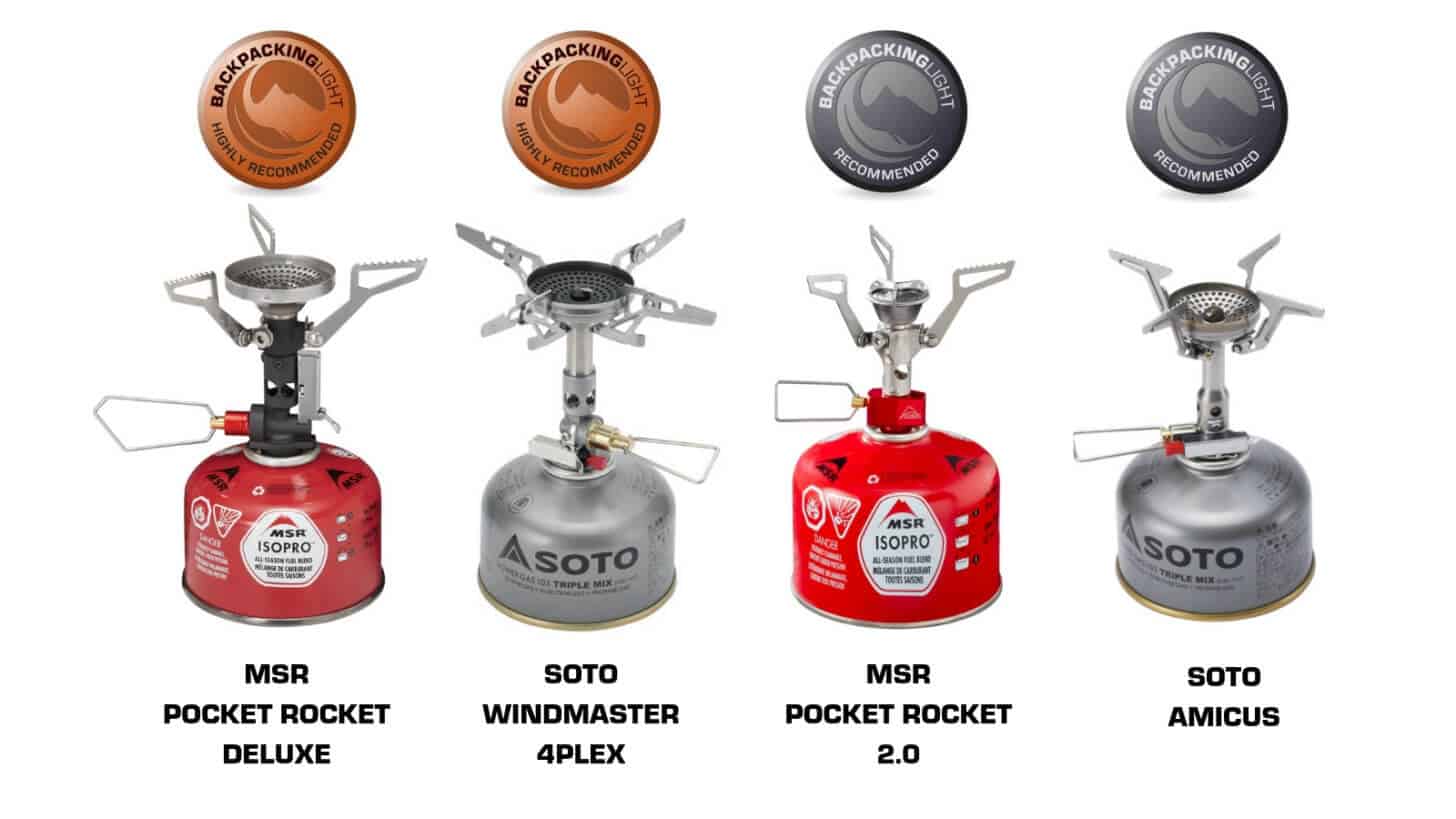
The MSR PocketRocket Deluxe exhibited the best overall performance across all categories, including the best StoveBench performance in control, wind, cold temperature, large water volume, and stress tests.

- Purchase the MSR PocketRocket Deluxe from REI today.
Gear Guide Scope
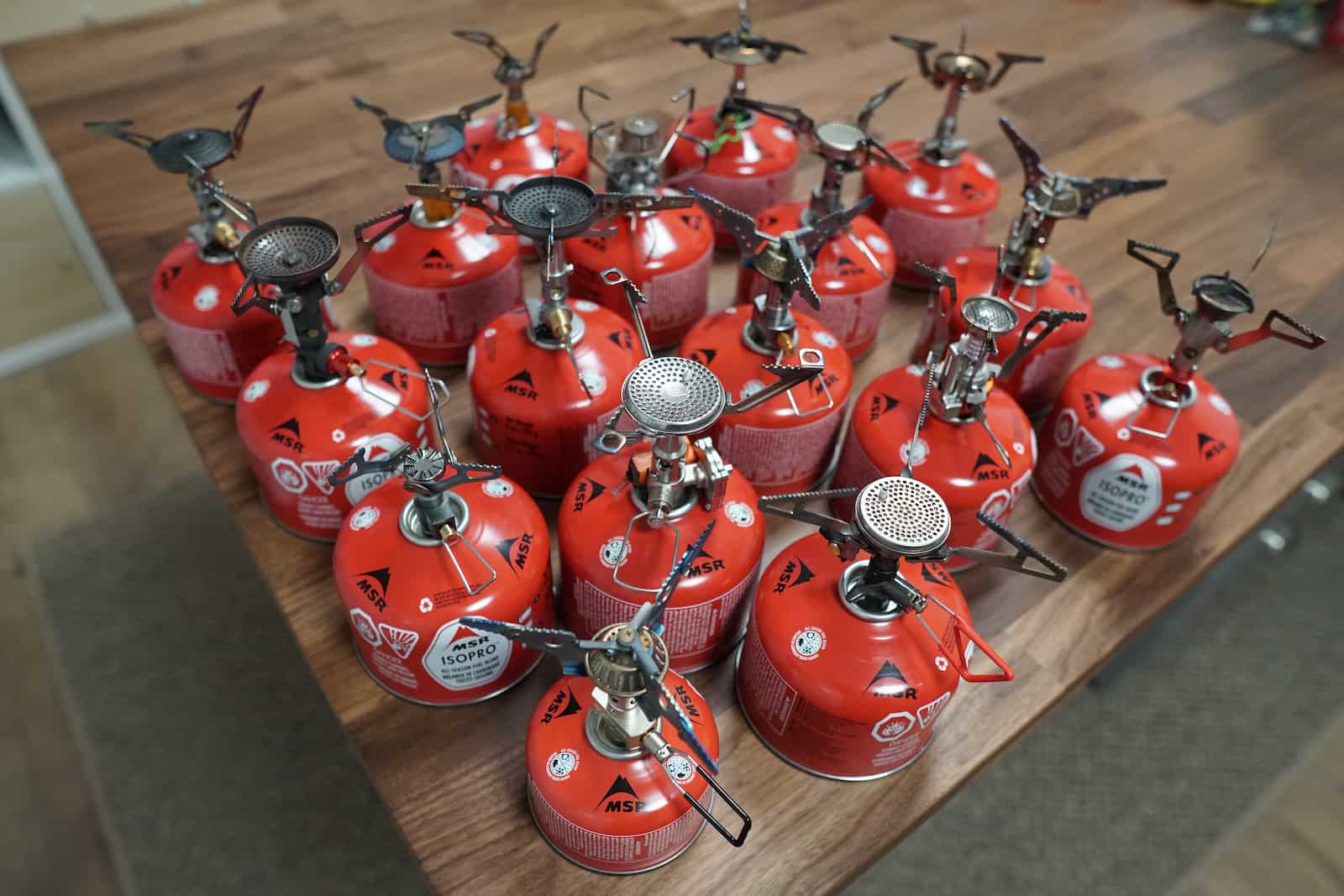
Herein are the results of a months-long effort to evaluate the detailed performance of the market’s most prominent upright canister stove products. The three of us spent several hundred hours of research, testing, analysis, and writing this 15,000-word report. It is our hope that it would provide a standard of reference that will be useful to backpackers as they consider their options in what has become a very crowded product market.
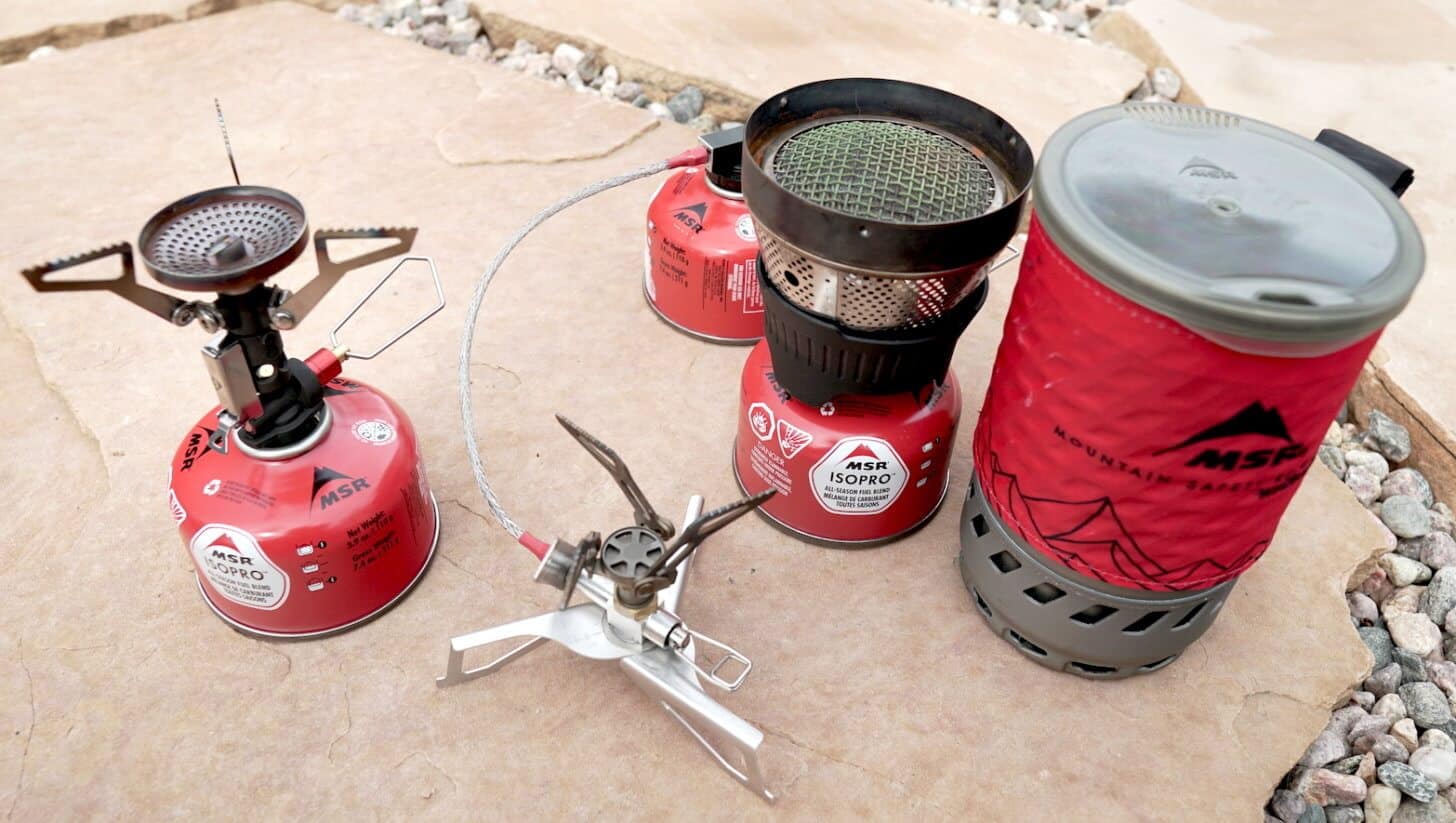
Upright canister stoves are a subset of a broader product category of canister stoves that also includes integrated canister stoves and remote canister stoves. Stoves from these latter two categories are not included in this gear guide – we’ll save those for another one!
Where do Canister Stoves Come From?
The vast majority of OEM (original equipment manufacturer) parts and assemblies for backpacking stoves originate from factories in Russia, China, and Korea. One can generally distinguish products in the upright canister stove market into two categories:
- Exclusive stove designs that are designed and marketed under relatively well-known brand names, consisting of unique assemblies of burners, wind blades, stacks, pot supports, valves, and regulators. These brands include MSR, Jetboil, Snow Peak, Soto, Primus, Kovea, Fire Maple, and Optimus. Although you may see some parts of these stoves found in other products, all of the stoves from these brands include either an exclusive combination of parts or custom parts not found in other products. OEM prices for these stoves to the brands are generally $10 to $30, with MSRPs ranging from about $25 to more than $90, with an average in the $40 to $70 range.
- Nonexclusive stove designs manufactured by an OEM supplier and sold as OEM units under a variety of different brand names. These represent the vast majority of stoves sold under a variety of odd brand names via the online mega-retailers Amazon and Alibaba. Examples of these brands include BRS, Etekcity, Joyard, Housweety, Redcamp, Etopsell, Monoprice, Hikevalley, TopOne, Icetek, Desert Walker, and Chenbo. OEM prices for these stoves to the brands are generally $1 to $6 per unit, with MSRPs being less than $15.
There is some confusion abounds in the backpacking stove market. For example, while Fire Maple manufactures its own stoves, it also licenses nearly identical designs for distribution under the Olicamp brand. The design of current-model MSR stoves can’t be found anywhere else, but Kovea is one of their OEM suppliers. And Kovea makes their own line of stoves, and they don’t look like MSR stoves. Further adding to the confusion is that OEM suppliers of finished stoves often purchase their parts from other factories, who are also OEM suppliers of finished stoves. Globalization at its chaotic best, perhaps!
Although not a hard-and-fast rule, we found that the exclusive stove designs in category #1 (which are generally more expensive) feature a higher level of manufacturing quality and durability, and offer marginally-to-significantly better performance than the nonexclusive stove designs found in category #2. Of the brands presented in this review, it’s clear to us that MSR and Soto are the market leaders in terms of design and engineering with an eye towards maximizing performance.
Discarding cheap OEM knockoffs (defined in category #2 above), we surveyed a total of 35 stoves marketed specifically to the backpacking community from MSR, Jetboil, Snow Peak, Soto, Mons Peak IX, Primus, Kovea, GSI, Optimus, and Fire Maple. We did include two more popular white-labeled brands, BRS and Etekcity. We eliminated any stove that weighed in excess of 8.0 oz (227 g) from this initial survey, as this represents the approximate weight at which significantly more function and performance can be realized by a different stove design (e.g., remote canister, integrated canister or liquid fuel stove).
The average weight of this initial group was 3.3 oz (94 g), with a range of less than 1.0 oz (28 g) to more than 6.0 oz (170 g).
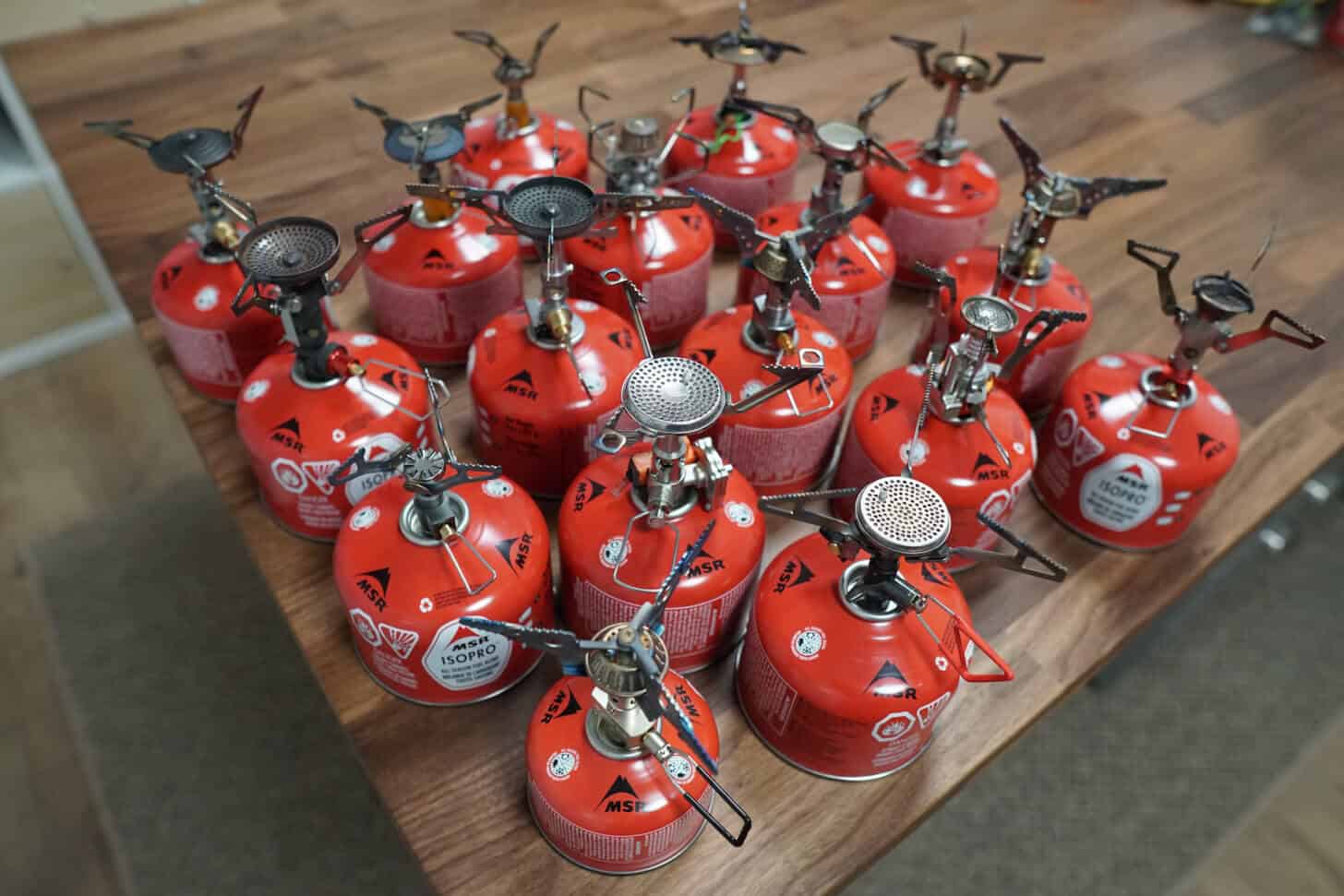
Of the initial group of 35 stoves, we selected 17 stoves (with the heaviest stove being 3.44 oz / 101 g) for a more detailed examination and inclusion in this gear guide. A few are heavier than average, most are lighter than average, and a few are in the truly “ultralight” category (less than 2.0 oz / 57 g).
Summary of Products Featured in this Review
The following chart details feature and specifications for the stoves featured in this review, and provides our Overall Rating. See the Performance Analysis section below for a detailed performance assessment.
| Stove | Overall Rating* | MSRP (USD) | Weight (oz) | Regulated | Piezo Ignition | Burner Diameter (mm) | # of Supports | Support Radius (mm) |
|---|---|---|---|---|---|---|---|---|
| MSR Pocket Rocket 2 | Recommended | $45 | 2.6 | no | no | 25 | 3 | 61 |
| MSR Pocket Rocket Deluxe | Highly Recommended | $70 | 2.9 | yes | yes | 37 | 3 | 61 |
| Soto Windmaster 4Flex | Highly Recommended | $65 | 3.08 | yes | yes | 39 | 4 | 72 |
| Soto Micro Regulator | Average | $70 | 2.5 | yes | yes | 38 | 3 | 55 |
| GSI Pinnacle | Above Average | $50 | 2.43 | no | no | 28 | 3 | 70 |
| Optimus Crux Lite | Average | $40 | 2.61 | no | no | 46 | 3 | 55 |
| Fire Maple FMS-300T | Above Average | $30 | 1.59 | no | no | 17 | 3 | 45 |
| eTekCity | Above Average | $20 | 3.34 | no | yes | 20 | 4 | 45 |
| Snow Peak GigaPower 2.0 | Below Average | $50 | 3.05 | no | yes | 25 | 4 | 53 |
| Snow Peak LiteMax | Below Average | $60 | 1.99 | no | no | 28 | 3 | 62 |
| BRS 3000t | Below Average | $17 | 0.89 | no | no | 17 | 3 | 41 |
| Kovea Supalite Titanium | Below Average | $50 | 2.12 | no | n/a | 29 | 3 | 62 |
| Kovea Titanium | Below Average | $60 | 3.25 | no | yes | 29 | 3 | 62 |
| Jetboil MightyMo | Above Average | $50 | 3.44 | yes | yes | 37 | 3 | 60 |
| Fire Maple FMS-116t | Above Average | $40 | 3.55 | no | no | 45 | 3 | 55 |
| Primus Micron Trail | Below Average | $45 | 3.25 | no | yes | 32 | 3 | 68 |
| Soto Amicus | Recommended | $45 | 2.77 | no | yes | 34 | 4 | 54 |
Summary Reviews
Presented in order from highest to lowest overall grade.
Member Exclusive
A Premium or Unlimited Membership* is required to view the rest of this article.
* A Basic Membership is required to view Member Q&A events


Discussion
Become a member to post in the forums.
Interesting, thanks, this makes sense
“However, if (IF) this is a genuine BRS-3000T it suggests …”
I question if there is a real BRS company that has quality control and so forth, so the word “genuine” doesn’t really apply
Is this just a bunch of individuals with parts with unknown pedigree? The Chinese manufacturing system is different than ours.
Another failure that people have mentioned is bits of metal from the manufacturing process that plug up the fuel path.
I got one of these and have used it no problem a few times.
Roger said:
We now have more info.
This from Ryan J.
Some photos to explain it all follow.

This is an undamaged BRS-3000T stove (mine) heating a Ti pot. Please note carefully the pot support arm which is connected to a ring under the burner head by a rivet. That little ring must stay ‘flat’ (albeit with right angle bends) for the pot supports to be at the correct angle.
This is the only photo I have of one of the damaged stoves. It was provided to me by Ryan J, to whom thanks. Please note the way the pot support arm sags down at an angle highlighted by the blue line. The pot support arm itself is NOT bent or damaged: it is the support ring (with rivet) which is bent or twisted.
How did this happen? I have no idea, although to me it looks as though the riveted support ring was bent down by force. This might indicate serious ‘trauma’, or it might indicate a really soft bit of metal as Ryan suggests. In the latter case, the ‘force’ would be that of gravity on the pot. Plasticine metal. But there is more.
What is curious is that some units seem to have kinked pot support arms, as shown here. My BRS-3000T stoves (I have several) do not. Is this damage or a fault? I don’t think it is either: I think the kink was part of the manufacturing. However, if (IF) this is a genuine BRS-3000T it suggests that there has been some variation in the production process, which leads on to this photo.
I found this photo on the web (author unknown). The pot support arm has that possibly genuine kink, but the bent part of the support ring shows a bad crack as highlighted. This sort of crack looks to me as though the metal was bent up after it had been tempered. I have made similar cracks in test pieces of Ti 6Al4V myself. Once again, some variation in production, and definitely some deficiencies in Quality Control.
What this leads to is that the QC on this support ring may have been lacking, at least for a batch or two. Not enough tempering, too much tempering, tempering at the wrong time, … whatever. If you have a ‘good’ unit, then that’s fine: keep cooking. After all, Ryan did find 3 good ones in his batch of 7. If you have been unlucky enough to get one from a bad batch – go back to your supplier with photos and demand a refund.
If you are thinking of buying one – do so, but test it carefully as soon as you get it, and only buy from someone you could go back to in case of a problem. Remember: many of us are very happy with our units.
HTH Roger Caffin.
Cheers
<ul id=”bbp-reply-revision-log-3618571″ class=”bbp-reply-revision-log”>
<li id=”bbp-reply-revision-log-3618571-item-3618572″ class=”bbp-reply-revision-log-item”>This reply was modified 15 hours, 47 minutes ago by
Roger, there is no visual evidence in the photo saying Ryan ever tested it with heat applied. No discoloration caused by heat. We are led to believe the support arm was bent prior to heating. A possibility is when the stove was screwed onto the canister or when the supports were raised to the open position. That would be 2 “operator errors”
Very possible that it was a faulty rivet(weak metal) or an assembly error created by child labor ;) not enough pressure to the rivet to make a complete closure/assembly.
Can’t agree that there is no evidence of heat, of the stove having been used.

Look at the corner of the pot support pointed to by the green arrow. That is typical heat discoloration. Also, Ryan did say until the pot fell off the stove during operation. in the above quote. You would not expect a lot of heat marking if the stove failed on first use.
Cheers
BRS 3000T failed. Pictures have been posted. Older stoves don’t have the problem. Some newer stoves may have exhibited the problem. Some recent ones seem ok. Are we done yet?
Look at the scrape marks on the canister. Stove was screwed down onto canister while pot supports were in the down position causing support arms to bend outward. “User Error” of the ultimate kind. Errors are so obvious.
Ryan had 4 that melted, so he was in error….should have said “rivets failed” ;)
<div id=”post-3454249″ class=”bbp-reply-header”>
</div>
<div class=”odd bbp-parent-forum-1215628 bbp-parent-topic-3454249 bbp-reply-position-1 user-id-37976 topic-author post-3454249 topic type-topic status-publish entry”>
<div class=”bbp-reply-content”>
Sorry Jon, you are in error, the older ones are the ones that failed according to HikinJim, posted in the year 2017. See his above statements in the thread “another one bites the dust”
</div>
</div>
I was fiddling with my BRS-3000T. There’s no position of the arms that would produce scrape marks on the canister like that. Maybe that was from some other stove. If I push the valve handle down I can get it to reach the canister at about that location, but it doesn’t seem like that would cause any failure.
My stove says “Fuhoz” on it. Maybe that’s the manufacturer name.
Sorry Jon, this subject will never die. Mystery must be analyzed to death and then some.
Hey Jerry – can you post a photo of yours?
If it has Fuhoz written on it, I don’t think it is a genuine BRS-3000T.
I found this in the web. What is it?
Brass column, not Ti.
Different pot supports, and weaker
Different (bigger) rivet
Narrower bent arms
“Fire Maple BRS” conflates two different brand names (one Korean I think)
Move over America, now we have the Wild Wild East!
Cheers
Who are BRS?
This is their web site: http://www.brs.net.cn/company. But the ‘English’ button does not work yet.
They may be part of http://www.futailong.com – that URL brings up the same web pages. Or the other way around?
Anyways, they are not a backyard job.
Cheers
Roger, translated it for you:
<span>Since 1999, the company has invested in outdoor leisure, investing tens of millions of yuan and “Wal-Mart” and “Metro” to achieve an annual output value of more than 10 million US dollars. All products are exported. In 2005, the company once again invested 10 million yuan to invest in the field of outdoor camping supplies, opened up the domestic outdoor products market, and registered the English “BRS”; the Chinese “Brothers” brand, focusing on the design, development, production and sales of outdoor equipment, The products cover 4 core products: outdoor oil stoves, outdoor gas stoves, pots and self-driving equipment, as well as other types of extension products. </span>
<span>BRS is the abbreviation of English Brothers (brothers), representing the brand concept of the brothers.</span>
<span>With strong financial and technical advantages, BRS quickly gained recognition from consumers and quickly stabilized the domestic and international outdoor products market. The company has accumulated more than 1,000 domestic distributors and a huge sales network in more than 50 countries.</span>
<span>In order to adapt to the rapid development of the household market, “Jie Deng Outdoor Products Co., Ltd.” was established in 2012. With independent intellectual property rights, the company has more than 60 patents in 2012, and has the industry’s leading technical reserves, production capacity and testing equipment. A number of key technologies have been in the international leading position, and at the same time, it is one of the domestic outdoor camping equipment production bases. There are already five national military designated procurement company products. BRS always leads the technology trend of outdoor camping equipment, and constantly innovates to make products better serve the public.
“Mobile landscape, unchanging home” is BRS’s philosophy of pursuing outdoor products, and hopes that this positive, healthy and civilized lifestyle will be passed on to everyone’s hearts through our products and services. A healthy and positive life.
</div>
Thanks Dan.
Not a backyard operator then.
Cheers
what I bought according to Amazon:
https://www.amazon.com/Titanium-Backpacking-Miniature-Ultra-light-Camping/dp/B01N5WRJ8A/ref=sr_1_3?dchild=1&keywords=Camp+Stove+Titanium+Stove+Backpacking+Stove+Hiking+Stove+Miniature+Stove+Ultra-Light+Stove+Camping+Stove+Pocket+Stove&qid=1573776480&s=sporting-goods&sr=1-3
But mine is actually a little different:
I see there are a lot of BRS labeled stoves on Amazon
“With independent intellectual property rights, the company has more than 60 patents”
I think intellectual property rights are a little different in China. No reason for anyone to respect them
The tiny stove market is nutz. i wonder how many sub 3oz stoves are sold yearly, worldwide.
I wonder what will be next. Different fuel? Nothing? Stoves finally made of Unobtanium?
hydrogen fuel rather than butane?
Hi Jerry
I think your stove, branded Fohoz (not Fuhoz), probably IS a BRS-3000T unit, but rebranded by BRS for whoever Fohoz is. The Chinese do a lot of this rebranding. After all, it is just a change of silk-screen. They probably just have an MOQ for it. You pay for the silkscreen and buy 1,000 (say) units.
Test it. If it goes well and does not get warped, then fine.
I will stick my neck way out and suggest that the ’60 patents’ comment is probably aimed mainly at the USA market.
Cheers
Roger, I seriously doubt that qc would not have seen such an error.
Attaching the arm would not have been possible with such a fracture. The action of setting the rivet would have broken it completely.
More than likely, the owner tried to bend it back to level off the pot support arm and oops, didn’t work to well. operator error.
Ryan has 3 more BRS’s that failed, see if you can get him to take photos of them please.
I seriously doubt that qc would not have seen such an error.
You would not see it if you were making thousands of them and inspecting them from above. Could have been a very cursory scan over a few dozen at a time at $2/hr.
Attaching the arm would not have been possible with such a fracture.
When I have managed to make similar fractures in Ti alloy, the bend was still strong – which amazed me. If the riveting was automated then I think it would have been quite possible for the unit to pass through the system intact.
the owner tried to bend it back to level off the pot support arm
The damage in Ryan’s photo was a twist, not a bend. From inspection of the photo, I think the bend was intact, unchanged. So it is possible that the stove was still able to support a pot. Funny stuff, Ti alloys.
So what caused it the twist? Don’t know. Very puzzling. Could it have been a maladjusted assembly machine? They always have many adjustments on them which have to be tuned and then locked.
It’s always possible: Coleman once had a batch of ‘faulty’ Powermax canisters due to a maladjustment in the crimping machine used for attaching the Lindal Valves. Caused no end of strange customer complaints. They fixed it after I alerted them to the source of the problem.
Cheers
Roger, the stoves are packaged by hand, I know, I carefully unpacked 6 of them looking for defects.
What are the odds that 4 rejects of the same type ended up in the package of 7 that Ryan purchased. Highly unlikely. Ryan needs to show us the other 3 rejects ;)
Jerry, I noticed a defect in your stove pictured above. How did that outward bend occur on the support ring? I enlarged your photo to get a screen shot.
Dan, that support ring on the one of mine that failed a year ago also had such an ‘outward bend’, although much less dramatic. It was pretty easy to bend it back into proper position when I got home.
I finally got around to re-testing that stove’s performance earlier this week, to see if I could replicate the previous failure. I purposely chose to run it at a higher flame setting. I usually run it at 1/4 turn from the off position, but for these tests I opened the valve about 1/3 turn . I did five 2-cup boils using 45* F water. Then, to test a heavier pot weight, I did 3 boils of ~3 cups of that same water in an MSR Titan Kettle. The stove functioned perfectly, with no sign of impending failure as what happened before.
I’m guessing that excessive heat might have caused the support ring issue. I am thinking that my friend, (who doesn’t quite get it about using a lower flame setting to conserve fuel), would continually fire up the stove at a rather high flame setting. In addition to wasting fuel, this likely created a good amount of heat which could have caused failure of the support ring. I’m just guessing here…
this likely created a good amount of heat which could have caused failure of the support ring.
Trouble with that idea is that the top of the pot support, which does get red hot (see my photo near the top of this page), is not distorted. The rivet area does not get that hot. Strange.
Cheers
Roger, you’ve been around here for ages and then some, In your opinion, why doesn’t Ryan J participate in this discusion being he is the one that has had the experience of the 4 melting stoves?
I am surprised the Crux lite was here but not the Crux. I’ve been a Pocket Rocket user for a very long time. I thought the Crux might be a good competitive choice. It was clear the Crux lite wasn’t. Big miss in a comprehensive review.
Become a member to post in the forums.