


By Andrew Marshall, Ryan Jordan, and Chase Jordan
Introduction
This gear guide features lightweight upright canister stoves for backpacking (i.e., a canister stove that weighs less than 4 oz (113 g) that sits on top of a canister of fuel).
We evaluated the following criteria:
- Power, efficiency, and fuel economy in control, large water volume, cold temperature, and wind tests
- Piezo ignitor durability
- Pot stability
- Packability
- Noise
- Simmering Ability
- Durability
- Weight
- Cost
Among 17 models of stoves that were subjected to rigorous performance testing, the following stoves were the highest rated stoves in our review:
- MSR PocketRocket Deluxe – Highly Recommended
- Soto Windmaster 4Flex – Highly Recommended
- MSR PocketRocket 2 – Recommended
- Soto Amicus – Recommended
Learn more about our review ratings here.
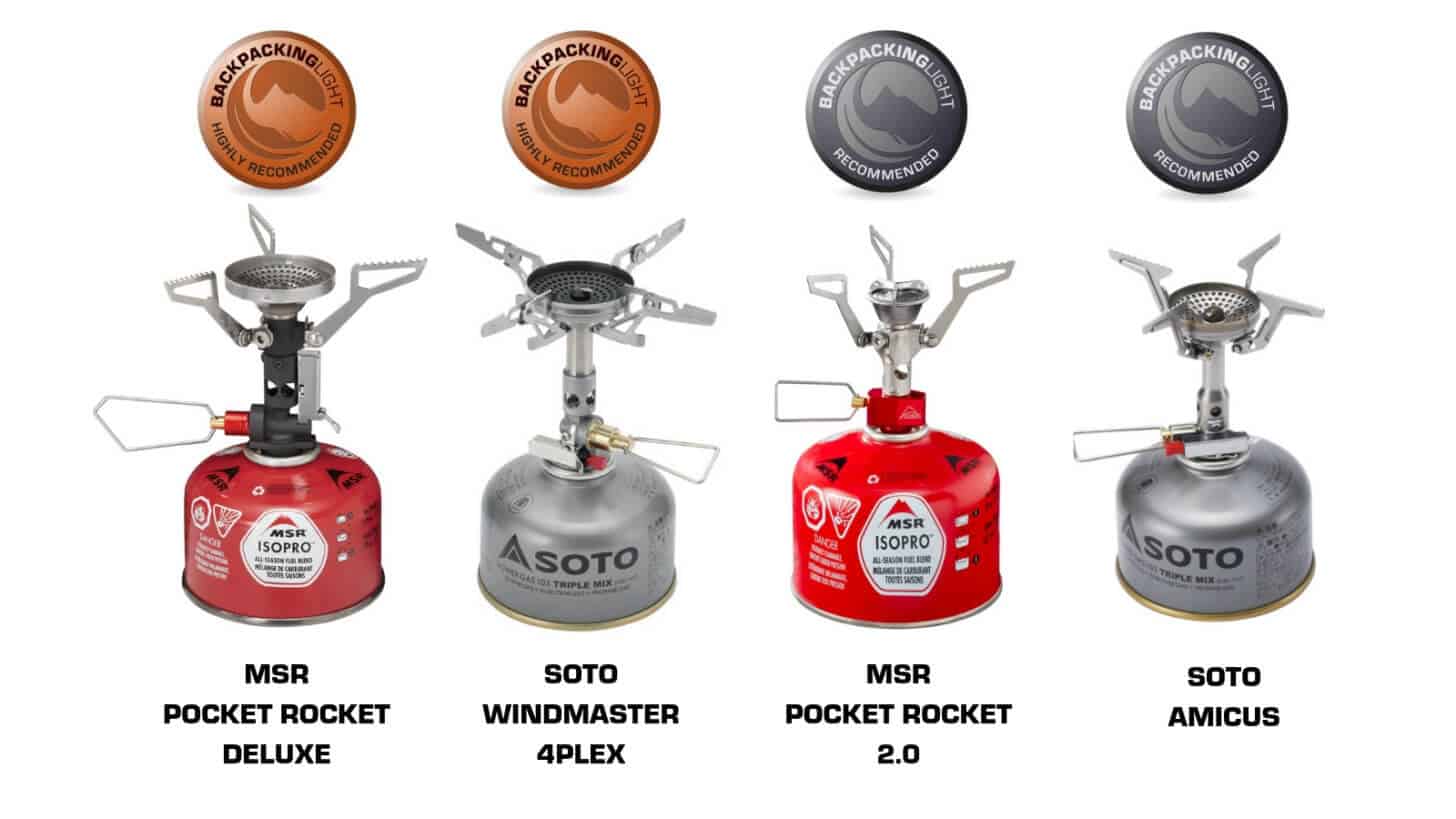
The MSR PocketRocket Deluxe exhibited the best overall performance across all categories, including the best StoveBench performance in control, wind, cold temperature, large water volume, and stress tests.

- Purchase the MSR PocketRocket Deluxe from REI today.
Gear Guide Scope
Herein are the results of a months-long effort to evaluate the detailed performance of the market’s most prominent upright canister stove products. The three of us spent several hundred hours of research, testing, analysis, and writing this 15,000-word report. It is our hope that it would provide a standard of reference that will be useful to backpackers as they consider their options in what has become a very crowded product market.
Upright canister stoves are a subset of a broader product category of canister stoves that also includes integrated canister stoves and remote canister stoves. Stoves from these latter two categories are not included in this gear guide – we’ll save those for another one!
Where do Canister Stoves Come From?
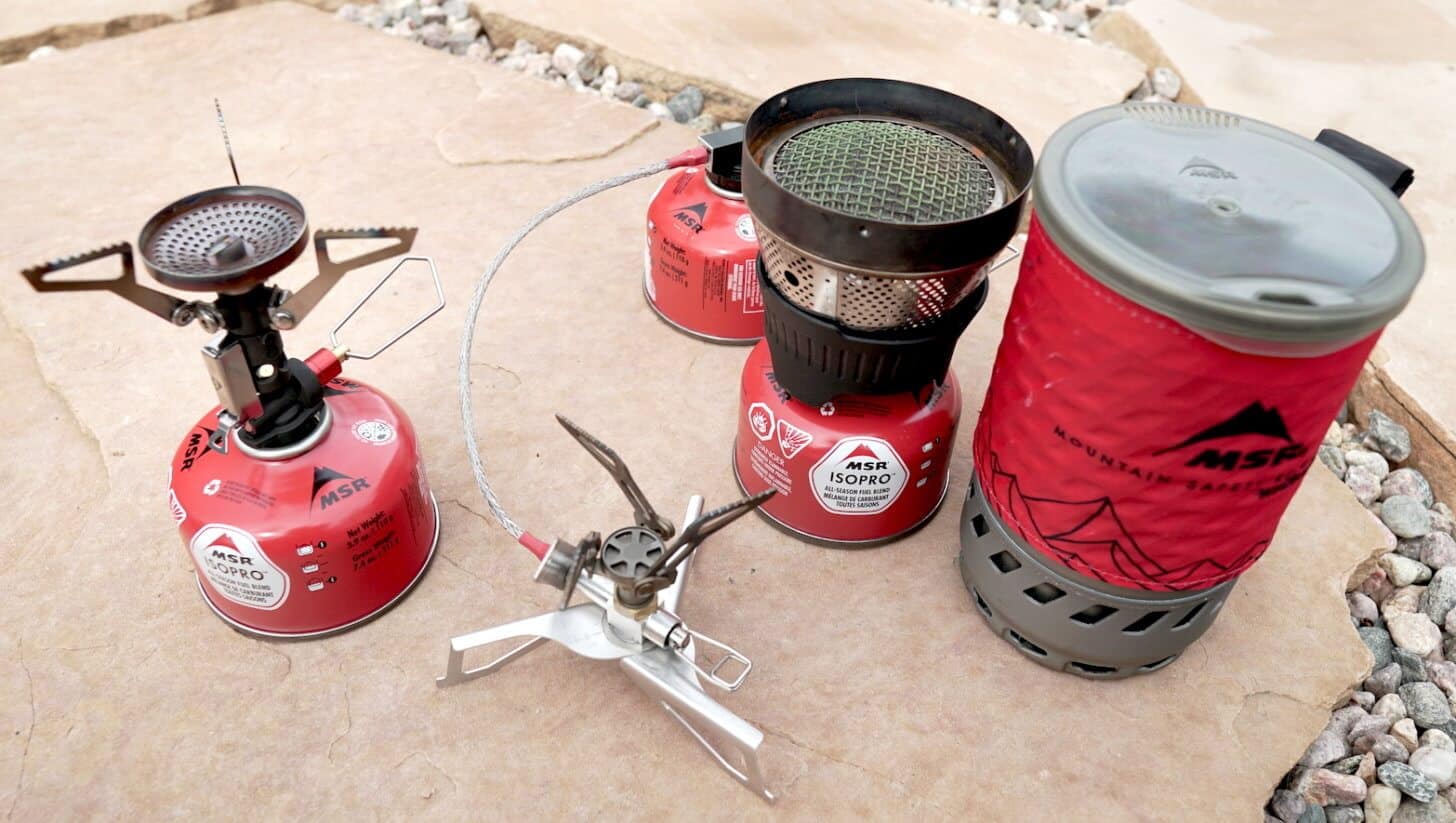
The vast majority of OEM (original equipment manufacturer) parts and assemblies for backpacking stoves originate from factories in Russia, China, and Korea. One can generally distinguish products in the upright canister stove market into two categories:
- Exclusive stove designs that are designed and marketed under relatively well-known brand names, consisting of unique assemblies of burners, wind blades, stacks, pot supports, valves, and regulators. These brands include MSR, Jetboil, Snow Peak, Soto, Primus, Kovea, Fire Maple, and Optimus. Although you may see some parts of these stoves found in other products, all of the stoves from these brands include either an exclusive combination of parts or custom parts not found in other products. OEM prices for these stoves to the brands are generally $10 to $30, with MSRPs ranging from about $25 to more than $90, with an average in the $40 to $70 range.
- Nonexclusive stove designs manufactured by an OEM supplier and sold as OEM units under a variety of different brand names. These represent the vast majority of stoves sold under a variety of odd brand names via the online mega-retailers Amazon and Alibaba. Examples of these brands include BRS, Etekcity, Joyard, Housweety, Redcamp, Etopsell, Monoprice, Hikevalley, TopOne, Icetek, Desert Walker, and Chenbo. OEM prices for these stoves to the brands are generally $1 to $6 per unit, with MSRPs being less than $15.
There is some confusion abounds in the backpacking stove market. For example, while Fire Maple manufactures its own stoves, it also licenses nearly identical designs for distribution under the Olicamp brand. The design of current-model MSR stoves can’t be found anywhere else, but Kovea is one of their OEM suppliers. And Kovea makes their own line of stoves, and they don’t look like MSR stoves. Further adding to the confusion is that OEM suppliers of finished stoves often purchase their parts from other factories, who are also OEM suppliers of finished stoves. Globalization at its chaotic best, perhaps!
Although not a hard-and-fast rule, we found that the exclusive stove designs in category #1 (which are generally more expensive) feature a higher level of manufacturing quality and durability, and offer marginally-to-significantly better performance than the nonexclusive stove designs found in category #2. Of the brands presented in this review, it’s clear to us that MSR and Soto are the market leaders in terms of design and engineering with an eye towards maximizing performance.
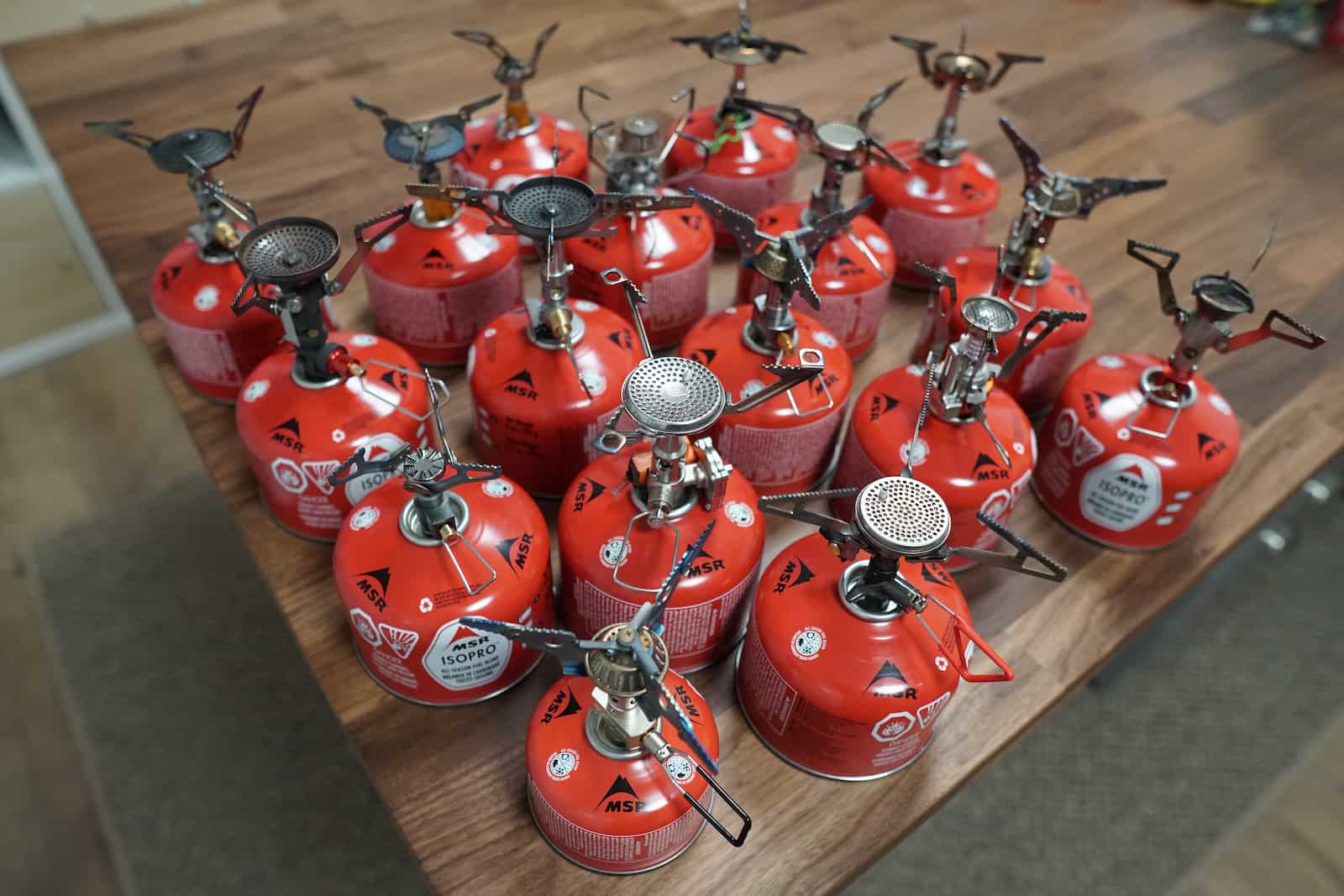
Discarding cheap OEM knockoffs (defined in category #2 above), we surveyed a total of 35 stoves marketed specifically to the backpacking community from MSR, Jetboil, Snow Peak, Soto, Mons Peak IX, Primus, Kovea, GSI, Optimus, and Fire Maple. We did include two more popular white-labeled brands, BRS and Etekcity. We eliminated any stove that weighed in excess of 8.0 oz (227 g) from this initial survey, as this represents the approximate weight at which significantly more function and performance can be realized by a different stove design (e.g., remote canister, integrated canister or liquid fuel stove).
The average weight of this initial group was 3.3 oz (94 g), with a range of less than 1.0 oz (28 g) to more than 6.0 oz (170 g).
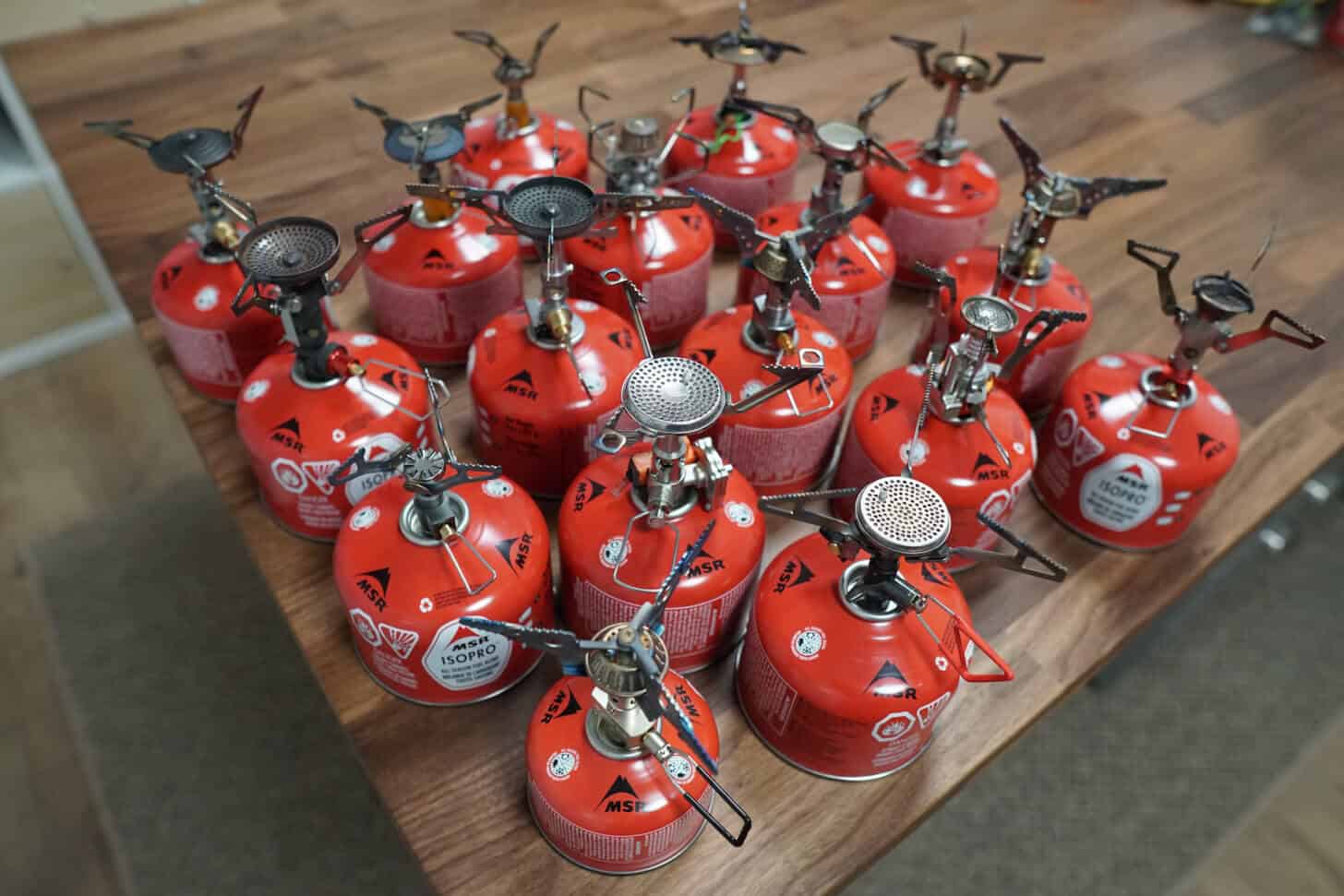
Of the initial group of 35 stoves, we selected 17 stoves (with the heaviest stove being 3.44 oz / 101 g) for a more detailed examination and inclusion in this gear guide. A few are heavier than average, most are lighter than average, and a few are in the truly “ultralight” category (less than 2.0 oz / 57 g).
Summary of Products Featured in this Review
The following chart details feature and specifications for the stoves featured in this review, and provides our Overall Rating. See the Performance Analysis section below for a detailed performance assessment.
| Stove | Overall Rating* | MSRP (USD) | Weight (oz) | Regulated | Piezo Ignition | Burner Diameter (mm) | # of Supports | Support Radius (mm) |
|---|---|---|---|---|---|---|---|---|
| MSR Pocket Rocket 2 | Recommended | $45 | 2.6 | no | no | 25 | 3 | 61 |
| MSR Pocket Rocket Deluxe | Highly Recommended | $70 | 2.9 | yes | yes | 37 | 3 | 61 |
| Soto Windmaster 4Flex | Highly Recommended | $65 | 3.08 | yes | yes | 39 | 4 | 72 |
| Soto Micro Regulator | Average | $70 | 2.5 | yes | yes | 38 | 3 | 55 |
| GSI Pinnacle | Above Average | $50 | 2.43 | no | no | 28 | 3 | 70 |
| Optimus Crux Lite | Average | $40 | 2.61 | no | no | 46 | 3 | 55 |
| Fire Maple FMS-300T | Above Average | $30 | 1.59 | no | no | 17 | 3 | 45 |
| eTekCity | Above Average | $20 | 3.34 | no | yes | 20 | 4 | 45 |
| Snow Peak GigaPower 2.0 | Below Average | $50 | 3.05 | no | yes | 25 | 4 | 53 |
| Snow Peak LiteMax | Below Average | $60 | 1.99 | no | no | 28 | 3 | 62 |
| BRS 3000t | Below Average | $17 | 0.89 | no | no | 17 | 3 | 41 |
| Kovea Supalite Titanium | Below Average | $50 | 2.12 | no | n/a | 29 | 3 | 62 |
| Kovea Titanium | Below Average | $60 | 3.25 | no | yes | 29 | 3 | 62 |
| Jetboil MightyMo | Above Average | $50 | 3.44 | yes | yes | 37 | 3 | 60 |
| Fire Maple FMS-116t | Above Average | $40 | 3.55 | no | no | 45 | 3 | 55 |
| Primus Micron Trail | Below Average | $45 | 3.25 | no | yes | 32 | 3 | 68 |
| Soto Amicus | Recommended | $45 | 2.77 | no | yes | 34 | 4 | 54 |
Summary Reviews
Presented in order from highest to lowest overall grade.
Member Exclusive
A Premium or Unlimited Membership* is required to view the rest of this article.
* A Basic Membership is required to view Member Q&A events


Discussion
Become a member to post in the forums.
The originals had titanium pot support arms, and they were reliable. I have used one for years. It sounds as though BRS have changed the metal used to something cheaper. Sad.
Cheers
Even if they used cheaper metal, I don’t envision a canister stove melting a pot support.
Ryan reported 4 out of seven “melting”
Even if they used cheaper metal, I don’t envision a canister stove melting a pot support.
Here I have to disagree with you. I am currently testing some new stove designs, and I am finding that it is quite possible to melt some metals with the flames from a canister stove.
I will quote from sciencing.com:
Ignore the 1995 C figures: that is for a propane/oxygen mix, not for a propane/air mix. We must use the second set of figures. We all know what has happened to the heat exchanger fins on some Jetboil pots, don’t we? Yeah, they melted.
Now Ti 6Al4V alloy has a melting point of about 1900 C, which is a lot hotter than 1225 C. But pure titanium (CP) is not as good as that: it is only about 1668 C. The alloying improves things for pots and aerospace.
However, while Ti is wonderful, that is not the full story. When Ti gets red hot (I think that is about 800 C) it enters a ‘super-plastic’ phase, where it can bend, deform and flow quite well. That is how you shape high-strength Ti alloys: at red heat. I have done this myself a number of times.
In fact, the ‘maximum service temperature’ for Ti 6Al4V is as low as about 650 C. This is in the region of what is conventionally called ‘red heat’, which is 500 – 790 C. That is easily reached with a propane torch.
There is a secondary factor here. Ti 6Al4V alloy is expensive, but ‘CP: commercial purity’ Ti, is not as expensive. It is also a LOT easier to form or shape. Bend sheet 6Al4V cold and it will likely crack; bend CP Ti cold and it will bend nicely. Been there, done a lot of that!
You may be able now to see what I am suggesting. Some silly manager at BRS decided that they could use a cheaper version of titanium, and one that is easier to work, and get away with it. A brilliant bit of management innovation, but with very sad results.
Cheers
PS: and aluminium pot supports are especially dicey!
Yeah, it is not so much of an actual melt (it doesn’t just turn into a blob of metal,) it deforms badly while pretty much retaining it’s overall shape… Yes, aluminum is not real good at pot stands!
All good information…..thank you!
I quote Ryan:
Very interesting article and well-documented data.
I have used an Optimus/Brunton CRUX folding canister-top stove for about a decade and have found it to be a very reliable stove which has a nicely wide burner to avoid hot spots.
For an ounce or so weight savings I’m not rushing out to buy another stove and I do not need or want a built in sparker.
I’m toying with some sheet roofing aluminum for a better windscreen than my current pie pan version. Sooner or later I’ll come up with one that works well and stores small.
Ryan reported 4 out of seven “melting”
But the metal in today’s production runs just isn’t holding up. It’s not unique to BRS, the same parts are failing on some other stoves that we purchased from China as well. Same parts supplier, perhaps.
For one of the failures, I had a pot of nearly boiled water fall over when a pot support melted. That’s a safety problem, <span style=”text-decoration: underline;”>especially when this stove is being used by kids (this is a popular stove among youth groups like scouts because of its price).</span>
Fix this issue, and the stove gets a different rating.
Ryan wrote ‘melted’, but I suspect what he meant was ‘deformed so the support collapsed’. You just can’t melt titanium with a propane flame in air.
Unless whoever actually does the stamping and forming (for several ‘manufacturers’) has substituted a totally different metal for the titanium. But I think that is unlikely.
Cheers
Roger, I quote Ryan again and point out the the water he was attempting to boil had not reached the boil yet and the pot support failed and the pot of water fell over. Length of time being heated could not have been more than 4-5 min. This is some really serious stuff. Again….4 out of 7 melted. Red flags are going up ;)
Hi Dan
Please do not misunderstand me! I agree totally that this is a very bad thing, a very dangerous thing. The current crop of BRS-3000T stoves are clearly not fit for use.
All I was trying to do was to figure out just what had happened. And to point out that a titanium pot support could not have actually melted in a propane/air flame. Softened and sagged, in a very dangerous way, certainly.
Sad, really.
Cheers
Roger, even softening and sagging I don’t envision that happening.
It would behove one of the three that did the testing, Andrew Marshall, Ryan Jordan, or Chase Jordan, to report their findings to The Consumer Product Safety Commission (CPSC). It’s in the best interest of the entire backpacking comunities around the world. 4 0ut of 7 melting is absolutely terrible. They can contact the (CPSC) at: https://www.saferproducts.gov/Default.aspx
Here is the form to fill out:
https://www.saferproducts.gov/CPSRMSPublic/Incidents/ReportIncident.aspx
The Consumer Product Safety Commission (CPSC) protects the public from unreasonable risks of serious injury or death from thousands of types of consumer products under its jurisdiction, including products that pose a fire, electrical, chemical, or mechanical hazard or can injure children.
The current crop of BRS-3000T need to be removed from sales all over the world. They are a danger of the largest magnatude. As Roger has clearly stated: “The current crop of BRS-3000T stoves are clearly not fit for use.”
Hopfully, Andrew Marshall, Ryan Jordan, or Chase Jordan, will report their findings to The Consumer Product Safety Commission.
Yeah, well, keep it on the QT. They don’t really want to let it be known very loudly… We all do not so safe things, but, I agree about the BRS-3000.
The BRS-3000 is the lightest by a mile, and functions just fine if used as I assume it was originally designed: To boil 2 cups of water in a reasonable amount of time.
I run mine with a 550 cup at 1/3 fuel (it’s more efficient this way anyways) without issue.
What we really need is a good photo of a failed BRS-3000T and the pot supports. Just give me one photo and I should be able to tell what happened.
Cheers
Roger, can you get in touch with Ryan, Chase or Andrew and ask them to take some photos of the 4 that failed out of the 7 they tested? Those are the ones we really want to see.
They indicated that they purchased the 7 just so they could test for failures.
Ryan
Can we get a photo of the failed BRS-3000T and the pot supports please? There has been a lot of discussion about this one stove in your stove review, partly because a propane/air flame can NOT melt titanium – but it can soften it enough for it to bend.
Cheers, Roger
Roger,
I’d also like clarification on why the Amicus’ weight is listed as a disadvantage, while the PR Deluxe (which weighs more) has no such disadvantage listed. Seems very misleading. It makes the entire article seem like a PR Deluxe advertisement.
My own personal opinion is that the whole Pocket Rocket series have a bad design. The original has thin bendy pot supports which failed and a cutting torch flame, and the follow-ons are only very slowly improving. There are many much better and sometimes cheaper stoves available from elsewhere.
But to your question – you would have to ask the authors.
Cheers
Roger, are the authors ok? They are not responding to questions. Can you email them and check in on them please. Maybe they had a mishap in the back country.
I have already emailed Ryan, but it can take some time…
Cheers
Thank you Roger. Hope they are ok.
Here is some important information given by “Adventures In Stoving” concerning the safety hazards of the BRS3000T, I quote Hikin’ Jim:
I put approximately 750 ml (three cups) of water into the pot, fired it up, and waited. And waited. And waited. And waited. After about 10 minutes the water came to a low boil. The stove was not able to achieve a full roiling boil. I had heard that a BRS-3000T would struggle in wind, but I had no idea it would be this bad. All open burner upright canister stoves are impacted by wind, but I have <i>never</i> seen a stove this wind sensitive before. Even at highest output it could not bring 750 ml of water to a roiling boil, and this was not a particularly windy day. I would describe the winds as moderate. I had to put a weight on my ramen noodle wrapper to keep it from flying away, but it wasn’t like cups were being pushed over by the wind, and the trees around me were not blowing way over or anything like that. These were pretty ordinary, common outdoor conditions, conditions that I probably wouldn’t even take particular note of normally.
Well, I was hungry, so I put my noodles in, and, after a bit… what the heck? Did I put the pot on wrong or something? My pot was clearly listing to one side like a sinking ship!
 My Evernew 1300 ml pot – canted off to one side atop a BRS-3000T</td>
Quickly, I grabbed my pot before my lunch took a tumble! Examining the stove, I realized that the pot support had bent. It may be a little hard to see here, but the pot support on the right in the below photo is bent outward and down with a slight twist.
 <
<
<
Note the bend and partial twist in the pot support on the right.
All I had in the pot was about 750 ml of water and some ramen noodles. I mean c’mon, that is a very normal load for a stove. If I had put a 3 liter pot on a little stove like this maybe I’d understand, but 750 ml? That’s trivial. A stove should be able to handle 750 freaking little milliliters. 750 ml is only 0.75 kg (1.7 lbs). <b>Do <i>not</i> get distracted by the pot size.</b> This is not a pot size issue. Read the Analysis section below. The real issue in this case is the wind and the design of the stove.
Yes, I tested the stove on <i>top</i> of the picnic table. Yes, it would have been better to set it on the ground behind a rock or something, but c’mon! I ought to at least be able to boil water after 10 minutes on high. This stove is a really poor performer in wind, and there certainly shouldn’t have been any deformation in the pot supports after 10 to 12 minutes.
 The pot supports of a BRS-3000T are exposed to a great deal of heat.

<
Remember that photo I posted earlier? The pot supports absorb a <i>lot</i> of heat from the flame. After 10 minutes on high, they had absorbed enough heat that the pot supports deformed even though they weren’t under a particularly heavy load.
<b>Analysis</b>
I noticed during use that the wind was blowing the flame toward the pot support that eventually failed. Said pot support was glowing brightly while the pot support opposite was barely affected. So much heat was channeled into the one pot support that even under a relatively light load of less than a kilogram, the pot support experienced “creep deformation” (or “creep failure”), the tendency of a metal to slowly deform under stress – a tendency that increases when both stress and heat are present.
The way that the flame and supports are configured, the pot supports are blasted with heat. Magnify that effect with wind directing the majority of the heat to a single pot support, and you get creep deformation. Yes, I realize that 10 to 12 minutes is a little long to be running a stove, but, it’s not a grossly unreasonable time to run a stove, particularly in wind. A stove shouldn’t deform due to its own flame in such a short time. The stove should not have been designed such that the pot supports are blasted with heat – or they should have been made a little more heat resistant. Remember that photo I posted of the flame? Most stoves don’t have that kind of discoloration in the flame. There’s something peculiar about this stove and its design.
Read more: https://adventuresinstoving.blogspot.com/2017/02/the-brs-3000t-worlds-lightest-stove.html
Jim also reports of Failures #2 and #3:
https://adventuresinstoving.blogspot.com/2017/03/brs-3000t-failure-2.html
https://adventuresinstoving.blogspot.com/2017/03/brs-3000t-another-failure.html
Combine Jim’s information with Ryan’s, file a report to the Consumer Product Safety Commission (CPSC) would certainly “fix the problem”
https://www.usa.gov/federal-agencies/consumer-product-safety-commission
Jim’s blog mentions another user Miguel:
Miguel reports that he just bent the pot supports back after the stove cooled and went on his way.
That is very revealing. You can NOT do that with a good high-strength titanium alloy such as 6Al4V, but you could do it with plain CP titanium. Unfortunately, CP Ti has a service temperature hundreds of degrees C below that of, say, 6Al4V.
So I will stick with my idea that someone changed the good Ti alloy they were using at the start to CP titanium without realising the consequences. After all, some of us who bought early versions of the BRS-3000T have been using them for years without a problem. The early models are fine.
Side comment: trying to use a small canister stove without a windscreen is just silly. Big waste of gas. Sorry if anyone is offended, but I will stand by that comment as well, based on lots of experience.
Cheers
Boy this is a hot topic ;)
I’m seriously amazed at the skill, knowledge and experience so often displayed on this blog!
<span style=”font-weight: 400;”>When we read the comment Ryan made about his stove and pot falling from the picnic table due to the failing stove ( ) and look at the photo of the failing stove on Jim’s picnic table where the pot is just about to slip off makes us think of how many children will be hurt because of failing BRS3000T stoves. Jim is lucky his daughter was not hurt from the failing stove, Jim’s daughter, photo from Jim’s Adventures in Stoving:</span>
<span style=”font-weight: 400;”>If a pot of boiling water falls onto one of our children, our thoughts will go directly to them and the pot and stove will fall from the picnic table onto the ground that has leaf litter which will catch fire and the wind will blow the burning debri into the sage brush which will catch fire and in turn work it’s way to a forest and the forest will catch fire. The western states are prone to raging fires during the hot summer/fall months. Ryan…….please file a report to the proper government agency.</span>
Yes, I’m still concerned about the failures Ryan reported so I quote James Marco, his comment from the Companion forum thread to: Podcast 011 | Canister Stove Reviews</span>
Become a member to post in the forums.