


By Andrew Marshall, Ryan Jordan, and Chase Jordan
Introduction
This gear guide features lightweight upright canister stoves for backpacking (i.e., a canister stove that weighs less than 4 oz (113 g) that sits on top of a canister of fuel).
We evaluated the following criteria:
- Power, efficiency, and fuel economy in control, large water volume, cold temperature, and wind tests
- Piezo ignitor durability
- Pot stability
- Packability
- Noise
- Simmering Ability
- Durability
- Weight
- Cost
Among 17 models of stoves that were subjected to rigorous performance testing, the following stoves were the highest rated stoves in our review:
- MSR PocketRocket Deluxe – Highly Recommended
- Soto Windmaster 4Flex – Highly Recommended
- MSR PocketRocket 2 – Recommended
- Soto Amicus – Recommended
Learn more about our review ratings here.
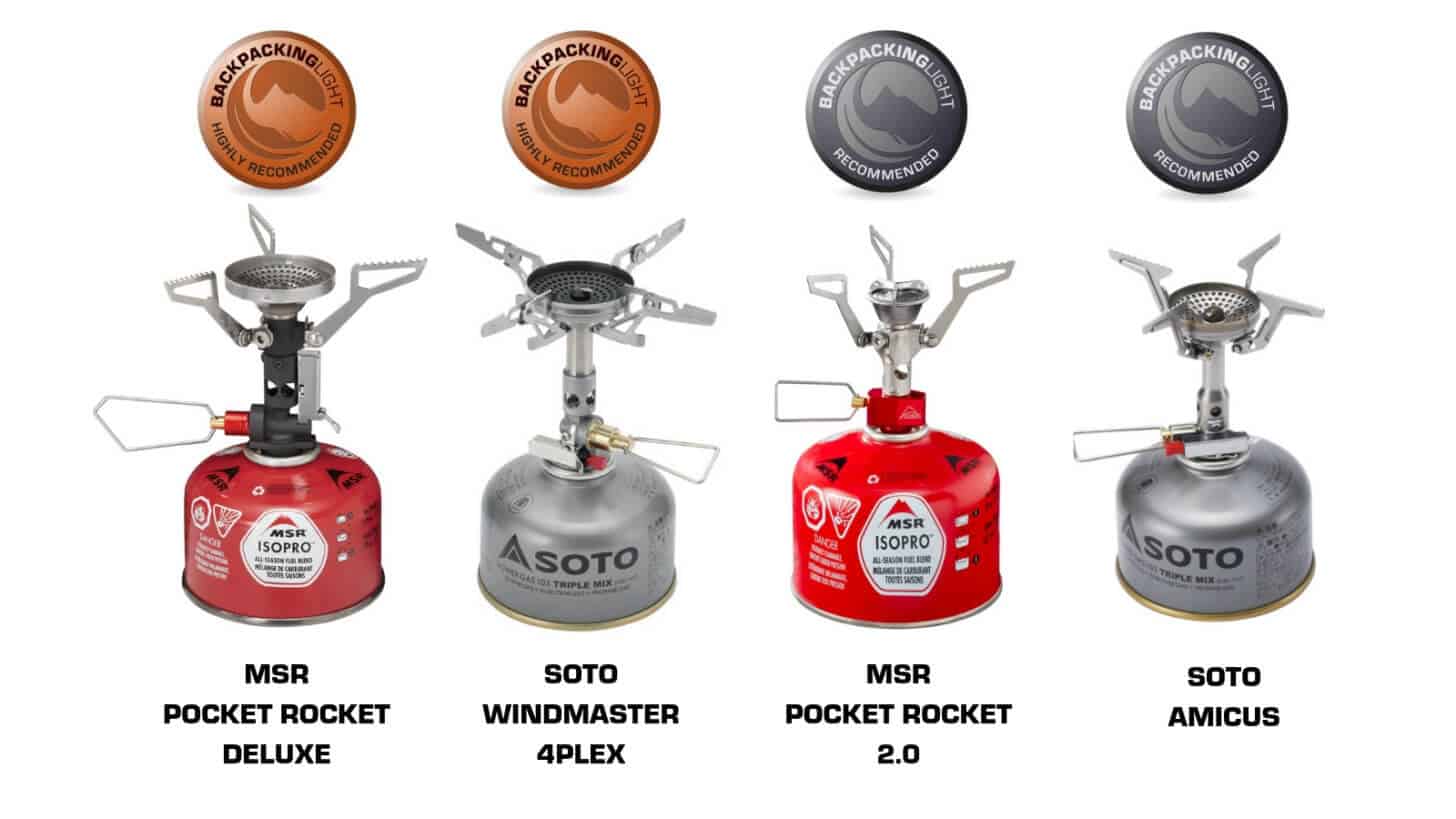
The MSR PocketRocket Deluxe exhibited the best overall performance across all categories, including the best StoveBench performance in control, wind, cold temperature, large water volume, and stress tests.

- Purchase the MSR PocketRocket Deluxe from REI today.
Gear Guide Scope
Herein are the results of a months-long effort to evaluate the detailed performance of the market’s most prominent upright canister stove products. The three of us spent several hundred hours of research, testing, analysis, and writing this 15,000-word report. It is our hope that it would provide a standard of reference that will be useful to backpackers as they consider their options in what has become a very crowded product market.
Upright canister stoves are a subset of a broader product category of canister stoves that also includes integrated canister stoves and remote canister stoves. Stoves from these latter two categories are not included in this gear guide – we’ll save those for another one!
Where do Canister Stoves Come From?
The vast majority of OEM (original equipment manufacturer) parts and assemblies for backpacking stoves originate from factories in Russia, China, and Korea. One can generally distinguish products in the upright canister stove market into two categories:
- Exclusive stove designs that are designed and marketed under relatively well-known brand names, consisting of unique assemblies of burners, wind blades, stacks, pot supports, valves, and regulators. These brands include MSR, Jetboil, Snow Peak, Soto, Primus, Kovea, Fire Maple, and Optimus. Although you may see some parts of these stoves found in other products, all of the stoves from these brands include either an exclusive combination of parts or custom parts not found in other products. OEM prices for these stoves to the brands are generally $10 to $30, with MSRPs ranging from about $25 to more than $90, with an average in the $40 to $70 range.
- Nonexclusive stove designs manufactured by an OEM supplier and sold as OEM units under a variety of different brand names. These represent the vast majority of stoves sold under a variety of odd brand names via the online mega-retailers Amazon and Alibaba. Examples of these brands include BRS, Etekcity, Joyard, Housweety, Redcamp, Etopsell, Monoprice, Hikevalley, TopOne, Icetek, Desert Walker, and Chenbo. OEM prices for these stoves to the brands are generally $1 to $6 per unit, with MSRPs being less than $15.
There is some confusion abounds in the backpacking stove market. For example, while Fire Maple manufactures its own stoves, it also licenses nearly identical designs for distribution under the Olicamp brand. The design of current-model MSR stoves can’t be found anywhere else, but Kovea is one of their OEM suppliers. And Kovea makes their own line of stoves, and they don’t look like MSR stoves. Further adding to the confusion is that OEM suppliers of finished stoves often purchase their parts from other factories, who are also OEM suppliers of finished stoves. Globalization at its chaotic best, perhaps!
Although not a hard-and-fast rule, we found that the exclusive stove designs in category #1 (which are generally more expensive) feature a higher level of manufacturing quality and durability, and offer marginally-to-significantly better performance than the nonexclusive stove designs found in category #2. Of the brands presented in this review, it’s clear to us that MSR and Soto are the market leaders in terms of design and engineering with an eye towards maximizing performance.
Discarding cheap OEM knockoffs (defined in category #2 above), we surveyed a total of 35 stoves marketed specifically to the backpacking community from MSR, Jetboil, Snow Peak, Soto, Mons Peak IX, Primus, Kovea, GSI, Optimus, and Fire Maple. We did include two more popular white-labeled brands, BRS and Etekcity. We eliminated any stove that weighed in excess of 8.0 oz (227 g) from this initial survey, as this represents the approximate weight at which significantly more function and performance can be realized by a different stove design (e.g., remote canister, integrated canister or liquid fuel stove).
The average weight of this initial group was 3.3 oz (94 g), with a range of less than 1.0 oz (28 g) to more than 6.0 oz (170 g).
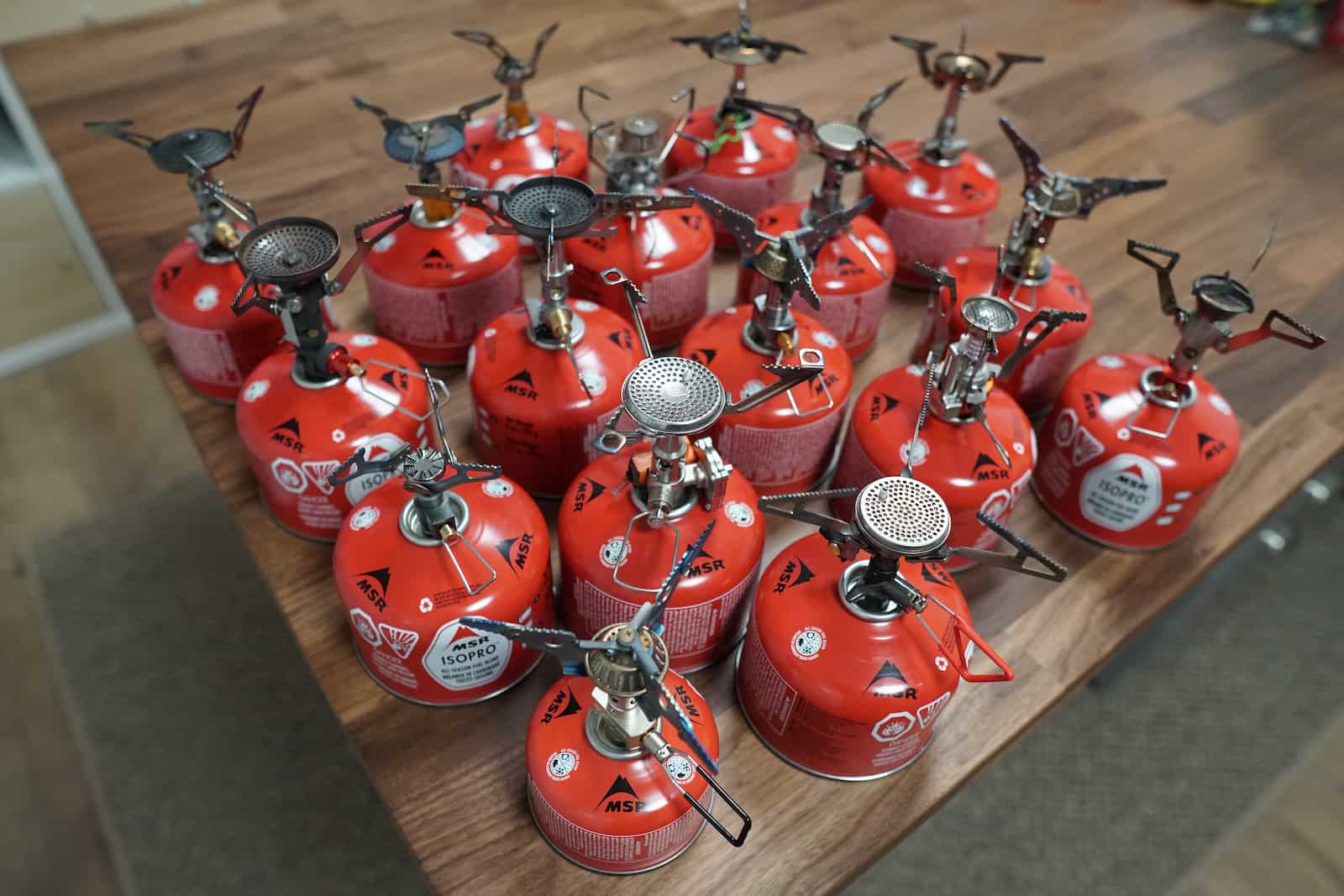
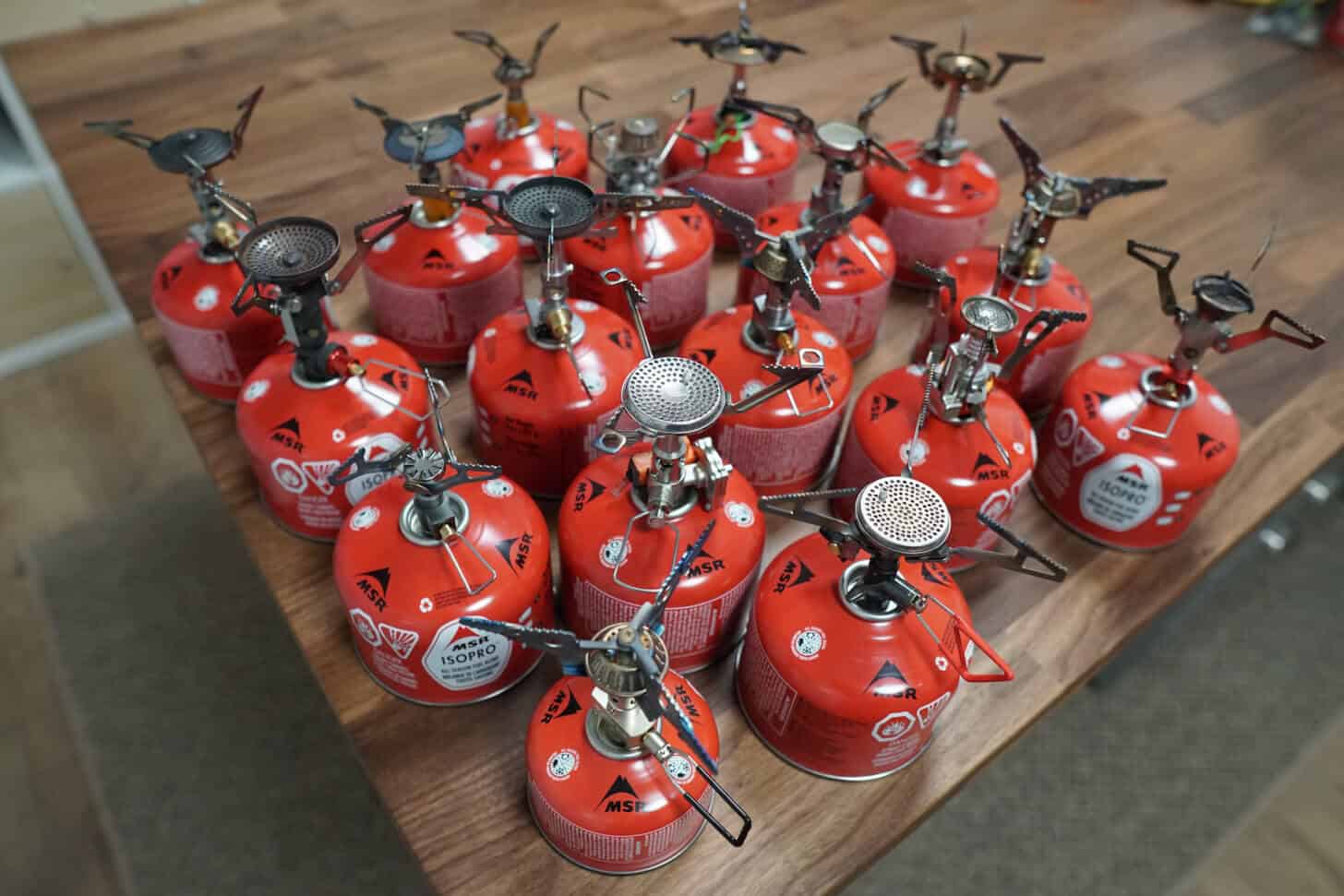
Of the initial group of 35 stoves, we selected 17 stoves (with the heaviest stove being 3.44 oz / 101 g) for a more detailed examination and inclusion in this gear guide. A few are heavier than average, most are lighter than average, and a few are in the truly “ultralight” category (less than 2.0 oz / 57 g).
Summary of Products Featured in this Review
The following chart details feature and specifications for the stoves featured in this review, and provides our Overall Rating. See the Performance Analysis section below for a detailed performance assessment.
| Stove | Overall Rating* | MSRP (USD) | Weight (oz) | Regulated | Piezo Ignition | Burner Diameter (mm) | # of Supports | Support Radius (mm) |
|---|---|---|---|---|---|---|---|---|
| MSR Pocket Rocket 2 | Recommended | $45 | 2.6 | no | no | 25 | 3 | 61 |
| MSR Pocket Rocket Deluxe | Highly Recommended | $70 | 2.9 | yes | yes | 37 | 3 | 61 |
| Soto Windmaster 4Flex | Highly Recommended | $65 | 3.08 | yes | yes | 39 | 4 | 72 |
| Soto Micro Regulator | Average | $70 | 2.5 | yes | yes | 38 | 3 | 55 |
| GSI Pinnacle | Above Average | $50 | 2.43 | no | no | 28 | 3 | 70 |
| Optimus Crux Lite | Average | $40 | 2.61 | no | no | 46 | 3 | 55 |
| Fire Maple FMS-300T | Above Average | $30 | 1.59 | no | no | 17 | 3 | 45 |
| eTekCity | Above Average | $20 | 3.34 | no | yes | 20 | 4 | 45 |
| Snow Peak GigaPower 2.0 | Below Average | $50 | 3.05 | no | yes | 25 | 4 | 53 |
| Snow Peak LiteMax | Below Average | $60 | 1.99 | no | no | 28 | 3 | 62 |
| BRS 3000t | Below Average | $17 | 0.89 | no | no | 17 | 3 | 41 |
| Kovea Supalite Titanium | Below Average | $50 | 2.12 | no | n/a | 29 | 3 | 62 |
| Kovea Titanium | Below Average | $60 | 3.25 | no | yes | 29 | 3 | 62 |
| Jetboil MightyMo | Above Average | $50 | 3.44 | yes | yes | 37 | 3 | 60 |
| Fire Maple FMS-116t | Above Average | $40 | 3.55 | no | no | 45 | 3 | 55 |
| Primus Micron Trail | Below Average | $45 | 3.25 | no | yes | 32 | 3 | 68 |
| Soto Amicus | Recommended | $45 | 2.77 | no | yes | 34 | 4 | 54 |
Summary Reviews
Presented in order from highest to lowest overall grade.
Member Exclusive
A Premium or Unlimited Membership* is required to view the rest of this article.
* A Basic Membership is required to view Member Q&A events


Discussion
Become a member to post in the forums.
I’ve got a new topic for study — why piezo igniters fail or don’t work.
A small correction but one that matters “The BRS 3000t also happens to be the loudest stove we tested, by a wide margin – we clocked it at 91 dB in a test group that averaged less than 80 dB – that’s right, the BRS 3000t is more than ten times louder than our average stove (because dB is measured on a log scale)!”
A 10 dB increase in sound pressure level is perceived as twice as loud. So the BRS will sound twice as loud, not 10x as loud. Not great, but not catastrophic.
From the web,
https://www.healthyhearing.com/report/52514-What-is-a-decibel#:~:text=Decibels%20increase%20exponentially&text=For%20example%2C%20every%20increase%20of,times%20louder%20than%20near%20silence.
David D. is right – 10 dB is a 10x higher sound pressure level – but we don’t perceive it that way. Human perception of sound volume is closer to 2x for a 10 dB difference in level.
Given that dB is a log scale, that does not make sense to me. Please elaborate.
Remember two things: the range of sound intensities is huge, really huge, and the ear ‘hears’ sounds on a log scale, not a linear scale. Why? Evolution I guess, to be able to handle the huge range. Loud rumble of rock fall (or predator scream), vs tiny rustle in the grass as the predator approaches.
Eyeballs are similar: the range of light intensities is also huge, and your eyes can handle that too. Bright daytime and starlight.
Cheers
First up – I messed up – posted too quick without thinking. While SPL is a base 10 logarithmic calculation, it is a 20xLog calculation, not 10xLog, so a 10 dB SPL difference is not 10x, it is 3.16x difference in sound pressure, and a 20 dB difference in SPL is a 10x difference in sound pressure. The Sound Pressure Level in dB is 20xLog(P1/P0) where P0 and P1 are linear pressure measurements and P0 is 20 micro-pascals). How embarrassing – nothing worse than a math error on a BPL posting!
Here is info on SPL: https://pressbooks.umn.edu/sensationandperception/chapter/loudness-and-level/
Anyway the 2x loudness for 10 dB SPL difference is a common rule of thumb in audio engineering. If you google SPL vs perceived volume there will be many links (e.g. https://www.engineeringtoolbox.com/sound-pressure-d_939.html ).
Most references I could quickly find state it as a good approximation, without references. It is more complicated than that of course because there are differences in perception based on the frequency of the sound as well. Also the ear is compressive at higher volumes. This being BPL, I will try and find a good documented study later.
This is probably digging way deeper than really worthwhile on this topic – the BRS-3000T is louder than the other stoves – but maybe so what? Unless it really matters to you – then don’t use it. Its certainly not a risk to your hearing given the extremely short time period you would be exposed to it.
First, this statement in the original article is incorrect: “we clocked it at 91 dB in a test group that averaged less than 80 dB – that’s right, the BRS 3000t is more than ten times louder than our average stove (because dB is measured on a log scale)”. The Healthy Hearing website linked above by Jon Fong is also wrong for the same reason. A 10 dB difference in SPL corresponds to a 3.16 x difference in sound pressure (because an SPL difference in dB = 20 x Log (P2/P1) where P2 and P1 are the two sound pressures being compared). A 10x difference in sound pressure corresponds to a 20 dB difference in SPL.
Now as far as perceived volume or loudness – I found many places the 2x loudness vs 10 dB SPL difference was used and attributed to earlier studies, but with no actual references. This link (https://www.itu.int/dms_pub/itu-t/oth/06/17/T061700000D0002PDFE.pdf ) is an ITU slide deck on measuring loudness. Slide 11 shows that at 1000 Hz a 10 dB difference in SPL produces an approximately 2x change in Sone (a linear loudness measurement). Other frequencies have different slopes. What this means for a stove that is more like a filtered noise source? Who knows – more internet searching is not worthwhile.
Sorry if I took this too far – the 10x for 10dB SPL difference mistake needed correcting.
My wife likes the stove noise. She sits at the back of the tent while I am at the front, with the food. To her the noise says ‘dinner is coming’. This is good!
And really, it is not a loud noise anyhow. Try one and see.
One of my Vortex stoves (which I make an sell) are louder, and their noise has never been a problem for any of my customers either.
Cheers
10x the loudness would disqualify the BRS for many, 2x is an easier pill to swallow.
For any other sound nerds out there, perception of change in loudness is a pretty complex topic
A couple suggestions for future noise measurements, to compare with everyday sounds and put them into context:
Is the BRS SPL 91dB (C weighted) at a typical distance away? That’s the loudness of a typical lawn tractor.
Is the BRS SPL 91dB (C weighted) at a typical distance away? That’s the loudness of a typical lawn tractor.
I have never measured the sound level, but I can say my BRS is nowhere near the sound of my lawn tractor! Far from it.
Cheers
The latest version of the BRS3000T (left) and its clones have thicker pot supports than the old ones (right):
Has anyone had a failure of the new pot supports?
Most interesting news. A fine tweak on the underside of the arms.
Thank you David.
Cheers
Become a member to post in the forums.