Roger said:
We now have more info.
the failure was in the tiny little piece of metal that supports the pot support. It has a rivet through it. The pot support leg itself didn’t fail. The metal in that riveted piece slowly creep(ed) as it heated, until the pot fell off the stove during operation. Same mode of failure for 4 of the 7 stoves I bought of a single batch. I haven’t been able to replicate since. So, possibly a batch defect resulting from improper tempering of this particular part.
This from Ryan J.
Some photos to explain it all follow.

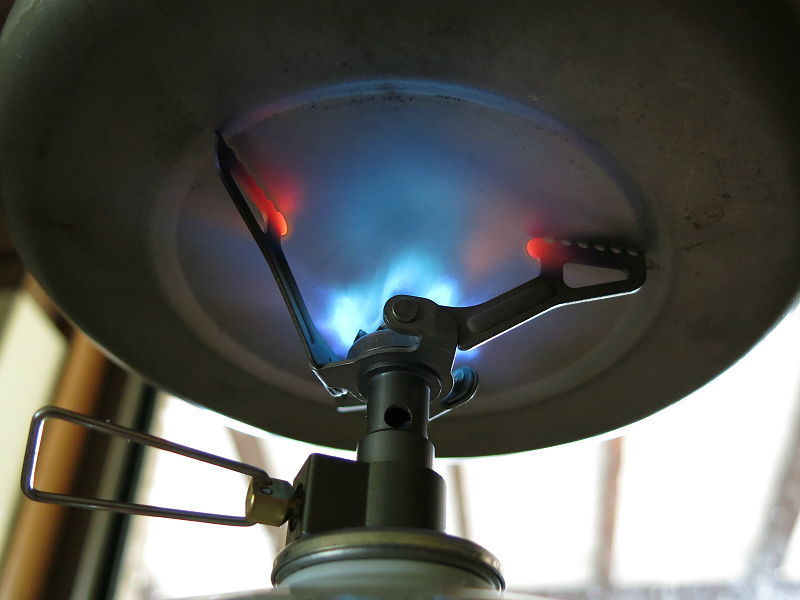
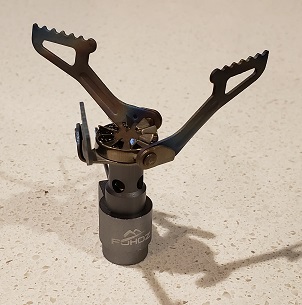
This is an undamaged BRS-3000T stove (mine) heating a Ti pot. Please note carefully the pot support arm which is connected to a ring under the burner head by a rivet. That little ring must stay ‘flat’ (albeit with right angle bends) for the pot supports to be at the correct angle.
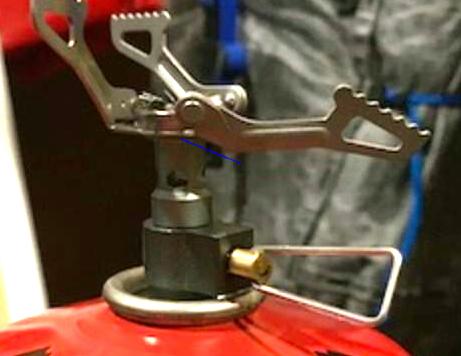
This is the only photo I have of one of the damaged stoves. It was provided to me by Ryan J, to whom thanks. Please note the way the pot support arm sags down at an angle highlighted by the blue line. The pot support arm itself is NOT bent or damaged: it is the support ring (with rivet) which is bent or twisted.
How did this happen? I have no idea, although to me it looks as though the riveted support ring was bent down by force. This might indicate serious ‘trauma’, or it might indicate a really soft bit of metal as Ryan suggests. In the latter case, the ‘force’ would be that of gravity on the pot. Plasticine metal. But there is more.
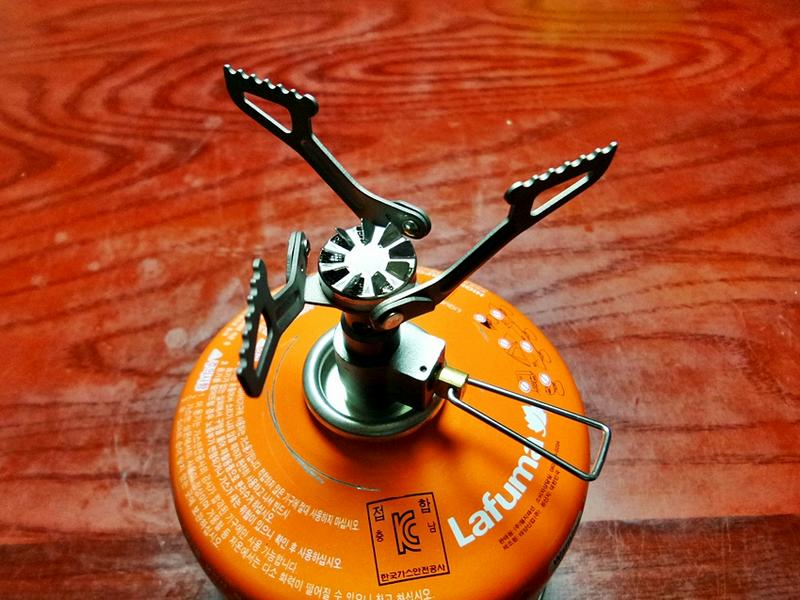
What is curious is that some units seem to have kinked pot support arms, as shown here. My BRS-3000T stoves (I have several) do not. Is this damage or a fault? I don’t think it is either: I think the kink was part of the manufacturing. However, if (IF) this is a genuine BRS-3000T it suggests that there has been some variation in the production process, which leads on to this photo.
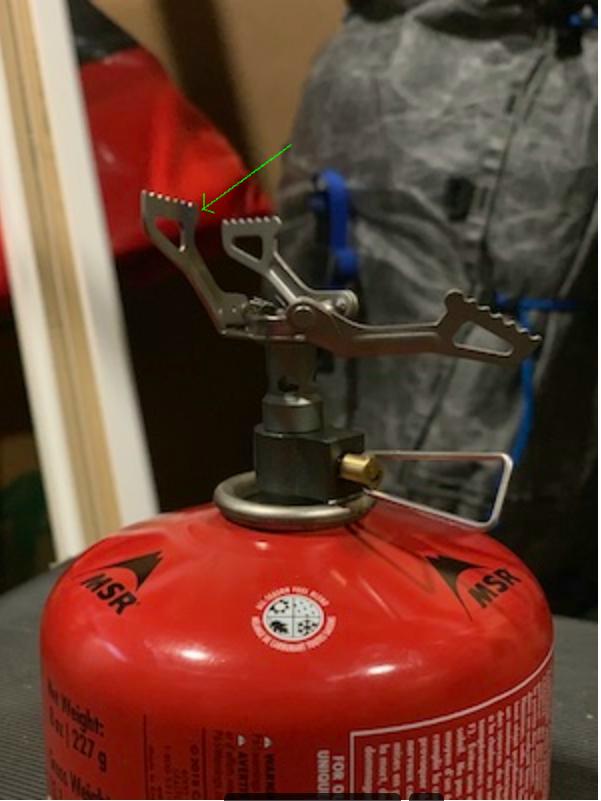
I found this photo on the web (author unknown). The pot support arm has that possibly genuine kink, but the bent part of the support ring shows a bad crack as highlighted. This sort of crack looks to me as though the metal was bent up after it had been tempered. I have made similar cracks in test pieces of Ti 6Al4V myself. Once again, some variation in production, and definitely some deficiencies in Quality Control.
What this leads to is that the QC on this support ring may have been lacking, at least for a batch or two. Not enough tempering, too much tempering, tempering at the wrong time, … whatever. If you have a ‘good’ unit, then that’s fine: keep cooking. After all, Ryan did find 3 good ones in his batch of 7. If you have been unlucky enough to get one from a bad batch – go back to your supplier with photos and demand a refund.
If you are thinking of buying one – do so, but test it carefully as soon as you get it, and only buy from someone you could go back to in case of a problem. Remember: many of us are very happy with our units.
HTH
Cheers
<ul id=”bbp-reply-revision-log-3618571″ class=”bbp-reply-revision-log”>
<li id=”bbp-reply-revision-log-3618571-item-3618572″ class=”bbp-reply-revision-log-item”>This reply was modified 15 hours, 47 minutes ago by  Roger Caffin.