Topic

Current UL windshirts and breathability: are there other options and layering techniques?

  • This topic is empty.
Viewing 25 posts - 126 through 150 (of 246 total)
PostedFeb 24, 2014 at 1:29 pm

Not sure there is any consensus about anything on this site. Especially wind shirts.

Having said that, I really like mine a lot…way more than I liked the older Houdini. I love the way it feels against my skin, and it's breathable enough for me.

Enjoy it!

PostedFeb 24, 2014 at 4:46 pm

"Having said that, I really like mine a lot…way more than I liked the older Houdini. I love the way it feels against my skin, and it's breathable enough for me. "

(Summoning my best Gomez Addams) – Ooo, ooooo, Jen, That's UL! When you speak UL you drive me wild! Speak some more UL, Jen. Anything! Cuben fiber! Frameless packs! Trail runners in winter! ANYTHING!

PostedFeb 24, 2014 at 5:36 pm

Is the rab cirius similar to the Arc'teryx squamish in terms of the way the fabric feels?

I think the new squamish uses a updated fabric gossamera not luminaria?

I think the Arc'teryx incendo wind shirt is light and nice, but I would rather not have mesh side panels.

PostedFeb 24, 2014 at 9:45 pm

Hi Dale:

Mike Glavin here with Sierra Designs. I find your thread fascinating, because this is a subject we are attacking with vigor in our development at Sierra Designs.

One thing that caught my eye was the discussion of "breathable", which is NOT the key performance metric for a wind shirt. Air Permeability, measured in CFM via various tests, is the key performance metric you seek. However, above you say 2-3CFM plastic bag. A plastic bag has 0CFM. Gore-Tex is about .1CFM, and NeoShell about .5CFM. Frankly, as we all know, there is not much performance difference between Gore-Tex and a plastic bag as it relates to airflow. And breathability (measured in Moisture Vapor Transfer Rate is not much different either). It is why Gore-Tex, like a plastic bag, is guaranteed to keep you wet when hiking with a pack in moderate temperatures.

So, since the rain jacket is always a performance compromise, the wind jacket ought to be the key piece in the clothing system, not the "hard shell" as has become the norm.

Now, the reason this caught my eye is that 2-3CFM is actually the PERFECT air permeability for a cooler weather wind shirt. We target 3-5CFM for all of our wind wear since we think it is the perfect blend of windproof and permeability that allows it to be worn as a second skin in a very wide variety of conditions.

Two things to note: contrary to popular belief, the most effective place in your layering system to wear your 2-5CFM second skin is very close to the skin, right over the base layer. Common "soft-shell" thinking would dictate taking the jacket off in cooler conditions and adding a layer underneath, but this is actually not what you want to do. You actually want to layer OVER your wind layer, which is counter intuitive, but the works with the evaporative process rather than against it. Like a fur jacket. The intuit still wear caribou fur rather than "performance" apparel for this very reason, the "skin" in near your body with ever more breathable (higher CFM) layers moving further out. Ironically, and this is the best part, they traditionally wore an ULTRALIGHT sealskin or fish skin shell OVER this layer ONLY in wet weather (their ultralight rain jacket/plastic bag compromise piece).

You should check out our new Stow Windshirt. The NEW SD website launched tonight!. This is the baby of Jim Trombly, our Product Director. Jim used to be the Alpine Director at Patagonia and is a Houdini HATER! The Stow uses an amazing fabric that has kiss-coat of PU that gives permanent water resistance (unlike a DWR that wears off). AND it hits our magic air permeability rating of 3CFM.

Finally, I will note that in warmer weather, say 50 degrees or warmer, the second skin needs to have a higher CFM to be comfortable in a wider range of temperatures and exertion levels. Our 3CFM garments are poor bug or sun shirts, for example, in warmer weather. For these a 30-50CFM garment will probably work best for wind, bugs, and sun protection.

Hope you find this useful, and thanks for the intriguing thread……

In addition

PostedFeb 24, 2014 at 10:26 pm

>> Finally, I will note that in warmer weather, say 50 degrees or warmer, the second skin needs to have a higher CFM to be comfortable in a wider range of temperatures and exertion levels

I can't imagine wanting to wear any top layer hiking hard at 50 degrees, unless there was a howling wind or a drizzle. Hiking hard at 50 degrees, I'd either be in a short sleeve shirt or a long-sleeve wicking shirt with the sleeves pushed up.

To me, the bigger challenge is cold weather hiking. That's where breathability is important because I'll actually have to wear layers.

Ironically, I'm more likely to wear the breathable top layers on nice weather cold days and a lower CFM windshirt on a cold (or warmer) day when the wind is howling — like when you get a stiff 30 mph wind on a summit on a nice fall day.

I think the call for very high CFM top layers for high aerobic output is really a call for something other than a wind shirt.

James holden BPL Member
PostedFeb 24, 2014 at 11:29 pm

its called a non membrane softshell …

as ive said over and over again … if you want breathable … get a thin non membrane softshell

the problem with less "breathable" windshirts is that for active pursuits (going sustained uphill with a pack on) you will generally sweat it out even with a minimal base layer unless its quite cold …

theres no point having a windshirt or softshell if you arent basically living in it IMO …. if you are only using it occasionally when its windy or youre stopped, you might as well use your hardshell … and many people do this just fine

i think its quite interesting that richard recently tested a few rab pieces as highly breathable … and rab is known for being used by top alpinist all over the world … as was the old houdini

hmmmm

;)

Dale Wambaugh BPL Member
PostedFeb 24, 2014 at 11:55 pm

Mike, I don't agree with your opinions on the efficacy of 2-3 CFM fabrics for windshirts at the level of exertion while hiking uphill with a load in typical PNW conditions with cool overcast and high humidity.

The plastic bag reference is slang and a put down of the low CFM offerings on the market. Simply put, they don't work for my uses. I've had the opportunity to see nearly 50 years of hiking product offerings and my conclusion is that very few of the mass market manufacturers can wrest control of the development process from the marketing department and bring a product to the shelves that truly serve a hiker's needs.

The idea that someone can maintain moderate activity in a 2-3 CFM garment is preposterous. If you are going to delegate the use to rest stops or belays, there is no point to bringing the item as a rain shell would fill the same needs— which I'm carrying anyway.

I've owned a number of lightly PU coated shells. Sierra Designs has tried to pull that off for years and only managed to turn out the sweaty plastic bag wind shells that many here object to.

My advice is to come to web forums to listen to your prospective customers rather than tell them they are wrong and preach. We have the wallets: listen and prosper.

PostedFeb 24, 2014 at 11:55 pm

>> i think its quite interesting that richard recently tested a few rab pieces as highly breathable … and rab is known for being used by top alpinist all over the world … as was the old houdini

It might be because the lightweight RAB softshells are so butt ugly, the only place people would wear them is dangling from a rope off the side of a mountain…

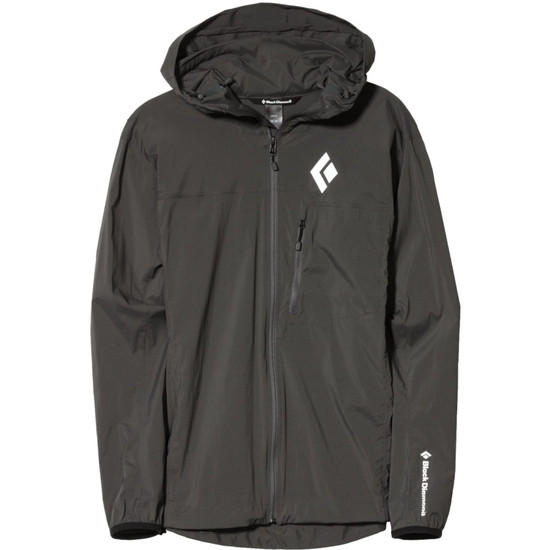
This new Black Diamond Alpine Start hoody I just got isn't likely to win any beauty contests, either. Good, grief, could they have made the logo any bigger…

Black Diamond Alpine Start Hoody

PostedFeb 25, 2014 at 12:04 am

I don't understand the complaint with wind shirts. If a windshirt is too hot, wear something more breathable. There are dozens and dozens of options that are highly breathable for high aerobic output activities. If you are limited to just two jackets, then a wind shirt probably doesn't make sense as one of them — unless you are leaving the rain shell at home. For high output activities, it probably does make sense to carry a rain shell and a highly breathable "running jacket" or hybrid or mesh quarter zip or whatever you like.

I wrote up a little report on hiking with the Marmot Incline Hoody that is extremely breathable. I've got three more that I'll write up in the next few days: a Patagonia Nine Trails hybrid, a Black Diamond Alpine Start sub-8 ounce softshell hoody, and a Marmot Stretch Light pullover that is the most breathable and comfortable of all of them.

Dale Wambaugh BPL Member
PostedFeb 25, 2014 at 12:08 am

Eric wrote, "theres no point having a windshirt or softshell if you arent basically living in it IMO …. if you are only using it occasionally when its windy or youre stopped, you might as well use your hardshell … and many people do this just fine"

Just what I said too. I like the "living in it" analogy. We need to get a few of of these guys out from behind their desks in California and march up some dewy PNW switchbacks. If we can keep them from going over a cliff with a three foot heel slide on a slug, they might learn something :)

Paul Hatfield BPL Member
PostedFeb 25, 2014 at 12:21 am

Variety is good. Personally I just want to see air permeability and hydrostatic head data for a large number of garments, and I can make my own decision as to what best fits my needs.

James holden BPL Member
PostedFeb 25, 2014 at 12:54 am

who cares if they are ugly if you arent using them in town or at the ski lodge

if youre using them as they should be used, youll be scuffing them up and putting pinholes in em anyways =P

how many windshirts/softshells does everyone here own … for some of us its too many, including myself

ideally one should buy one windshirt/softshell and live in it the majority of the time …

is this possible? … yes, but it helps if its breathable as it has a wider usage range

to put it simply, you can always extend the range of a breathable windshirt downwards … you cant with a less breathable one, once you find the the point were youre wearing just a base layer and still sweating it out, you cant use it at any warmer temps

or to put it even more simply … you can use a 50F windshirt at 30F easily through an extra layer … you cant use a 30F windshirt at 50F without sweating quite a bit or reducing your activity level

;)

PostedFeb 25, 2014 at 8:29 am

You do understand that we are all certifiable nerds, right? I mean, who else has discussions like this???!!!!! And ENJOYS them!!!!!

Stephen M BPL Member
PostedFeb 25, 2014 at 8:46 am

how many windshirts/softshells does everyone here own … for some of us its too many, including myself

2 Windshirts for me, an older and newer style Houdini, also have a Paramo Anorak which technically is a softshell (but also a hardshell)

Ryan Smith BPL Member
PostedFeb 25, 2014 at 8:58 am

I own two wind shirts currently. One that is very breathable, and one that is not. I think there are conditions out there that warrant each. Their combined weight is only 4.4oz so maybe I just bring them both along.

Ryan

Dale Wambaugh BPL Member
PostedFeb 25, 2014 at 10:17 am

Jennifer added, "You do understand that we are all certifiable nerds, right? I mean, who else has discussions like this???!!!!! And ENJOYS them!!!!!"

This is news? :) Somebody did a personality survey here at one time. There was a high proportion of nerdy introverts. Duh!

It's a search for the highest performance at the lowest weight. A windshirt is a key component to my clothing layering system and clothing is a significant part of my pack load. Like shelter, it is vital to my comfort and safety, so it deserves the scutiny.

I think the design and marketing aspect of this one item makes a very interesting study of how products fold into the practice of ultralight hiking, particularly after having a representative from a manufacturer barge in and tell us were are all wrong. There are a LOT of implications in that message!

I can find many breathable wind shells in the 10-12 ounce range, but of course there have been many market "teasers" in the 2-3oz range. There WERE perfectly acceptable 4oz models that have been discontinued. In a hiking niche market where grams are significant, 8 ounces is a massive compromise.

And yes, as has been said, we are the largest gathering of gram weenies on the planet. So be it! :)

PostedFeb 25, 2014 at 10:22 am

It might be interesting to create another thread about how many windshirts people own, but I'm looking forward to an important conversation about Glavin's / Sierra Designs' statement that:

"We target 3-5CFM for all of our wind wear."

Doesn't sound so dissimilar from Patagonia's "Beyond this we don't go" statement:

"We've found that fabrics that measure as much as 5 CFM are still functionally windproof: … we use 1-5 CFM as our standard for weather-protective soft shells …Shells for higher exertion activities … must be even more breathable. For these products we hold to a comfortably wind-resistant, but not windproof, standard of 10-15 CFM. Beyond this, we don't go."

So here we have two mfgrs actively disagreeing with the idea that a 35 CFM windshirt is a good idea, which is very interesting. It's not that they're just being inattentive…they appear to simply not buy the rationale for a highly permeable windshirt.

Which is a shibboleth here at BPL!

The size and scope of this disagreement is interesting; both sides have credibility, and this discussion should provide insights aplenty.

EDIT: Posted at the same time as Dale, who is honing in on the same conversation. I agree, Glavin's post is worthy of close examination.

Ben C BPL Member
PostedFeb 25, 2014 at 10:35 am

I'm not going to buy their windshirts based on this statement that 5 CFM is a ceiling. I'm glad a got a light, air permeable windshirt before they stopped making them. The more breathable varieties seem like a much better option, as long as we can get access to them again.

I think they sell more windshirts to guys who walk from their house to their car and not much more-ok, maybe a short walk of the dog. In those cases the 5 CFM windshirts are perfect.

I will trust Richard's research over the marketing plans of the large manufacturers.

PostedFeb 25, 2014 at 10:58 am

We keep attributing the lack of high CFM windshirts to Dilbert-style "craven marketing."

What if that is a misattribution?

What if mfgers have done their own testing, have come to different conclusions than the BPL consensus, and actually don't believe that high CFM windshirts are a worthy product? That they don't deliver the benefits of a less permeable shirt?

I've found Nisley's arguments for high CFM windshirts persuasive, but at the same time, I'm taking a lot of that argument on faith. I would not mind at least hearing the opposing arguments fleshed out a bit more.

I would like to ask manufacturers: "What do you think is the drawback of a 35 CFM windshirt?" and see what they say. I'm guessing they'd say: "Insufficient wind protection, you'll get cold." I'd ask, "Then why did you used to make them?" and "What do you say to people wetting out from the inside on a strenuous hike when wearing a low CFM shirt?" I would like to hear those answers.

I'm trying to get beyond this reductionistic argument that "any disagreement with BPL dogma is driven by corporate greed alone." That whole narrative is wearing thin for me. I'm open to the possibility that a manufacturer might actually be acting in good faith, and trying to put out an improved product. Improved products happen all the time; manufacturers aren't out to screw their customer base or they'd shortly be out of business. I really want to hear the rationale for low CFM windshirts, even though I might not buy the argument, being a Nisleyite myself.

Dale Wambaugh BPL Member
PostedFeb 25, 2014 at 11:05 am

Another thing to consider is whether the 5cfm decision was based on other factors like fabric availability and cost and the chatter from the companies is post production marketing hype to justify the the product.

You have to keep in mind that wind shells are typically one small part of an extensive line of clothing. If Patagonia dropped all their windshirt products, it would be something like 1/250 of their line. We may be a small minority that is willing to drop $100 on a thin bit of nylon when there are poor performers at TJ Maxx for $20.

rick . BPL Member
PostedFeb 25, 2014 at 11:07 am

I'd understood Richard to equate 35cfm for a base/windshirt ensemble as the max benefit in moisture transport. It's a continuum from a few cfm up to that. Over that it is less wind/water resistance without more gain.

There's also enough anecdotal evidence and our own experiences that wearing a garment of a few or less cfm causes moisture buildup.

If there is a test showing contrary to that, I'd be interested in seeing it.

Meanwhile, i dont think I'll be the guinea pig trying a 2cfm shirt against my skin. No thanks.

PostedFeb 25, 2014 at 11:09 am

Dale, I've wondered that, too.

It just seems implausible that nylon of a certain permeability, that was once widely available, is no longer produced. Generally manufacturing options tend to proliferate.

I suppose it's possible, though.

>There's also enough anecdotal evidence and our own experiences that wearing a garment of a few or less cfm causes moisture buildup.

Yes, and we've also seen plenty of commentary to the opposite, too; people who own low CFM windshirts posting their satisfaction with them, and stating that the whole "insufficiently breathable" argument doesn't make sense to them.

And then there is the "Unzip the windshirt and get all the breathability you want" argument.

I guess I will just have to buy a low CFM windshirt and test this for myself!

PostedFeb 25, 2014 at 11:44 am

>> What if mfgers have done their own testing, have come to different conclusions than the BPL consensus, and actually don't believe that high CFM windshirts are a worthy product?

It's not that the manufacturers think that high CFM layers aren't worthy. Most of them, certainly including Patagonia and Marmot and Nike and addidas and Brooks and Reebok and UnderArmour and Sacouny and ACIS and New Balance et al make very high CFM long sleeve shirts, jackets, hoodys, and half zips for high aerobic activities such as running, climbing, trail running, hiking, biking, etc.

It's just that these products aren't worthy; it's that these products are not windshirts. They are not intended to significantly block the wind. Just the opposite, they are intended to be air permeable. Most manufacturers pretty clearly identify the products that are intended for high aerobic activities and maximum venting of heat/perspiration.


BTW (and on a separate topic) I also suspect that there may be some disconnection between the CFM numbers that are being generated here and the numbers the manufacturers are using for the same materials.

Viewing 25 posts - 126 through 150 (of 246 total)
Loading...