


"In freezing temps, I can't seem dry wool layers under my insulation fast enough either and need to change out of them asap."
I'm the same way, which is why I stopped wearing wool (except for a wool blend – the Rab MeCo stuff).
Topic
Become a member to post in the forums.
"In freezing temps, I can't seem dry wool layers under my insulation fast enough either and need to change out of them asap."
I'm the same way, which is why I stopped wearing wool (except for a wool blend – the Rab MeCo stuff).

“I don't think it is greed, just attention to marketing factors that don't fit my needs. It's more incompetence than malfeasance.”
Maybe it’s marketing COMpetence, rather than marketing INcompetence. There may simply be too few people asking for a high permeable windshirt, or too many other options available for people who want high permeability.
“Lots of people are lamenting the loss of the older houdini…”
And they’re all here! This might be the entire universe of Old Houdini mourners–maybe 50 of us, max.
That indicates our strategy is the one Dale (I think it was) mentioned earlier: we should make more noise. If Patagonia gets 50 requests…that might move the needle.
Finally, an interesting selection of comments from this thread (one of them mine–I’m no different):
“I will trust Richard's research over the marketing plans…”
“…being a Nisleyite myself.”
“I'd understood Richard to equate 35cfm for a base/windshirt ensemble as the max benefit in moisture transport….”
“We have to check air permeability of SD windshirt on Richard Nisley's equipment before making any conclusions….”
The implication for Richard Nisley is clear. His real calling is as a cult leader, and we are the Nisleyites! We all wear pre-2012 Houdinis and meditate on windshirt permeability. We’re waiting for a giant spaceship from Patagonia to land and bring about a new world order.

"We’re waiting for a giant spaceship from Patagonia to land and bring about a new world order."
Okay Delmar, but you're first in line for the orchiectomy.
Want some Kool Aid? It's been in the bus refrigerator since Woodstock :)
Just a hypothetical scenario. Im doing something aerobic outdoors in 32F weather. If I have just a wool long shirt baselayer and a windshirt. I might be okay running or hiking fast, but as soon as I drop my pace a little bit or the wind gets heavier I will get uncomfortably cold. And I want to continue walking/running and don't want to put on an insulation layer.
That's why I usually use my R1 as a baselayer (it's warmer, especially when it's a little wet).
So if I have a R1 and a newer Houdini. If I layer the Houdini on top, and let's say I'm running. I will get sweaty. Half and hour ago I was running with my Houdini under my R1, and I didn't sweat. And when I stopped I didn't feel cold.
My original question was that is this something Mr. Glavin originally intended by saying that you should layer on top of your windshirt, and keep it as next to skin as possible (next to say a wool t-shirt).
I was interested in more in-depth look behind this idea. And also I wonder wouldn't that kind of layering make the DWR on the Houdini pretty useless.
So why would you sacrifice breathability in order to get better water-repellency (as was suggested in this thread before), if the windshirt's optimal position not as a top layer?
This intrigued me, and I thought it was worth a discussion.

del
Rick M >> "I think the idea of using fleece as the overlayer is a little strange. Any wicking or breathable layer should be UNDER the less breathable windshirt. If I layered anything over the windshirt, it would be puffy insulation or rain shell if absolutely necessary."
I find it a bit strange too. I just wanted to test it after reading this:
"Two things to note: contrary to popular belief, the most effective place in your layering system to wear your 2-5CFM second skin is very close to the skin, right over the base layer."
So I tried running about 1km as fast as I could. Wearing Icebreaker t-shirt > Houdini > R1. Couldn't Didn't get sweaty. Maybe I ran for too little time. This was just a test.
Maybe I misunderstood Mr. Glavin from Sierra Designs?
I got to go to sleep. I apparently seem to make less sense as the night goes on here…
Folks,
If you are going to layer OVER a windshirt you need wind resistant insulation
This means a light synth puffy
Climbers do this all the time and have since the nanopuff became popular years ago … Synth over softshell
Fleece generally goes UNDER the windshirt or softshell …. Thats where you want the moisture wicking properties to come into play … Those little fuzz and bumps on an R1/T3 are useless if they arent close to the skin
Regular fleece as well should go UNDER the windshirt … As wind will reduce the insulative value of it
So basically with a less breathable windshirt you shoulkd have
Base->windshirt->light synth poofay
The problem is that if your windshirt + base is good for active use in winter only below say 30-40F … Thats then the warmest you can use it without sweating for active use
Now if you have a more brethable one that has a higher active use temp … You can easily extend it downwards with a light fleece
Think of less brethable windshirts like softshells … Which are generally best for colder weather or lower level activities if you dont want to sweat it out
The difference is that instead of the extra insulative balue of the softshell, the less breathable windshirt provides the same "warmth" at a ligher weight when active
Which is exactly how i use my not so brethable trail wind …
;)
The OR Ferrosi is on clearance for half-off at REI ($61). Has anybody got experience with this?
I'm mainly interested in it for rock climbing but at less than half the price of the Black Diamond Alpine Start and with seemingly a more durable face fabric than the Westcomb Crest it might be a nice jacket for backpacking as well.
I don't think anyone was really reading Sala's posts. He made it perfectly clear he was trying out what Glavin suggested: going against the conventional wisdom and putting the wind layer under the insulation.
I found it very interesting that when he wore the R1 UNDER the Houdini, as we all pretty much would do, he got wet with sweat.
But when he EXPERIMENTED with Glavin's suggestion that the windshirt is actually supposed to be next to skin, right above the baselayer (base > windshirt > fleece) he found that he did not sweat.
So…
For the sake of actually using our brains and not necessarily simply repeating what we know must be true (duh, you always wear the insulation under the windshirt!), might Glavin be on to something here? Perhaps that's why the lower CFM would work……. Maybe it doesn't work with the system we are all used to using, but that just maybe it MIGHT work if you switched things up a bit??????
Well ask yourself this whats the point of having insulation if the wind will blow the heat away? Or if it gets drizzled on?
Ive tried the fleece over softshell/windshirt thing … And sure it provides some warmth … Till its starts snowing, or drizzling, or youre using yr ice axe on a climb (you WILL get snow on you) … What happens to the R1 on the outside then?
The snow will melt from body heat, it will soak through and then itll freeze when you stop for the day into a nice ice sculpture
And if theres a lot of wind, that R1 will have little insulative value
Realistically part of the reason we wear windshirts is to protect us against the elements somewhat
And as i said … A fleece on the outside wont get any protection
Think of it for a second … Walking around in winter with your R1 on the outside plunging that ice axe into deep snow, and having it snow or drizzle on you …
A synth puffy has its own dwr and wind resistant fabric
;)
I would agree that this is an empirical question. Everything else is opinion and conjecture. But in the spirit of skeptical inquiry, it could simply be that he did not sweat because the R1 was no longer really insulating much. But I agree, the physics here could be more complicated than we realize. There could be a humidity effect that suppresses perspiration similar to a VBL. As well as a myriad of other factors at play.
I'm not at all surprised that he got soaked running with an R1 under a Houdini. Under a wind shell, the R1 is serious insulation. That combo is pretty much like running in a ski jacket. Just running in an R1 without a shell would be marginal, IMO. At 32 degrees, I'd sweat that out hiking uphill. That's why I got the Cap 4 Hoodies. I was sweating out Power Stretch fleece. I've been hiking in the teens with a lightweight baselayer and a Cap 4 hoody. I snowshoed last week in the 30s with just a Cap 4 top as the only layer.
What I'm not sure about is the wind shell under the R1. With any wind, you've cut the insulation value of the R1 way down.
By wearing the R1 on top was effectively wearing less insulation, which would make sense with more aerobic activity.
Add some precip to that combo and you'll have a nice mess.
Don't forget that I wouldn't be wearing a fleecy layer under a windshirt unless it is very cold or my exertion level is low and it is cold, like level or downhill walking with a light a light load, like a day pack, or I have stopped for a break or camp.
I think Eric is right and assume that Galvin was talking about soft shells rather than fleece, and you won't see many soft shell jackets on the UL gear lists here.
umm…
wind shirt ain't rain gear. And sometimes insulation over windshirt works really, really well. Not for all situations. Mix and match. Think outside the burrito.
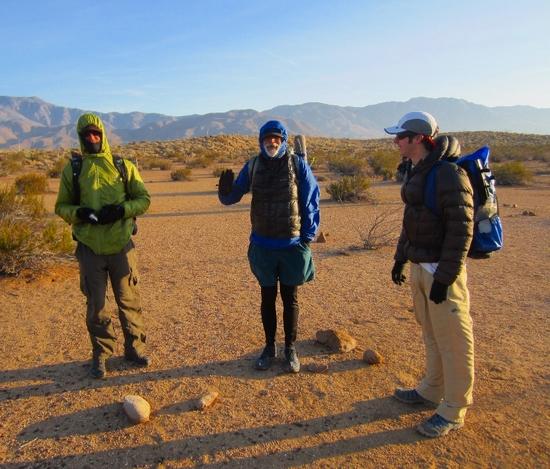
See that really good looking guy in middle? He had it dialed in for a very cold and very windy morning.
Bottom: Cap 1 bottoms under Patagonia Shorts.
Top: REI mesh shirt under Houdini, under Montbell Ex UL Vest.
Hat under hood: REI eVent baseball cap.
Fashion statement? .001 out of a possible 10.
Synth poofay not softshell dale
For an excellent explanation of how climbers layer light synth poofays OVER their windshell/softshell read this
http://kellycordes.wordpress.com/2010/01/28/the-micro-belay-parka/
It works well for climbing because its either stop and go in technical climbing or really effing cold and windy onnthe approach
Also the entire system is additive … Which means you live in your windshirt/softshell and almost never take it off … This should be your optimum layer at max exertion
If its colder you just add a light poofay, then a belay jacket
It means you dont take off your layers to put something on underneath the shirt … And thus dont lose het in the process
It works very well … But its really for colder weather
Its been well known among climbers for over 2 decades
;)
Separately, I just picked up a Patagonia Nine Trails jacket through their winter sale. I have no real experience with it yet. But based on the simple test of breathing through the fabric, I like the hybrid design. I bought it for running, but will give it a try backpacking as well.
Nick …
Thats an exl … It basically IS a windvest, well two actually with down inside
Were talking about an R1
;)
Eric….
I know :)
but it works!
> See that really good looking guy in middle? He had it dialed in for a very cold and very windy morning.
Where did Ponce De Leon find those green ultralight hiking pantaloons?
Synth poofay not softshell
Yeah, got that. With a Nonopuff that's like three windshirts and a bit of polyfill. I get the climbing thing and managing all the stop start and managing clothing around your harness and ropes while hanging off a rock.

> The OR Ferrosi is on clearance for half-off at REI ($61).
> Has anybody got experience with this?
The fabric is highly-breathable. It is constructed of two blends of 2-way stretch nylon/elastane. The blend on the shoulders and outside arms has less elastane, and is slightly less breathable than the body fabric. The stretch in the torso is vertically oriented. The hood works very well for me.
The three things I don't like:
The hand pockets are in the way of a pack's waist belt. (What were they thinking?)
The stomach area is not particularly trim fitting. Maybe it's about the same as Eddie Bauer First Ascent clothing.
It's a bit heavy.
I don't have experience with the DWR.
I also have the Ferrosi, which I bought just for rock climbing. Oddly enough, it's great for ski touring when there is no precip.
I had to size down to a small because it's cut very chubby in the stomach. OR stuff seems to be cut that way. The hood *can* fit over a helmet, but it's a really tight fit. Also, the chin part of the hood is very low and rubs against my neck in an uncomfortable way. This might just me the way it fits me personally though.
Wind resistance is fine. The breathability isn't great, but it's the best out of any softshells I have used. Not as good as the older Houdinis. It also takes longer to dry. I haven't tried the DWR.
Overall it is a nice ski and cragging jacket with good abrasion resistance. I wouldn't take it backpacking though. Too heavy and bulky and clammy compared to a proper windshirt.
The fabric on my Ferrosi is quite easy to breath through with the breath test. The jacket is almost new and has never been washed.
Michael, what level of air permeability is on the front panel of Nine Trails?
The Ferrosi shirt is very porous, as much or more than a Supplex shirt. I noticed that the fabric on the shirt that I got from STP is 86% nylon/14% elastane. It is model 55535.
The hoodie on sale at REI is spec'd at 91% nylon/9% spandex. There is yet another on REI spec'd at (Body) 86% nylon/14% spandex/(panels) 91% nylon cordura/9%spandex and that makes me wonder if the reporting on the sale model is correct.
To add to the fray, there is a Ferrosi jacket, which OR spec's at 86% nylon, 14% spandex, stretch woven (see http://www.outdoorresearch.com/en/catalog/product/view/id/41050/category/2158/) [model 55517OR]
There are at least three Ferrosi men's hoodies listed on the OR website:
http://www.outdoorresearch.com/en/catalog/product/view/id/41051/category/2158/ [model 55531OR]86% nylon, 14% Spandex stretch woven body and hood // 91% nylon Cordura®, 9% spandex stretch woven shoulders and lower sleeves
http://www.outdoorresearch.com/en/catalog/product/view/id/25590/s/mens-ferrosi-hoody/category/2158/ [model 55530OR] 91% nylon Cordura®, 9% spandex shoulders // 86% ripstop, 14% spandex body, DWR-treated, stretch-woven
http://www.outdoorresearch.com/en/catalog/product/view/id/44043/s/mens-ferrosi-hoody-1/category/2158/%5Bmodel 55530CLO]91% nylon Cordura®, 9% spandex shoulders // 86% ripstop, 14% spandex body, DWR-treated, stretch-woven
There are several women's Ferrosi models too. I'm not going there.
I've noticed similar with OR before. They crank out an amazing array of clothing. Try to ID an older OR hat. I'll bet there are a dozen variations on the Seattle Sombrero types. My understanding is that they have in-house production facilities, so they can whip up a new model on the fly. That would be so much fun to work with!
Become a member to post in the forums.
 New Gear with Aluula FabricsLighter, stronger, more abrasion-resistant, and highly water-resistant - explore ultralight backpacking gear made with ALUULA Graflyte fabrics. Engineered for exceptional strength, durability, and lightweight performance, ALUULA Graflyte helps reduce pack weight without sacrificing reliability, making it ideal for demanding backcountry adventures.
 © Beartooth Media Group Inc.
 Loading...