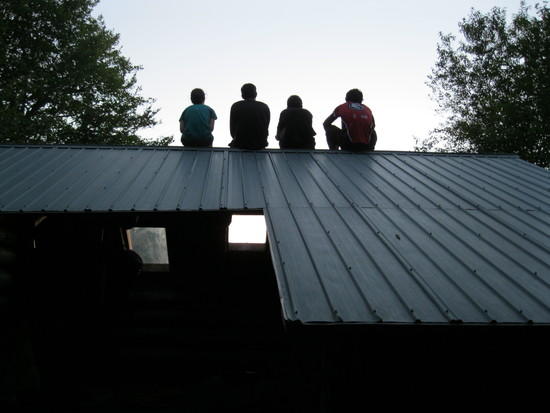
When you do it right, either with a camera or with a pen and paper (they are very different in execution), photography and drawing can bring an incredibly rich "seeing" of the world around you, mainly because you are intensely focusing on that. Good photography is not just snapping the camera. That's why great photographs don't depend so much on the camera, but on how the person with the camera is looking at things.
Topic
The “I don’t get it” thread
Become a member to post in the forums.
- This topic is empty.
Plus it is nice to share your experience with others who did not go. or to look back and remember and relive it again. With experience you can start being selective with what you shoot. There are only so many mushrooms, "neat little waterfalls", flowers, ferns etc before you need to just let it go ;) but nice landscapes, portraits, fun summit photos etc
This shot sums up a lot of my Long Trail experience in one shot.

I flip flop on this one all the time.
First 10 years of my travel trips, I never took a camera. Very similar to what David Thomas wrote a few posts above.
Then the last few trips, I started bringing my camera. On some of them, I was really snapping away — and glad to have it with me. On another one (two months' duration) — I took exactly 3 photos.
I enjoy being able to look back at a trip through pictures, but I noticed that taking pictures constantly can kinda ruins the fun. Mostly I like to share the photos with others. It works well when you have a good photographer hiking with you that will do all of the work.
Jake:
How dare you question me!
Haha, just kidding.
Seriously though, here is my reasoning behind the idea:
1) Standard days – makes it easy to calculate your consumables, and since, as you pointed out, a 2 night trip will use the same base gear as a 2 week trip, it will be easier to base the standard on a shorter trip length, and one that is probably the most common.
This also helps account for weights that otherwise go unaccounted for. Say your baseweight is 10lbs, and my baseweight is 10lbs. But, you use esbit and carry 6 ounces of fuel for a 3 day trip, and I use a canister stove and carry 1 pound of fuel for a 3 day trip. See, right there is unaccounted for weights that are a big topic here, but don't find there way into baseweights. Same for guy who uses efficent alcohol stove vs. someone who uses super fast but fuel hog alcohol stove.
2) Water – while this won't be relevant to me and you comparing weights, since the water will be the same, it will help people who are new to backpacking, or just new to BPL compare to us. It will also be helpfull to those that don't own a gram scale, and don't know about geargrams.com.
The whole idea behind my "standard" is that anyone and everyone can compare there "BPL standard" weight to someone else, and be comparing apples to apples. As it stands right now, you have people listing "baseweight", "skin out weight", "trailhead weight", "bone out weight", etc. etc.
With the "standard" any Joe Schmoe can step on a scale right before he leaves for a trip and have a good idea of how he compares to others, and where he falls in the traditional, UL, SUL, XUL scheme of things.
Another thing it would do is help account for different food preferences. Jimmy only eats olive oil and peanut butter and thus only carries 3lbs. of food for 3 days, while Rebeca brings two steaks, and a repackaged bottle of wine on a 3 day trip, and wonders why her trail head weight is 35lbs. despite her 10lb. baseweight. Well, with this system, she can better figure out where the extra weight is coming from.
Anyways, it's just an idea I had that would make things easier for people to get a better understanding of what they are actually carrying on the trail.
Maybe I should give this topic its own thread, if there is interest in discussing it further.
> 12oz bottle of HEET is $5 on Amazon.. 12 boils 4oz canister of isobutane is $4.5-5.50 and is 15+ boils. never leaks, never spills, boils 1.5c of water in 3 minutes.
That's some seriously expensive Heet. Even in Aspen, CO, I picked up a bottle for $2.50 at a Shell station downtown. You should be able to get at LEAST 18 boils out of a bottle. I get 20-22 (using a Super Cat) though some of my boils are just 1 cup.
I think the main reason I haven't felt compelled to spend the money on one is that my normal hiking shirt (BPL Thorofare) pretty much acts like one. It's tightly woven so insects can't bite through. It does not however have DWR so I'd need to add the rain layer if conditions dictate.
My neurons don't seem to recall as well as David's or Ben's. I like to relive the trip and share with others. I'm fairly selective on what I'll take pics of but will admit I'll sometimes take a lot of a particular scene and at time think I go overboard. I've moved toward taking more video than pics so I can document the trip better. I prefer video trip reports than photos and text.
I used to "not get" this "Base Weight" and "Skin Out Weight" fanaticism, but now I do. In terms of Base Weight, it's still confusing to anyone that is concerned with the more basic "what's my pack going to actually weigh when I hike" issue, but it's useful to isolate weight and gear issues. Of course, it's also useful to brag with misleading-ly low numbers, ha ha! The part of "skin-out" that I get is that it's dumb. (Yes, I get it clearly and anyone that likes "skin-out" numbers doesn't get it. Everyone but me is crazy, etc…) Finally, although I "get" Base Weight, I still focus and prefer Pack Weight/Trailhead Weight/Carry Weight.
I still don't "get" floorless shelters, Reflectix sleeping pads, 5-toe shoes to backpack in and the ascetic "take the bare minimum to survive" approach. I have been lured and swayed by Tony Ronco's "Comfort UL" (or "comfort light") even though I carry WAAAAAY more than he and his crew do. Come to think of it, I think he uses floorless shelters. That man needs help.
"2 night trip will use the same base gear as a 2 week trip"
For what it's worth, my base weight's usually significantly different for a 2 night trip vs a 10 night trip. Even if everything else were the same (which it's usually not, see below), 12 extra pounds of food would normally push me up to a different pack.
My base weight will also vary based on expected weather, terrain, proximity to potential exit points, recreational opportunities, and whether solo or group.
Best,
Bill S.
"For what it's worth, my base weight's usually significantly different for a 2 night trip vs a 10 night trip. Even if everything else were the same (which it's usually not, see below), 12 extra pounds of food would normally push me up to a different pack."
Agreed. I usually only do overnight trips when the weather forecast is good. A 10 day trip means I pack for every kind of weather imaginable, including extra food and water if I should get caught by a swollen river or whiteout. This means my tent, sleeping bag, clothing, stove and fuel choice are different, as well as the extra food. For an overnight, I would not even bother to carry stuff like toothpaste, toothbrush, washing supplies etc…, and may just throw in a Frogg Togg just in case. Longer trips I will take a more durable rainjacket. So to me, base weight, skin-out, total weight and all that nonsense varies by trip, and also by whether it's just me or me and my partner.
I don't get why people freak out about cotton clothing.
I wear a simple cotton t-shirt 90% of the time, but it's usually mild weather when I hike. I get a slight cool down from sweat when I stop, but it's not that big of a problem. They are comfortable and cheap and don't smell horrible after an hour of hiking. Polycotton is really good too. If the weather gets nasty, I always have a wind shirt and a non-cotton base layer to throw on.
What I REALLY don't get is people wearing synthetic shirts in the middle summer when it's scorching hot out. Why would you want a wicking layer in a hot environment? Maybe I just don't sweat enough to get uncomfortably sweaty.
Denim pants aren't that bad either if the weather is dry. They protect your legs much better than thin nylon pants if you are bushwacking or walking through prickly thorn stuff.
I'm just tired of people treating cotton clothing as if it's always unacceptable for hiking in any situation.
Justin, I agree with you 100%. Cotton is overly demonised in backpacking circles. And I like silk too :)
Definitely agree with both of you. I wonder, sometimes, how many people in the backpacking circles have hiked in super high humidity or jungles. You want just the opposite in those situations, where trying to stay cool means something that doesn't dry out too fast, and the danger of hypothermia is nonexistent. And why would anyone want to wear a synthetic layer in hot, humid conditions when you want something that breathes as much as possible? Both nylon and polyester breathe terribly compared to cotton (or silk). It's different from hot, dry conditions, where you can get cool in the shade.
A cotton bandana makes a great towel and neckerchief.
"cotton kills" is the easy way out, saves having to explain when and why.
(BTW, cotton does not kill, it is people that wear wet cotton at just above and below freezing that kill themselves)
oddly well below freezing cotton is good again.
Anyway, I wear a wool T (or cotton) when it is really hot, so there.
@Miguel
Yes a wet cotton bandana (OK I use a hankie…) around the neck helps a lot too when hot.
I always have a large cotton hankie with me.
(and the Buff…)
Cotton doesn't kill people. Cottonmouths kill people, or make them very sick.
Still, I never wear cotton while backpacking. I don't want to get bit.
Seems "a lot" of people don't get it.
For gear brought, think about what you actually need (on your back).
A warm enough jack to lounge around in.
A sleeping bag that with the jacket is warm enough.
Food, maybe a can stove and gas to cook.
A pad
About 4 ounces between sun block, and toiletries.
Pack and maps.
So look at everyones pack lists, there are 3-4 times as much crap in them.
I don't get it…
Oh really, Aaron, why do you need to cook food?
He did say maybe.
Aaron doesn't look like he eats very much. Probably dispenses with the stove.
hmm.. i find cotton to be pretty damn abrasive when it's sweaty/wet. when i was younger and wore cotton tshirt i'd always have chaffed up shoulders and hips from my straps. now it's wool or synthetic. i wear carharts for rock climbing but they are pretty rough for lots of hiking and hot too. nylon zip offs for me.. no bushwacking here.
"Cotton doesn't kill people. Cottonmouths kill people, or make them very sick."
I hate it when I get cottonmouth. Makes me stop for water more often….
what about something to keep the rain off (while moving and while resting – seems nescessary.
Something to ancor this shelter to the ground with is nice when it windy.
A pot to cook the food in (& eat it out off) is handy. And a lid and windshield is nice so you can carry less fuel. Some device to start the stove helps.
Container to protect your food from critters is helpful in many hiking areas.
But yes many thing aren't really essential to getting by while out…just essential in determining how well we get by. Each enviroment coupled with each individual will demand different things for getting by and getting by well.
I would rather get by with half the weight then fell like I need what I really don't.
Then again, some people don't get why you have to go so light when some of the stuff they carry "only" weighs a few pounds.
I don't get the whole " let's see how low, cold, uncomfortable I can go and still make it through the night". I have seen it over and over, as if it is an achievement worthy the risk or even just the discomfort.
Two things I don't get….
1. This need to compare with others. Don't get me wrong, I value other hikers' opinion and experience. But at the end, it's whatever works for me. Which brings us to #2…
2. The need to explain or justify to others.
Become a member to post in the forums.