Topic

The “I don’t get it” thread

  • This topic is empty.
Viewing 25 posts - 101 through 125 (of 221 total)
Justin Baker BPL Member
PostedMar 11, 2013 at 8:59 pm

You don't even "need" a sleeping bag. Just sleep by the fire all night. I'm being completely serious here. I have done this a couple of times in warm weather and pushed a 35 degree bag into the teens more times than I want to admit.

I am not recommending this, but if we are discussing what we "need" then… yeah.

Kattt BPL Member
PostedMar 11, 2013 at 9:12 pm

Comparing….it's human nature. Not that it makes right, but we seem hard wired for it.

Ian BPL Member
PostedMar 11, 2013 at 9:51 pm

"I don't get the whole " let's see how low, cold, uncomfortable I can go and still make it through the night". I have seen it over and over, as if it is an achievement worthy the risk or even just the discomfort."

Amen. To each their own but I'll save weight anywhere else but my sleep system. Freezing through the night is serious type three fun.

Justin Baker BPL Member
PostedMar 11, 2013 at 11:03 pm

Cold, uncomfortable nights can really wear you down and ruin your energy for the next day/

PostedMar 12, 2013 at 12:13 am

Stephen M. wrote, "…and I see skin out weight as anal retentive…"

Haha, glad i'm not the only one (actually, i don't really care too much one way or the other what others do or don't do, but in the spirit of this thread…) Only exception is my footwear–i do pay attention to weight of that.

PostedMar 12, 2013 at 12:49 am

" 'Justin, I agree with you 100%. Cotton is overly demonised in backpacking circles. And I like silk too :) '

Definitely agree with both of you. I wonder, sometimes, how many people in the backpacking circles have hiked in super high humidity or jungles. You want just the opposite in those situations, where trying to stay cool means something that doesn't dry out too fast, and the danger of hypothermia is nonexistent. And why would anyone want to wear a synthetic layer in hot, humid conditions when you want something that breathes as much as possible? Both nylon and polyester breathe terribly compared to cotton (or silk). It's different from hot, dry conditions, where you can get cool in the shade.

A cotton bandana makes a great towel and neckerchief."

I don't mind poly/cotton blends so much, but i really prefer either pure linen or high linen blends, when it's very hot and especially muggy out. To me, linen has the perfect balance of absorbing, and evaporating moisture at a nice fast, but not too fast rate. Linen also has odor managing properties similar in effectiveness to wool, but since it's so much stronger than Wool (it's 2 to 3 times stronger than cotton which is already stronger than wool), it can be made thinner, and thus will dry out faster. Being hollow fibers that are primarily cellulose (but also lignin) and thus highly absorbent in nature, it acts like a super wicking straw that sucks and absorbs the moisture right off the skin to evaporate nice and evenly throughout the fabric–NOT just on the surface like synthetics–especially pure polyester.

Something i would like to try, but haven't found yet, is Linen-Nylon blends.

Linen can be expensive, but i've bought most of mine at thrift stores, the occasional store closing, or the really good, occasional sales at Men's Wearhouse. So yeah, i don't get why linen isn't more popular for hot weather hiking/backpacking.

Nothing so far beats it, imo and ime. However, i would like to try a 70% or so Linen to 30% or so microfiber nylon blend. Increase the strength, resilience, and drying time somewhat. (however, pure Linen does tend to last a lonnng time in and of itself).

A decent alternative to Linen imo/e is Tencel-Poly blends. I have a couple of pants that range from 40 to 60 percent tencel to 60 to 40 polyester and a t-shirt that is primarily tencel with some poly, and these too are nice for hot weather, but not quite as cool as the linen.

Bill Segraves BPL Member
PostedMar 12, 2013 at 6:00 am

A couple of people mentioned the undesirability of a garment material that dries *too* fast. I'm having a hard time thinking of specific circumstances under which that would be a problem. (The only one I've come up seems really obscure and easily avoidable.)

Thoughts on when/whether this would ever be an issue?

Thanks!

Best,

Bill S.

David Thomas BPL Member
PostedMar 12, 2013 at 6:59 am

Bill, I prefer a cotton shirt – either a T-shirt or an old collared dress shirt for a Grand Canyon Rim-River-Rim in summer. I find I feel fresher if I wet such a shirt from any stream crossing or water station than to sweat that much moisture to cool myself. A wicking shirt just doesn't hold water and isn't as cooling.

So it is a short term situation, I suppose – 7 or 8 hours solo or 9 with a grade schooler along.

Now for Eugene's R2R2R which was much earlier in the year and started and ended in snowstorms, there was no cotton on me.

Bill Segraves BPL Member
PostedMar 12, 2013 at 7:12 am

Thanks, David. That's helpful.

Just to be sure I understand, it'd be for hot, low humidity conditions where water sources are relatively infrequent, to allow you to spread out the cooling effect over a longer period of time? I get cooled nicely if I soak the poly/nylon blend shirts I usually wear, but it doesn't last very long. Same amount of cooling per gram of water though, right, so I could in principle recoup by carrying some extra water and re-soaking the shirt? (Not that I'd want to, in preference to your solution, just trying to be sure I'm understanding the underlying science.)

Cheers,

Bill

Elliott Wolin BPL Member
PostedMar 12, 2013 at 1:13 pm

We always use totally soaked cotton t-shirts in the really hot weather, they work great. And nothing holds water better than cotton!

Although come to think of it, just after Douglas Adams' anniversary, maybe a cotton towel would be a better choice…

PostedMar 12, 2013 at 3:46 pm

I've been trying to think what it is that I really don't get, and this morning, while browsing for waterproof shells, it came back to me… I don't get outer shells that are shorter than the shirts you wear underneath them. What is the point? Your shirt sticks out from below the hem and gets wet. Unless you wear your mid layer tucked into your pants, I see no advantage to this. And so many outer shells are designed to be short like this, with hardly any alternatives! Am I the only one who is frustrated by this?

Justin Baker BPL Member
PostedMar 12, 2013 at 8:37 pm

Even in cooler weather (around freezing), I have hiked in all cotton and been fine. It's not the ideal fabric, but it's not going to kill you unless it gets wet. The slight cooling from sweat tends to be more of an inconvenience than a problem. However, I don't sweat all that much.
What I am trying to say is someone can go backpacking in their street clothes in mild weather and be perfectly fine.

PostedMar 12, 2013 at 8:46 pm

It is amazing that this thread is the busiest on the whole site. Mostly over Cotton of all things!
My two cents- cotton is why some Wise Man invented Anti Monkey Butt Powder! I guess the abrasiveness was more than he could bear??

PostedMar 13, 2013 at 10:41 am

Bill wrote, "Just to be sure I understand, it'd be for hot, low humidity conditions where water sources are relatively infrequent, to allow you to spread out the cooling effect over a longer period of time? I get cooled nicely if I soak the poly/nylon blend shirts I usually wear, but it doesn't last very long. Same amount of cooling per gram of water though, right, so I could in principle recoup by carrying some extra water and re-soaking the shirt? (Not that I'd want to, in preference to your solution, just trying to be sure I'm understanding the underlying science.)"

Another plug for linen: I live in the Southeast (central VA), and so experience a lot of hot, rather humid weather. If you compare the thermal conductivity of different common fabrics it goes like this from least thermally conductive to most; polypropylene, silk, polyester, wool/acrylic (silk, poly, wool, and acrylic are relatively close to each other) , nylon, linen, and cotton.

Where i live during the hot weather, you want something that absorbs and/or wicks moisture fast off your skin, and also releases it relatively fast, while being fairly thermally conductive at the same time. The only thing which fits this bill, in both my experience and research is linen (and hemp, these are very similar).

However, in the Sun, you want some thermal resistance. Linen has more thermal resistance than cotton because it has hollow fibers, and so it does insulate you some from the Sun as well–definitely more than cotton.

I've tried different types of fabric for those hot humid days, and so far my linen shirts seem to keep me the coolest of any. The next best that i've found is high nylon content with some cotton or tencel (so like 65 to 75% nylon to 35 to 25% cotton or tencel). However, untreated nylon is one of the fabrics most quickly broken down and degraded by UV rays.

Pure cotton i only like for desert like conditions of hot and very dry, but even then it's not ideal because there is so little thermal resistance, and processed cotton doesn't have much UV protection–unlike linen and hemp, which are naturally highly U.V. protecting and resistant. Linen holds water longer than the synthetic fibers (given similar thickness, weave, etc), but releases it noticeably faster than cotton.

There are probably good reasons why so many of the earlier Euro and American explorers of Africa and Asia typically wore light colored, loose fitting, and long all Linen clothes. Because it worked.

Plus Linen, like Wool, is great at controlling and minimizing odor. It is commonly known as the most hygienic fabric.

PostedMar 13, 2013 at 10:58 am

Hi Miquel,

My guess is why some WPB shells are designed that way, is probably to increase aeration? A shorter and especially if also wider outer shell will breathe better than a longer and more narrow one.

If that is the case, it's a good tradeoff to me to tuck in my mid layer into my pants.

Rob P BPL Member
PostedMar 13, 2013 at 12:41 pm

Scandinavian outdoor gear seems to use a fair amount of cotton. I remember some of the Lundhags trousers having a fair bit of cotton, for example.

jscott Blocked
PostedMar 13, 2013 at 12:41 pm

Cotton is a poor sun shirt–or hat, for that matter. The rays just shoot on through. One reason that a cotton bandana draped from a hat for sun protection is not as good as it seems.

PostedMar 13, 2013 at 1:19 pm

Going to have to dsagree with you guys on the usefullness of cotton.

1. It's heavy
2. doesnt breath as well as say a nice thin smart wool shit
3 it might be warm/hot during the day but in the desert that changes at night (same with the sierra's my backyard)and nothing is worse than a cotton shirt that wont dry before you go to bed in your down sleeping bag(i dont carry much extra clothing if any and use almost everything i bring in my sleep system to save weight)
4. i have seen first hand someone(my dad) get VERY cold cause he wore cotton out for one of our winter split boarding trips on a really nice day. its soaked through from sweat and when the sun started dropping he was not comfortable at all.

I can only see one use for cotton out on the trail and that is to get it wet and wrap it around you. but not worth the weight IMHO. Rather just have a loose fitting breathalbe exificio or columbia collared shirt. you barely even know they are there andthey protect from the sun.

The mitts thing i could see only because a lot of people get really cold hands and other do not. I personally do not.

Wind shirt-dont really get it either. I have read every single entry in this thread and still havent found a use mentioned that is not covered by another piece of gear I HAVE to already carry. But that is my personal gear list and every one has there own. I guess I could replace a piece of my gear with it and it would be lighter but as i said i use all my clothes(summer spring fall not winter)in my sleep system and that would change things.

I dont really get hammock camping in winter. With all the crap you have to get to bring that thing out there(huge tarp,under quilt top quilt) you would just be better off on the ground. But my winter philosophy is the opposite of my summer I pack heavy(ie. filet, wine, fondue extra everything) and drag it in a sled so me and my dad end up in a Kifaru 8 man tent with a wood burning stove heater for just the two of us.

PostedMar 13, 2013 at 2:23 pm

Scandinavian outdoor gear seems to use a fair amount of cotton
That is why I stated that "cotton kills" is used to save having to explain…
Cotton breathes very well so it become useful again at well below freezing point when the air is dry so there is no chance of the material getting wet (from rain or humidity).
On the other hand in really hot weather when a layer that stays wet is desirable it works as long as you are flexible enough to have another layer for when the temperature drop.
So as usual you need to have the whole picture not just one bit of info and most of all apply some "common" sense…

Just to amplify that a bit and this has to do with how I think not necessarily "scientifically" correct…
If I hike in really hot weather , 90 plus, and I have a layer that once it gets wet (cotton or wool) stays wet for longer than a wicking type I will than sweat less because I am already wet.
Sweating less means that I can drink less, that means I don't need to carry as much water.
Now a shirt to wear at night once I take my wet layer off is going to be 8 oz (mine is…).
Having had that wet layer on during the day probably saved me a lot more than 8 oz in water and I have a clean layer on at camp.

PostedMar 13, 2013 at 2:33 pm

defranco? hope I spelled that right?

Yeah I guess the really cold would work as long as you dont sweat. and I guess that depends on the definition of what is really cold -5F -15F -20F -60. I know at -10F If I was active I still would not want to be wearing cotton(personally). Below that I cant speak from expierence so I couldnt say.

Justin Baker BPL Member
PostedMar 13, 2013 at 3:27 pm

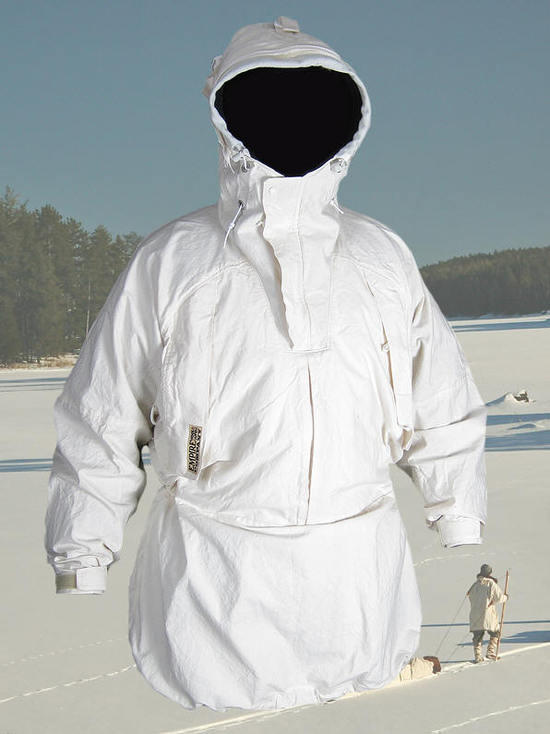
Cotton makes great outerwear for cold winter weather. It makes terrible base layers and insulation layers for cold winter weather.
Canvas anoraks are very popular for cold snow camping. The block the wind and snow and breathe well. They won't get wet in very cold conditions. They are similar to soft shells, just older technology. Some people claim that canvas breathes much better than modern winter outwear.

Check out the Empire Wool and Canvas Company Arctic Anorak:
http://www.empirecanvasworks.com/arcticanorak.htm
a

PostedMar 13, 2013 at 4:04 pm

Outer layers now there is a concept that I havent thought of. That does look promising! But it would still have to pretty cold for me to wear cotton in the snow. But that is an insight i havent thought of and definately adds to the usefullness of cotton.

I'll stick with my FF volant jacket and pants. Probably half the weight for 5 times the price(I cant see that site at my office).

I know of a couple companies that make wall tents out of heavy canvas meant to be used in winter but that stuff is seriously heavy duty. So I guess I should have known some one woulod make a jacket for similar use. what about oiled canvas? do you know if that is breathable?

Justin Baker BPL Member
PostedMar 13, 2013 at 6:27 pm

Oiling or waxing canvas really ruins the breathability (the oils and waxes also add a ton of wieght). Anoraks used for cold snow hiking aren't treated with anything. Canvas mukluks/booties are also very popular for cold snow hiking and aren't treated with anything.

You can take a canvas anorak (or any heavy cotton jacket) and wax/oil it to make a really good, tough rain jacket that is mostly waterproof. This is what they used for rain gear before the invention of rubberized rain jackets. It will last for years and years of heavy use. But a modern rain jacket is much better and lighter for backpacking.

PostedMar 13, 2013 at 8:52 pm

Well atleast you changed my stand point on cotton to some degree.

lets get this thread back on track "I dont get" Ultra light winter back packing. I have to carry so much extra gear to keep warm I just dont really get trying to lighten that up. Nor do I get carrying a back pack. Sleds/pulks are so much easier to drag. You might have to change your path some times or be creative up steep areas but nothing a rope and two people pulling it cant solve. This is just for winter backpacking obviously is your goals are to just summit peaks a sled wont work.

Ive done side hill steep up hill and let me tell you I love down hill. I use a split board so I just glide the whole way no energy spent. Maybe some one can shed some light on this for me.

What advantages does a backpack have over a sled in deep snow?

Viewing 25 posts - 101 through 125 (of 221 total)
Loading...