Bob is correct on the highest recorded temperature, at least from the last time I checked. People do tend to exaggerate temperatures.
Craig, good call by your wife. Remember our 105F hike? 105 vs 120 is another universe.
I have lived and hiked in the lower desert for over 30 years, and like to say I am acclimated — meaning the heat affects me less than others — but we cannot truly acclimate to this kind of heat, but we can adapt or strategies for survival. Our bodies are going to work very hard to keep our core at 98.6 F; which means we are going to sweat a lot as the temperature goes up.
And as our sweating increases (evaporation in an effort to keep the core temperature at specs), we are going to lose precious body minerals, as Gary shared earlier. Lose too much in the way of body salts/minerals you will get sick and often irrational — I know, it has happened to me a couple times. Many people take salt tablets, (which upset my stomach). I like to eat Pringles, which have gotten me through some difficult situations, but salt alone is not going to replenish everything you need; not to mention your thirst increases when you eat salty foods.
I usually avoid hiking in really hot weather, but do hike in triple digits. When it gets to 108 or above, then I am hiking at night and resting under a tarp during the heat of the day… but even under a tarp I am not truly comfortable and it is difficult too sleep. Also don't assume low deserts have low humidity. Some years it is not unusual for tropical storms to come up from Mexico and 117F with a 90% chance of afternoon thunderstorms happens. You do not know what "crotch rot" is unless you have spent a week in 117F and 90% humidity. Another thing, when daytime temps hit highs of 120+ you can normally plan on the temperature at midnight to be 100+.
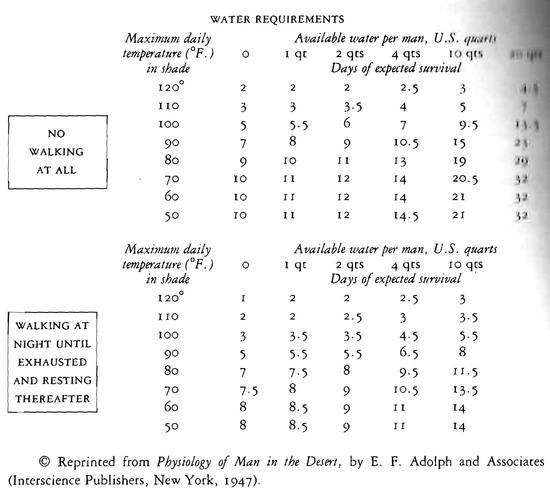
Here is a table from The Complete Walker, by Colin Fletcher that shows how much water is needed to survive; and survive in this table means how many days until you die.