


@Reese – I take back what I said directed to you. When one brings up the word 'Troll' there are bound to be responses.
Happy Sunday.
But… I will believe it when I see it. And I would like to see it now. Full proto specs.
Topic
Become a member to post in the forums.
@Reese – I take back what I said directed to you. When one brings up the word 'Troll' there are bound to be responses.
Happy Sunday.
But… I will believe it when I see it. And I would like to see it now. Full proto specs.
Interesting thread and interesting packs. But almost laughed myself off my chair when I saw the price tag.
Raymond
I offered numbers, we could have it tested? The guys on the MYOG forum are pretty good at this kind of thing. With a tear strength of ~300 lbs, and a puncture resistence of ~25psi, I'm sure there are some people that would like to get their hands on this stuff. Maybe I am wrong, testing would be the only way to determine this. Its just that I've read allot of claims about fabric, and where its from, only to know otherwise. But like I said there is an imperical way to do this. Thats what the gear forum is all about.
David
It may be rare for some manufactures to jump in the way I did, but not for me, I'm class-less. Thats just how it is in a gritty world. Not too long ago I even talked someone out of buying my gear on this forum, thats just me. :-)
I'm surprised no one has brought up our over the top, web blitzing, add campaign we have had running all week. That alone would prove just how bad it all is. Maybe I need a bigger clock and more jester colors, to grab attention.
'High Tenacity Nylon' is an important qualifier. It means
the nylon has a higher strength than some of the less
expensive nylons.
Adding a PU coating will decrease the
tear strength, while sil increases it.
A lot of low strength synthetics come
from overseas. Some of the beautiful sewing I have seen on some bags from Asia, combined with really poor
quality fabric, just makes me cry for the sewists there.
American made is a good thing in my opinion.
Dave
Correct me if I'm wrong, the type of coating and its effect on tear strength, depends on what kind of tear strength we are measuring, right?
In this particular case the high tenacity refers to the use of type 66 nylon which has been among other things, "stretched" more than standard type 6 nylons, justifying the "high tenacity" claim. That should narrow this down for some of you. So have you ever seen any "high tenacity" nylon with a tear strength of 300lbs?
Hi Josh
I am curious as to the weight in grams/sq metre and the water pressure rating of the fabric you have. My apologies if this has already been given, but I could not find it.
If you don't know the pressure rating you could send me a sample and I can test it for you. I have a Suter tester.
cheers
Roger
I'll send you samples after the first of the year when things slow down. You want to do the tear strength tests too?
The tear strength I have seen listed for .25 oz. silicone coated 30d type66 is 15 lbs. At one time they
listed it at 25 lbs. Don't know if the fabric or method
of measurement changed.
For 70d imports with 1 oz. PU coating,
9 lbs.
For 70d domestic with .5 oz sil/pu blend coating, 18 lbs. (this was the red I sent to Roger to check out).
I had a daypack that survived years of daily use in the
rough granite of the Sierra Nevada and Joshua Tree that
was made of standard 210 with a PU coat. That material
doesn't have a very high tear strength either, but was
better than 30d for UV and abrasion in my experience.
For daily use and larger loads of a multiday, multiactivity pack, I would go with a 210
with a silicone coat and put something heavier on the
bottom 1/5 of the pack.
I am still testing cuben fiber applications.
Photos posted on other threads.
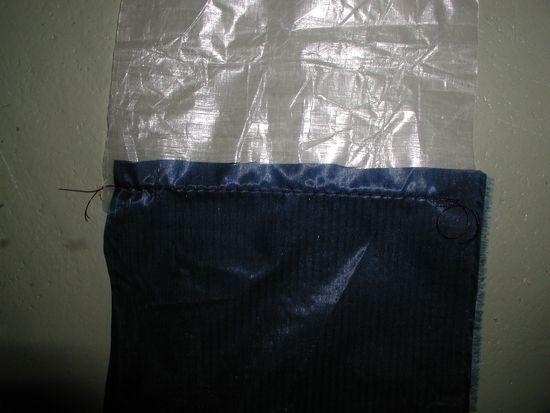
Dave
I'm pretty sure the 15lbs number would be a puncture number, its similar to human skin at ~13. This number can also be affected by coatings, I'm pretty sure its another place where sil shines. I'd like to see some 25lbs stuff, Sil would make sense with numbers like because its fairly stout rubber membranes that have numbers like that.
With tear strength, there is grab and tongue tear stength, it depends on how you tear it. It is the tongue tear strength that is reduced by the application of firm coatings like PU, where as Sil can actually increase this number, as you mentioned. An exception to the PU coating rule would be thermoset PU coatings, they flex like sil and add to the tear strength. I'v got a project pack I'm doing with 70D thermoset PU, that I think will be pretty darn tough. Grab tear strengths are based on the force required to pull a peice of fabric apart in the same manner you are using to test seams. The ~150lbs, or,…uh… I mean 300lbs, number would be a grab tear strength number. Or maybe someone read the columns wrong?
Hi Josh
> I'll send you samples after the first of the year when things slow down. You want to do the tear strength tests too?
Suter water pressure test is easy.
Tear strength – you need to specify (in detail) what test (or Standard) you want. There are a number of configurations. If the fabric has been tested at all, there should probably be a test report already, and that would be better as the test lab will have more experience than me with that Standard.
Cheers
If I am remembering correctly, I dont have the reference info in front of me, the 15lbs number could be the Grab tear strength number. I believe the puncture numbers are very similar to Grab numbers with Sil. Its been awhile.
I agree. The only way to get this figured out for sure is to test some. I have no idea how to do that or even what needs to be tested. I emailed a few at Kifaru and haven't gotten a response so we might have to do this on our own. One thing for sure is we need to get the material from Kifaru to be sure it's exactly what they use.
That raises the question on what tests should be done and how much material we would need? I'd think we'd want to compare it to the typical stuff used in tarps? One problem would be getting material. Maybe Mel could help out with that?
I think we're back on track now.
Roger
Grab is done across a specified width. Tongue uses a hook/pin of particular dimensions. And puncture is also done with a pin that has particular dimensions. I'll dig the details out, or look them up again. The tear and puncture tests need not be to industry absolute standards. If identical tests are performed on several "regular" silnylons, to establish base line numbers. Then regardless of what those numbers are, say they are 2, then all we are looking for in a straight comparison is the number 4.
guys … you can comment and dice all you want
i invite you to stuff a goat in your pack and carry it a decent distance
and no i dont hunt or have anything to do with the funky named pack in any way
IMO … if it works and it doesnt fail … that what matters
"stuff a goat"
Live, or dead?
–B.G.–
live bleaters get bonus points bob
if the pack survives a living goat inside …. its definitely bomber!!!
of course competitors could up the ante by putting a live bear in theirs …
Bob
Really?…his nick name is Bear breeder….;-)
Eric
There are several packs at that weight range that can haul that kind of weight. It comes down to some long known facts about silnylon. The particular written claims about the fabric, are lofty to say the least.
Thanks for the laugh! Bleating goats!……:-)
A live bear probably would not fit.
Try a wolverine. Any pack would be ripped to shreds.
–B.G.–
I'm on my way up the mountain to wrestle down a good sized "billy goat", stuff him in the KU and see if he can figure out the tear strength (of the KU) on the pack out back to the truck.
I speak fluent "MTN GOAT", so I'm hoping the data that I get from him will work for now.
I will also swing by Kifaru and ask for a sample for someone one BPL to test.
Josh
I was curious about the packs in the KU weight range that can handle 150-180 lbs, could you list a few of them for me?
"The ~150lbs, or,…uh… I mean 300lbs, number would be a grab tear strength number. Or maybe someone read the columns wrong?"
Since I have personally tested the "grab tear strength" of the KU packs, I can say that it held up great at 300 lbs. I don't know that I did the test correctly (text book), but I will explain what I did when testing the materials strength.
I took a 2' x 2' section of the material and tied a knot at one end, I then tied a small section of 550 cord to that knot and tied the other end to a bench press bar with 7 45lb plates attached to it, I then picked up the bar with the other end of the material…. I did not tear or rip. I know this is a bit "redneck", but for what I use packs for, it seemed to be the most logical way to test the materials durability.
How far is the truck?
Well, this years goat hunts were 2 miles and 3.1 miles, but I'm thinking the snow is going to slow me down today and it may be a few miles before I get a chance to use my Jujitsu on the billy……. It could be a long night…. and a LONG pack out, but at least I'll have the goat to keep me company!
Take some pics. I get tired of looking at Mystery Rants.
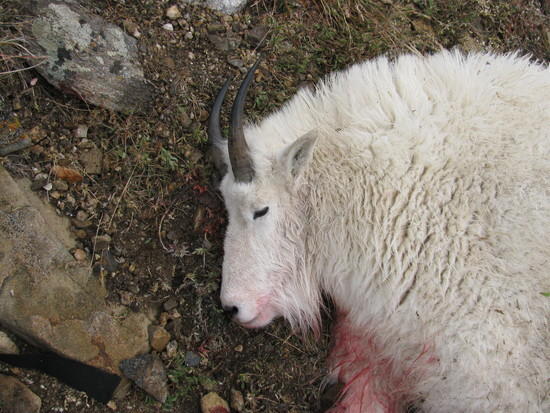
It was easier than I thought, but I had to choke him out!
If you were testing hammocks that would work fine.
So now its 180? :-) How about you let us know how its doing when you get the first 1000 miles on it. And yeah the fabric sample would be great, I'm sure some one is will to do the testing.
Become a member to post in the forums.
 Tactical Wool Thermo ShirtSuperfine merino wool-blend mesh baselayer with a slim unisex fit and densely knitted shoulder panels for pack-carrying comfort. Weighs 4.9oz | 140g
 © Beartooth Media Group Inc.
 Loading...