


Introduction
Once upon a time, Polartec Alpha and then Polartec Alpha Direct were the only fuzzy fabrics. I bought a Rab Alpha jacket and later a Rab Alpha Direct jacket. I’ve been singing its praises on BPL for its high warmth-to-weight ratio and excellent breathability (MVTR).
Fast forward a few years, and more contenders have emerged. Are they just pretenders to the throne, or do they improve performance for this fabric category?
In this study, I compare the performance of Polartec Alpha Direct, Primaloft Evolve, and Teijin Octa (in three different fabric designs).
Here is what we will learn: Which has the best MVTR? Which has the best warmth-to-weight performance? Which has the highest R-value? Which requires the least drying energy, and which dries fastest? Are there specific cases where a single fuzzy fabric would offer a better solution than the others?
Here is a little of what we shall see.
- These are very different fabrics. Their construction is dissimilar, and those differences in construction help explain their performance relative to each other.
- Fuzzy fabrics can take about twice as long to dry as conventional fabrics. However, they require about the same amount of energy to dry. This means that, as they dry, at a point in time, you won’t feel as cold as you might with other fabrics. However, if you are drying them with body heat, the toll on your body will come from the amount of water trapped in the fabric, and this will be similar across all fabrics that hold a comparable amount of water.
- Fuzzy fabrics tend to work differently depending on which side faces out. This will vary depending on the fabric’s construction.
What is a Fuzzy Fabric?
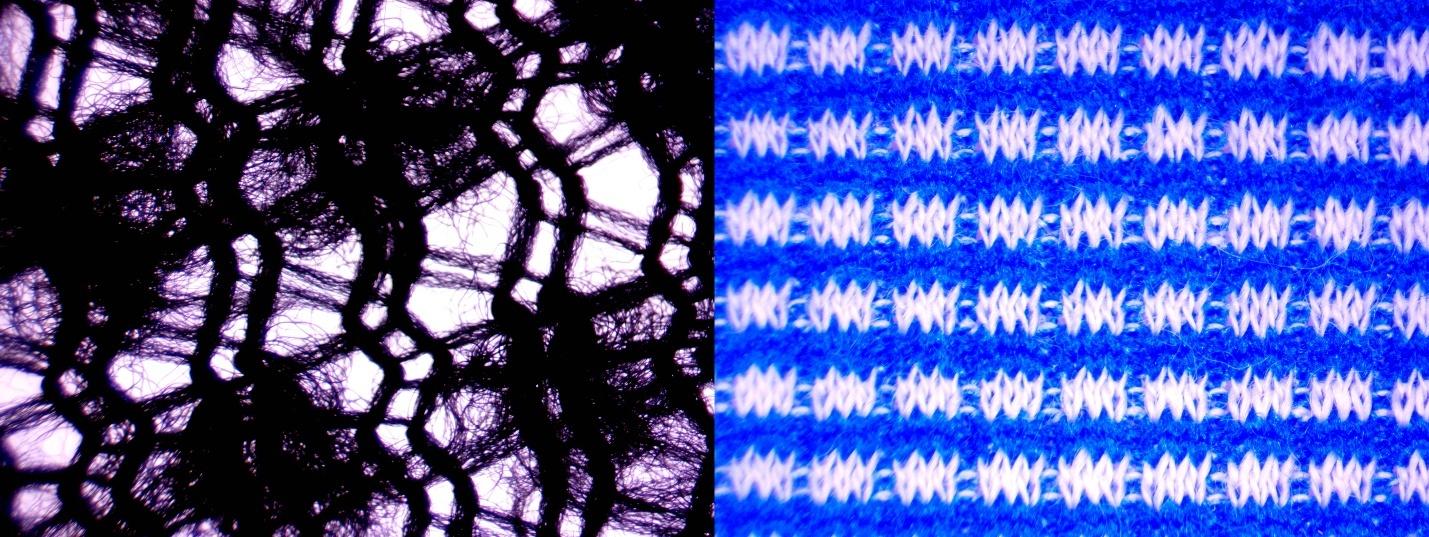
Fuzzy fabrics trap more air using less structural fiber, creating open, lofty grids. This structure improves insulation efficiency and breathability but can compromise durability.
Compared to conventional base and midlayers, fuzzy fabrics, in general:
- Trap more air with less fiber.
- Have lighter fabric weights
- Show higher porosity, air permeability, and MVTR
- Retain more water when saturated
- Take longer to dry but require similar drying energy
- Are more prone to snags and abrasion
What do our Fuzzy Fabrics Look Like?
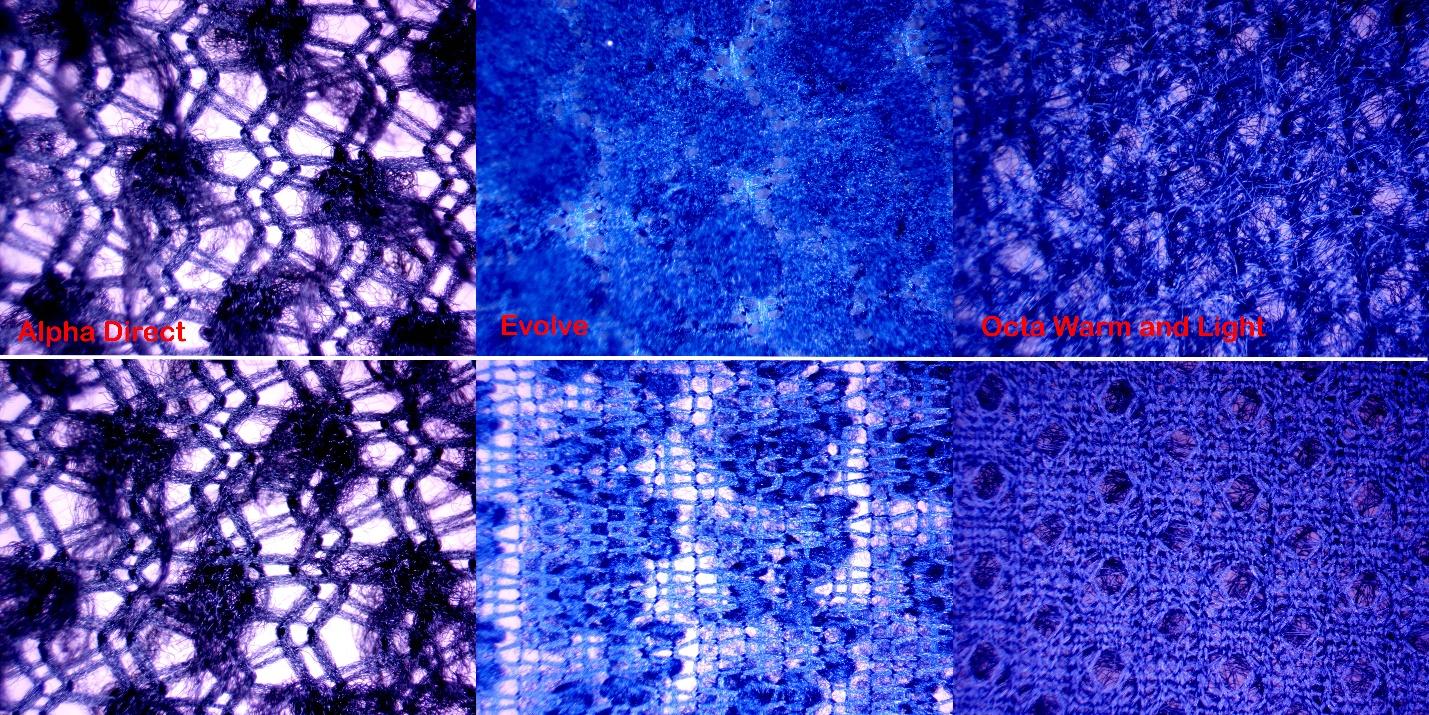
Figure 2 shows “typical” fuzzy fabric: fabrics with relatively high loft and large visible voids. Alpha and Evolve are somewhat similar: they have a loosely knit grid structure through which tufts of fiber are inserted. The tufts may have minimal twist, allowing their fibers to spread after insertion. The tufts may also be brushed to maximize fiber spread. Increased fiber spread traps more air.
Teijin Octa Warm and Light will be familiar to most readers as the fabric used in Mountain Hardwear Airmesh. It has a denser base grid structure than the other two fabrics. The grid is brushed on one side to provide loft to the fiber grids. The fibers are eight-lobed, hollow Octa.
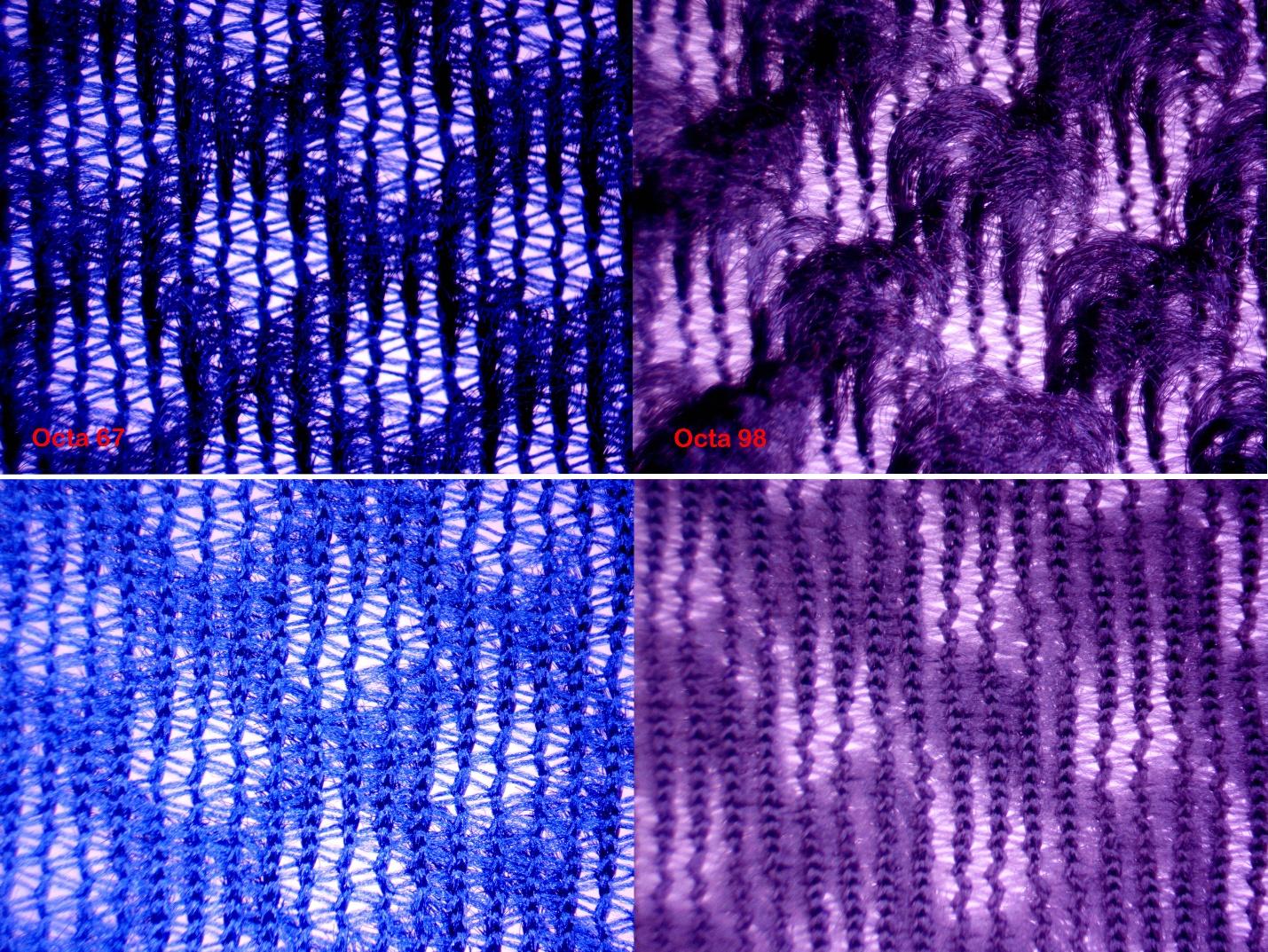
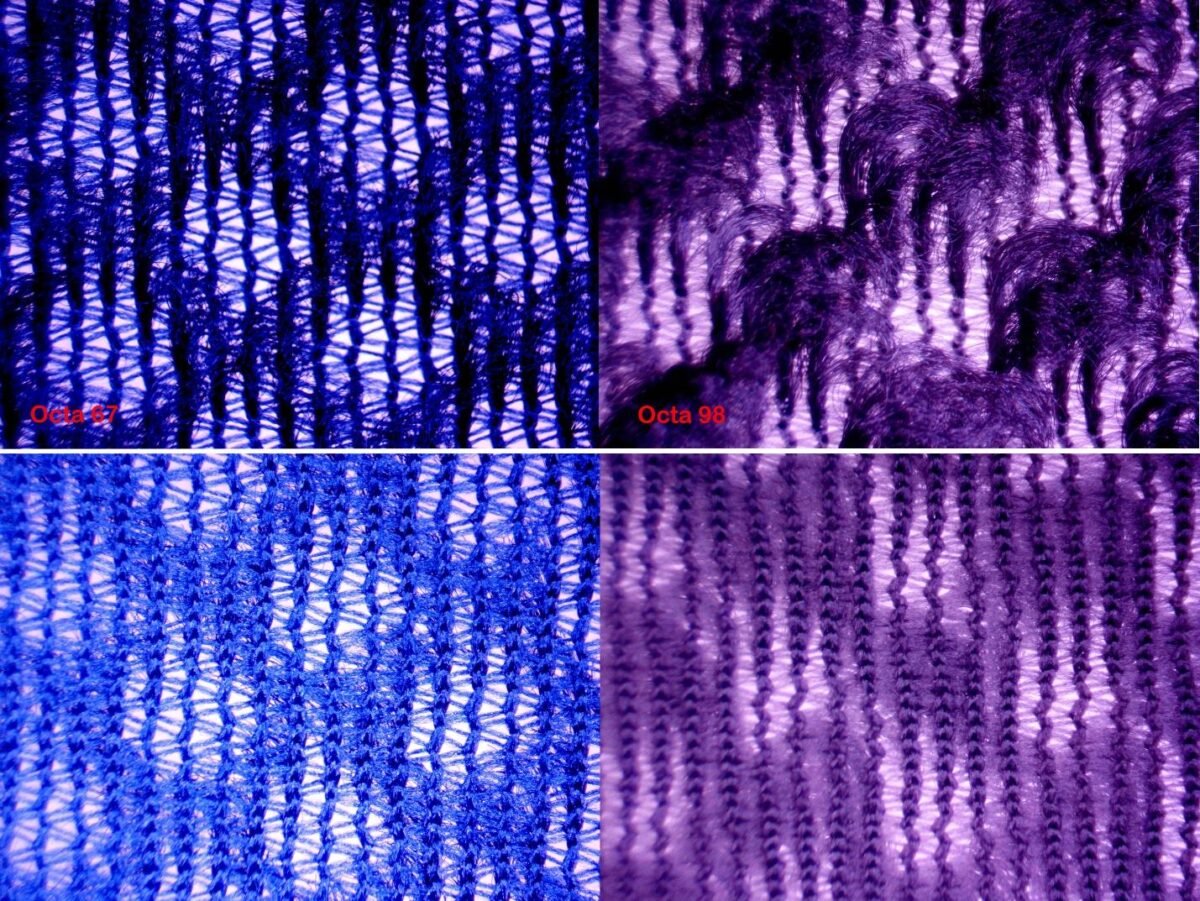
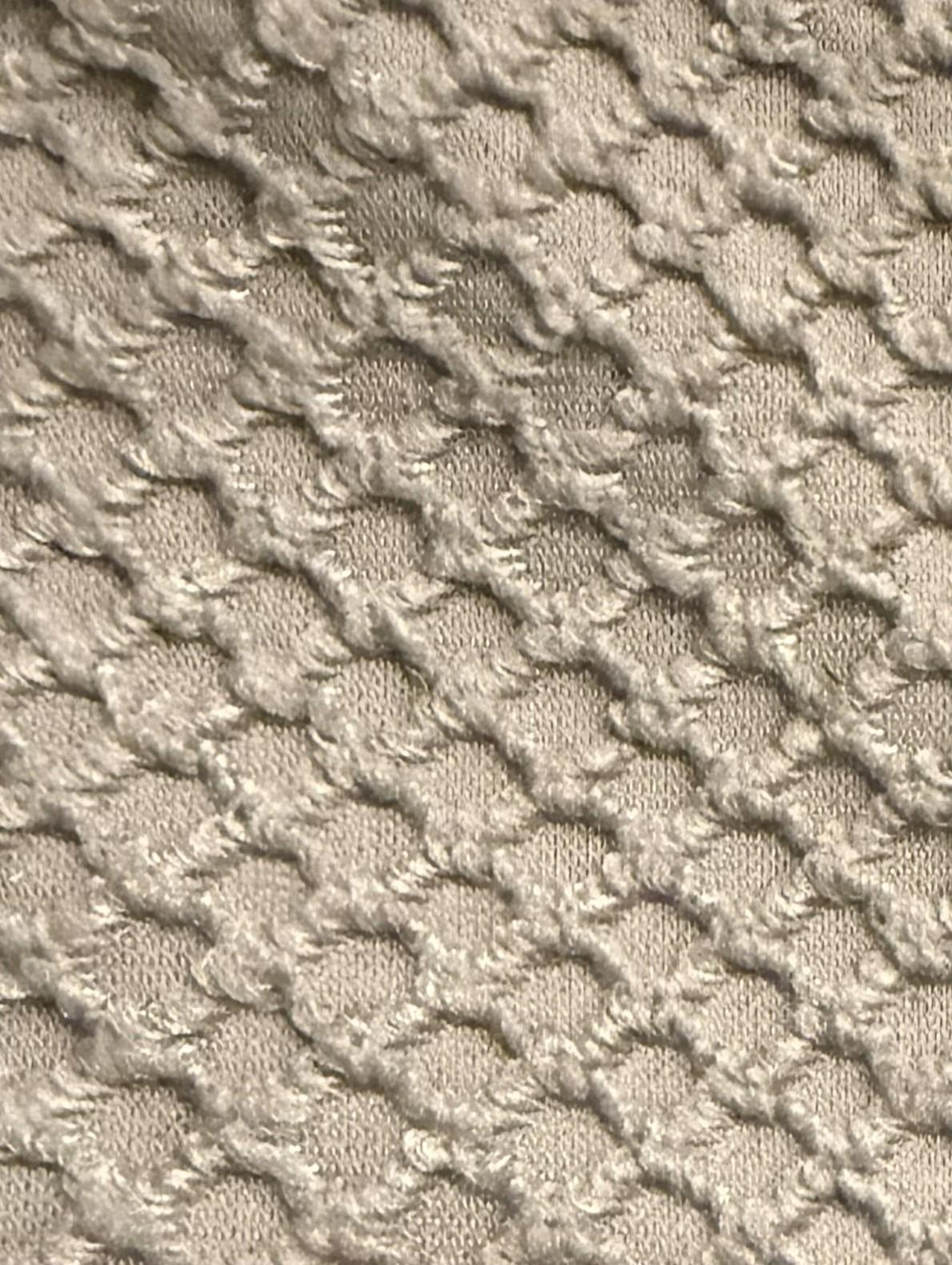
Figure 3 presents a different perspective on fuzzy fabrics. Octa Thermofly fabric may be familiar to readers as the diamond-patterned insulated material used in the Arc’teryx Proton FL and the Norrona Falketind Octa jacket. Here, I analyze two weights of this fabric: 67 GSM and 98 GSM. The knitting technique used is called Russell knit. The fabric has a knit base grid with pile fibers anchored to it, creating diamond-shaped ridges. In the 67 GSM version, the ridges are very short, while in the 98 GSM version, they are noticeably longer and wider. The grid dimensions for both fabrics seem similar.
Figure 4 shows the Octa 98 lining in my Noronna Faltikind Octa. The diamond-shaped ridges and the knit of the structural grid in the open area they define are easy to understand. Octa 67 is similar, but the raised diamond stitching offers almost no relief from the structural grid.
The ridge provides a spacer standoff to trap insulating air in the open area. This can provide a unique function that will be discussed later.
Member Exclusive
A Premium or Unlimited Membership* is required to view the rest of this article.
* A Basic Membership is required to view Member Q&A events


Discussion
Become a member to post in the forums.
Companion forum thread to: By The Numbers: Fun Findings For Five Fuzzy Fabrics
Five fuzzy insulations get measured head-to-head: Polartec Alpha Direct, Primaloft Evolve, and three Teijin Octa builds. See how structure drives air permeability, MVTR, drying rate and energy, directional R-value, and durability. Results highlight Alpha’s breathability and efficiency, Evolve’s resilience, and Octa’s structured, durable use cases for high-output backcountry layering systems.
Interesting, thanks
When you measure the R value, do you put the fabric between two plates? Or over a plate with air on the other side?
That is, does the R value include the air layer outside the fabric if it’s worn on the outside?
These fabrics have a raised grid with a void between. That void gives a lot of insulation. Do you have an idea how much insulation a void produces compared to a volume that’s occupied by fibers, like down or synthetic or fleece?
Hi Jerry: I use a guarded hot plate. This device is open to the air, and the test fabric is laid on its heated plate. I measure the watts required to maintain the plate temperature during the test. This is divided by the difference between the plate temperature and the ambient temperature. From the resulting number, the air film R-value is subtracted. I measure the film R-value using the guarded hot plate. If calibration and room conditions are consistent, this number won’t change. The film R-value is .56. If you want to know how this works, you can read about it here.
If you look at the data tables, you will see that some of these fuzzy fabrics have measurable differences in R-value depending on orientations. The difference is the way convection impacts heat loss depending on whether the open spaces are open to the air or contained by, in this case, having the open space toward the guarded hot plate. In the real world, I don’t expect these open spaces to insulate as I measured them because they can be subject to moving air with every step you take. The differences can be larger than the differences in the data table for fuzz up/down per gram of fabric weight.
Hi Steven, thanks for the interesting tests!
I would have loved to see a comparision to a non-fuzzy conventional fabric in the charts. The charts help me to understand the differences of the fabrics discussed here. But they do not help as much to decide whether it is time (and worth it) to swap my current fleece. Maybe you could integrate a “standard conventional fabric” for reference next time? (I am aware that there are lot’s of standard conventional fabrics to choose from but I trust your expertise to pick a relevant one.)
One more question: how do typical “grid fleece fabric” (like in the former Patagonia “Non-Air” R1 pullover compare to the Teijin Octa fabrics? (If you have already covered this somewhere, please feel free to point me to it.)
” In the real world, I don’t expect these open spaces to insulate as I measured them because they can be subject to moving air with every step you take. ”
another study? : )
The R value of an air film drops about 25% at 2.5 MPH, a typical walking speed, so maybe it’s still a factor in the real world.
If you had the fuzzy fabric as a mid layer then it would be effective. Like fishnet fabric.
That’s reasonable you subtract out the 0.56 R value of the air film. Like you’ve said before, it’s confusing whether other measurements of R value take this into account.
HI Robert: Here is a discussion of fleece vs fuzz. The primary benefit of fuzz vs fleece is warmth per ounce of fabric. A secondary benefit is the vast air permeability for vapor removal. Of course, this is effective only if all your layers support moisture removal. Fleece may be more resiliant that fuzzy fabrics. Fuzzy fabrics do not resist crushing well. When the loft is crushed, fuzzy fabrics no longer perform as expected. The loss of loft can lead to increased vapor condensation and wet fuzzy insulation. I have not studied this performance aspect enough and have not compared resilience between fuzz and fleece.
Hi Jerry, the various standards for guarded hot plates use handle air-film subtraction differently. I subtract it out. Leaving it in would greatly inflate R-value claims, especially for base-layer fabric, where the air-film thermal resistance can be much greater than that of the base layer. You can read more about this issue here. This discusses the concept of “intrinsic” thermal resistance, which is another way of saying to subtract out the air film. Also, I would not rely on the thermal resistance of large air spaces in baselayers to remain stable. Every time you move, pumping disturbs these air spaces in your layers.
I was just re-reading that the other day
“We can see there are different treatments of clo calculation and different definitions of intrinsic clo or intrinsic insulation. No wonder people find this topic confusing!
Why does this matter? The short answer is the potential for double-counting the air film resistance. Double counting will inflate the expected performance of the insulation for multiple ounces of insulation.”
Good points. You are the only one I’ve found that deals with this explicitly.
Another question, I’ve always been confused by the term intrinsic clo. I find places where they multiply the clo of a garment by percent of body area that it covers. So, you can add up the intrinsic clo of pants, jacket, and hat, for example, and that will give you the average clo over your body. But if you add to that the intrinsic clo of a mid layer then you risk double counting the air film.
So, intrinsic clo is affected by the air film, but intrinsic clo does not completely account for air film.
What you’re doing seems better – use clo (or R value) without air film, then add the air film insulation at the end. Or better, you could have total body R value with and without air film so you’d know how it performed in calm and windy conditions.
Thanks, Stephen. Excellent.
Hi Stump. You are welcome. I am glad to see you are still following things at Backpacking Light
Stephen – did you consider testing all these fabrics for insulation value with a shell layer over them?
No. The measurements are taken in still air. Real-life use adds all kinds of thermal complexity to performance. The shell, in real use, would help provide somewhat still air. So, kind of a wash. The shell provides a negligible increase in warmth, in terms of added R-value. Of course, if you are walking rapidly, or subject to wind, the shell will dramatically reduce convective losses that would occur in a bare fuzzy fabric. I don’t know if that gets to your concern, so let me know if I am missing something.
I faintly remember Polartec having a pile with hollow core fibers what were supposedly warmer. If I remembered wrong IS there a company making hollow core pile?
I know my alpaca socks are definitely warmer than equally thick sheep’s wool socks B/C alpaca fibers are hollow. I would therefore assume hollow core fiber pile is warmer than very similar pile without a hollow core.
I wish a lightweight alpaca fabric could have been tested here. BUT alpaca must be combined with a synthetic fiber for ease of knitting due to the “difficult” nature of alpaca wool fibers working in weaving/knitting machines. That means if nylon is used it will hold more moisture than if polyester is used to make the weaving or knitting feasible.
I was using buffalo wool socks. They’d wear thin and the buffalo wool would dissipate leaving the synthetic knitting. I’ve read the same about the Hollow socks. Soft and warm, but wear out quickly. I’m wearing possum now, but I don’t expect them to last.
Eric, as far as I know, there are no fuzzy fabrics made with Alpaca or Alpaca blends. I do have a fuzzy blend shirt made with wool and polyester. It was sent to me, and I don’t know much about it. I have spent a lot of time wearing it. It is a 90 gsm fabric, and the performance characteristics that I can measure without cutting up the shirt are nearly identical to those of 90 gsm Alpha Direct.
I have never measured superior warmth from a hollow fiber. Why is that? Consider that the volume of air in base layer fabrics is over 75% of the fabric volume. The rest of the volume is made up of fibers. The base layer fabrics I am working with at the moment range from 80% to 92% air. So, how much more air will you trap by adding a micron-sized hollow space in a fiber that might be 15-25 microns in diameter, constituting less than 25% of the fabric volume? I don’t know the answer, but so far I haven’t been able to measure an impact on fabric R-value.
are you saying hollow fibers are a marketing thing? : )
it’s never made sense to me like you said
Funny enough they called it …. Aircore
I wouldn’t call hollow fibers marketing hype though there is hype in every market. Exaggerated perhaps in performance. Other factors come into play. I prefer the fluffy fabrics in most cases. I restrict the hollow fibers to my feet. Even then, they’re mostly a high percentage of moreno and synthetic.
The North Face Futurefleece is Octa Thermofly. Comes in 124 g/m2 and 100 g/m2. They’ve put the fuzzy part on the inside but surely you could turn it inside out if you’d want to test your theory.
https://www.thenorthface.com/en-us/p/mens/mens-collections/mens-summit-series-324273/mens-summit-series-futurefleece-lt-1-2-zip-NF0A5J8R
https://www.thenorthface.com/en-us/p/mens/mens-collections/mens-summit-series-324273/mens-summit-series-futurefleece-full-zip-hoodie-NF0A5J7S
FWIW, I own both and have been very happy with the fabric for the 2-3 years I’ve been wearing them. They’re my go-to for any winter sports currently. The 124 g/m2 full-zip hoodie is almost too warm for XC skiing and cycling if it isn’t well below freezing. Pairs really well with a mesh layer, but the thicker grade is great right against the skin even though they advertise it as a second layer in their Advanced Mountain Kit collection.
Some people have complained about Thermofly not being as stretchy as they’d like, but I actually prefer it over stretchy grid fleeces and tricots because elastane holds on to moisture, becomes saggy and eventually loses it’s form over time.
US folks have the option of ordering fabric remnants straight from Teijin Frontier USA: https://order.teijin-frontier-usa.com/brand/octa/
Hi SoftKjell. Thank you for the information and for reading. I tried the 205 gsm for the application that I was interested in. In that fabric weight, the diamond ridges were insufficiently rigid to serve as a barrier layer. Also, for my application, a stretchy fabric works best, so it did not perform as I had hoped. I am glad the fabric works for you. I don’t do much Nordic these days, but I do a lot of AT skiing. The difference is that aerobic activity can be similar to Nordic when climbing, but the descent is fast and can be cold. For the climb, I use an Rapha Thermal Core jacket. It is a pretty basic knit jacket, perfect for high-output activities. It has an air permeability of around 44 CFM/Ft2, so if there is wind blowing, as there usually is on the Colorado Front Range, I can achieve very good moisture control in my layers. My layers for this are some weight of Alpha Direct (I have shirts in every fabric weight). Under that I usually wear a Finetrack Basic Elemental Layer. Now that spring conditions are here, I can use just the Finetrack and Alpha for ascents.
Stephen, are you finding Finetrack covers more use cases than Brynje?
I wouldn’t say that. I am wearing fairly high-air-permeability outer layers during high-MET activities to allow vapor or liquid sweat to be eliminated. The large pores in Brynje can allow cold air to reach my skin. The Finetrack layer provides better skin coverage. I will shortly be submitting an article that does in depth comparisons of 8 base layer fabrics for liquid water transfer for skin. Included will be Finetrack and Brynje, covered in more depth than previously. I think you will find it interesting.
Looking forward to it!
@Stephen Seeber, I’m hoping to find data backed comparisons of warmth per weight of modern fleeces but am running into conflicting data.
Is there a comparison table available of CLO (or R value) per osy for AD 60, 90 and 120 compared against “classic” fleeces” like Polartec 100 and 200? Bonus would be comparing against 85gsm Octa like the old MH airmesh
Assuming CLO = R * 1.136:
Here has AD 60 @ R = 0.22/osy (0.25 CLO/osy)
Here has AD 60 (fuzz up) @ R = 0.044/g =1.25/ounce (how to convert to osy?)
Here (Table 5) has AD90 @ R = 0.13/osy (CLO = 0.15/osy). Seems too low?
[Edit] Here has Polartec 100 @ R = 0.097/osy (CLO = 0.11/osy; Polartec 200 CLO = 0.1/osy)
Here based on Richard’s data has Polartec Classic @ R = 0.14/osy (CLO = 0.16/osy) (no air boundary layer added)
Anecdotal reviews say Alpha Direct is “2 to 3 times warmer by weight than classic fleece”.
I’ve spent hours at this and can’t find any legitimate comparisons backed by data. I know AD is warmer but by how much seems shrouded in mystery. I’m trying to determine how much warmer an AD120 hoody will be in comparison to my existing fleece (no wind & when using a wind shirt) before buying and committing myself to trust its warmth in upcoming cold weather shoulder season trips.
Thanks if you can lend a hand and have the data.
Become a member to post in the forums.