


Topic
Become a member to post in the forums.
.

Thanks, Richard.
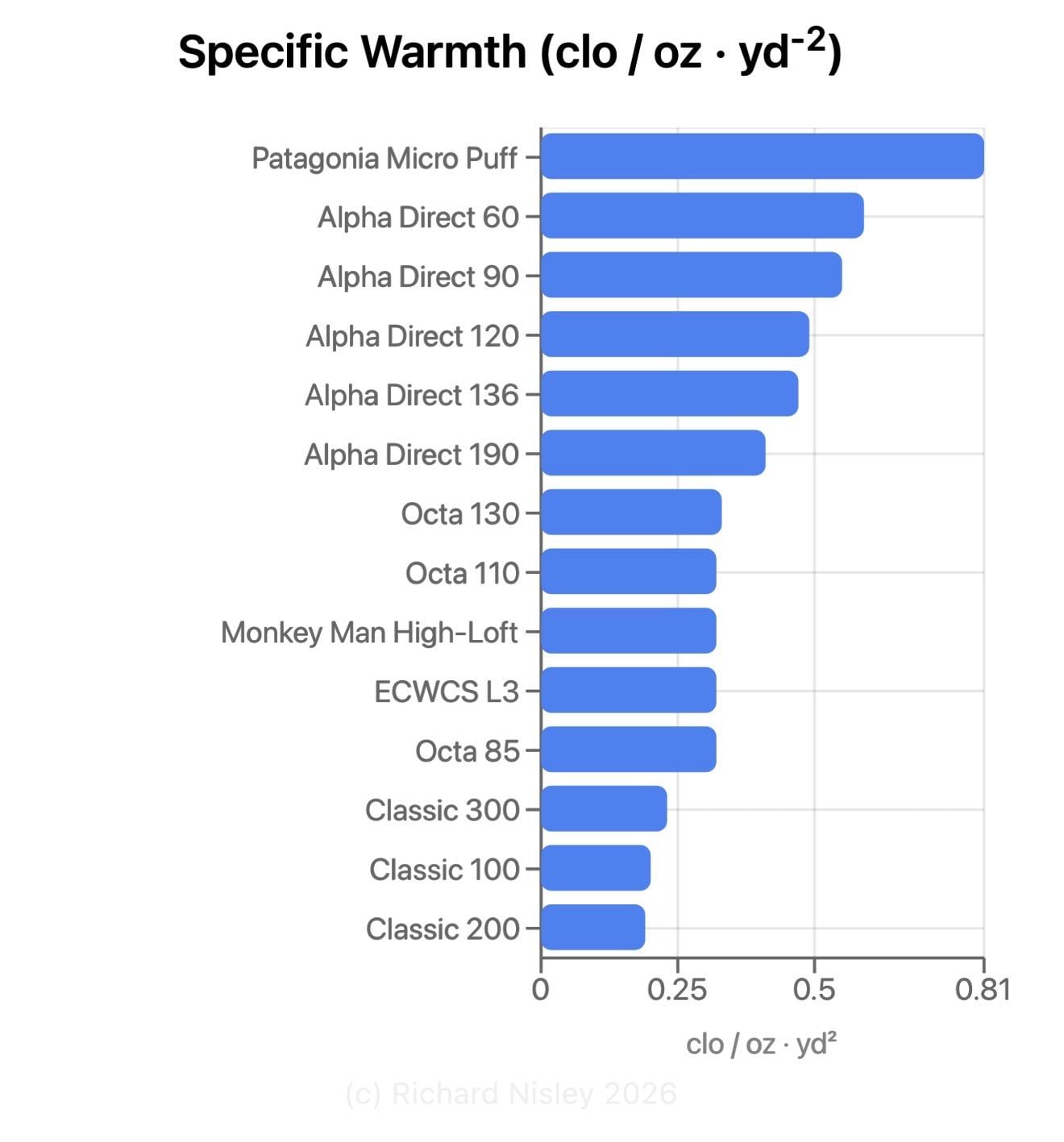
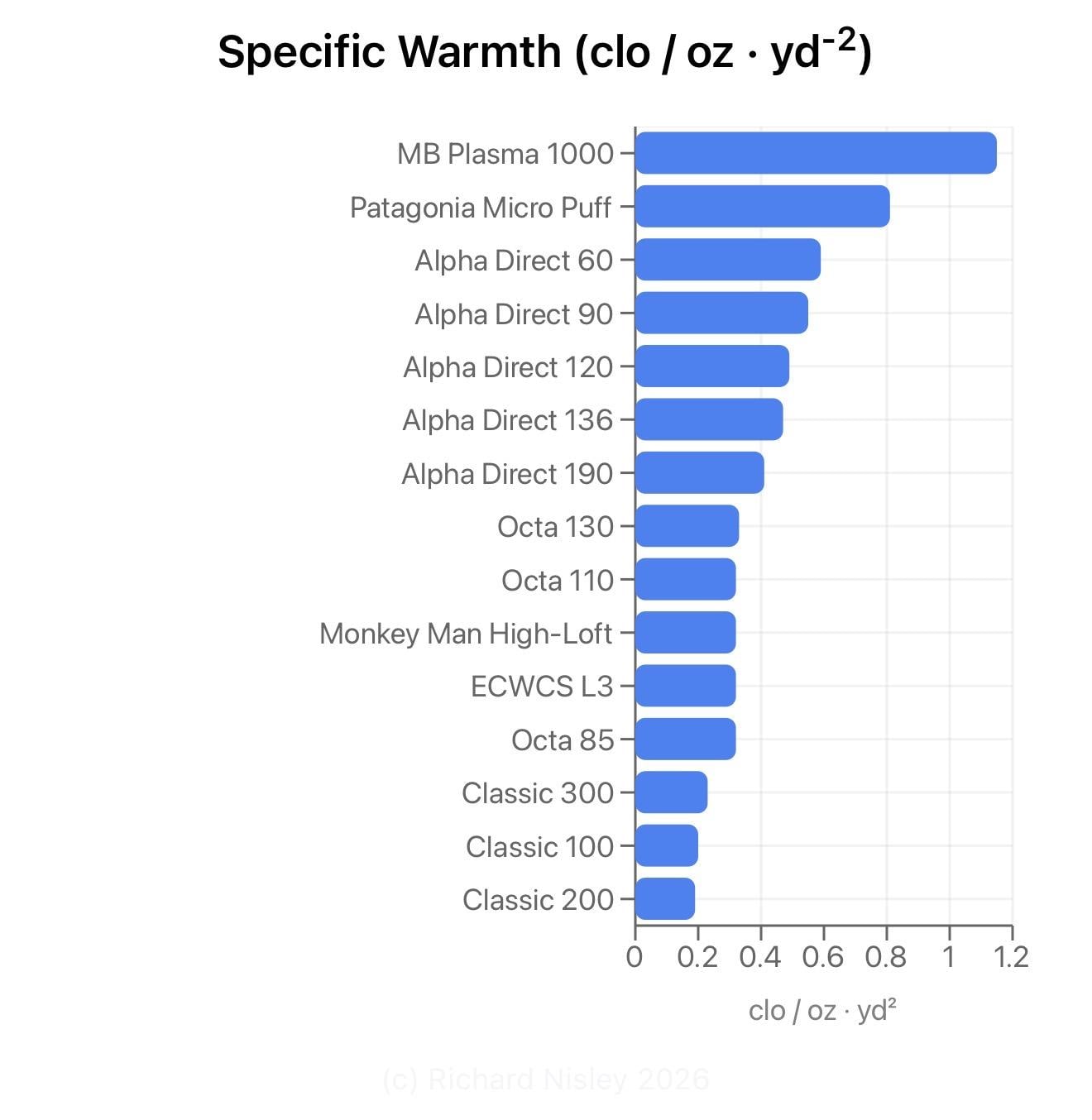
I read your document (A Revised Paradigm…) several times and understand much or most of it (air boundary layer removal from test result, and addition after layering; wind effect; % body coverage; adding garment CLOs; comparing final result to MET based target) but am struggling to get from clo/oz*yd2 to a garment CLO.
Take the example of an AD120 hoody (ignoring manufacturing variance):
Could you please show the steps using this data to calculate an AD120 Hoody CLO, as an example?
The document calculation example requires CLO/oz which I can’t conceptualize the meaning of absent an area term and isn’t usually available.
This stuff is interesting and I’m hoping to use this to pack for some conditions I haven’t experienced with some new clothing. My background is engineering (fiber optics) and I work with models all day but I’m struggling getting to the finish line with this one. Thanks!
@Richard, sleeping on it, I think the document has a typo where 0.56CLO/oz is meant to be 0.56 CLO/osy?
In that case, is this correct using your numbers? Its how I interpret the method in your paper.
Then later when summing CLOs of layers, add back air boundary insulation CLO based on wind speed using here
That site is based on your paper and also gives a CLO of 0.55 for an AD120 hoody using your above posted CLO/osy, so must calculate it the same way and interpret your paper as I did.
This method seems to have a hiccup due to the 0.6 subtraction for indoor testing air boundary insulation. For light insulations, it results in very low CLO, possibly negative.
For example, with Octa 85:
The online calculator gives the same result. Maybe the calculation assumes adding back in the air boundary layer makes it look more more reasonable? Unfortunately that doesn’t work in a layering system. For example, if I layer 5 Octa 85s, the layered total CLO will be far higher than .15+air boundary layer.
A sun shirt would result in a negative clothing CLO and layering 5 would just make the entire ensemble -ve CLO even with air boundary layer.
Hoping you can help clear this up.
FWIW, I unleashed ChatGPT assuming Ad120 @ 0.47 CLO/osy and it came back with hoody CLO ~ 0.8 (with a shell over it). So maybe in a layering system if assuming a shell, don’t subtract the 0.6? That would give AD120 Hoody CLO ~ 0.8 in a revised version of your method, in line with ChatGPT.
Another explanation might be that you already removed the effect of air boundary layer in your posted values? i.e. different than the method in your paper?
When Stephen posts these sort of CLO/osy test results with air boundary insulation removed, he calls them “intrinsic CLO”.
BTW, thanks a ton for sharing your data with us, its very generous and appreciated. Just trying to sort it out so it can be used as intended.

Hi David: For some reason, I am not getting notified of posts to this thread.
Here is one article: In particular, see Table 3 for six weights of Alpha Direct. Here is another article that presents Fleece measurements.
Be aware, in my fleece testing, I found that fleece warmth/weight is all over the place, and the concept is kind of useless. Thickness/warmth is useful. Alpha Direct produces useful warmth/weight and warmth/thickness relationships.
That means you can kind of use my data to compare warmth/weight for fleece and Alpha Direct. But you will have a hard time applying that to a fleece product you find on the shelf. On the shelf, all you know is whether it is 100, 200 or 300 but you won’t really know anything about the warmth. You can guess at warmth by measuring thickness.
Here is what I concluded in the fleece article: What does this all mean? Based on the samples we tested, the Polartec fleece product names may have little to do with the actual product warmth. However, the more the product is napped during production, the greater will be the loft and the warmer will be the insulation.
Thanks, Stephen. I recall seeing these before and the variance in mfg is depressingly high, and manufacturer claims suspect.
But something else seems afoot besides manufacturing variance.
For example for AD90, your testing gave CLO = 0.15/osy with no air boundary insulation. That seems really low.
If I interpret Richard’s data correctly, he gets 0.52/osy with no air boundary insulation. As I posted above, if his results are with air boundary, garment layering CLO summation doesn’t seem to work with his model.
For the AD data, use Table 3 of the Active Insulation article. That is a test of a range of Alpha D products and you can see how everything changes for the different products. You can also see a glaring example of manufacturing variance comparing AD 60 Gray and the AD90 sample. From Table 3, you can see that AD becomes warmer as you increase fabric weight. It also gains loft, which is the actual physical reason that its warmth goes up. You can see that its warmth/ounce (a measurement of thermal efficiency) decreases as the fabric becomes heavier. If you compare with Table 3 in the Fleece article, you can see that AD is always substantially warmer than fleece on a weight basis. It is clearly more efficient at trapping air for a given weight of fiber. Compare the values in Fleece table 3, Hot Plate Intrinsic C/o/Oz/Yd2 with Active Insulation, Table 3, Hot Plate Intrinsic Clo/oz. In the fleece article, go down to Table 4 and look at the hi-loft batt insulations (climashield and primaloft). These are in a different league of thermal efficiency.
Thanks for these. I had gathered all this as well when I read the articles years ago and most are common sense: thicken the same fabric = warmer, higher loft = warmer, AD is warmer than traditional fleece by weight, and less common sense, the lighter AD fabrics are loftier (cool outcome of this testing)
My point isn’t about mfg variance or those above points. AD60 variance in table 3 is 17%. My points I’m trying to get clarification on are:
Appreciating mfg variance will make absolute warmth predictions noisy, I still want to estimate my clothing ensemble CLO, +/-. I’ve already baselined my existing layers CLO against field comfort experience and can use it to calibrate expectations for new clothing warmth.
Just need to ensure the data is what it purports to be and to have a model that makes sense. Then live with the mfg variance as a risk factor.
But mfg variance is in the noise when compared to required CLO variance due to even modest changes in physical activity in camp (near rest) due to MET’s high rate change between resting and light work. And required CLO changes little over temp when hammering on trail at METs 7-8. So I’m not super concerned about the mfg variance. I can compensate with a “skill” (getting off my butt and doing some camp chores).
Of course I could just carry extra clothes and not worry about any of this. But the entire ethic here is to learn skills and use those to go as light as possible.
Only Richard can tell you where he got his numbers. How I produce mine are well documented in my various articles. Here is one if you want to get into the weeds or build your own. You can see further discussion of the hot plate methodology here. You can read how I do it, and choose what to use for guidance. However, a little common sense is needed here. These are laboratory experiments conducted in still air. The insulations achieve full loft. In real use, a full loft will likely not be achieved for a variety of reasons. Also, during real-world use, clothing layers will move, producing convective losses not encountered in lab testing. Finally, as the moisture content of the garments rises, the actual thermal resistance will steadily decline until, at saturation, it approaches the thermal conductivity of water.
I have all manner of data on all sorts of clothes that I can wear. I use it for guidance, but I still rely on my experience with clothing, expected conditions, and expected exertion level to dial in my clothing selections.
Hi Stephen,
Montbell is joining the game with the “CLIMAAIR LIGHT” (https://www.montbell.com/jp/en/products/detail/1106828?fo=0&color=OG) which looks like an Alpha Direct kind of knock-off. I think for the price (especially in Japan!) it would be interesting to add it to the comparison ;)
Hi Alexandre: They don’t seem to be available in the US at the moment. At that price, I’d be happy to get one. The jackets are available in the US. It is a very heavy fabric @ 243 gsm. It could work in very cold weather beneath a wind layer. The jacket fabric is seems unique.
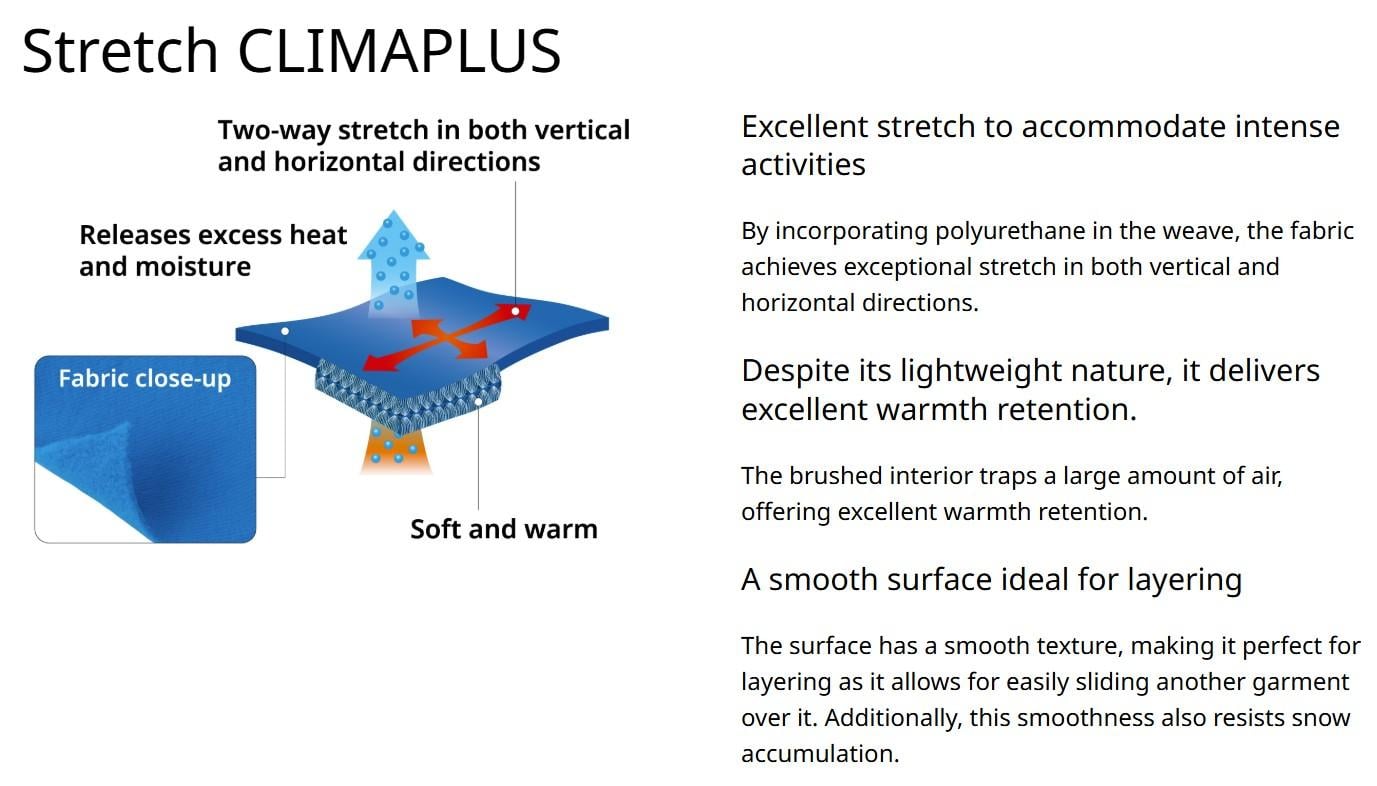
Hi Stephen,
The image you posted is for the Climaplus which I believe is different from the Climaair Light I mentioned. It seems it’s a “Special Order” in the US. I went to a shop yesterday to see the long sleeve I linked and it does very much look like Alpha. It’s very light (102gr according to Montbell).
Become a member to post in the forums.
 New Gear with ALUULA Graflyte FabricsLighter, stronger, more abrasion-resistant, and highly water-resistant - explore ultralight backpacking gear made with ALUULA Graflyte fabrics. Engineered for exceptional strength, durability, and lightweight performance, ALUULA Graflyte helps reduce pack weight without sacrificing reliability, making it ideal for demanding backcountry adventures.
 © Beartooth Media Group Inc.
 Loading...