Pack cover with an integrated hood – what a clever idea!

Overview
Now here’s a clever idea, a pack cover with an integrated hood to provide full rain protection for your pack, head and shoulders. The OR Pack Hoody is constructed of 40 denier silnylon fabric with taped seams. A bungee cord anchors the hood to a pack sternum strap. And the whole works packs into an integrated stuff sack.

Backpacking Light staffer Joel Walthall models the Outdoor Research Pack Hoody, a combination pack cover and hood.
Obviously, its not a full poncho, but it will suffice in a shower in many cases.
Bummer: It’s only available in a large size that fits up to a 80 liter pack, but maybe that’s not really bad because the larger cover will easily cover a small pack, and more. Also, it’s a bit heavy at 7.1 ounces and expensive at $55. A typical silnylon pack cover weighs around 3 ounces and costs around $30.
Specifications and Features
- Manufacturer: Outdoor Research
- Sizes: One size (Large)
- Dimensions: 47 in x 15 in x 15 in
- Features: Integrated hood and stuff sack, elastic drawcord around back and bottom, bungee attachment to sternum strap
- Fabrics: 40d silnyl, taped seams
- Weight: 7.1 oz
- MSRP: $55
Fingerless 1 ounce/pair gloves for sun and blister protection.
Overview
Thru hikers and others who spend a lot of time hiking under intense sun will be interested in these nifty fingerless hand protection gloves that weigh a scant 1 ounce per pair in size L/XL. Their main purpose is sun protection, but they would also be useful to provide warmth in cool weather and to grip trekking poles more efficiently.
The Sun Gloves are made of SPF 50+ Lycra and weigh just 1 ounce/pair.
They are made entirely of SPF 50+ lycra fabric, which makes them easy to put on and take off. As shown, the finger tips are exposed for greater dexterity. The gloves are available with a plain (lycra) palm, synthetic leather palm, or a thin polyurethane coated palm. We could not detect any difference in weight between the plain and PU coated versions, although the PU must have added a tenth of an ounce or so. The Sun Gloves are a good value at $14.95.
For comparison, the Coolibar Fingerless Glove is made pf stretch polyester microfiber, has a hole in the palm, blocks 98% of UV radiation, and costs $19.95/pair.
Models are available with plain, synthetic leather, and polyurethane coated (shown) palms.
Glacer Glove also has a a very light (1.1 ounce) Universal Sun Shade that attaches to any ball cap, and a cool Outback Hat that resembles a Tilley Hat but weighs just 3.4 ounces and costs $39.95.
Specifications and Features
- Manufacturer: Glacier Glove
- Sizes: All Lycra Sun Glove in S/M and L/XL; Lycra Sun Glove with PU Palm in S,M,L,XL; Universal Sun Shade in one size fits most; Outback Hat in m,L,XL
- Fabrics: Sun Gloves are Lycra; Universal Sun Shade is microfiber
- MSRP: Sun Gloves are $14.95/pair; Universal Sun Shade is $12.95; Outback Hat is $39.95
Full US coverage with USGS 1:24K digital downloadable maps are available for Magellen and DeLorme GPS units.

Electronic Mapping Comes of Age for Handheld GPS
Full US coverage with USGS 1:24K digital downloadable maps are available for Magellan and DeLorme GPS units.
I’m betting that in less than three years non-mapping GPS sales will tank and all but be replaced by high-res mapping units. High resolution internal maps and even aerial imagery are the future of GPS. In anticipation of this, two companies, Magellan and DeLorme, both debuted GPS units with the capability to download USGS 1:24,000 (7.5 minute) internal maps into their units. Magellan partners with National Geographic Topo! for maps. DeLorme uses their own “Topo USA” for maps.
Sweet spot: The Magellan 400 and 500. Both units accept 1:24K downloadable maps and have an SD memory slot for digital map storage. The 500 also includes a magnetic compass and barometer. Both use a 2.2 inch one-quarter VGA resolution display and have high performance electronics including the SiRFstarIII chipset. GPS weights are a bit over 6 ounces with batteries (pre-production unit weights).
Until now, Garmin had been the industry leader with their USGS 1:24K series of maps for National Parks East (NPE) and National Parks West (NPW) which could be downloaded into mapping capable Garmin GPS units. These maps were proprietary to Garmin and could not be downloaded into other GPS’s. This left other GPS units without internal USGS 1:24K maps. They stored maps at much lower resolutions, typically around 1:100,000 – not really suitable for precise off trail navigation.
In addition to rasterized topo maps, the EARTHMATE GPS PN-20 displays DeLorme vector based topo maps and aerial imagery. Like the Magellan the EARTHMATE GPS PN-20 is a rugged, IPX-7 waterproof device, with high performance GPS electronics using the STMicroelectronics chipset with SiGE RF front-end. Performance should be close to SiRFstarIII. It is a bit heavier than the Magellan Triton at 7 ounces. The form factor is a bit awkward with the top tap sticking out. The tab is masquerading as a lanyard attachment but also contains the unit’s antenna
And even for Garmin, their proprietary NPE and NPW 1:24K maps covered only a small fraction of the country that was national parks – places with good trails that are well understood with lots of navigational resources – arguably the places least in need of internal GPS maps. For the rest of the country where one could really use high resolution internal GPS maps, there were only 1:100K maps to download to your handheld GPS.
Another problem with internal maps was the complexity of downloading them to your GPS unit. Many times downloading waypoints and internal maps was a multiple-step, multiple-software process. Usually you did your route planning and GPS waypoint setting in one mapping tool, like National Geographic’s Topo! (the most popular online mapping software). Then you had to shut down Topo! and load another product like Garmin’s Mapsource to download the appropriate 1:24K maps to your GPS. Wouldn’t it be better if you could download the same 1:24K maps you were just using in Topo! directly to your GPS along with your waypoints and routes? Thus saving a step and remaining in a mapping software product you are familiar and comfortable with. And you could download whatever 1:24K maps you needed country wide, not just the national parks.
Finally, the high resolution internal GPS maps tend to be expensive. Garmin’s NPE and NPW list for $117 each. This is frustrating when you already spent $100 on 1:24K maps in another mapping software (but are unable to download them into your GPS).
Magellan Triton Units and National Geographic Topo! mapping software.
Magellan has solved all of the above mentioned problems via their collaboration with National Geographic Topo! electronic mapping software. Now you can now download any Topo! 1:24K USGS maps you own into Magellan’s Triton series of handheld GPS units. This simplifies trip planning and downloading waypoints, routes and maps to a single step. You can do all of this with a software program many backpackers and hikers are familiar with. It also reduces your electronic map costs.
The Magellan units contain excellent quality circuitry with a high sensitivity antenna and the high performance SiRFstarIII chipset. They should have excellent GPS performance even in difficult reception areas. They are rugged (able to withstand a drop on concrete) and waterproof to IPX-7 standards.
Magellan’s top of the line Triton 1500 and 2000 units offer full-color, touch-screen controls and the ability to record and attach audio to waypoint files and a built-in LED flashlight. The Triton 2000 also has a built-in 2MB pixel camera, and magnetic compass and barometer.
While the touchscreen on the 1500 and 2000 is indeed very nice, the unit’s weight is around 9+ ounces. While we can see some justification for additional weight for a larger and more functional screen, we wonder why they put a metal clip bar at the top of the unit instead of the much lighter traditional lanyard attachment point.
We did have a chance to briefly play around with a working version of the Magellen Triton 2000. At first blush the touchscreen display, operational menus and screens seem promising.
Expected availability for Magellean Triton GPS units is Fall of 2007. Prices will be quite reasonable with the most basic mapping units (Model 300) at $149 (10K internal map storage and lacks an SD expansion slot); and the mid-price units, the Model 400 and Model 500, at $199 and $249 respectively. The larger Triton 1500 and 2000 are quite a bit more expensive at $399 and $499 respectively. Add another $100 for each 1:24K Topo! state series map set you need.
Delorme Earthmate GPS PN-20 and DeLorme Topo USA mapping software
The DeLorme Earthmate GPS PN-20 also solves most of the problems mentioned at the beginning of this article. You can do trip planning, waypoint setting, and map downloading via a single software program, DeLorme’s Topo USA 6.0. In addition to USGS 1:24K raster maps the EARTHMATE GPS PN-20 takes mapping quite a bit further. You can also download 1:24K DeLorme vector maps, as well as aerial imagery and street map. The EARTHMATE GPS PN-20 makes it fairly simple to toggle between the different map and imagery overlays. For instance, you can first look at the aerial image and then view the 1:24K map underlying it.
USGS rasterized topo maps on the EM.
DeLorme Topo USA software (vector maps not USGS topos) is included with the EM, while Garmin and Magellan owners must purchase separate software. The EARTHMATE GPS PN-20 comes with a $100 dollar credit to download 154 square miles (400 square kilometers) of USGS rasterized 1:24K topo maps and aerial imagery. Additional data can be purchased at $1 per square mile.
In addition to rasterized maps, the EARTHMATE GPS PN-20 displays DeLorme vector based topo maps and aerial imagery. Like the Magellan the EARTHMATE GPS PN-20 is a rugged, IPX-7 waterproof device, with high performance GPS electronics using the STMicroelectronics chipset with SiGE RF front-end. Performance should be close to SiRFstarIII. It is a bit heavier than the Magellan Triton at 7 ounces. The form factor is a bit awkward with the top tab sticking out. The tab is masquerading as a lanyard attachment but it also contains the unit’s antenna.
DeLorme also includes the ability to download maps and waypoints directly to the SD card (included) which is faster and easier than downloading them via the GPS unit.
The EARTHMATE GPS PN-20 is available now for $367. Included with the Earthmate GPS PN-20 with Topo USA 6.0 National Bundle:
- The Earthmate GPS PN-20, handheld GPS receiver
- SD Card & Reader (speeds transfer of date between computer & GPS)
- DeLorme Topo USA software with full U.S. topographic and street-level detail
- Pre-loaded worldwide highway and major road base map
- Certificate for $100 worth of Aerial Data Packet downloads from DeLorme (up to 400 sq. km)
- USB interface cable
- A convenient neck lanyard
EARTHMATE GPS PN-20 Specs
Physical
- IPX-7 waterproof standard, impact-resistant rubberized housing
- Device dimensions: 2.43" W x 5.25" H x 1.5" D
- Weight: 7.05 ounces with batteries
Performance
- New high-sensitivity NMEA-compliant 12-channel GPS receiver with low-power baseband and RF chipset
- STMicroelectronics chip technology with SiGE front-end and DeLorme firmware for faster acquisition times and outstanding signal retention
- Proprietary Kalman filter for enhanced GPS accuracy
- 75 MB available internal flash memory for user-uploaded maps
Power
- Uses 2 AA batteries (included)
Battery Life:
- AA Energizer Max: 14 hours, at an average cost of .12/hour
- AA Energizer e2-Lithium: 22.50 hours, at an average cost of .22/hour
Receiver:
- WAAS-enabled, 12 parallel channel GPS receiver continuously tracks and uses up to 12 satellites to compute and update your position
Acquisition Times:
- Warm: Approximately 15 seconds
- Cold: Approximately 60 seconds
- Update rate: 1/second, continuous
GPS accuracy:
- Position: < 15 meters, 95% typical*
- Velocity: 0.05 meter/sec steady state
WAAS accuracy:
- Position: < 3 meters, 95% typical*
- Subject to accuracy degradation to 100m 2DRMS under the United States Department of Defense-imposed Selective Availability Program.
Display
- Sharp high-resolution 2.2" Transflective TFT color display (220 x 176 pixels)
Memory & Storage
- SD card slot for up to 2 GB additional map storage (1GB SD card and Reader included)
- Holds up to 10 tracks (10,000 points per track), 1,000 user-defined waypoints, and 50 routes
An utralight monopole shelter that requires no trekking poles sets up with as little as two stakes

Integral Designs SilDome
An utralight monopole shelter that requires no trekking poles sets up with as little as two stakes
Unlike many ultralight shaped shelters or tarps, the monopole-based SilDome requires no trekking poles to setup. It takes a little as two stakes to pitch the dome and quickly get out of the rain.
Even Jones created the Integral Designs (ID) SilDome based on their popular shaped tarp/shelter, the SilShelter. He added a single arched pole (taken directly from their wedge tents) and included a zippered side entry. The result is complete weather coverage with ample interior room for two. The monopole arch height and tension is adjusted by a webbing strap between the pole ends.
The SilDome uses catenary cuts to improve panel tension and shelter stability. In keeping with the flexibility of the SilShelter, the SilDome has numerous pitch variations. There are also multiple tie-outs for added stability in strong winds.
Spec’s:
- 1 lb 10 oz with pole
- 1.1 oz silynylon fabric
- catenary cut
- 12 ft shock corded Easton .340 in 7075 aluminum pole
- adjustable webbing between pole ends to adjust shelter height and tension
- waterproof entry zipper
- 8 reinforced tie-outs
The SilDome with entry neatly tied back. The arrows point to the adjustable tensioning webbing between the pole ends.
Looks like a Platy, but a 2-liter flask weighs only 0.8 ounce and costs $4.
Overview
It’s basically the same technology as a Platypus flask, at two-thirds the weight and a fraction of the cost. A 2-liter MPACK flask (without cap) weighs 0.8 ounce and costs $4.
The MPACK AquaFlo Hydration System uses a “disposable” flask that weighs just 0.8 ounce (2-liter size) and costs just $4 each.
Disposable hydration system? That’s the marketing approach. The rationale is that many existing hydration systems are hard to clean, accumulate contaminants with age, and are pricey to replace. So the MPACK solution is to buy them cheap and recycle them when they get worn or contaminated. Of course, one could alternatively give it reasonable care and make it last a fairly long time.
The flask is made of a co-extruded formulation of low-density polyethylene (inside) and nylon (outside) that is claimed to be durable and odor/taste free. It has a screw fitting that looks the same as a Platypus flask, but it’s not (we tested it). The MPACK drink tube and cap will not fit on a Platy flask, or vice-versa. Bummer.
The manufacturer claims the flasks are very durable and they have not had one fail yet, but they are also targeted to be “disposable”, so time will tell on how long they actually last. A competing 2 liter Platypus flask weighs about 1.3 ounces and costs about $10. However, it has a lifetime guarantee, backed by Cascade Designs, which is an important point.
We suggested that they create an MPACK with two vertical compartments and two caps so hikers can put water in one half and a performance drink in the other. They liked the idea.
Specifications and Features
- Manufacturer: MPACK Endurance Gear, Inc. Boulder, CO
- Product: AquaFlo Disposable Hydration System
- Sizes Available: 2 liter, 3 liter
- MSRP: Starter Kit (three 2-liter flasks, two caps, drink tube, bite valve) $26.99; drink tube and bite valve $14.99; five 2-liter flasks $19.99; five 3-liter flasks $24.99; five caps $4.99
GoLite goes lighter in their shoe line with this shoe built for speed.
Timberland Invention Factory has developed a new shoe, the Carbon Fyre, which will be available from GoLite in Spring 2008. At 11.4 oz it will be the lightest shoe with the innovative Isomorphic Suspension system where lugs adjust individually to uneven trail surfaces. The Carbon Fyre is built for speed. (The 12.0 oz Versa Force – blue in photo – also available in the spring, offers more stability.) GoLite reduced weight by trimming the Trail Claw lugs and using a carbon fiber cradle for support. The shoe has an air mesh upper which should be more durable than last year’s mesh and the same glued on NeoFORM (a type of dense foam) to provide seamless support.
I’m hopeful about these shoes. I’ve been wearing last season’s Sun Dragons and absolutely love how good my feet feel after strenuous trail hiking. The Sun Dragons are deteriorating very quickly though. The mesh upper problem has been addressed in the Carbon Fyres but it remains to be seen how fast the soles wear.
Trail Claws on the GoLite Carbon Fyre.
Specifications and Features
- Manufacturer: GoLite
- Product: Carbon Fyre
- Weight: 11.4 oz
- Features: NeoFORM seamless upper, debris shield system, stabalizing heal cradle, anti-microbial footbed, Trail Claws, Gripstick rubber, PreciseFit system
- Sizes: men 7-13.5, women 5.5-11
At 2.15 ounces this new stove from Snow Peak sets a new weight record for canister stoves.
Snow Peak has raised the bar (and lowered the weight) again for canister stoves. The as yet unnamed new stove tips the scales at a mere 2.15 ounces. This represents a weight savings of 20%. The stove remains capable of producing 11,000 BTUs.
- The lightest canister stove yet, weighing 2.15 ounces.
- 11,000 BTUs output.
- Aluminum and titanium construction.
- Pot supported by 3 fold-out struts.
- MSRP $55 (available May, 2008)
folded form.
|
ready for use.
|
| The new Snow Peak canister stove weighs 2.15 ounces and burns at a maximum output of 11,000 BTUs. |
Finally, a truly lightweight and comfortable inflatable sleeping pad, and it’s a great value, but keep some patches handy.
Overview
Finally, a lightweight inflatable sleeping pad that looks to be truly comfortable. The Big Agnes Clearview sleeping pad measures 60 inches long x 20 inches wide and has 2.5 inch diameter inflatable tubes, and weighs a scant 11 ounces (weight not verified by our scale).
The Big Agnes Clearview Air Pad weighs just 11 ounces.
By comparison, a Bozeman Mountain Works TorsoLite pad weighs 10 ounces, is one inch thick, and pads just the torso area. The Therm-a-Rest Prolite 3 Short pad weighs 13 ounces, is also one inch thick, and is 47 inches long x 20 inches wide. The comfort difference is mainly in the thickness, 2.5 inches thick versus 1 inch.
The Clearview pad is made of clear polyurethane, which is durable and lightweight. Our first question to the manufacturer’s rep was “How puncture resistant is it?” His answer was “It’s very easy to repair”. So, we have to read between the lines for now. We plan to obtain samples and give it a good test for a future review.
One important detail is that this pad contains no insulation, so it’s a summer pad. Big Agnes rates it to 35 F. We will also be testing that important factor.
The Clearview Pad is also a great value at $35, assuming we don’t have to spend too much money on patches! That’s half the cost of the TorsoLite and Prolite 3 Short.
Also of interest, Big Agnes is also coming out with the 6-ounce Cyclone SL chair adapter to convert the Clearview (or any comparable sleeping pad) into a camp chair. So, all you folks who really want to have a camp chair can get your fix for just 6 ounces of luxury weight.
The Clearview Pad inserted into the Cyclone Chair Adapter makes a comfy camp chair.
Specifications and Features
- Manufacturer: Big Agnes
- Product: Clearview Air Pad and Cyclone SL Chair Adapter
- Dimensions: Pad is 60 in long x 20 in wide x 2.5 in thick
- Materials: Clear polyurethane
- MSRP: Clearview Pad $35, Cyclone Chair Adapter $40
Finally a compact Caldera Cone Stove System!

Finally a compact Caldera Cone Stove System!
The Trail Designs (TD) Caldera Cone system is arguably the most stable, fuel efficient, wind resistant and stable alcohol stove system on the market. But until now aficionados of the Caldera system had to deal with the thorny problem of packing the Caldera Cone into a compact space. The root of the problem is that the tall, springy and somewhat delicate Caldera Cone doesn’t come close to fitting into the cooking pot.
Enter George (Tin Man) Andrews of AntiGravityGear (AGG), the packaging guru who created the wildly popular Momma’s Kitchen. George applied his packing genius to the Caldera Cone for the AGG 3 cup pot to create the Caldera Kitchen. The beauty of the Caldera Kitchen is that it packs an entire two person kitchen including the Caldara Cone into such a small package.
The complete Caldera Kitchen.
Caldera Kitchen contains (clockwise form back left):
- a 4 cup covered zip-loc container with insulated cozy
- new asymmetrical Caldera Cone
- cozy for the AGG 3 cup pot
- 8 fluid ounce fuel bottle, pot holder
- AGG 3 cup nonstick aluminum pot with lid
- TD 12-10 alcohol stove (on top of pot)
- 2 fluid ounce graduated fuel measuring cup
- and under it all a green silnylon stuff sack.
The entire Caldera Kitchen weighs approximately 11 oz. Without the insulated cozies it is around 8 ounces. If you take out the pot holder it is down to only 7 ounces. That’s less than the weight of many backpacking pots alone.
The real beauty of the Caldera Kitchen: It packs into this compact shape. (The cone, fuel bottle, fuel measuring cup and pot holder all fit into the 4 cup zip-loc container!)
Other advantages of the Caldera Kitchen are an insulated 4 cup container large enough to re-hydrate a two person meal with room to stir. The meal hydrates better and is much hotter after the usual 10-20 minutes necessary to fully hydrate a freeze dried meal. To re-hydrate food this well you’d normally need to use extra fuel to simmer the meal a number of minutes after a boil. With the meal re-hydrating, the pot is free to boil more water for a hot drink. (I usually have a hot drink while the meal re-hydrates.) The insulated 3 cup pot is also an excellent container to brew hot tea or coffee. The cozy keeps the water hotter much longer than an un-insulated pot which improves both tea and coffee brewing and keeps the drink much hotter. Once brewed, one person can drink out of the insulated pot and the other out of the insulated 4 cup container.
The Caldera Kitchen should also be available for Evernew or Vargo 0.9 Liter titanium pots (left), and the Backpacking Light 500 ml pot right (right). The AGG 3 cup Caldera Kitchen is center. It is possible but not certain that there may also be a Caldera Kitchen for the BPL 550 ml pot.
The SPOT Personal Tracker offers emergency locating capability with unique features at low cost and weight.
HISTORY
When Personal Locator Beacons first came on the hiking scene circa 2003 the lightweight backpacking community had a mixed response. Here was an electronic device that you could use to summon help from virtually anywhere in the world with a push of a button. PLBs were a seemingly ideal insurance policy for backcountry adventurers in remote locations. But, they were heavy (initially over one pound), expensive, and as their use became more widespread, likely to set rescue operations in motion for non-life threatening scenarios.
Technology, however, does not stand still.
At the 2004 Outdoor Retailer Winter Market, we reported on the 12 ounce, $740 MSRP ACR Electronics TerraFix 406 GPS Personal Locator Beacon and the 9 ounce, $999 MSRP McMurdo FastFind Personal Locator Beacon. In 2007, ACR released their Microfix PLB with further reduced size and weight. While these units were still very expensive, the trend towards smaller, lighter PLBs had begun. In addition, these units incorporated GPS technology to pinpoint the user’s location with unprecedented speed and accuracy making them far more useful to hikers than older non-GPS PLBs designed primarily for ocean rescue. However, these second generation PLBs still set an expensive and possibly hazardous full-fledged rescue operation in motion when activated, with no option for a lesser response.
Last Winter, we reported on the non-satellite based 1.6 ounce, $130 MSRP TracMe locating device. At first glance, this seemed to offer emergency locating capability that was small, light, and inexpensive enough to carry anytime you ventured beyond the pavement. However, the device’s short range, reliance on a third party to initiate a search, and need for specialized locating equipment (Radio Directional Finders) in the event of a rescue limit its usefulness in many situations. Nevertheless, the TracMe is still a clever device that is well suited to certain backcountry activities, such as group outings where RDF equipment is carried in the group.
OVERVIEW
The SPOT Satellite Messenger promises to overcome many of the shortcomings of these other systems. Presumably because SPOT does not use the 406 MHz PLB frequency and instead relies on a commercial satellite network, it is marketed as a “Personal Tracker” rather than a PLB. However, like conventional satellite-based GPS-enabled PLBs, SPOT has the ability to broadcast your exact position to emergency personnel at the push of a button. And, it offers this capability for less weight and cost than ever before. But what really sets SPOT apart from conventional PLBs is its ability to send out non-emergency messages containing your location. This allows you, for example, to alert your family or friends (instead of Search and Rescue) if you just become lost or suffer a minor injury. You can even send out “I’m Ok” messages with your current location, or allow contacts to track your position with Google Maps™. As any hiker who has ever left a worried spouse at home can tell you, these last features are well worth SPOT’s 7.4 ounce weight and $149 MSRP.
Google Maps™ screen shot of spot tracking. Photo courtesy of SPOT, Inc.
SPOT offers four types of messages based upon varying levels of need:
- Alert 9-1-1 – Dispatch emergency responders to your exact location
- Ask for Help – Request help from friends and family in your exact location
- Check In – Let contacts know where you are and that you’re okay
- Track Progress – Send and save your location and allow contacts to track your progress using Google Maps™
Specifications and Features (claimed)
- Worldwide Satellite Coverage via the Globalstar network
- 7.4 ounce weight
- $149 USD MSRP
- $99 USD annual OR $9.99 monthly service fee
- Available Nov, 2007
Backpackinglight has arranged with SPOT to test the device ahead of its November release. Check back for a complete review where we’ll provide further details, specifications, test reports, and field impressions.
Inov-8 improves on its most popular shoes. They are lighter with more cushion.

Inov-8 adds two new shoes based on the immensely popular Terroc 330. The new shoes are lighter, with more cushion and durable soles. Inov-8 also introduces its lightest shoe yet!
The new “Roclite 295” is based on the Terroc last but adds a more cushioned midsole (up to 3 arrows from 2), and the lighter and durable Roclite outsole. The 295 also includes the facia-band of the Rocklite line. The Roclite 305 is almost identical to the Rocklite 295 but adds an even more cushioned midsole (4 arrows).
Finally, based on the popular F-Lite 300, Inov-8 gives us one of the lightest trail shoes on the market, the F-Lite 230. At 8.1 ounces (230 grams) it is Inov-8’s lightest shoe. The 230 also incorporates the Roclite sole and facia-band but with a 2 arrow midsole and an extremely light upper.
The “Roclite 295” is also based on the Terroc last but adds a more cushioned midsole and still saves over an ounce (35 grams) over the Terroc 330.
Both the Roclite 295 and 305 are significant improvements over the Terroc 330, one of my favorite ultralight trail shoes. The 295’s are over an ounce lighter and should find favor with the thru hiking crowd as well as casual ultralight backpackers. At almost an ounce lighter, the added cushion of the 305’s is rapidly gaining acceptance from the ultra running crowd (people who run 50 to 100+ mile races). The 305’s should work equally well for people who have sore feet after a long day of backpacking.
The “Roclite 305” adds an even more cushioned midsole (4 arrows) and still saves over an ounce (35 grams) over the Terroc 330.
The lightweight and durable Roclite sole with facia-band.
At just over 8 ounces the F-lite 230 is Inov-8’s lightest shoe.
Waterproof and shockproof MP3 player that sports a screen and weighs 1 ounce.
Freestyle Audio has taken the next logical step with their waterproof and shockproof MP3 players. They’ve added a screen. The new 1GB unit can store up to 320 songs and supports MP3, WMA, and protected WMA formats An FM tuner which can be programmed with up to 20 presets is also built in. The color OLED screen displays display track details and an equalizer which has several presets too.
Unlike previous models this unit also supports playlists which can be created using iTunes though actual import is done through WIndows Media Player. As such the unit will work with both Windows and Macintosh computers.
- Waterproof, shockproof, and it floats
- Weighs 35 grams
- 1 GB memory capacity holds up to 320 songs.
- Can be used as a storage device for files.
- Includes waterproofearbuds
- MSRP: $99.95 Available October, 2007
Solid and perforated wool construction make this series of clothing more breathable.
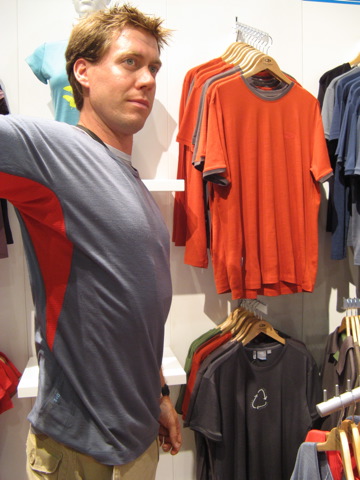
Wool clothing continues to be a popular choice for base layer clothing. Icebreaker, out of New Zealand, has revised much of their product line with new prints, but the big news is the new AGAT Series of base layer clothing.
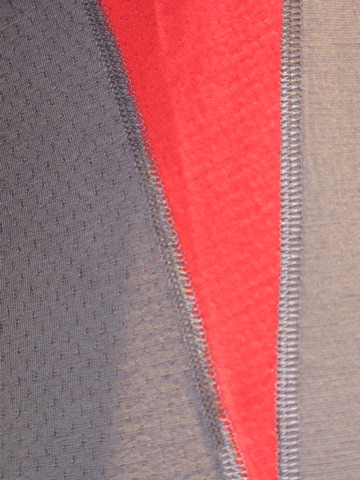
The GT shirts come in men’s and women’s style, long and short sleeve, and tank top designs. Icebreaker has designed this series with two fabric weights: 140 g/m2 and 190 g/m2. What makes the series most interesting though is the mix of solid wool and perforated wool that is intended to increase breathability. Icebreaker claims that the perforations increase overall breathability by 23% compared to similar solid wool products. Products within the series place the perforated wool in different locations: at the sides, on the back.
The GT series clothing features solid and perforated wool construction which improves breathability by up to 23% over solid-only garments of similar design.
- GT series in both men’s and women’s styles: t-shirts, long sleeved shirts, tank tops.
- 140 and 190 g/m2 merino wool weights
- Sewn with solid and perforated sections of wool to increase overall breathability by up to 23%.
- MSRP from $74.99 to $99.99 – available spring 2008.
Fourteen new lightweight single wall tents, some with breathable fabric
Overview
Following their revamped backpack line that we reported on at the Summer 2006 Outdoor Retailer; GoLite now introduces their re-designed and coordinated shelter and sleeping bag lines. The lineup now makes more sense – with light, lighter, and lightest packs, sleeping bags, and shelters coordinating with each other.
The Shangri-La group of six single wall pyramid shelters will accommodate from one to eight people. All are made of SilLite, which is GoLite’s proprietary version of silnylon that is slightly heavier (1.7 ounces/square yard) and stronger than ordinary silnylon. The one and two person models use two trekking poles. The three and four person models are a revision of the popular GoLite Hex, and use one provided center pole. The 6+ and 8+ person models have two provided poles, and are expecially useful as a group shelter. Ventilation is a combination of a perimeter gap and top vent(s). All models are floorless, and an optional floor is sold separately.
The new GoLite Shangri-La 2-person (left) and 4+ person (right)
The Utopia group is claimed to be the “world’s first free-standing ultra-lite tarps”, and consists of three shelters for one, two, or four+ people. Each shelter uses two DAC Featherlite poles in an X-configuration, that is attached to the canopy by several hook and loop tabs to create a solid unit. There is a front zippered door and ventilation is a combination of a perimeter gap and large sidewall vents. All models are floorless, and an optional floor is sold separately.
Utopia 1 and 2 tents are in the center background.
The Xanadu and Valhalla group are full-featured breathable fabric free-standing tents. They’re a hybrid design, with Epic fabric in the body and SilLite fabric in the vestibules. The vestibules are technically double-wall because they are separated from the tent interior by a mesh wall/door with dual directional zippers. These tents also use DAC Featherlite poles in a X-configuration held secure with hook and loop tabs. All are four-season tents, but the Valhalla series is more adapted for cold weather with an extra fabric door and more floor space.
Xanadu 1 (left) and 2+ (right).
Overall, we like the designs of the new shelters. They are a tad heavier than many comparable tents, due mostly to the use of heavier fabrics. We have been testing the Xanadu 2+ for the past month and find it to be very roomy and extremely wind sturdy, but a bit heavy by our standards and the ergonomics are not convenient a few respects.
Here are the all-important weights (in ounces) of the new tents:
| Shangri-La |
21 |
29 |
46.5 |
55.5 |
89 |
104 |
| Utopia |
34 |
42 |
49.5 |
|
|
|
| Xanadu |
59 |
70 |
83 |
|
|
|
| Valhalla |
|
82 |
95 |
|
|
|
And here are the MSRP’s:
| Shangri-La |
$150 |
$175 |
$225 |
$300 |
$400 |
$500 |
| Utopia |
$225 |
$275 |
$325 |
|
|
|
| Xanadu |
$325 |
$450 |
$525 |
|
|
|
| Valhalla |
|
$525 |
$600 |
|
|
|
Golite rejoins the hoodless quilt market with an innovative new bag.
Overview
Golite is no stranger to the sleeping quilt market. Indeed, one of their first products was the quirky, synthetic-insulated Fur quilt introduced circa 2000 that attached to an oversized sleeping pad with hook and loop patches. After abandoning quilts for several years in favor of more conventionally configured mummy-style bags, Golite takes aim at premium quilt manufacturers like Jacks ‘R’ Better and Nunatak with their new Ultra quilt.
Top view of the Ultra quilt. The darker panels are made from Pertex Endurance fabric.
The Ultra quilt closely resembles the $362 MSRP Nunatak Arc Alpinist in design, features, construction and temperature rating. However, the Ultra boasts an innovative use of water-resistant shell panels in select areas, and does so at an MSRP of only $225. New this year across Golite’s entire line of bags is the use of highly water-resistant panels made of Pertex Endurance in the head (or neck in the case of the hoodless Ultra) and footbox areas. I generally prefer breathability over water resistance in a sleeping bag shell to minimize the accumulation of moisture within the bag. As such, I usually don’t recommend full waterproof/breathable shells on bags except in special circumstances. However, Golite’s use of Endurance in only the head and footbox areas, while using highly-breathable 15D nylon for the majority of the bag potentially offers the best of both worlds – good resistance to loft degredation from accumulation of internally generated moisture, and good protection from external moisture in those areas most likely to bump up against the walls of a wet tent, or catch spray entering the ends of a tarp.
The open bottom of the Ultra. This type of quilt design saves weight by eliminating insulation on the bottom where it would otherwise be compressed against the ground and provide little warmth.
Specifications and Features (claimed)
- “Hyperlite” 15 denier double ripstop nylon shell with DWR
- 22 denier polyester micro fiber liner
- Twin grosgrain ribbon straps to adjust girth or secure to sleep pads
- Snap and drawcord closure at neck
- Highly water-resistant Pertex Endurance panels on footbox and around neck opening
- 800 fill-power down
- 20°F temperature rating
- Small, regular and long sizes available
- 1 lb 3 oz
- MSRP: $225
- Available Spring 2008
The open back showing the girth-adjusting straps and neck closure.
A pillow that feels real that weighs 3.2 ounces
The prototype pillow and stuff sack weigh 3.2 ounces and provide true pillowy comfort.
It is hard to put a quantitative measure on a good night’s sleep. Is it worth a projected 3.0 ounces, the target weight of the Cocoon pillow by Design Salt? The prototype model I saw this morning weighs 3.2 ounces with its stuff sack and I think many will feel as I do: the weight sacrifice will often be worth it. The production model, slated for release Spring 2008, could very well shave 0.2 ounce off the total weight.
To achieve this weight and still have a pillow that feels like a true pillow the Cocoon uses a combination of an air bladder and synthetic fill insulation inside the shell fabrics. The bladder is positioned in the center of the pillow and is surrounded by the insulation It’s all wrapped with a fleece-like top and slick bottom.
The author at rest.
A preview of new products at ORSM
Greetings from … Huntsville!
While the rest of the BackpackingLight team was travelling to Salt Lake City today in preparation for Outdoor Retailer Summer Market, I spent the day 45 miles North of Salt Lake City at the Open Air Demo in nearby Huntsville, Utah. Open Air Demo gives show attendees the opportunity to try paddling, navigation and climbing equipment in an outdoor setting, while giving makers of bulky equipment like tents and vehicles, as well as smaller vendors who may not have a booth at the main exhibit, a venue to show their wares.
This year’s show is bigger than ever with over 1100 exhibitors at Outdoor Retailer, and nearly 100 at Open Air Demo. Most of the products shown are aimed at mainstream (read “heavy weight”) outdoor activities. While walking through the booths today, I was struck by what a small minority backpackers are in general, and lightweight backpackers are in particular, in the outdoor community. Nevertheless, I saw a number of exciting new lightweight products including a potentially revolutionary Personal Locator Beacon, innovative tent designs, and lightweight sleep systems.
Open Air Demo’s location at Pineview Reservoir provides the perfect setting to test paddling gear.
New Satellite Personal Tracker from SPOT.
It’s about 95 degrees in the sun today. For some reason, this is by far the most popular booth.
The single-person Sierra Designs Velox 1.
New 4-season convertible tents from Big Sky Products.
Golite introduces an entire line of new tents.
A prototype hammock underquilt system from Eagles Nest Outfitters.
Maybe we’ve been going about this lightweight backpacking thing all wrong… With the Earth Roamer Jeep conversion, there’s no need to carry a pack at all. Just drive to your pristine, remote site and deploy your shelter.
That’s a wrap from Open Air Demo. Stay tuned throughout the next few days as we begin our dispatches from main show at Outdoor Retailer Summer Market 2007.
Ultralight by child carrier standards, the Sherpani Rumba Superlight child carrier offers advanced features and a comfortable ride.
Introduction
At 5 pounds 14 ounces with the sun/rain cover, the Sherpani Rumba Superlight is among the lightest framed child carriers with additional storage capacity on the market. In addition, it has many features that make it good for both day hikes and multi-day trips.
What’s Good
- 5-point child harness is comfortable and secure
- Framed pack carries up to 45 pounds with reasonable comfort
- Baby stirrups increase leg circulation and help get out the “wiggles”
- Self supporting for easy loading and unloading
- 1500 cubic inch pack bag, large outside mesh pocket, and lash points provide sufficient storage for ultralight backpacking
- Topper installs easily, provides good sun protection, and includes an attached rain cover for downpours
What’s Not So Good
- Perforated shoulder straps fold and pinch after extended usage, causing discomfort
- Raincover doesn’t protect child’s arms and legs
- A full ¾ pound heavier than the manufacturer’s claim weight
- At 5 pounds 14.1 ounces with the topper, it’s still not an ultralight pack (but it’s still among the lightest on the market)
Specifications
|
Year/Model
|
2007 Sherpani Rumba Superlight |
|
Style
|
External frame child carrier |
|
Volume (pack bag)
|
1500 ci (24.6 L) |
|
Weight
|
Measured weight: carrier only: 5 lbs 4.0 oz (2.38 kg); manufacturer’s specification 4 lbs 8 oz (2.04 kg); Topper with attached rain cover: 10.1oz (.29 kg); Total weight: 5 lbs 14.1 oz (2.67 kg) |
|
Fabrics
|
“Ultra-light fabric (rip stop nylon) with Ballistics fabric reinforcement,” aluminum frame |
|
Features
|
Lower zippered storage compartment, upper mesh outer pocket, padded 5 point child harness, Topper sunshade attached rain cover, padded shoulder straps and waist belt with perforated foam, baby stirrups for increased leg circulation, self-standing for easy child loading |
|
Comfortable Load Carrying Capacity
|
45 pounds (20.4 kg) estimated maximum comfortable load an average person can carry all day in this pack |
|
Carry Load to Pack Weight Ratio
|
7.6 (based on a 45 lb load and measured weight of 5.89 lb) |
|
MSRP
|
$165.95 |
|
Options
|
Protective storage cover for Topper (included): 1.5 oz (43 g) |
Performance
The Rumba Superlight provides a safe, comfortable ride for an infant and also provides 1500 ci of storage. My son Henry loves this pack!
The Sherpani Rumba Superlight has sufficient storage for day hikes and ultralight family backpacking trips. While at 5 pounds 14 ounces it might be heavy by ultralight backpacking standards, it’s among the lightest framed child carriers on the market.
The 5 point chest plate harness is very secure, and is adjustable for a wide range of sizes and weights.
The heart of the Rumba Superlight is its child harness system. This consists of a foam chest plate and 5-point retention system. It adjusts up and down in the carrier with Velcro in the back and a strap in the front to accommodate children of different sizes and ages. To secure a child you drop him/her into the seat, attach three quick release buckles (two on the shoulders and one on the right side – the left is adjustable without a quick release buckle), and tighten the harness. You then tighten the outer compressions straps to pull the child closer to your back.
The harness is easy to use and is very secure. No matter the angle I held the pack at, my son had no chance of falling out. We used the pack starting at 4 months old (about 14 pounds) and will continue to use it far beyond his current age of 15 months (about 21 pounds). There is still a large amount of growing room in the pack due to the adjustable sizing.
With its comfortable padding, our son Henry has always enjoyed riding in the Sherpani pack. He talks and giggles while riding in the pack and often gets upset when we take him out after short hikes. Obviously, the Rumba Superlight delivers a comfortable ride.
The unique stirrups allow a toddler to partially support his/her own weight, increasing circulation and making the ride more active.
A unique feature of the Sherpani child carrier is its set of Baby Stirrups. These are small nylon pouches at the lower sides of the pack that have vertical sliding adjustments for kids of different heights. The foot goes inside the stirrup and is held in place with an elastic cord and toggle. The stirrups allow the child to support part of his/her weight in the pack rather than simply leaving the legs hanging. According to Sherpani this increases circulation and I certainly noticed that Henry enjoyed using them; while I walked, Henry would often push up on the stirrups to get the wiggles out.
The Topper has an attached rain cover that kept Henry’s core dry but allowed his arms and legs to get wet.
For sunny days, the Topper attaches quickly to the pack by sliding long rods into vertical pockets on the pack and attaching quick releases in the front. This provides good shade for sunny days, although we often used a sunhat and sunblock as well. A zippered pocket at the back of the Topper conceals a rain cover; the rain cover gives waterproof coverage over the Topper, additional rain coverage in front, and clear plastic windows on the sides that secure to the pack with Velcro.
While the Topper with rain cover kept our son’s head and core dry in heavy rains, it doesn’t protect the child’s arms or legs. While full coverage rain covers are available for carriers from Macpac and Vaude, a cover of this sort is not available from Sherpani. Instead, we supplemented with an umbrella and put on his rain pants.
When not in use, the Topper easily stores in a zippered lower pocket.
The carrier’s aluminum frame provides support and is self-standing while folding flat for transport.
The frame of the Sherpani Rumba Superlight is made of aluminum plate. This frame, along with the plastic backpanel, is reasonably comfortable for loads up to 45 pounds (Sherpani claims a 55 pound rating). The frame folds flat for easy transport and also provides a stable base for loading and unloading the child.
The self-standing feature is a real benefit, making breaks and loading easier and even providing Henry’s favorite backcountry spot for napping.
We found the self-standing frame to be indispensable when using the carrier. While non-framed carriers are difficult to load with one person, the Sherpani is easy to manage by yourself. During breaks, we often prop the carrier against a tree instead of removing our son and when he falls asleep while hiking (a common occurrence) we can let him continue sleeping upright in the carrier. However, you want to be careful when leaving the carrier upright – it is not perfectly stable and can fall over.
The carrier’s molded closed cell foam backpanel is further reinforced with plastic reinforcement sheet.
The backpanel is molded foam and is reinforced with a removable plastic sheet. The waist belt is 4 inches wide and has stabilizer straps. It is sized well for larger hikers but at its smallest adjustment was a bit loose for my wife. The shoulder straps are 2 ° inches wide, have load lifters, and are contoured for a comfortable fit for both men and women.
The perforated foam shoulder straps (left – exterior) result in folds and creases in the foam after extended use (right – interior).
While the width and adjustability of the shoulder straps and waist belt are fine, Sherpani chose to use perforated high density foam in these items. The perforations may increase breathability somewhat, but they caused the foam to fold and pinch the shoulders to an uncomfortably extent. This foam is the weak point in an otherwise excellent suspension system; it lowered the maximum weight capacity significantly and made long days with a fully-loaded pack uncomfortable.
At $165.95, the Sherpani Rumba Superlight is a good value for a child carrier with this weight and feature set. It is secure, comfortable (especially for the child), and is quite durable. We used it over many months for day hikes, multi-day backpacks, and numerous trips around the neighborhood and it’s shown virtually no wear. I’m sure it will easily last through another child as well.
What’s Unique
The Sherpani Rumba Superlight is not exactly “superlight” but is definitely lightweight by child carrier standards. It is secure, adjusts for a wide array of child sizes and weights, offers stirrups to increase comfort and circulation, and has adequate storage space for adventures of many sizes.
Recommendations for Improvement
The Rumba Superlight is an excellent child carrier overall. However, I can offer the following recommendations for improving the pack:
1. Get rid of the perforated foam and use standard non-perforated foam, especially for the shoulder straps. This will increase the load capacity and make the pack much more comfortable during long days on the trail.
2. Offer a full-coverage rain fly. While we usually hike in fair weather with our son, rain is sometimes inevitable. Having a lightweight full-coverage rain cover would be a great option.
3. Carefully select lighter materials to get the pack closer to the claimed manufacturer weight of 4 pounds 8 ounces (that would be a 12 ounce diet).