

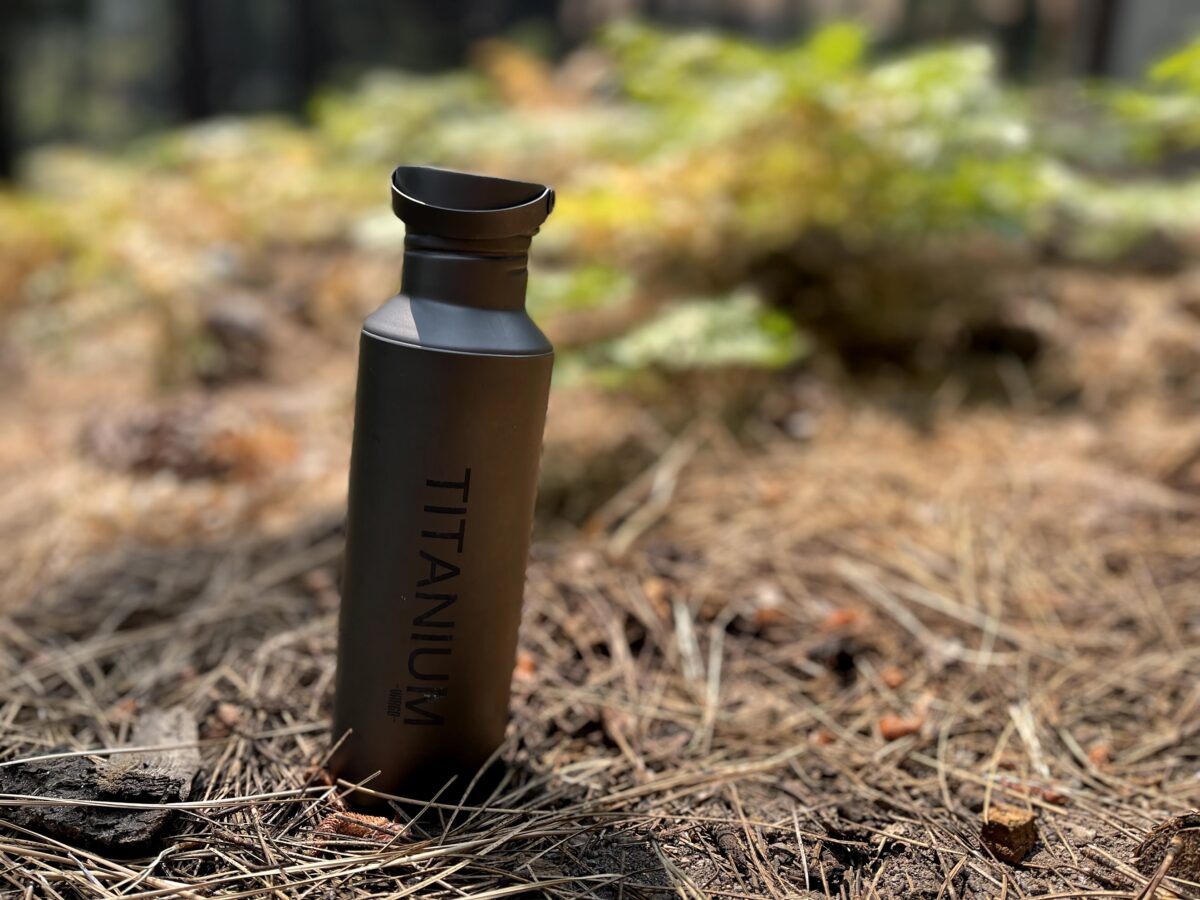

In Defense of my Insanely Expensive Purchase
This article will technically be a First Looks review – heavy on photos with a few observations about the Vargo Titanium Water Bottle. But before I get to the formal review I feel the need to explain why I decided to purchase (two!) $85 titanium water bottles in the first place.
I will absolutely be the first to admit that $85 is a ridiculous amount to spend on a water bottle – even if you are relatively well off and financially secure (I’m a writer and my wife is a teacher, so, spoiler alert, I’m not). If I were reading this review on another website I’d likely just ignore it completely because:
- a combined $170 is halfway towards a medium-range DCF shelter
- I rarely – if ever – have $85 to put towards new gear, and when I do it tends to be replacing clothing that I’ve worn out or destroyed while backpacking
- Smartwater bottles are under $5 and last a relatively long time – if it ain’t broke, don’t fix it
- many (if not most) professional gear writers receive their testing products for free
This last point is especially salient to me. Even with the best intentions and rigorous journalistic ethics, it can be difficult for a gear reviewer to make accurate cost-benefit analyses, especially if you’ve been at it for a while. You start to take high-end gear for granted. I remember my days of backpacking with a hand-me-down pack, the same cheap-and-heavy synthetic sleeping bag I’d been using since high school, and a fleece I bought for ten bucks from TJ Maxx. But only vaguely.
That’s why I decided to purchase two Vargo Titanium Water Bottles instead of requesting media samples – I wanted to know if such a simple product at such an astronomical price point was actually worthwhile. Is it a useful piece of gear, or one of those stripped-down, overpriced, trendy-minimalist products aimed at people who listen to Silicon Valley software engineer podcasts?
And I’ll tell you – it hurt me to buy these bottles. I have a tattered envelope in my desk drawer where I keep the spare cash I earn from my side gig as a fine artist. I normally use it to treat my wife and me to pizza and beer after a particularly hard week. Emptying out that envelope was physically painful, not to mention that it put me in danger of ticking off my wife.
So trust me when I say this: my cost-benefit analysis of this product is as accurate as it can possibly be and as free as I can make it from the media bias introduced by getting free or discounted gear.
The Confusing Environmental Elephant
I’ve been playing around with alternatives to disposable water bottles for a while. The last time I wrote about my experiments it kicked off a rousing discussion on the environmental impacts of utilizing single-use plastic bottles for backpacking. It’s an astonishingly nuanced debate, particularly if you are a millennial like me who was trained, essentially from birth, to recycle plastic when you can and not buy it at all if possible. When do Smartwater bottles begin to fall apart? When do they start to grow bacteria? When do they begin leaching chemicals? How effective is recycling in America anyway? Didn’t most of our recycling used to get shipped to China? What happens to it now? What’s the carbon cost of using, say, 12 SmartWater bottles over the course of a 3-month thru-hike vs. something made from a sturdier plastic or metal? And shouldn’t we be directing most of our environmental attention away from individual consumers and towards large industries – particularly the fossil fuel industry?
Some of these questions depend upon use-cases and some are only answerable by more intelligent people than me – specialists in their field or folks whose background includes more math and less art history. Some of these questions seem to not be answerable at all, at least for the moment.
Sometimes you just have to make a personal choice and hope it’s the right one. So it is with me and single-use plastics. I use bamboo toothbrushes. I don’t use plastic razors with throw-away blades. And I no longer use Smartwater bottles. Is this mathematically or environmentally the correct decision? Does it actually accomplish anything? Is it, somehow, worse? I certainly know that somebody somewhere had to mine the ore for a titanium water bottle. Where did that happen? What were the conditions like in the factory where the raw metal was turned into a bottle? Does Vargo’s HR department treat its workers well? I don’t know the answer to any of these questions. All I can do is make the next right choice at every opportunity.
So I invested in an extremely expensive water bottle that is heavier than a single-use plastic bottle but lighter than any other option that I know of. It is virtually indestructible and – unlike pretty much any other piece of backpacking gear I own – will last me for the rest of my life. It may never end up in a landfill.
That feels good to me. Your mileage may vary, but it feels like the next right choice from a philosophical standpoint and, yes, an environmental one.
But I’m willing to admit that the latter might be because I have the ghost of Captain Planet yelling at the part of my brain that’s still five. C’est la vie. I’m doing the best I can.
Vargo Titanium Water Bottle Review
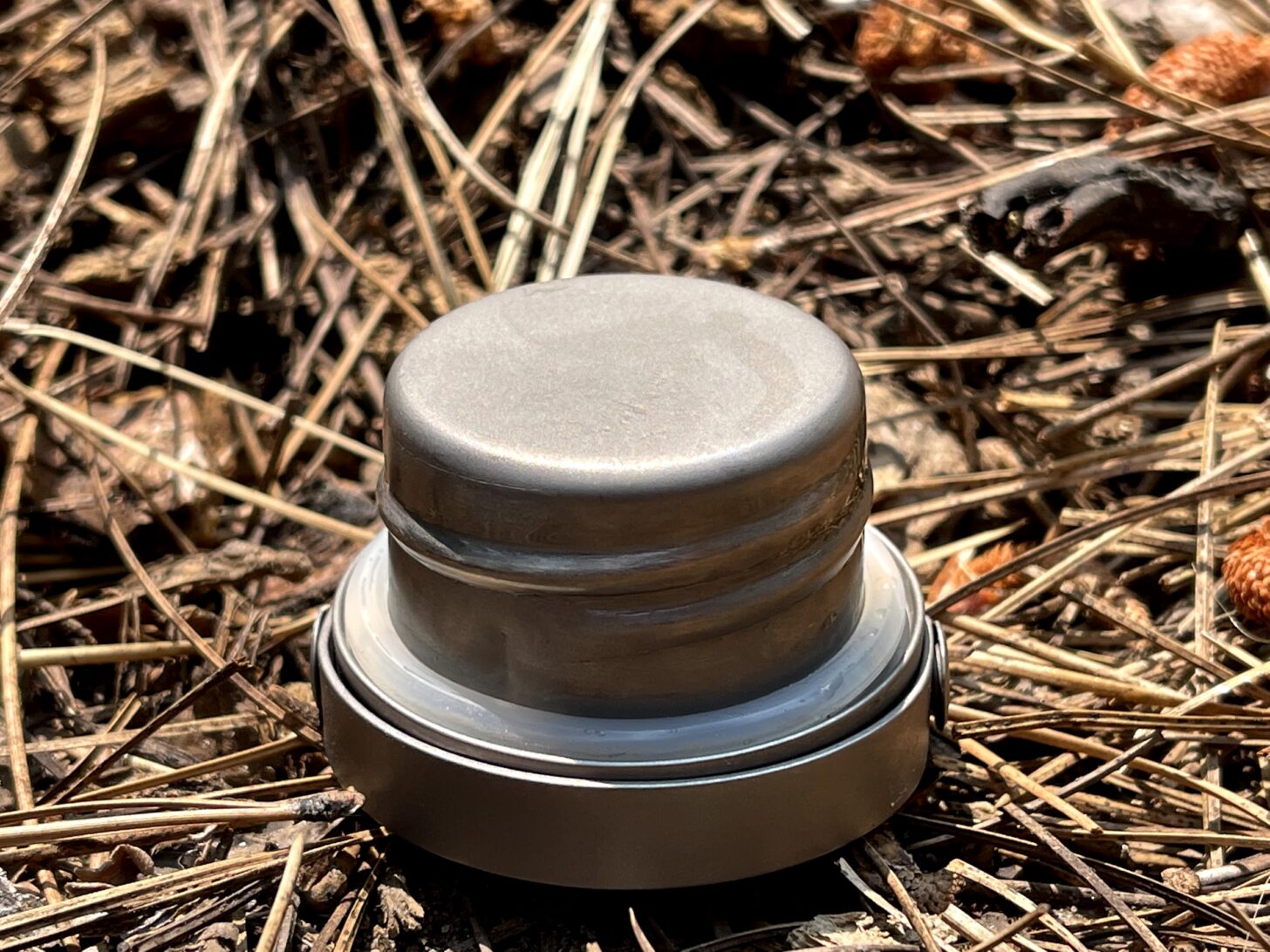
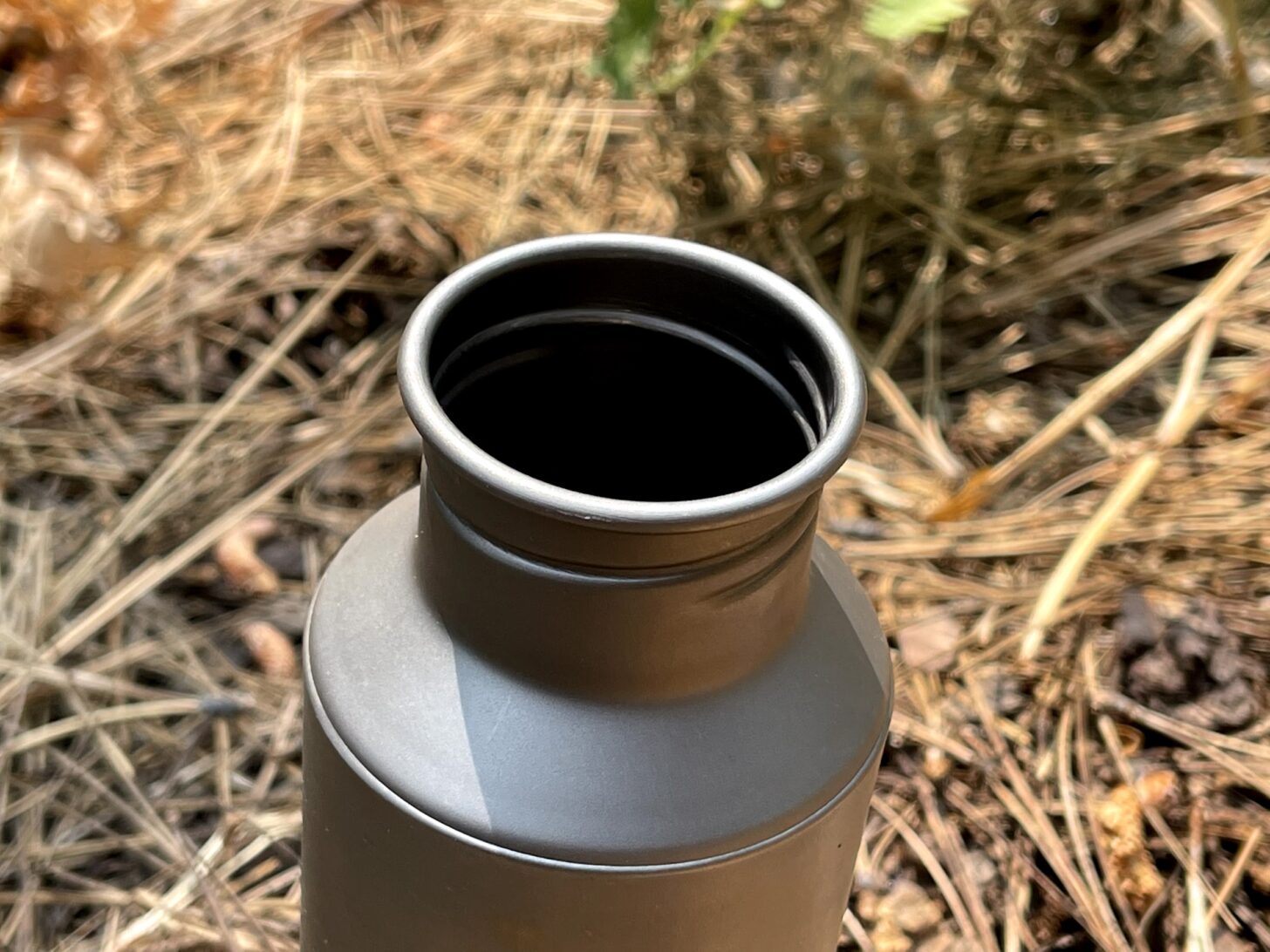
The Vargo Titanium Water Bottle (MSRP: $85, 3.9 oz / 111 g) is a 650 ml (22 oz) water bottle constructed of grade 2 titanium. It features a screw-on titanium lid, a silicone O-ring, a matte finish, a 44 mm (1.7 in) mouth, and a tall, narrow construction designed to slide easily into pack pockets.
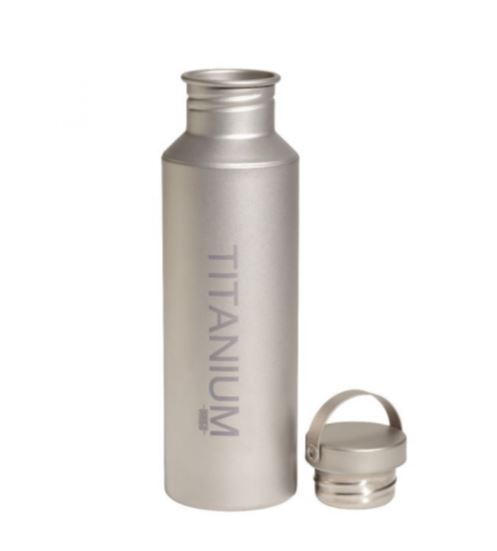
Highlights
- 3.9 oz (111 g)
- MSRP: $85
- grade 2 titanium construction
- tall, skinny construction fits into pack pockets well
- 650 ml (22 oz) capacity
- minimally threaded metal cap design
- 44 mm (1.7 in) mouth
- cap features a foldaway carry loop
- Vargo ships quickly (within 24 hours) and my customer service experience with them was excellent (my initial order was incorrect and they fixed it immediately)
Testing Context
I’ve already gone into my reasons for being interested in the Vargo Titanium Water Bottle in great detail. (If you skipped it, you might want to pop back up to the top and give it a read). The Vargo Titanium was my bottle of choice for my summer backpacking and bikepacking season – though that season was cut short by smoke and land closures related to the Dixie and Caldor fires in the Sierra Nevada.

In the end, I got about 15 use-days while backpacking, 7-use days while bikepacking, and over 50 use-days on day hikes. The Vargo Titanium Water Bottle is also my daily water bottle.
First Impressions
Strengths
The Vargo Titanium Water Bottle is emblematic of everything I’m looking for in ultralight backpacking gear: simple, streamlined, lightweight, effortlessly functional, and very, very tough.
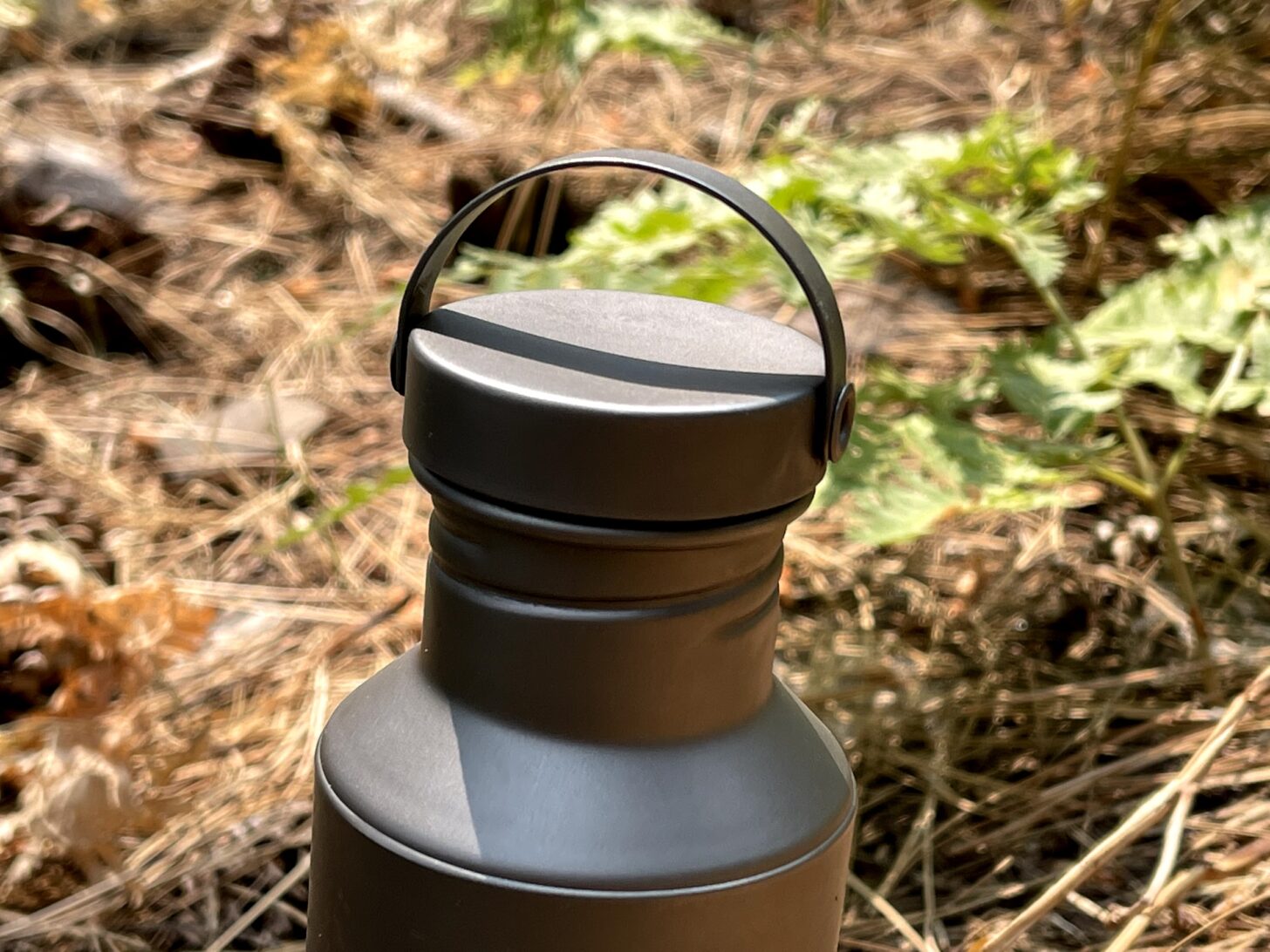
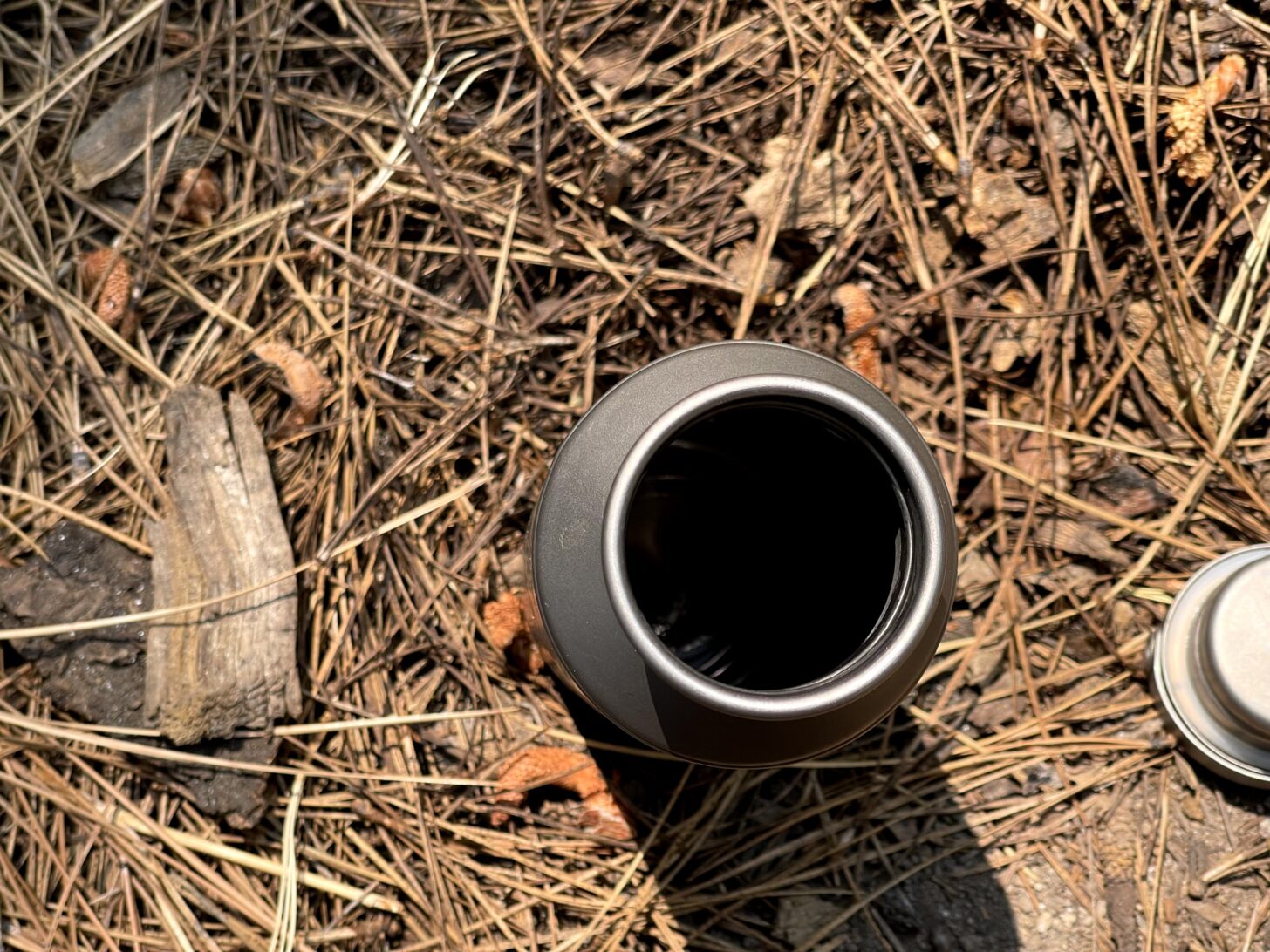
The 650 ml (22 oz) bottle is tall and skinny, designed to fit easily into pack pockets and bottle cages. The minimally threaded lid unscrews with two turns. The foldaway handle sits flush with the lid until needed. It’s dishwasher safe and has a moderately wide 44 mm (1.7 in) mouth – both of which make cleaning for storage and long-term use simple. An added bonus of the wide mouth is that it’s easy to spoon chia seeds or powders into the bottle without causing a mess.
The extra ~3 oz (24 g) of weight over a plastic bottle buys a lot of utility. The titanium can, obviously, hold hot or boiling water with much more certainty and safety than a thin plastic bottle – a feature that has all kinds of applications in wilderness first-aid situations. You could even boil water in it (though you’d really have to be in a pinch to make the attempt). All of the above goes for any single-layer (i.e., non-vacuum sealed) metal water bottle. The Vargo Titanium Water Bottle stands out because it is, well, made of titanium. Titanium has long-term food-safe properties, a clean aesthetic, and a superior strength-to-weight ratio over steel or aluminum.
This last item is the most obvious strength of the Vargo Titanium Water Bottle.
Limitations
An opaque bottle has its drawbacks, mostly when it comes to cooking or water-use management. Backpackers with lots of backcountry cooking experience are likely able to eyeball needed water measurements, but beginners or backcountry chefs with a precise frame of mind might find the lack of measuring ability frustrating.
Using two 650 ml (22 oz) bottles gets you to 1.3 L (44 oz) of storage capacity. Unless you are backpacking in regions unaffected by drought, or you are backpacking routes where water sources are prolific, you may need more storage capacity than that. I solve two problems at once by pairing my Vargo Titanium Bottles with a HydraPak RECON 1L bottle, which gives me both a way to measure my cooking water and an extra liter of storage. You could also just use a soft bladder-type storage solution.
I also find opaque bottles to be a bit of a psychological advantage. There are definitely times when I’d prefer not to see what’s swirling around in my water bottle.
Hard-sided bottles don’t play well with hollow-fiber squeeze-based filter systems. I’m not a fan of those systems (I use Aquamira or a Steripen), so that isn’t really an issue for me.
If you take winter trips in cold climates, metal bottles can be problematic. The Nalgene 24 oz Sleeve is a neoprene sleeve that, according to Vargo, fits the Titanium Water Bottle like a glove. It will cost you 4.8 oz (136g). Backpacking Light publisher Ryan Jordan has a DIY solution that’s lighter – his Reflectix cozies for 1-liter water bottles (referenced in this article about winter gear) weigh only 1.4 oz (40 g) each.
The silicone O-ring, the only part of the bottle that isn’t made of titanium, may need replacing after a few years. An after-market replacement should be fairly simple to find – a few seconds of Googling got me to this website.
Photos
The Takeaway
I’m not advocating that every ultralight backpacker needs to buy the Vargo Titanium Water Bottle. As with every gear purchase, consider your use cases, budget, and how the gear in question interfaces with the rest of your kit. The Vargo Titanium Water Bottle’s cost may be prohibitive to any backpacker who doesn’t already have their kit precisely dialed. This water bottle, is, in essence, a financial luxury – one I’m privileged to be able to afford. And it is not without drawbacks – it’s a few ounces heavier than the ultralight standard of single-use plastic bottles, it’s opaque, it’s hard-sided, and it only holds 650 ml (22 oz) of water. I consider some of these drawbacks to be advantages, but you may not.
I happened to be in a moment of life when I could afford the purchase, though as I said earlier in this piece, that decision was not without a little hesitation. Having now tested the bottle for a summer, I don’t regret my decision. That cost-benefit analysis I mentioned at the top of this piece comes out on the plus side – for me. The Vargo Titanium Water Bottle matches my needs and my kit – and at the end of the day, the cost is worth it, because I’ll never have to buy another single-use plastic bottle ever again.
Related Content
- read Andrew’s review of the HydraPak Flux 1L water bottle
- check out Ryan Jordan’s extensive Ultralight Water Treatment Options for Backpacking article
Research and Discover
DISCLOSURE (Updated April 9, 2024)
- Product mentions in this article are made by the author with no compensation in return. In addition, Backpacking Light does not accept compensation or donated/discounted products in exchange for product mentions or placements in editorial coverage.
- Some (but not all) of the links in this review may be affiliate links. If you click on one of these links and visit one of our affiliate partners (usually a retailer site), and subsequently place an order with that retailer, we receive a commission on your entire order, which varies between 3% and 15% of the purchase price. Affiliate commissions represent less than 15% of Backpacking Light's gross revenue. More than 70% of our revenue comes from Membership Fees. So if you'd really like to support our work, don't buy gear you don't need - support our consumer advocacy work and become a Member instead.
- Learn more about affiliate commissions, influencer marketing, and our consumer advocacy work by reading our article Stop wasting money on gear.


Discussion
Become a member to post in the forums.
Companion forum thread to: Vargo Titanium Water Bottle Review
I bought the $85 Vargo titanium water bottle to see if it was worth it. The answer? It’s complicated. Here’s my review.
Just curious, why not use the BOT? It can hold water and be used as a pot.
The thing I don’t like about the Bot as a water bottle is that it’s as fat as a 1L nalgene and harder to stow and access. I really like the idea of skinny lower capacity bottles like this combined with soft bottles for more storage if/when needed.
I find that titanium has a taste. Not terribly bad, but not what I want my water to taste like…
Holy Toledo. I don’t need to do a review–or read someone else’s–to give my conclusion.
I’m still using Gatorade bottles I repurposed in 2008. So apart from enviro-virtue signaling, what else would I get for my $170?
How’s the slight unscrew trickle pour for butt cleaning performance?
Just don’t lose it.
What made you decide to choose the Vargo bottle? I’ve used a Keith Titanium 700ml bottle for a few years now, it was much less than the Vargo. And it comes with the neoprene sleeve instead of that being an extra cost.
I find Vargo titanium overpriced compared to other titanium offerings.
Forget $85. That’s a ripoff. Same thing for $30
https://m.aliexpress.com/item/32857222015.html?spm=a2g0n.productlist.0.0.34474c6dHEyeVx&browser_id=ef13ebb0356147388a9739c3e5371e7a&aff_trace_key=&aff_platform=msite&m_page_id=qyldgeiyo1ucayiq17bd32cd5d1d8a55f0ae2fb1f0&gclid=&_imgsrc_=ae01.alicdn.com%2Fkf%2FHf6790d7e861c46128cea8c65c3490a370
I have 2. Never use em. Heavy, tastes like metal, can’t backflush filter with them. This is a reminder I should sell them.
I had the titanium BOT but got rid of it. Every time you would change altitude or your hot liquids would cool off you could not get the top off. They recommend using a credit card to break the suction seal. Who wants to carry a CC or destroy it trying to break a suction seal? The titanium cap on a titanium bottle had enough friction that if you created a pressure differential it was impossible to unscrew the cap. I had to even stop at a house and request a screwdriver one day to get it off. This was not a piece of gear I could trust my life with. Was a great idea water bottle and cook pot. I believe that using a different material (plastic) for the cap may solve the problem.
Interesting idea, but yeah…expensive. I would have to be very sure of the benefit before committing to the number of bottles I would need to supply my water needs. My average hot-weather, five-hour dayhike would require three of these.
This is a genuine question on my part: how does one virtue-signal with a water bottle? I honestly can’t think of a method other than walking up to a person with a plastic water bottle and saying “You know, you really shouldn’t be using that”…but that method doesn’t signal any sort of virtue: it just signals that you’re a complete ass.
I honestly don’t know that I’ve ever paid a great deal of attention to someone else’s water bottle…except for this one kid that had a plastic bottle with dinosaurs on it, which I immediately wanted as soon as I saw it, because dinosaurs.
I am with Todd about the Gatorade bottles. They are nearly indestructible. Another durable water container is the under-appreciated parmesan cheese container. You need to find a screw top lid for it, but there are several that work for them.
Lately I’ve been geeking out making cuben fiber insulated water bottle holders to give to friends for Christmas gifts. ( I still call it “cuben” because that’s what it was called when I last bought a few yards of it from Z-Packs several years ago.) The bottles that I am including are aluminum ones such as Brita (18 fl. oz.), which can be infinitely re-filled, as long as you don’t step on them when they’re empty. Being aluminum, they can also be used to heat up some water for tea. The 2-cup capacity is plenty for my 2+ hour jaunts through my nearby open space.
I also picked up a Bot when they were selling at a discount early on at MassDrop. Karl was right on about how the lid can be REALLY hard to unscrew once things cool down. It took me 1/2 an hour to get it off, breaking a couple of finger nails in the process. I won’t take it hiking anymore, but I still think that it’s a unique piece of kit.
I’ve been looking at these things for awhile because I’d love to be able to boil water in a bottle on quick overnights and save the space of a pot. Outside of the cost, what stops me is that there isn’t a drink lid available. My other metal bottles have drink lids, so not having one is kind of a non-starter.
Has anyone found a drink lid that will work for this bottle? Either straw- or bike-bottle lid.
Bonzo: the virtue signaling can be real even if it is only ever in the purchaser’s mind. I definitely see folks spending $12 on a high-end plastic bottle imagining how very many disposable water bottles they won’t use and then going for the $30 SS one that involves no plastic and is therefore morally superior.
All of which ignores the greater amount of energy that went into the heavy plastic much less the smelting and processing of the iron, nickel and chromium ore.
Often, long before it has really displaced its energy-equivalent in disposable plastic bottles, it’s been left on the car roof or trail and lost or left with a drink residue inside for weeks and gotten too funky for future use.
Whereas I dumpster dive for not the crinkly PEET bottle, but the name-brand PEET soda or water bottles, use them dozens of times and toss them back in the recycling bin when they get bunged up or funky. So there’s ZERO impact to my choice of water bottle although I earn no eco-cred for that – I’m just known as being a cheap bastard.
David. In the parched SW, we need to consider the amount of soap water it takes to clean out your dumpster bottles. That also applies to cleaning out food from plastic in order to recycle it. Which is worse here, plastic in the dump or wasting precious water to clean the plastic? Good question.
Ti water bottles for mega-dollars.
Amazing stuff!
The ‘benefits’ of extreme marketing are clear. Benefits to the vendor at least.
Me, I use 1.25 L rocket-base PET mineral water bottle, thus:
They are totally free (after drinking the fizzy mineral water), they last for years, they don’t leak, and they survive extremely rough treatment, like being dropped off cliffs. (A deliberate test.) And they come quite clean after use too.
Cheers
I can’t understand why titanium would be any better than aluminum for this application. Of course aluminum is much much cheaper and if I’m not mistaken it is slightly lighter than titanium on a per volume basis.
I do like the idea of a metal water bottle in cold, freezing environments though because if the contents freeze I can place it near a flame and melt what’s inside. Can’t do that with plastic.
Take this $8.42 Sigg aluminum 1 liter bottle on Amazon for example. Why would it be inferior to titanium. It weighs 146 gm, however it also has .4L more volume than the Vargo, so that makes the weight comparable. I understand the utility and advantages of titanium over aluminum for many uses, but someone please explain what would make titanium any better for a water bottle.
I am not sure, but I seem to remember reading a few years back that Sigg bottles have some sort of lining or coating. I am not sure whether they still do and what the result of applying heat is…
A quick search on the web brought this up:
The classic, durable water bottles are considered almost unbreakable and are made from a single piece of aluminum, with no seams. They have an EcoCare liner to ensure no metallic aftertaste. Water tastes fresh and clean, and the high-performance lining does not transfer, absorb, or leach odors or flavors. The internal coating is resistant to almost all beverages, including carbonated drinks, energy drinks, fruit juice acids, and alcohol.
Sigg water bottles have been tested and are certified to not contain harmful chemicals. These BPA-free bottles do not have any volatile organic compounds or phthalates. They also meet European and American regulatory requirements.
My oldest SIGG water bottle, dating from the 1950s and bought in Switzerland, currently serves as a fuel bottle for my chain saws. It is still going strong, still has a good seal, but is too heavy for backpacking.
Cheers
I feel like many of the comments/questions in this post about virtue signaling – and price – and the nuances behind environmental decisions – I addressed in my essay that precedes the review. But as always I appreciate people reading. Somebody somewhere is buying these things, and based on my use it isn’t just BECAUSE they are expensive and/or sexy. But as I said a few times, your mileage will vary.
Andrew, I think that your article was well written, and you laid out the premises very well. Even with all the caveats, I think that the knee jerk reaction was the disparity between the cost of a Smart Water Bottle and the Titanium Bottle. The Vargo Bottle is not for everyone, but it has a purpose. One could say similar things about DCF tents (or for that matter stuck sacks!). Not in my budget and not something that I foresee using in the near future, but someone likes them. To each there own (or HYOH considering this a backpacking forum)
Thanks lago and Roger for pointing out the inner liner of the Sigg Aluminum water bottle. I wasn’t aware, but I did notice other aluminum water bottles such as those by Luken also have a “polyamide based inner coating”. Definitely not good to put a flame to a bottle like that, however, I do believe there are other aluminum bottles which don’t have the inner coating such as the SJR 750 ml aluminum. Weighs 139 gm so it’s 5.39 ml volume per 1 gm of weight, whereas the 650 ml Vargo titanium at 111 gm comes out to 5.85 ml per 1 gm weight, so the weights are pretty close really with the aluminum providing only 15% less volume per weight than the titanium. The SJS aluminum cost way way less though at under $7. And I’m not sure if the listed weight on the SJR 750 includes the carabiner.
Andrew, as far as price, the way I see it is if someone has the funds to buy something more power to them. I never saw the purchase as you trying to impress anyone with the price tag…not at all. No virtue signaling or anything else. If you can melt frozen water in the ti bottle (with flame) and also heat up water in it then I think it’s a great buy. I always say that the only expensive gear is the gear you don’t use. The Vargo ti bottle looks very nice really.
SJR 750 ml aluminum
what parmesan cheese container and what lid?
Other than avoiding plastic (for health or environmental reasons) it seems like the use cases for this are pretty tiny. If you plan on cold soaking, then a Vargo Bot seems like a better idea. You can boil water in this thing, but it clearly isn’t meant for it.
I could see this as a lighter, less effective thermos. Maybe boil some water, make some tea, and drink it on top of the mountain, away from your base camp. You could make dinner, pour it in there, and then eat it later (on the trail). You can do the same with most pre-packaged meals, but if you are making your own, I could see that.
It is relatively easy to clean, which comes in handy for those who like to add salts to their water (to deal with heat). It is extremely hard to clean a Platypus, as well as many small mouthed bottles. But you can clean a Nalgene fairly easily too, so I don’t see much advantage there. Overall, this is clearly a niche product.
Become a member to post in the forums.