

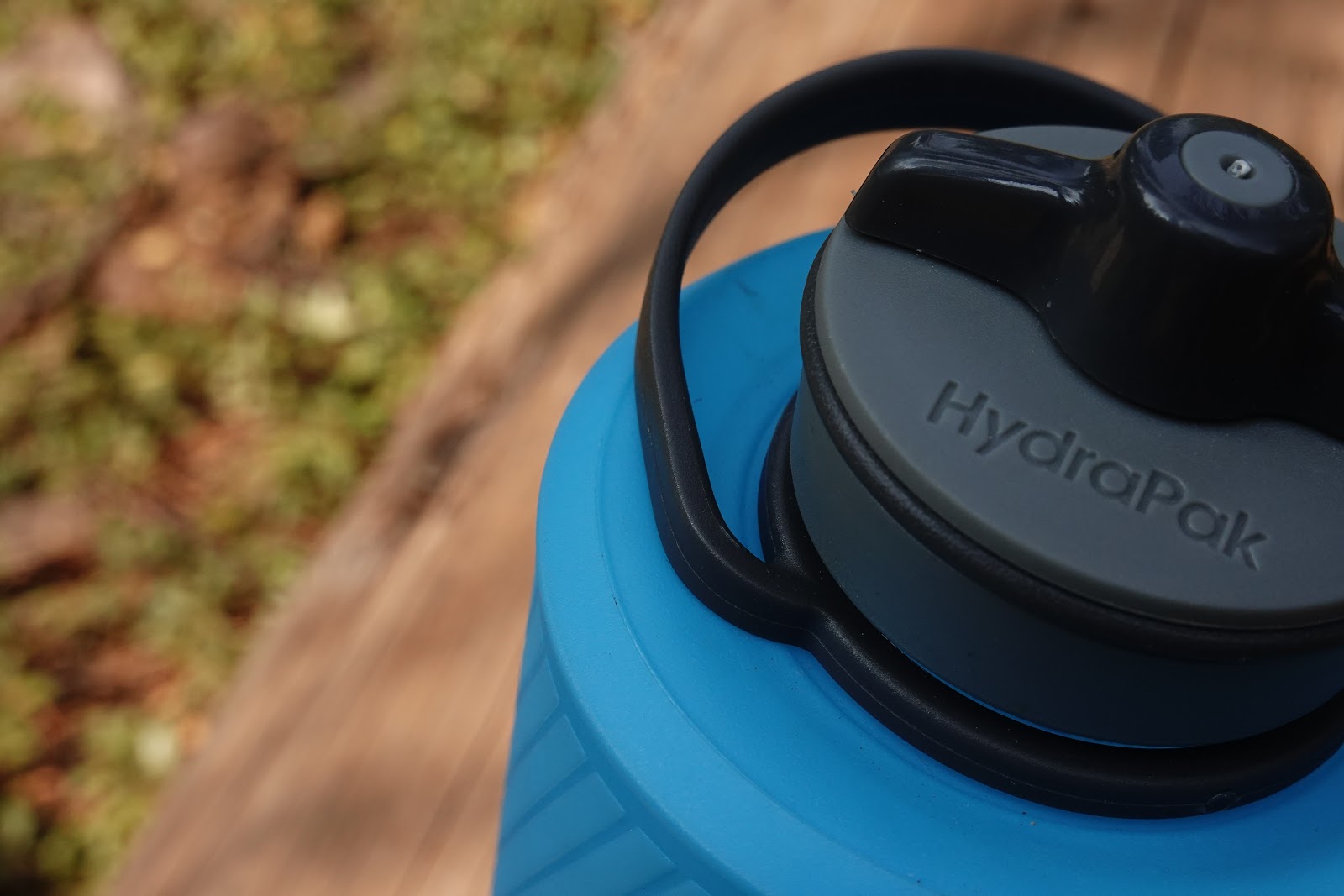

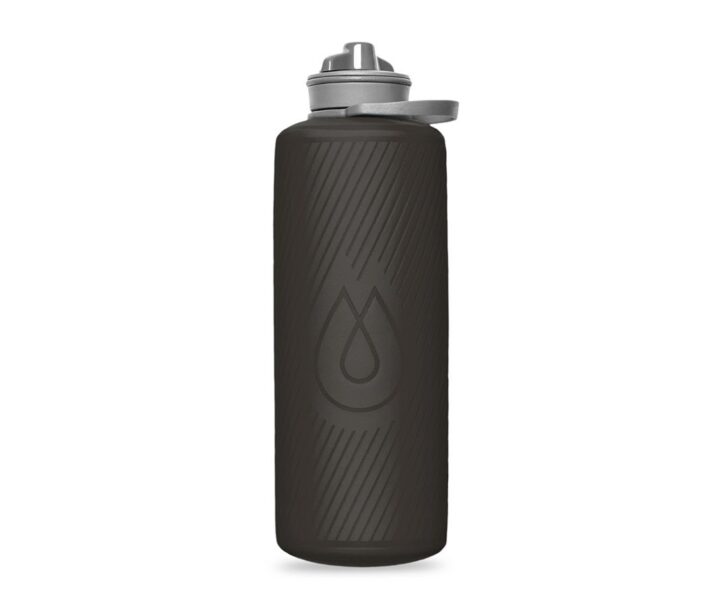
The HydraPak Flux (2.7 oz / 77 g, MSRP $20 for the 1L version) is a soft-sided, collapsible, 42 mm threaded, reusable water-bottle aimed at the single-use Smartwater or sports-drink bottle crowd.
The Problem
When I first took up the sport of long-distance backpacking in a serious way, my first instinct was to use Platypus-style soft-sided bottles. I appreciated their compressibility and weight, and I liked that they were not single-use. At the time, I was proud of myself for not using a big, heavy Nalgene bottle (we all start somewhere, right?).
But soon enough, the realities of trail life took their toll on my good intentions. I found this style of bottle challenging to fill from shallow pools or lakes when running water wasn’t available. They don’t dry out easily, don’t stand up well, and their softness and floppiness can make them hard to get in and out of pack pockets while on the go. On top of all that, they can’t take much abuse—at least they didn’t as of a few years ago (the last time I seriously put a Platypus bottle through its paces).
And so I did what a lot of thru-hikers do: I gravitated towards single-use plastic bottles, namely 1 L Smartwater bottles. As most of us know, Smartwater bottles hold up well (I usually use them for a month or so at a time) and have a long, skinny shape that slots nicely into most pack pockets. Some packs are even designing pockets with Smartwater bottles in mind, which I find to be a fascinating development. 750 ml (25.3 oz) sports-drink bottles are also popular for many of the same reasons.
But since becoming a full-time outdoor journalist, I find myself increasingly facing the realities of our community’s impact on the environment. I’m starting to do some thinking about my carbon impact with regards to traveling to a trail-head. I’m self-conscious about all the single-use plastic baggies in my food-packing strategy. And finally—and this is a big one—I’ve finally decided that it’s time to give up my beloved Smartwater bottles.
Enter HydraPak
The HydraPak Flux 1 L is the newest product from HydraPak, a company that’s taken a noticeably different approach to soft-sided bottles than Platypus and similar competitors. Readers may be familiar with the Stash – HydraPak’s original 1 L bottle. The Stash has a screw-off lid, a bail handle, weighs 3.7 oz (107 g), and is made with durable TPU and PP materials.
This design is notable because although it’s soft-sided, it stands up on its own when empty. This function comes with several benefits – notably that filling from difficult water sources is easier, and your drinking nozzle doesn’t get dirty from laying on the ground. Thanks to the material selection, these bottles are far more durable than either Platypus soft-sided bottles or single-use plastic bottles.
The 1 L Stash has a 63 mm threaded lid, and so it is nice if you want a wide opening and/or use a filtration device that matches that thread size (most of the pump-style ones do). But until recently, you had to go down to the 750 ml (25.3 oz) size to get a 42 ml (read Katadyn BeFree compatible) lid.
I prefer 1 L bottles, and the 3.7 oz (105 g) weight was just a little too much for me to pull the trigger on. And like most ultra-lighters, I don’t use pump-style filters.
The Flux Pros
And now we get to the Hydrapak Flux. This product retains all the great things about the Stash and tweaks the design to appeal to a broader range of ultralight needs.
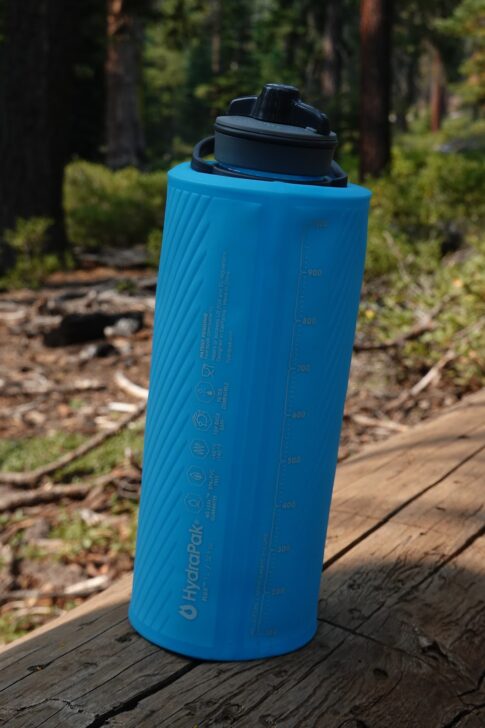
The Flux retains the bail handle, my favorite feature for keeping my hands out of cold water and filling from ponds with ease. The Flux also keeps the strong yet flexible construction, welded seams, and compressibility; although it doesn’t compress quite as neatly as the Stash. And of course, you get HydraPak’s signature feature–that standing-up-when-empty ability.
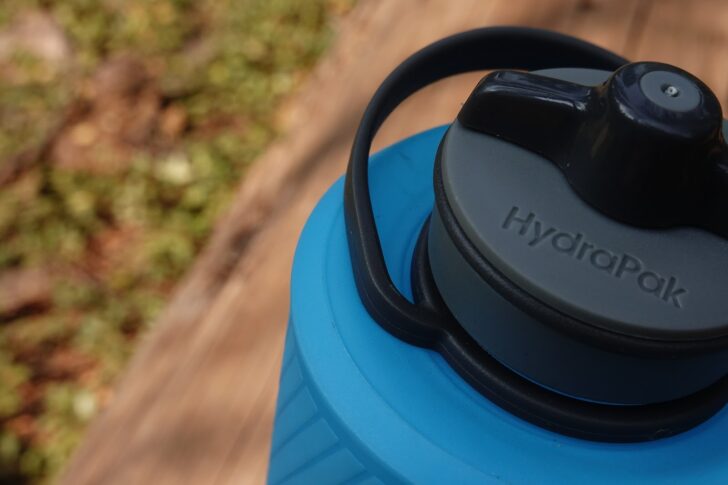
The Flux’s first difference is that you get a 42 mm thread with 1 L of storage, meaning that 1 L bottle fans can pair it with a Katadyn BeFree no problem.
The lid is still screw-off (for easy lemonade/chia seed/electrolyte additions) but now has a squeeze nozzle.
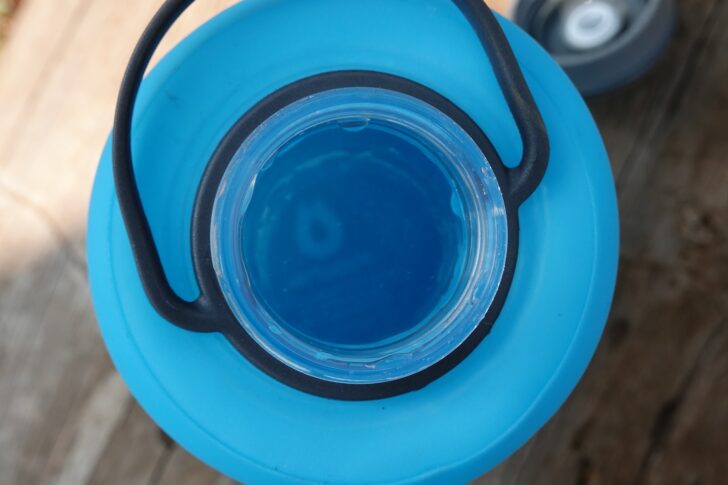
The final point, of course, is the weight. The 1 L Flux weighs 2.7 oz (77 g). That’s still 1.3 oz (36 g) heavier than a Smartwater bottle, but 1 oz (28 g) lighter than the Stash. For some reason, that one ounce was just enough of a mental nudge for me to make the switch.
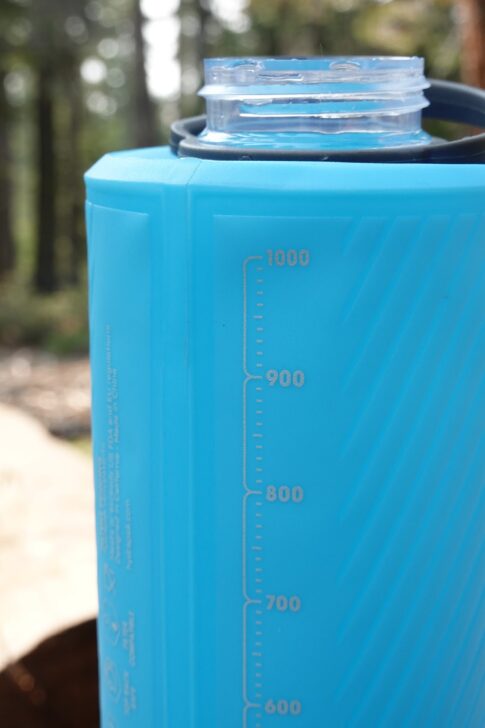
The Hydrapak Flux Bottle: Cons
There’s a lot to like about the Hydrapak Flux Bottle, but it isn’t all roses and sunshine. My load-hauling Rogue Panda Zoro has water bottle pockets designed with long, skinny, hard-sided Smartwater bottles in mind, and my Flux bottles are nearly impossible to get in there (go check out the pack to see what I mean).

I had slightly better luck when pairing Hydrapak Flux bottles with my Mountainsmith Zerk 40 L Fastpack. That pack utilizes a much more traditional side-pocket system. So, if that’s how your pack is designed, you might be better off. But it still wasn’t as easy as when using a Smartwater bottle. So I’ve come to accept this drawback as a necessary evil of switching away from single-use bottles. I’d rather re-think my bottle storage system entirely (and possibly commission a backpack with soft-sided bottles in mind) than continue to use single-use plastics.

A final thought: It’d be nice if the Hydrapak Flux could handle boiling water for use as a hot-water bottle in extreme conditions, but it maxes out at 140 F (60 C). You could maybe get away with attempting to heat up water to just below that point, but that seems foolish, dangerous, and easy to get wrong.
Conversation
I can tell you that HydraPak has a hard-sized reusable bottle coming out this October. This bottle is Smartwater-shaped and made of 50% post-consumer plastic. Called the Hydrapak Recon, it might be a good middle-ground between Nalgene bottles and Smartwater bottles. I’ll post a blog about it later this fall once I’ve had a chance to test one out.
What’s your current water-bottle setup? Are you thinking about ditching single-use plastics for more reusable (but heavier) options? Drop me a line in the comments and let me know where your head is!
Related Content
More by Andrew Marshall
- Backpacking and Long-Distance Hiking in the Time of Covid-19
- Beginner’s Mind: A Lifelong Ground Sleeper Takes to the Trees
Reviews:
- Andrew mentioned his Zerk 40 L Fastpack. It’s still his all-time favorite backpack. Read his review here.
Forums:
- This thread explains our community’s long-standing love affair with Smartwater bottles.
DISCLOSURE (Updated April 9, 2024)
- Product mentions in this article are made by the author with no compensation in return. In addition, Backpacking Light does not accept compensation or donated/discounted products in exchange for product mentions or placements in editorial coverage.
- Some (but not all) of the links in this review may be affiliate links. If you click on one of these links and visit one of our affiliate partners (usually a retailer site), and subsequently place an order with that retailer, we receive a commission on your entire order, which varies between 3% and 15% of the purchase price. Affiliate commissions represent less than 15% of Backpacking Light's gross revenue. More than 70% of our revenue comes from Membership Fees. So if you'd really like to support our work, don't buy gear you don't need - support our consumer advocacy work and become a Member instead.
- Learn more about affiliate commissions, influencer marketing, and our consumer advocacy work by reading our article Stop wasting money on gear.


Discussion
Become a member to post in the forums.
Companion forum thread to: The HydraPak Flux 1L – A Smartwater Bottle Replacement?
The HydraPak Flux 1 L (2.7 oz / 77 g, MSRP $20) is a soft-sided, collapsible, 42 mm threaded, reusable water-bottle aimed at the single-use Smartwater or sports-drink bottle crowd.
$20 will buy a case of Smartwater bottles that are rigid, have a one handed flip top. The top fits a Sqeeze filter
And come filled with water.
I think, in terms of sustainability, it’s also important to consider where a product goes at the inevitable end of its life. Are all the parts of the HydraPak Flux easily recyclable? It doesn’t seem like they would be due to the mix of materials. A Smartwater bottle or Gatorade bottle is 100% recyclable (bottle and lid) at the end of its life, but I realize that ultralight backpackers who reuse these bottles are a minuscule fraction of the consumers of them, most of whom don’t recycle the bottles. I’ve been gravitating more these days to leaving my trusty Gatorade bottles behind and using the white HDPE Nalgene bottles which are light, indestructible (I had one for thirty years before I donated it here on BPL for use at a vet’s office), and as recyclable (#2) as a milk jug (are the lids? I don’t see any recycling numbers on them). I can use them through all four seasons. I can use them as my daily water bottle at work, even in the winter when I bring hot water. Plus, they’re easy to get in and out of backpack pockets, as you can hook them by the lid loop. To me, a collapsible bottle that doesn’t play well with backpack pockets means I don’t drink nearly enough water because it’s inconvenient.
I use Platypus collapsable bottles for water storage and 1 rigid smartwater bottle for drinking during the day. The Platys last forever and the Smartwater bottle gets recycled when it is worn out.
I really don’t see water bottles as an area in need of innovation. There seem so many better places to spend research time and money…clothing systems that can actually keep you dry without overheating and/or developing condensation are just one example.
“I really don’t see water bottles as an area in need of innovation. ”
+1
Plastic recycling in the U.S. is mostly a failure – except for ♳ #1 PET/PETE beverage bottles like Smartwater and ♴ #2, mostly milk jugs. More plastics are burned each year than recycled:
“The current U.S. recycling rate for PET is just under 30%, with much of this material coming from applications other than [♳ #1] bottles.” Food Packaging Forum
Despite 50+ years of misleading advertising and recycling symbology, truly recycling any kind of plastic (e.g. bottles to bottles) is technically very, very hard for many reasons. Mostly they get made into other products which are not currently recycled.
If you use Smartwater bottles, remove the caps and make sure they go into a recycling bin at the end.
“Mixed” plastics like the Hydrapack bottle with “Dual-layer film laminate construction” are currently impossible to recycle – they go into the trash.
Choose your sins carefully.
— Rex
https://www.npr.org/2020/09/11/912150085/waste-land
Found that article very interested. I didn’t realize the situation was that bad…
Use a combo of Smartwater and white wide mouth Nalgene.
I’ve been eyeing this off…I’ve found I’ve loved my collapsible bottles in my UD vest lately for Rogaining…great for gatorade upfront, easy to use while moving, comfortable running, etc. While I run a 2L hosed bladder in the back with water, I really need more volume up front though… 2x500ml doesnt cut it. I can’t see a physical reason though why 1L flex bottles couldn’t be put in a vest with long enough bottle pockets to take them. Just need to find the right vest…
Thanks for your input Rex and iago. Very enlightening, and troubling. Glad to see the Smartwater bottles are of a material that may actually get recycled into something else. Precisely why I use what I use…my platys are probably 10 years old and going strong. The best way to “recycle” is to not have to throw it away! Come to think of it, my smartwater bottles are several years old as well.
I like it. Its compatible with my be free filter. When its empty it crushes down good enough to take less space. I love that it stands on its own.. Full or empty. I can also use my steripen in it if needed .
I have found Evernew bottles to be lightweight and reliable. I use them with a tube and bite-valve for drinking while hiking. In camp they stand upright. 900 ml rated at 1.0 oz. 1.5l at 1.3 oz. 2l at 1.5 oz. I started decades ago with Nalgene hard plastic bottles then migrated to Nalgene collapsible bottles. Nalgene collapsible bottles were not reliable – developed leaks.
http://evernew-global.com/products/waterstorage/index.html
Hydrapak bottles & reservoirs (2L Seeker) may not be recyclable, but they can be repaired with seamgrip wp or similar sealers. I’ve owned mine for 2+ years and just recently developed 2 tiny pinholes which were easily sealed.
My beater Smartwater bottle is a source of pride…
Honest question: why do backpackers/hikers recycle their disposable water bottles so frequently? I’m on my same collection (2x 700ml/1L/1.5) for the past three years and they’re still doing fine. I watch other hikers buy new ones and throw them away/recycle them after a single hike. That’s not keeping them out of landfills.
@jpriddle: I’ve recycled Smartwater bottles for two reasons.
At some point they get enough white-line “creases” from repeated squeezing/flexing/dropping to trust that they won’t fail in the backcountry.
And depending on water quality, what I’ve been eating, and “unknown unknowns,” eventually they get a pretty funky smell that screams “unsafe” to me. And I have a pretty tolerant nose.
A bottle usually lasts several months of weekly day hikes and much-less-frequent backpacking trips. The cost of replacement is low enough, and the promise of recycling sold well enough, that replacement seems reasonable.
I might reconsider that approach.
— Rex
As long as people are throwing away thousands of water bottles every day, it’s hard to see that the purchase of a bottle vs. using a bottle that was heading to the dumpster is a net positive, environmentally. That said, I like the bottle and have used a similar one from them because it fit my UV water treatment pen well. Thanks for reviewing.
“The single raindrop never feels responsible for the flood.”
So, is the reviewer using this as a dirty bottle or a clean bottle? I read that the pros are that the bottle is stiff enough to stand up on its own, and has a bail handle, so I assume dirty bottle, but then it says the 1L is the wrong thread size for a squeeze filter, and you have to go down a size for the smaller BeFree filter compatibility. If you have to use a pump filter or an adapter with the bigger bottles, is the only advantage of this bottle over a regular BeFree bottle its ability to stand up on its own? I am not sold on the form factor, the problems it proposes to solve, or the weight. I’ll keep using my smart water bottles, sawyer bags, and my bladder/gravity setups, all which have served me for many miles and hundreds of gallons of water. I have been on the same 3 smart water bottles for the last 3 years. I use them every day, whether hiking or going to work. I guess they might get gross someday, but they are easy enough to clean given the fact only water goes in them.
Have traditionally used a 1Q Gatorade bottle as it’s squat, stable, durable and has a wider mouth. But agree with Rex that after a year, regardless of washing and disinfecting with water & bleach, just cannot get the funky smell out of them. But this year switching to an ULA Catalyst made the reach back to grab it impossible vs my old pack (+ old shoulders). Also acquired a Hydrapak 2L Seeker resevoir as water storage but also as back up in case my Be Free squeeze bag springs a leak. This might be a better long term solution if it will fit in the Catalyst’s shock cord bottle holders on my pack strap while also serving double duty as a back up dirty bag for the Be Free. I can then go back to the more compact and lighter platy bags if I need to store water. Thanks for the review.
+1 for using the ‘single use’ smartwater type bottle. I’ve got 3 of them that I’ve used for several years as well. Lighter and cheaper than the reviewed bottle, and not buying something new made out of plastic is good.
I find this sentiment a little odd. You’d like to give up single use plastics so your solution is to consume a bunch more plastic in the form of a new backpack and more water bottles rather than re-use existing single-use bottles? Please elaborate how this is more environmentally friendly….
My biggest concern about single use plastic bottles is that people use them for months or years at a time when they are actually only meant to be used once. Over time they leach more and more toxic chemicals into one’s water. [edited – MK]
Is this true? A reused water bottle leaches chemicals faster than one on its first use? I.e. a reused bottle I filled with water the day before a trip will contain more leached chemical than a new one that has been sitting filled with water in a warehouse for a month? It seems doubtful to me.
However, PET can breed bacteria, which might be a cause for concern for some people.
So-called “biodegradable” containers are still mostly marketing hype.
NYT: Why ‘Biodegradable’ Isn’t What You Think
https://www.nytimes.com/interactive/2020/10/01/climate/biodegradable-containers.html
Relevant highlights:
– PLA, made from corn and used in some bottles and single-use cutlery, can only be composted in special industrial facilities – not your backyard. PLA bottles look a lot like PET bottles, but can’t be recycled.
– “Paper” bottles are really a multi-layer laminate that can’t be recycled or composted, like the Hydrapak. Oops.
– PHA “has been the next big thing in biodegradability for years.” And it’s still too expensive to replace petroleum-based plastics. Especially as the market price of oil stays so low.
— Rex
I appreciate the review Andrew. There are a lot of benefits for using a Hydropak bottle.
I’m also a big fan of Evernew water carry bottles. They can stand up empty or full and are very durable. I love the captive loop top cap. When empty, it rolls up and sits nicely next to my CNOC Vecto. I’m old with bad shoulders (25 years of martial arts) and have problems reaching back for a water bottle (depending on the pack) so like Harv, I rigged up a spare tube and mouthpiece from an old hydration system (could have bought the Evernew setup for same function). It screws onto any bottle with same thread pitch (Evernew uses the same pitch as Smartwater and other sportcap water bottles).
Do modern Platy bottles still have a different thread pitch? I went to Evernew when the Sawyer Squeeze became popular (cuz the first gen Sawyer bags sucked).
Become a member to post in the forums.