Topic

why tents fail in the wind

Viewing 25 posts - 101 through 125 (of 173 total)
Roger Caffin BPL Member
PostedMar 11, 2020 at 6:05 pm

Paul makes some interesting points. Guy ropes on a steep mountainside ARE a problem. I would add one extra point not mentioned for mountaineers: they very often have porters or sherpas to carry the extra weight – even up to the South Col.

Of course, those very solid polar pyramids do sort of have their own ‘porters’. Those tents are not disassembled in the morning; rather, the poles are brought together into an umbrella-style bundle and the whole tent is then placed on the top of the sled. Not an option if you want to be ‘fast and light’.

Cheers

PostedMar 11, 2020 at 6:30 pm

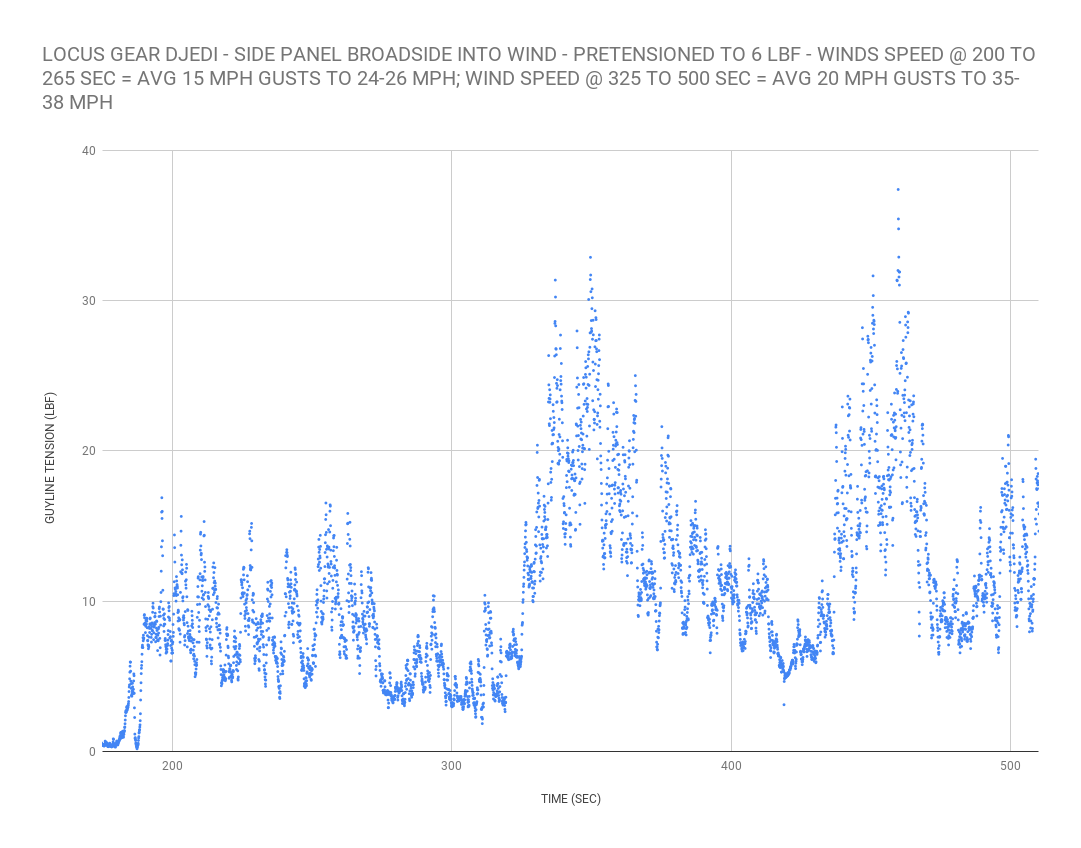
Here’s a plot from today’s test. The goal here was to pitch a dome broadside into the wind and measure the forces on a lightly tensioned (6 lbf) side panel.

X axis is time in seconds, Y axis is guyline tension in lbf.

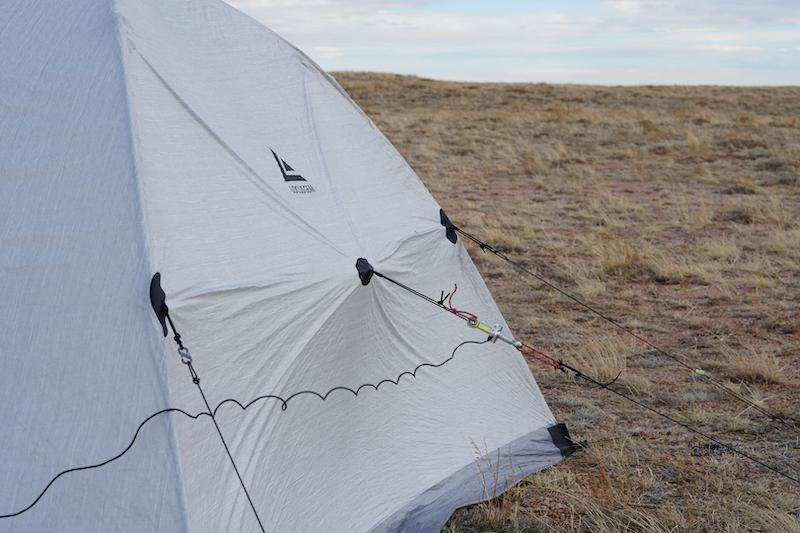
Here’s a pic of the tent in a steady wind of around 28 mph.

Roger Caffin BPL Member
PostedMar 11, 2020 at 6:58 pm

Interesting.
But it’s very hard to read the labels on the axes. Any chance you could change the font to larger and the colour to black?

So much for ‘steady’ wind!

Cheers

PostedMar 11, 2020 at 7:01 pm

How do you set the initial tension with the wind blowing?  Just curious.  Looks like a high peak around 38 lbs.

PostedMar 11, 2020 at 7:24 pm

@jonfong A combination of counterforce guylines and another windbreak.

Use the counterforce guylines to pull the tent into the wind, then preload the guyline I want to test, then release the counterforce guylines. I also have to setup another windbreak. For this one I used a large tarp, about 14’ wide. It gets a little chaotic in winds like this.

PostedMar 12, 2020 at 7:30 am

Paul,
Don’t think one needs to be crossing Antarctica or peak bagging in the Hindu Kush (if ISIS doesn’t get ya) to face the issues you raise. One is of the threat of a sudden and unexpected appearance of a wind with a loud humming noise that seems to rattle your teeth and permeate everything. I live in a bowl at the bottom of little Chocorua, only around 3400′. A nice looking peak, but really part of a long crescent shaped ridge that partially surrounds the bowl. We only get hurricanes every decade or so, but when they do come, they are quite destructive. In milder weather, just a lot of power outages. Many have their own generators. Am glad to have a cellar also.

So in a little tent up near the top of the ridges, one can get caught in life threatening situations. Fortunately, civilization is never more than a half day’s walk away, so you can get out quickly. It’s just that sometimes there is not much warning, especially if the weather seems fine in the morning and you’re not a weather forecast junkie.

In the Rockies, Colorado in particular, there are much larger expanses of wilderness, and rapid exit can be a problem, especially if at high altitude when you get caught. Still, one can often get quickly below timberline at least. But once surrounded by a good bit of cover, their is no time to futz about looking for the perfect tent site, with a large area for staking out guylines running in multiple directions from a tent.

Driving rain can also often be present in these situations. which adds to the challenge. This is especially true if the weather seems fine at bedtime, but during the night becomes unholy. This is when a tent with a light framework, and needing just a few stakes to be anchored, becomes a lifesaver.

Unfortunately, the industry seems to rely on just a few basic designs. The tent page on Sling Fin is a good example. For the one and two person tents, I’ve seen them innumerable times before, and they are not particularly stable. A tent is either a heavy ‘Geo’ or a ‘pop-up.’ Nothing new there. So it’s mids, tunnels and trekking pole tents with a pile of pegs, or domes with one or two poles or struts that cross at the top, and will be flattened when the wind gets nasty. It is obvious at this late date that the industry is not going to do better. But if we want something done right, we have the option to do it ourselves.

Geoff Caplan BPL Member
PostedMar 12, 2020 at 7:58 am

Sam

What would that look like? For a small shelter there are only so many practical structures you can create, given the properties of the poles…

Jerry Adams BPL Member
PostedMar 12, 2020 at 8:07 am

Regarding mids with poles on the four ridges.

A problem with mids is the ridges are on the bias, so they stretch, so the panels flap around.  This might not mean they fail though.

Putting a pole on each ridge is heavy.

Putting tape that doesn’t stretch on each ridge might be a lightweight solution – compromise trade-off between weight and functionality.

PostedMar 12, 2020 at 8:48 am

Ryan – These are radically different results compared to your OP.  Can you elaborate on your observations? How did the stakes hold up?  Just curious.  Cool test results.

Geoff Caplan BPL Member
PostedMar 12, 2020 at 9:32 am

Jerry –

Do you have any experience with stiffening ridges?

No-one seems to do this on mids or ridge designs, though the weight would be minimal. Is this because there’s a reason it doesn’t work? Or is it just that designers are tradition bound and have overlooked a good idea?

Intuitively you’d have thought that stiffening the ridges would reduce flexing and flapping which would reduce the spikes in tension that Ryan is reporting.

The Vango Force 10 A-Frame which I mentioned above has a very solid ridge pole. The pole weighs a ton, but the rigid frame makes for one strong tent and the side panels don’t flap. It’s such a classic that it’s still on the market, in cotton, as the Force 10 Classic.


Jerry Adams BPL Member
PostedMar 12, 2020 at 9:46 am

yeah, exactly Geoff, good questions

I have a plan to try it out.  I forget who else it was that suggested using DCF tape, that might work.

James Marco BPL Member
PostedMar 12, 2020 at 10:40 am

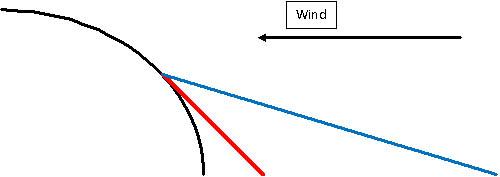
Good test, Ryan. It shows pretty accurately the forces a stake would be subjected to.  However, it doesn’t point to the angle the guy line sits at. In your picture, it looks to be around 35 degrees. Simple angular displacement would yield a LOT of different stake pressures.

Angular force vector

The red line is approximately 1.00:1. The blue line is approximately 3.50:1 The pressure on the red stake will be MUCH higher than the pressure on the blue one in the same test. Ofcourse, the rotational pressure on the floor is greater, but any tent floor should be staked down anyway.

Jerry Adams BPL Member
PostedMar 12, 2020 at 10:46 am

and the pressure on the red line angles up, trying to pull the stake out of the ground

Dave @ Oware BPL Member
PostedMar 12, 2020 at 12:26 pm

“Regarding mids with poles on the four ridges.

A problem with mids is the ridges are on the bias, so they stretch, so the panels flap around.  This might not mean they fail though.

Putting a pole on each ridge is heavy.

Putting tape that doesn’t stretch on each ridge might be a lightweight solution – compromise trade-off between weight and functionality.”

The ridges, being sewn, are stiffer already than the panels between.

“The pole weighs a ton, but the rigid frame makes for one strong tent and the side panels don’t flap. It’s such a classic that it’s still on the market, in cotton, as the Force 10 Classic.”

Build most any of those other styles of tents out of canvas and there won’t be much stretch or flapping.


Jerry Adams BPL Member
PostedMar 12, 2020 at 1:37 pm

“The ridges, being sewn, are stiffer already than the panels between.”

yeah, if it’s a regular flat felled seam its folded over twice so there are 5 layers of fabric.

Still, it’s on the bias so it stretches a lot.

When I look at my tent, blowing around in the wind, I can see it with my own eyes.

I’m not arguing adding a stiffener strip would be good, just that it’s an experiment to see if it makes any difference.

PostedMar 12, 2020 at 1:56 pm

I found I can insert 2 poles in the pole sleeve of my TT Moment DW. The problem is there is only room for one pole to fit in the Hypalon pocket at each end. So If I want to utilize 2 poles in the sleeve I’ll have to make an additional pocket sewn beside the original pocket. But this is a small item compared to the additional strength of having 2 poles for the main hoop.

The Hilleberg Akto provides a slightly larger hoop sleeve specifically for this purpose and maybe Tarptent could do the same to several of their tents with hoop poles like the Moment DW, the Scarps, etc.

Roger Caffin BPL Member
PostedMar 12, 2020 at 2:16 pm

but any tent floor should be staked down anyway.
My first thought was that I have never explicitly staked out the floor of any of my tents.
My second thought however was that the tips of the poles sort of stake out the hem of the tent all around. The pole feet always dig in a little bit due to the guy ropes. That seems to work fine.

Cheers

Geoff Caplan BPL Member
PostedMar 12, 2020 at 6:07 pm

Jerry

Just pulled out my TrailStar (ProSil version) and there is very substantial stretch along the length of the flat felled seams.

I my experience an A-frame shelter with a ridge pole is more stable than one with an unsupported ridge.

A true A-frame with sleeved poles up each side of the entrance is more stable than a shelter with a single pole in the middle of the entrance.

This is just common sense.

So logically you’d expect a shelter with stiff seams to be more stable than one with seams that stretch.

The challenge would be designing a stiff seam that still gave you the ability to stretch the panels when they sag in the cold and wet. With sleeved poles, you can stretch the fabric independently of the support, and this is essential for a good pitch. You’d have to replicate this in some way if you were using tape or chord under tension as a stiffener, rather than sewing it in.

Edward John M BPL Member
PostedMar 12, 2020 at 7:01 pm

A frame poles need to be stronger and therefore heavier than a single pole tho and these then start to fall outside of the UL

I liked my Vango Force10 but it was very heavy, the Eureka Timberline was bigger and lighter and possibly stronger but still heavy and those would be what I consider “Classic” A frame tents

Dave @ Oware BPL Member
PostedMar 12, 2020 at 7:07 pm

The cut of the fabric has much to do with how panels and seams stretch. If the curve of the seam is not correct, even having a pole in a sleeve will not provide strength evenly on the panels.

I have found that using low-stretch materials with stretchier ones sometimes concentrates the force on too small an area and is weaker. I would guess stiffening the corner seams might do that.

Sure, adding more solid materials makes things more bombproof. The three little pigs learned that. They didn’t have to carry their house of bricks tho.

Hang gliders make use of lots of poles, parasails not. Which would you like to carry up the mountain?

Dave @ Oware BPL Member
PostedMar 12, 2020 at 7:10 pm

“he challenge would be designing a stiff seam that still gave you the ability to stretch the panels when they sag in the cold and wet. With sleeved poles, you can stretch the fabric independently of the support, and this is essential for a good pitch. ”

The stretching of a tent supported by 1 vertical pole is super easy to stretch the seams, just raise it a bit. It the corner seams were stiff, it wouldn’t work.

PostedMar 13, 2020 at 12:29 am

It seems (ahem) that you would still have an elastic structure with inelastic seams if they’re curved.  I’m thinking specifically of a mid.  If a wind load pushed the tip down wind, the up wind seam gets loaded lengthwise, trying to pull the curve out of it.  This then exerts tension across the adjacent panels, which are themselves elastic.

As another example, consider a cat-cut a-frame tarp hung over an inelastic ridge line.  Try to pull the pole tips apart, the ridge line tries to straighten, stretching the fabric panels upwards in the middle of the ridge.

I feel like some one did once report on a mid with the panels cut on the bias, so the seams were not on the bias, but I can’t remember who, when, or what they had to say about it.

Jerry Adams BPL Member
PostedMar 13, 2020 at 9:39 am

tent on bias – me

I don’t recommend that.  It pulls the ridge sideways in weird ways, has other weird effects.  Good experiment though, keeps me out of trouble.

Good point about cat curve stretching

Viewing 25 posts - 101 through 125 (of 173 total)
Loading...