Stumphges, Thank you for that link to Yama MG. I note that it does not mention permanent distension with respect to silpoly, but does with the cautions about DCF.
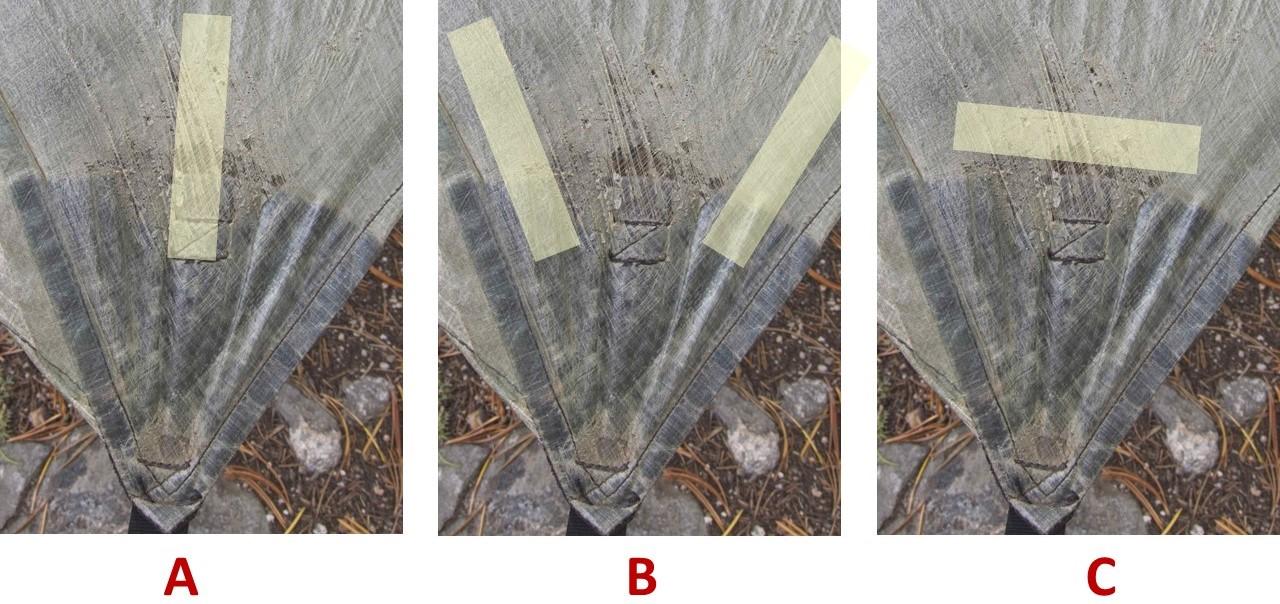
Your diagram and text were what I was thinking about in terms of the forces on a pull out beak being spread across an entire vestibule side panel. Kudos. But I did not raise it. Call me chicken. Anyway, you did a far better job than I would have.
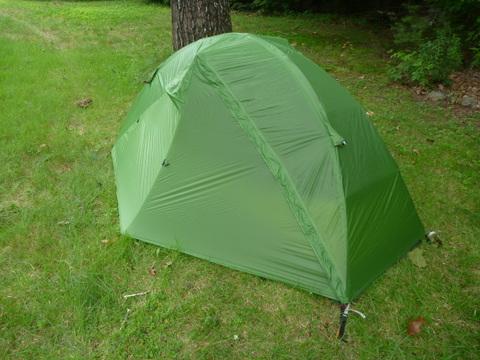
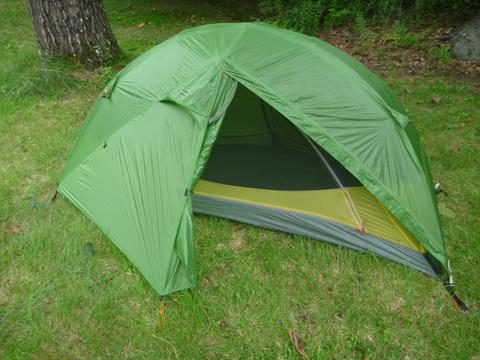
With pull out beaks that join with a center zip (or other connector), in the middle rather than off to the side like my Goondie, one of the beaks may be staked, and the other not. Interestingly, with the Goondie, they elected to place the door zipper off to the side where the beak attaches to the tent:

You can tell the zip location from the cover flap.
The Goondie approach may work better than a zipper between the vestibule beaks for several reasons, but I wanted a zipper in the middle to improve access on the next tent, and facilitate opening up the whole front of the tent in hot weather.
Note that the Goondie is less wrinkled when zipped up, but moreso when the zipper is open:
Then when you look at the beak on the staked left side, the stress lines are clearer, much like the lines in your diagram.
From this, it looks like that with the zip in the middle between the beaks, the pegged beak will be more wrinkled along the stress lines when the unpegged beak is unzipped in order to open the door. This does not seem a major problem, however. In a major blow, the unpegged beak would be attached to the peg, or to the bottom of the other beak in order to protect the zipper.
The Goondie is a PU coated nylon tent. How the above would work with silpoly or DCF might be another story. If the fabric would not stretch well, then instead of wrinkles, there might be a crater develop in the area of the beak that would flap like hell in a blow. Am not sure.
At this point, I’m thinking about using 0.5 oz DCF for the front and rear beaks that constitute the vestibules, as it would save over 50% in vestibule weight. If the DCF did not work, the beaks could be readily replaced. For the floor, I’m also thinking of using densely woven, double ripstop 29 gram, 20D paraglider PU coated nylon with a thinly applied Tent Sure coat, because if the extra coat did not add much weight, this would knock 0.5 oz/yd2 off the floor weight compared to a heavier 30D 6.6 silnyon.
But for the fly, which must have bias stretch to secure tautly over the double cross pole frame, but not over the vestibules, maybe a 20D silpoly if it has enough bias stretch to conform to the frame. If not, the fly might be the lighter 20D paraglider fabric, again with the added PU coat, assuming that also would have enough bias stretch, and also be able to shed heavy rain with an added Tent Sure coat or coats. Note that the double cross pole frame uses carbon shafts from Gold Peak that weigh .247 oz per running foot, or roughly 1.5 oz for a 6 foot pole, less ferrules, tips and shockcord.
The above are possible ways to shed weight, and lower weight of a self supporting tent at least down to the range of the all DCF tents, perhaps below 20 oz for a solo or 1P TENT with ample space for cooking, eating, canine company and gear storage.