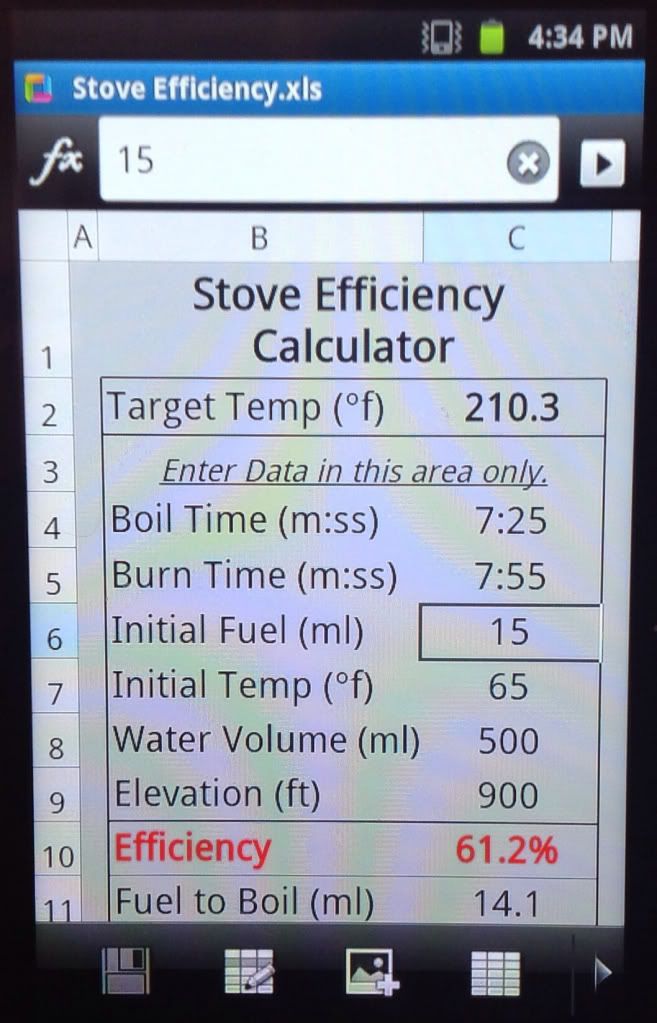
Ok, so here's my dig on efficiency.
Boiling point is actually kind of useless as a determiner for, well, for anything really. Real water temperature would be more determinate. But for our friends in the upper elevations, reaching a temperature of say, 200 degrees, is unobtainable. So we'd need a different system, like has been mentioned, we could use extreme parameters and extrapolate efficiency from the linear read out. Using too much water, too little fuel, a temperature of only 150 degrees, or other limiting factors solely for the function of extracting an efficiency rating.
All that is great for the cast of BPL, who has a fairly high scholarly membership and a critical eye. But let me pose this question: When was the last time you saw an average Joe Dirt guy like me, on a You Tube video, or a forum, say something like "Dude, I got 6 cups of water to 150 degrees with only 15ml of fuel!"? Never. It's just not fun. Not even the guys that sell stoves use that as an advertising hook. It's always about boil times. Boiling water is a universal test parameter that ordinary people can relate to. So for me at least, it's not just about finding an accurate efficiency quotient, it's about forming a set of parameters in a realm populated by average people that just want to boil water for experimental fun and comparison.
Using odd parameters like excessive water or minimal fuel doesn't test the system in question. Like guys who want to test an almond can for example. Or test variations of windscreen effectiveness on a certain pot design. Or compare my Ti pot to your Imusa mug, to Davids beer can. A linear read could be used I suppose, but there would still need to be a formula and spreadsheet used anyway, for degree rise, time elapsed, fuel used, energy consumed, etc. Some numbers could be thrown around making comparisons, but to get an efficiency rating still requires calculations. Calling this "stove" efficiency might be a bit of a misnomer, but it's not just a burner that's being tested, it's the whole stove system, and to what degree of efficiency the fuel is being utilized. At least that's my take on it.
So anyway, I'm rambling a bit, but for me, I'd like to see a simple formula that anyone can simply weigh up some water, measure out some fuel, get the local barometric pressure off a news site, put in their elevation constant, and stick a thermometer in a pot. Stop timing when the spreadsheet tells you, and get a reading. To tap into a different thread discussion, I'd say my mom could do this.
This isn't a perfect answer, and most everyone on here will find flaws and faults with it, that's the very nature of BPL lol. I understand that there are better ways to test efficiency. I realize the formulas for this simple task are more complex than need be. But I'm pretty happy with what we've achieved so far, and I'm hopeful that others will find it fun to play with. I know it's been a learning experience, and as I've repeatedly stated, that's kinda the whole fun part for me. :)
Edit: Getting a barometric reading AT elevation is problematic, since it's not posted as an absolute pressure, but an adjusted for elevation one. So to use adjusted barometric pressure AND elevation, it can be brought back to an absolute pressure reading. I've yet to find a formula for combining the two effectively. Hence my own morphed mixture. Maybe there will be a V.2.0 in the future :)