Topic

The Alcohol Stove “Efficiency Percentage” Test Thread

  • This topic is empty.
Viewing 25 posts - 101 through 125 (of 137 total)
PostedApr 22, 2014 at 2:44 pm

> I love all of the data that these threads are producing. It is really interesting to see the effects the various changes have.

Thanks to *you,* Ben! All we needed was your know-how to calculate efficiency scores.

StarLyte Modified with Boonie Hat Test. Put a Boonie Hat on my MSR Titan, a circle of thin foil that over-hangs the pot lid on all sides by 2" and flops down around the edges like a boonie hat. The idea was to keep the escaping heat in the area a bit longer. Same parameters as before with the StarLyte Modified, 1/4" screen standoff, Barometer 29.8, ambient 80-2F.

Water temp 80
8:28 to boil goal
10:35 to flameout
Efficiency 63.5%

Water temp 79
9:00 to boil goal
10:41 to flameout
Efficiency 60.8% (<- first boil of the day)

Average 62%, which doesn't beat my Boonie-HatLESS previous best of 63%, but, I'm certain this is well within the latitude of error. I think I am seeing a trend where the first boil of the day is a little less efficient, so maybe this comparison penalizes the hat…if the first test reported (last from previous day) had repeated, I might be reporting a very slight improvement. Not giving up on the hat; after all it did perform in David's tests. I don't mind going back and retesting for finer resolution at another time, but at this point I'm looking for bigger effects rather than subtle ones.

I don't think this thin foil boonie hat would be practical in the field, it would blow off.

Zelph StarLyte Simmer Test. It has an even smaller opening than the Modified. See it here:

http://www.woodgaz-stove.com/starlyte-burner-with-lid.php

Tested with 1/4" clearance of screen.

Water temp 80
9:10 to boil goal
11:15 to flameout
Efficiency 62.3% (<- first burn of new stove)

Water temp 80
8:08 to boil goal
10:13 to flameout
Efficiency 63.8%

So the StarLyte Simmer is averaging 63% efficiency so far. Notice that its boil times and flameout times are really not so different from the Modified. What do you make of that?

Pack-A-Feather XL Test, Half Throttle, an adjustable alcohol stove. For this test I opened it 1/2 way (that would be 2-3/4 turns of its adjustment knob):

Water 82
Boil 7:54
Flameout: 8:25
Efficiency 53.3%

Water 80
Boil 8:37
Flameout 9:07
Efficiency 53.7%

Average 53.5% for the Pack-A-Feather at half throttle.

Pack-A-Feather XL Test, Third Throttle, for this test the PAF was opened 2 full turns (that's actually 36% open).

Water 80
Boil 10:06
Flameout 11:18
Efficiency 57%

I did another test at 1.5 turns open (one-quarter throttle) and I got within a few degrees of the boil target, but not quite. So the throttle works well for simmering, but the efficiency doesn't get better on the low end.

Quick Review of Delmar’s Tests:

Previous in this thread:
55% efficiency, StarLyte Modified, straight 3 in windscreen at 1/2 in standoff (2 trials)
63% efficiency, StarLyte Modified, straight 3 in windscreen at 1/4 in standoff (2 trials)
60% efficiency, StarLyte Modified, straight 3 in windscreen at 1/8 in standoff (1 trial)
62% efficiency, StarLyte Modified, straight 3 in windscreen, 1/4 in standoff + “Boonie Hat” cover (2 trials)
63% efficiency, StarLyte Simmer, straight 3 in windscreen, 1/4 in standoff (2 trials)
53.5% efficiency, Pack-A-Feather XL, half throttle, straight 3 in windscreen, 1/4 in standoff. (2 trials)
57% efficiency, Pack-A-Feather XL, third throttle, straight 3 in windscreen, 1/4 in standoff (1 trial)
Ahead in this thread:
65+% efficiency, StarLyte Simmer, straight 3 in windscreen, 1/4 in standoff, K-S "Green" Denatured. (2 trials)
62% efficiency, StarLyte Simmer, straight 3 in windscreen, 1/4 in standoff, K-S Green, Imusa Mug (1 trial)

EDIT: I intend to keep modifying this same post throughout the day, rather than multiple small posts. I'm home sick but have enough energy and interest to do tests today.

Adam BPL Member
PostedApr 22, 2014 at 3:17 pm

What about a felt or cozy style lid on whilst boiling? Or has that already been shown to have minimal effect? (I think most of the heat loss from the lid/top would be via water vapour, not direct to air, so once a lid is on, further gains are minimal).

My thoughts as to why the boonie hat hasn't worked;
1. minimal contact between boonie hat material and pot and water
2. Is the water up to the lip of the pot? If not, then much of the caught heat will be trying to transfer via the metal of the top of the pot to an air gap, then downwards to the water.

I had an idea about internal fins…rather than just fins on the bottom/outside of the pot (aka jetboil), why not also have fins on the INSIDE of the pot. Heat will conduct well along and through all the metal of the pot. You (we) need to maximise the surface area of metal in contact with water. If there were a bunch of flat fins coming up a few cm from the bottom of the pot, vertically into the water (and fully submerged) then that would help heat transfer to the water, no? I imagine copper fins would be rather good for this. No idea how to construct it (weld, somehow). Also makes the pot a boil water only affair.

Cheers

PostedApr 22, 2014 at 5:57 pm

Delmar: In your SS, cell C11 has 11.8 entered. I'm assuming that's grams, but it looks like the formula is still doing a ml conversion? Ok, scratch that. I see it's fuel to boil, but is that still grams? Over 3ml of fuel remaining but still mid 60's efficiency? Something seems odd to me I guess, not sure what at a glance. The numbers jive, but doesn't it seem like the efficiency would be higher with so much fuel left over?

Richard: Per our discussion, any further development in the kJoules vs BTU/g ideas?

Bob: My bottle is 1-1/4" dia, but 1-5/16" 3oz would be ideal. Dispensability is a large concern.

Ben: Agreed that you'll remain the kickstarter of this whole enterprise.

Adam: Internal fins actually sounds intriguing, but wrought with complications I think.

David: Just hoping your move is going as planned.

PostedApr 22, 2014 at 6:27 pm

Glenn – I like working in BTUs as it eliminates the need to convert temperature from Fahrenheit to Celsius. It takes 1 BTU to raise a lb of water one degree F. All you need to do is convert lbs to grams.

Of course finding published values for BTU/lb for the various fuels can be a source of frustration. Most references give the Upper Heating Value for alcohols rather than the Lower Heating Value you are using. If you have solid kJoule values you like for Ethanol and Methanol they can be converted to BTUs by dividing by 1.055 (the number of kJoules in a BTU).

For reference I used 13,300 BTU/lb for Esbit which works out to 29.3 BTU/g or 30.9 kJoules/g. It doesn't really matter which unit system you work in as long as the units don't get mixed up.

I did figure out where the 25 kJoules/g came from that Ben used. He used published values for Ethanol (26.9 kJoules.g) and Methanol (19.6 kJoules/g) and assumed most alcohols used are a mixture of the two. I have 3 different types of alcohol fuel sitting in my garage. One is yellow Heat which, if I recall, is mostly Methanol. Another is SLX which is about 50/50 and the last one is Kleen Strip Green denatured which is ~90% ethanol. Each of these have their own unique kJoules/g value.

David Gardner BPL Member
PostedApr 22, 2014 at 7:32 pm

Back when I was experimenting with fins, one of the things I tried was coiling them up tightly into the bottom inside a Fosters can. Pretty good contact with the sides of the can, but only minimal contact with the bottom. Didn't seem to help anything, but with better bottom contact like on a Zelph flat-bottom can it might work better.

Love that Klean Strip Green and its high percentage of ethanol. Too bad it costs about twice as much as the regular Klean Strip. Fine for the limited quantities needed on a camping trip, but hard on the wallet for mass testing. But when I get my shop set up again I look forward to performance comparison tests. With higher energy density I would expect it to perform better in terms of time to boil, at least. But we'll see.

Glenn, thanks for your good thoughts. The move is chaos. Almost everything is in boxes now but I have no idea where any of it is. Just boxes marked "shop," "kitchen," "master bedroom" and the like. Ugh. The last thing to go into boxes will be my home office, since I can't afford much down time.

Jerry Adams BPL Member
PostedApr 22, 2014 at 7:49 pm

I think there wasn't enough air space between your fins and the pot, so the exhaust gasses flowed outside the fins.

But it would take a while to figure out a better size, not that much efficiency to be gained, would have to be done for the sake of doing a science project…

David Gardner BPL Member
PostedApr 22, 2014 at 8:01 pm

I was referring to a coil of fins *inside* the can. No air space there at all, just water.

David Gardner BPL Member
PostedApr 23, 2014 at 6:09 pm

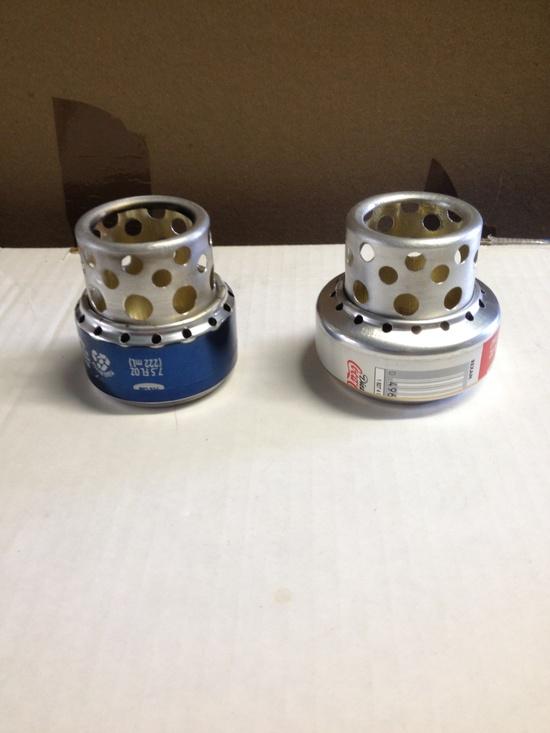
So I was going into stove withdrawal, and had to dig out a few things from boxes in the shop to try out a new stove design after I discovered that the mini 7.5 oz soda cans have the same base ring diameter as the full size soda cans. This allows me to use the same 1.75" hole saw and same 1.75" diameter aluminum hair mousse bottles for the pot support. Weight is a hair over 14 grams, vs. 16.6 grams for the earlier design.
l

Managed to do one test burn with my last bit of alcohol. The usual 500 grams of 70* F water and 15 ml of fuel. Used a standard aluminum windscreen, base sheet and pot lid. Boiled in 5:36 minutes, and flamed out at 5:45 minutes. Efficiency = 57.5%, so not spectacular in that respect, but I love the boil time. As soon as I am able I will do more thorough tests, and also try a tighter fitting windscreen, polished aluminum, etc.

PostedApr 23, 2014 at 6:32 pm

I'd speculate by saying that the shorter burn times, and decreased efficiency go hand in hand as an indication that the narrower diameter and less outer surface area is causing the fuel to over-vaporize from too much thermal feedback.

But it is fast! Always a trade-off. So with the same ring size, would that also mean the stability is the same?

On a different note, my tiny Barbasol stove gave me around 59% on both the Imusa 12cm and the MSR Titan Kettle (both with 3" windscreens and baseplates, 500/15 liquids). Curiously, a 28oz Bean can weighs exactly 3oz, is almost identical in size to a Fosters, and achieved 56% with the same cone windscreen I've been using. Hardly "elite", but useful information if my Fosters gets crushed and I need a replacement on-trail. No specialized opening system needed, and the beans taste better than the beer!

Galen Benson BPL Member
PostedApr 23, 2014 at 6:54 pm

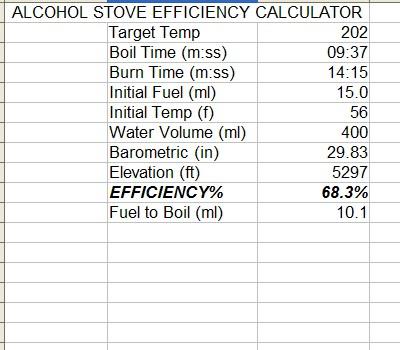
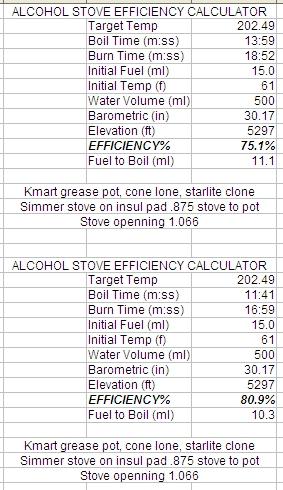
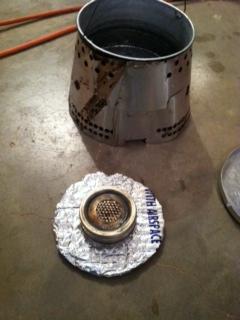
Here's a basic grease pot, cone clone, and simple stove setup with the numbers. Only 1 burn test as I'm healing from surgery and energy level is low. The temp maxed out at 203 and held it till the stove burned out. Elevation at 5297 makes a difference.Stove/pot setupNumbers from the spreadsheet

PostedApr 23, 2014 at 7:32 pm

Excellent results! Welcome to the thread!

Yes, the elevation makes a big difference in temps, which is where this spreadsheet should really level the playing field for making viable comparisons.

Is that a Starlite stove then? Seems the Starlite is showing some great results.

Galen Benson BPL Member
PostedApr 23, 2014 at 7:54 pm

it's a starlite clone. The wide pot helps too. I'll try again tomorrow to be sure I got the numbers right.

David Gardner BPL Member
PostedApr 23, 2014 at 8:26 pm

Glenn, same ring size on the base does give the same stability as the full-size soda cans. Also the diameter of the jet circle around the ring is the same.

The trade-off/compromise concept is interesting. My personal goal has become to boil 500 g of 70* water with 15 ml of fuel as fast as possible with as light a system as possible. I suppose that should be the subject of a different thread, since this one is about efficiency…

Galen, I was going to welcome you to the thread, but Glenn beat me to it! Great efficiency results with your set up. I wonder if the higher altitude not only reduces boil temperature, but also helps with efficiency somehow? Did you make the Starlyte clone, or acquire it somewhere?

PS: How do you guys make those nice efficiency spreadsheets show up in your posts?

PostedApr 23, 2014 at 8:51 pm

"How do you guys make those nice efficiency spreadsheets show up in your posts?"

The ones from my phone I just took a picture of. The actual spreadsheet shots I used the PRINT SCREEN button, and pasted the image that it put on the clipboard into an image editor, then cropped down accordingly and posted the image here.

PostedApr 23, 2014 at 10:37 pm

Galen steps in and takes top prize for efficiency! I put his numbers in my SS and came to the same calculation of 68.3%. I think we are witnessing the heat-absorbing power of a big-butt pot.

You guys with your skinny supermodel vertical pots have to work really, really hard to get the same efficiency that these broad beamed barnyard babushkas provide. My 4.5 in diameter MSR Titan gives me 63% without a lot of effort (straight, short, unpolished screen and all–I can feel the heat inefficiently pouring off the sides!). Galen’s 5.25 in diameter Greaser in a frustum gives him 68%–does this surprise anyone? I don’t think it should.

The downside to Galen’s setup (and the ONLY reason I don’t carry my Greasers any more) is that those Greasers takes a lot of real estate inside the pack…the same reason, I suspect, that the Skinny Supermodel bunch stick to their outback beakers…they’re very efficient space- and weight-wise. And that's important, too.

Galen: How far does the bottom of your pot sit above the top of the stove? One inch?

James Marco BPL Member
PostedApr 24, 2014 at 4:05 am

If you notice, the heating was at 9:36, or right around 10 minutes. This is about optimal for heating that pretty much does the job even in bad weather (wind, colder weather.) However, it is still burning a bit hot.

You will see that his stove continued to burn for about 14 minutes. A simple reduction in heat output will increase efficiency again. Almost 1/3 less fuel could have been used by the current numbers. Allowing for Galen's relativly high initial heat (70 degrees or so) and some allowance for real world variences he could have reduced the heat out put by about 20% and increased his burn time to about 12 minutes. This means that the burning surface area could have been reduced by about 20% too. This should give another ~5% efficiency, also.

You will see that conductance taks a finite amount of time across the thickness of the metal. Heating a pot will reduce the differential for heat transfer to occur. Soo, thinner metals and slower heats increase in efficiency simply for that reason. Checking a beer can, you will see that the thinest portion is on the sides with the bottom almost twice as thick as the sides. The bottom gathers most of the heat.

You will find that there is a sharp increase in efficiency with a balanced system. As things are better balanced, all things (stove, windscreen, pot, fuel) will hit a sweet spot. I use a series of radial rings dimpled into the pot bottom by tapping, about 1/4" or so, with a jig. This Heat Exchanger costs nothing in terms of weight or volume and only makes the pot slightly harder to clean. It thins the bottom metal a bit and it gathers another ~5-7% with a small stove and upwards of 15% on a WG/canister stove.

Wider pots also radiate more heat. I would look at increasing the insulation on the top of Galen's set-up for another 1-2%.

Large pots(grease pots) a waste of space?? Ha, ha, no. I put my tarp in it which just fills it. No wasted space. If you want speed to boil, just bring a canister or a WG stove.

PostedApr 24, 2014 at 7:46 am

Interesting. I didn’t know that 10 minutes to boil had been discovered to be near optimum.

> …he could have reduced the heat out put by about 20% and increased his burn time to about 12 minutes.

I’m not following…as it was, Galen’s burn time was 14:15. If he reduced heat output by 20%, his burn time might have been around 12 minutes? I would have thought reducing heat would make for a longer burn time.

> Soo, thinner metals and slower heats increase in efficiency simply for that reason.

Agreed, but isn’t there a tipping point where low heat can become INefficient, even if the setup is still capable of bringing to a boil? Where the cool environment almost but not quite overwhelms the warm stove? I thought that’s where you were going with the 10-min optimum idea, that a longer boil than 10 min might mean a less efficient boil?

David Gardner BPL Member
PostedApr 24, 2014 at 8:16 am

James, I can't quite visualize your ring of dimples. Would really like to try the same technique. Any chance of getting a picture?

Galen, how much does your system weigh?

Cut the bottom off a Fosters can last night, and press fit it into an aluminum flat-bottomed (Queen song again?) cat food can. Water tight, much thinner metal at the bottom, and that nice flat bottom for the flames to hit. Seemed to work well, but don't have the equipment accessible to really test it now. Soon, I hope.

Galen Benson BPL Member
PostedApr 24, 2014 at 12:57 pm

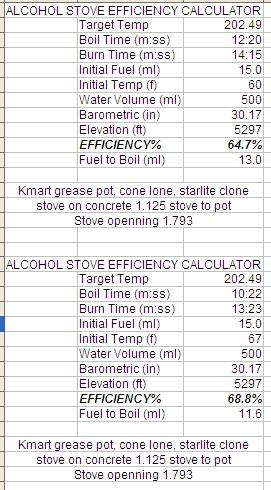
I know my measurements probably aren't as precise as those I see here so the numbers may be off a bit. I weigh the water and increased the amount to 500 ml which seems to be the norm here. There may be a difference based on weight versus measured volume which you numbers people can check out and advise on. My first test is with the water cooled to ambient and the stove set directly on the concrete floor. In the second test, also set directly on the concrete floor, the starting water temp was 7 degrees higher which contributed to the better efficiency. The pot bottom is 1 1/8" above the stove and the homemade starlyte stove has an opening of 1.793".
Numbers for stove on concrete

Galen Benson BPL Member
PostedApr 24, 2014 at 1:04 pm

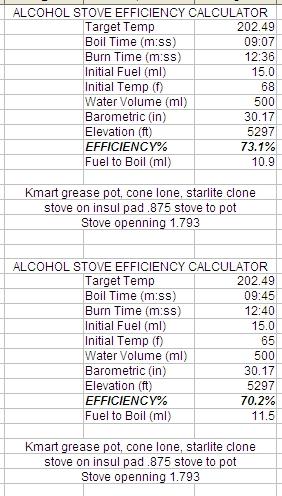
This test places the stove on a reflective bubble pad sized to fit in the bottom of the pot. The water temps start out higher which effects the efficiency. The stove to pot distance decreased to .875" (7/8") If the pot and the cone clone were shortened I think the efficiency would go higher yet. Changing the pot style to be more frying pan like. What I'm getting out of this is an idea of the amount of fuel I can get by with on a trip.
Stove on pad

Galen Benson BPL Member
PostedApr 24, 2014 at 1:11 pm

Since you guys brought this up & I happen to have one here are the tests done with a starlyte simmer stove with a 1.066" burner opening. I spilled fuel on the the top of the stove on the second test which created more heat at the start which kicked up the efficiency. This tells me I could enlarge the burner hole but it wouldn't improve the total burn time which is what I'm using the simmer stove for. I also added ice to the water to bring it down closer to what I'd find in the field.
Simmer stove
Simmer stove image

Ben H. BPL Member
PostedApr 24, 2014 at 1:12 pm

73% efficiency is impressive. I would like to see some pictures of your system.

I noticed you are measuring the fuel in ml. Are you multiplying it by the fuel density before multiplying it by the fuel's lower heating value? Water is usually pretty close to 1g/ml, but alcohol is more like 0.7-0.8 g/ml

Galen Benson BPL Member
PostedApr 24, 2014 at 1:19 pm

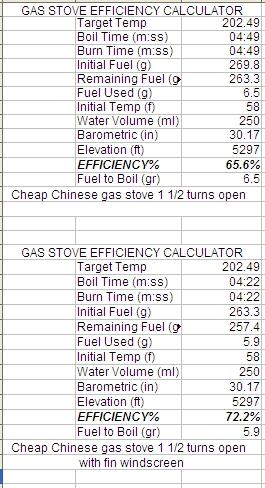
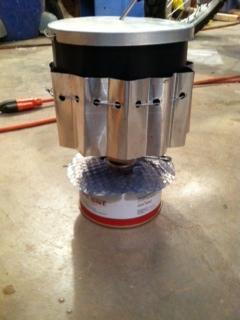
Decided to adapt the spreadsheet to use with a canister stove. You guys will know if this is even anywhere near correct. I added a couple of rows to put the original weight of the stove and tank, The ending weight of the stove and tank, and the subtracted to get the fuel used. Like I say I don't know if this is even realistic but it gives be a comparison number which is what I was looking for since I'm testing the finned windscreen that attaches to the pot compared to no windscreen. Fire away guy I want to know. 8)
Gas stove numbers
Finned windscreen

Viewing 25 posts - 101 through 125 (of 137 total)
Loading...