Topic

The Alcohol Stove “Efficiency Percentage” Test Thread

  • This topic is empty.
Viewing 25 posts - 51 through 75 (of 137 total)
David Gardner BPL Member
PostedApr 6, 2014 at 7:45 pm

What do people think about having two classifications for efficiency tests, like race cars have different classes?

One class could be something like a "Practical Class" for fuel-to-boil measured to the tolerance that actual campers would use. Like two cups, 15 ml, starting temperature to the nearest degree, time-to-boil to the nearest second, defining "boil" as a rolling boil rounded to 212* F/100* C, and requiring that the kit be packable in the normal sense of the word.

The other class could be something like an "Open Class" for us OCD types, with the various methodologies suggested above, measuring staring temperature to the nearest .1 degree, weighing fuel to the nearest .01 gram, weighing water to the nearest .1 gram, taking barometric pressure into account, possibly timing from ignition to burn out without reaching a boil, and not requiring packability.

Practical class is probably more fun, and certainly more realistic for real-world applications. But Open Class would just be pure science, to the closest measurements we can attain. Who knows, we may find something in the Open Class that can be applied to the Practical Class, the way research on mice is developed into something for human use.

PostedApr 6, 2014 at 7:49 pm

Well, there’s still the fact that people in Denver, for example, could never reach 212 degrees no matter how long it boiled.

But the “Basic” and “Advanced” tables that I mentioned earlier on addressed just such an idea.

I think with the worksheet I have now, even the Basic is pretty Advanced. Anyone can certainly feel free to advance it even further for the extreme class of testing though. I hope they do actually!

For immediate peer review, I’ve revised my formula data on the testing post back over on my thread. (At the end of that post.)

(Delmar, if all things are working properly, I’ll leave it up to you to transfer whatever you might want onto your thread here, where ever you might want it..)

PostedApr 6, 2014 at 8:16 pm

> So anyway, I'm rambling a bit, but for me, I'd like to see a simple formula that anyone can simply weigh up some water, measure out some fuel, get the local barometric pressure off a news site, put in their elevation constant, and stick a thermometer in a pot. Stop timing when the spreadsheet tells you, and get a reading. To tap into a different thread discussion, I'd say my mom could do this.

Totally agree. I think the "gold" in this vein of research is found when lots of people participate, experiment, try stuff. Make it easy enough to be democratic, not so complex it must be oligarchic.

> What do people think about having two classifications for efficiency tests, like race cars have different classes?

Glenn proposed just such an approach (minus the colorful language) and it seems to me, to be a really good idea.

> or I can post all the information here

Works for me! Looking forward to seeing an early draft of the open-class calculation.

David Gardner BPL Member
PostedApr 11, 2014 at 7:47 pm

In another thread I solicited ideas for improving efficiency. Fins were one of the suggestions.

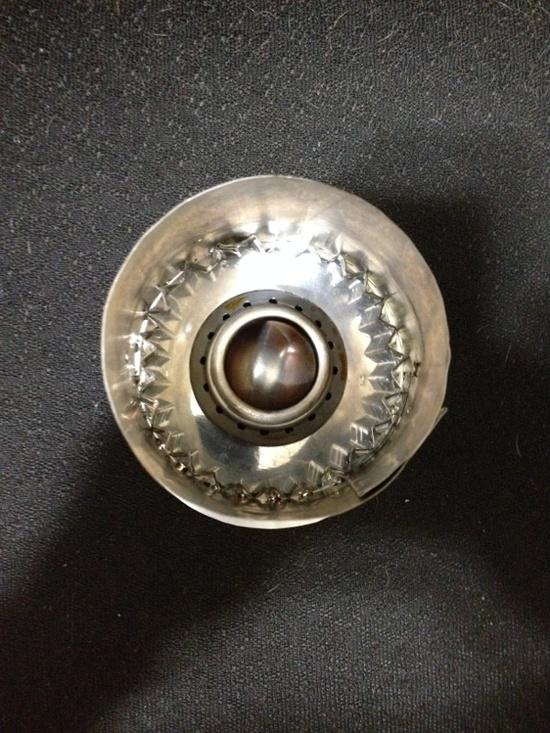
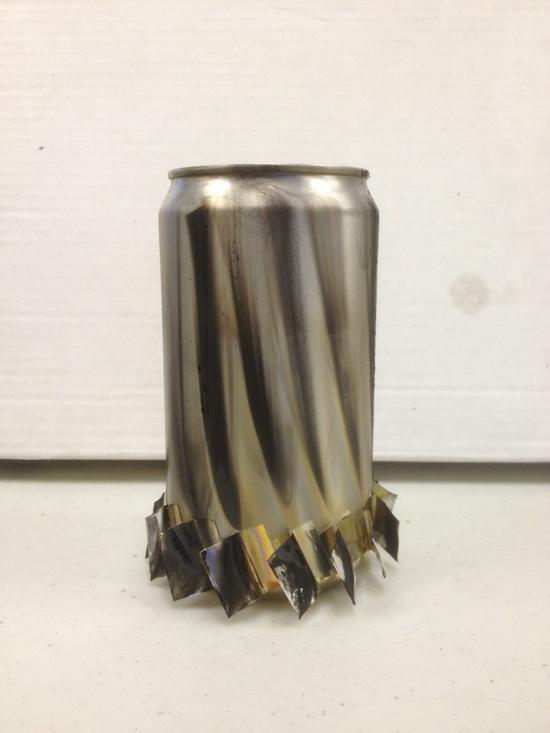
I previously tried fins made from aluminum tape attached around the base of a Fosters can, but it did not improve efficiency and the adhesive burned:fins

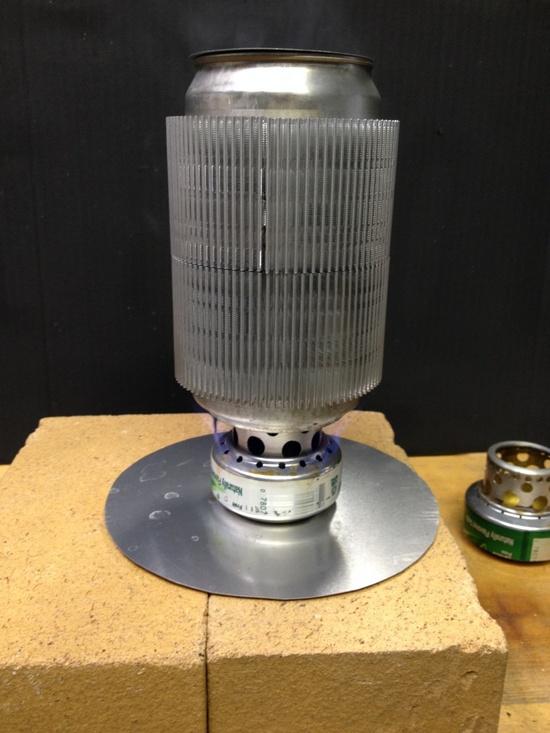
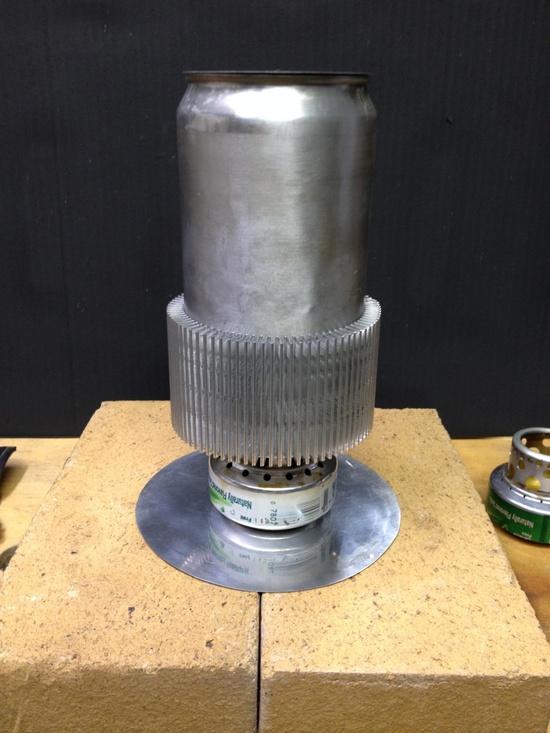
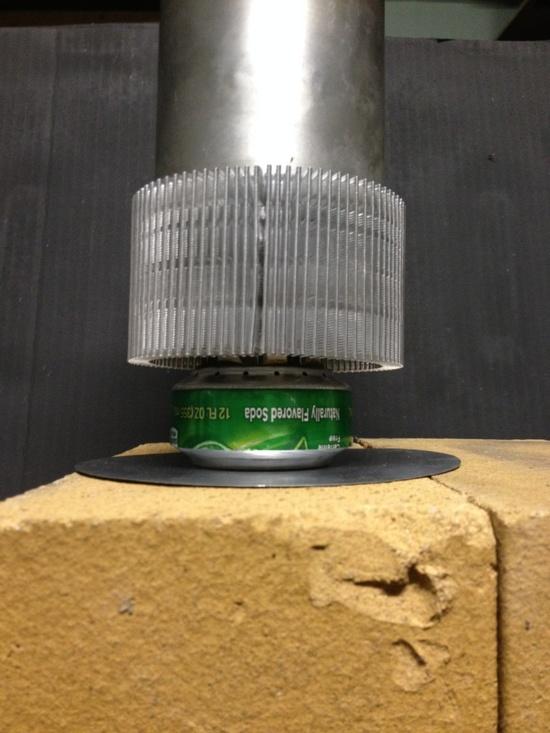
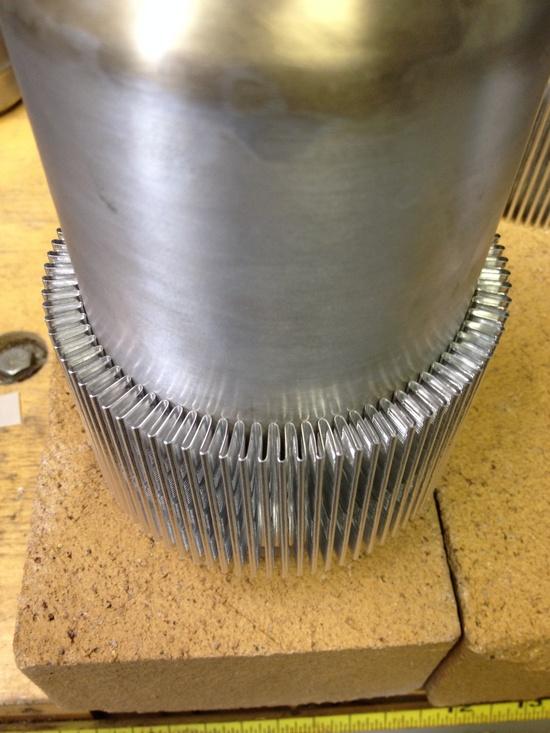
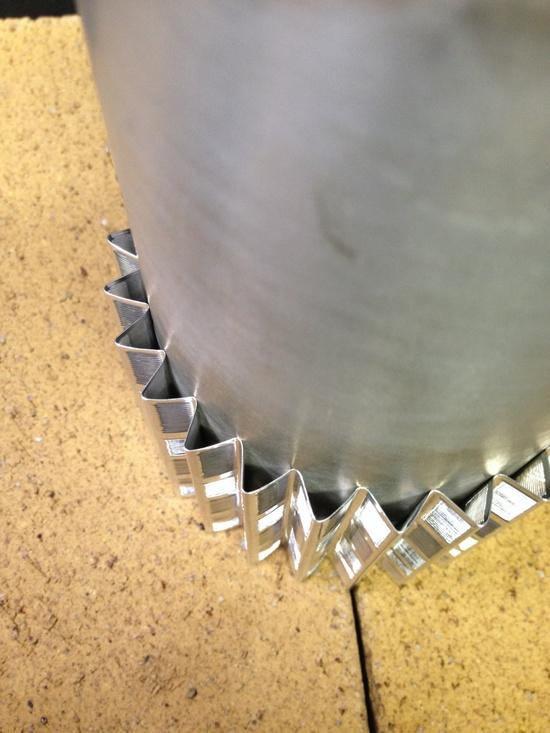
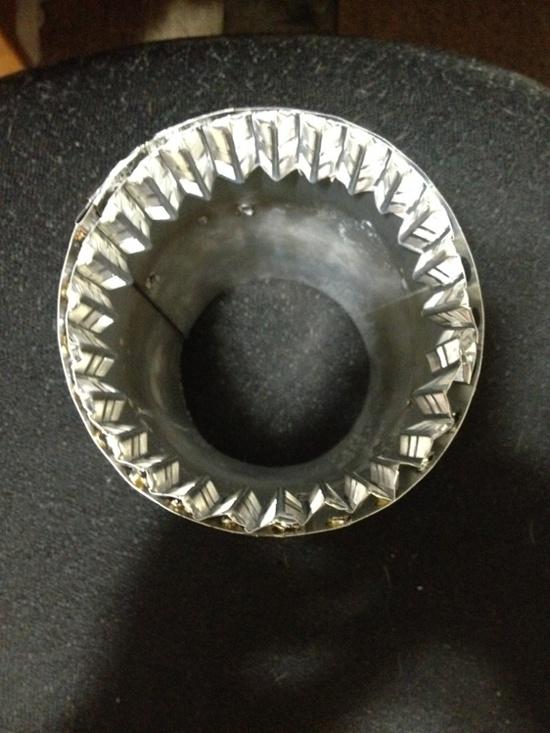
So I googled "aluminum fins" and got a hit for a custom aluminum radiator maker in Alabama. Called them up and they sold me 24" of their fins for $20. Tried them on the cans. First I did two tiers of fins (I used cone windscreens which were removed for the photos) but after 7:30 it flamed out with no boil. So I tried a single tier lower down, with similar disappointing results.fins
fins
Seems that the fins do more cooling than soaking up heat. The fins did not touch the windscreen.

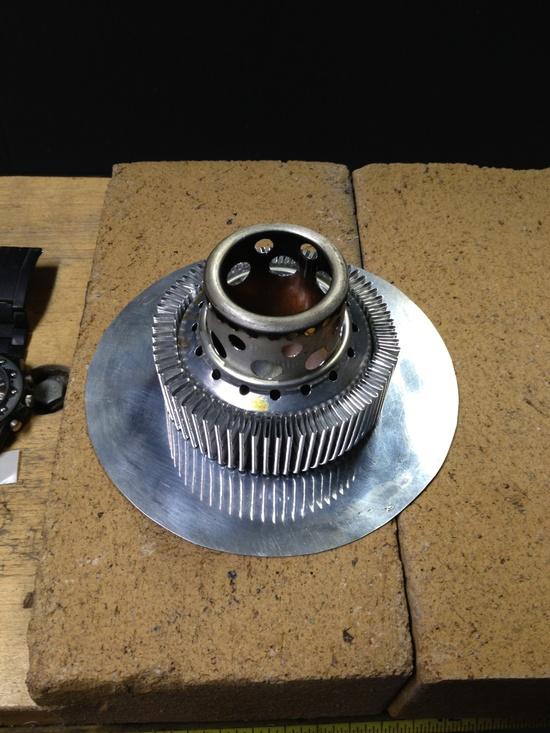
So I tried fins on the stove, to cool and slow it down:fins

Decent results (6:43 boil, 7:37 flame out, 63.5% efficiency) but not as good as a couple of previous set ups.

Back to the drawing board.

PostedApr 11, 2014 at 8:33 pm

Seems like placing fins on the can would just sink heat away from it, just like a CPU heatsink does in a computer.

I wonder how it would work to put a layer between the stove and pot, to capture escaping heat, contain it, and transfer it up to the can. Isn't that how a JetBoil performs?

Jerry Adams BPL Member
PostedApr 11, 2014 at 10:06 pm

You need more cross section area for exhaust to flow between fins and can

You need a wire around the fins, applying pressure so they have better thermal contact with can.

Have the fins go below the bottom of the can so most all the exhaust gas will be directed into the area between fins and can

This works a little for canister stove but might be applicable for alcohol
windscreen

Jerry Adams BPL Member
PostedApr 11, 2014 at 10:28 pm

Shine a bright light (like the sun) from one side, white screen on the other, in the shadow you can see where the exhaust gas is going.

If the exhaust goes mostly outside the fins, the fins will just make things worse, if the gas mostly goes between fins and pot than maybe the fins will do good.

David Gardner BPL Member
PostedApr 12, 2014 at 12:59 pm

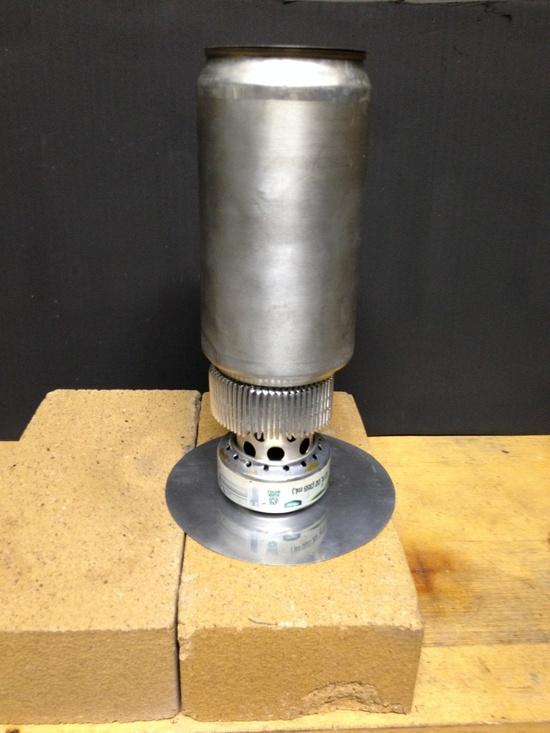
Tried putting the fins between the stove and the pot. 500 g of 70* F water, 15 ml fuel, no boil:jet

Tried putting fins down low to jet height, no boil:lowest

The fins are springy and fit tight to the can all the way around:tight

Giving up on the fins for now.

Roger Caffin BPL Member
PostedApr 12, 2014 at 1:51 pm

I suspect that the fins are packed far too closely together, creating far too much drag on the hot air. So the hot air goes up outside the fins completely, removing any advantage they might have had.

Cheers

Jerry Adams BPL Member
PostedApr 12, 2014 at 3:18 pm

Exactly – cut off half of your fins, pull the remainder apart so the air gap is bigger.

Even though the fins are springy and are touching the pot, if you put more pressure, there would be better thermal contact and more heat transfer.

Like I said, shine bright light and in the shadow, you can see where the hot gases are going – if they're going outside the fins, the fins will just reduce efficiency, has to go between fins and pot.

These are just ideas that might stimulate another experiment. Or another, even unrelated, idea : )

David Gardner BPL Member
PostedApr 12, 2014 at 4:09 pm

Tried stretching out the fins for better spacing:

fins

At least I got a boil this time. Did just one test, got 7:40 boil, 8:36 burn. E = 62.8%. Not as good as other systems I've tried, certainly no better, so didn't test it further.

Jerry Adams BPL Member
PostedApr 12, 2014 at 4:34 pm

Not enough cross sectional area for exhaust gases to flow through? So they just flow outside the fins?

What is the distance between folds on the fins? Maybe 1/2 inch would be good. Maybe more, maybe less. Not that difficult to bend aluminum. Use a wooden block with sharp edge, first mark lines at 1/2 inch (or whatever) spacing. If you can bend the aluminum even just 22 or 45 degrees, then you can bend it by hand to desired angle.

David Gardner BPL Member
PostedApr 12, 2014 at 6:10 pm

The spacing from peak to peak of the fins as tested above was 1/2". Tried it again with 5/8" spacing, no boil after 10 minutes. I am definitely done with fins now. Moving on to other, more promising and practical ideas. The fins do look cool though, and they work great for cooling down cans of boiled water.

David Gardner BPL Member
PostedApr 12, 2014 at 10:08 pm

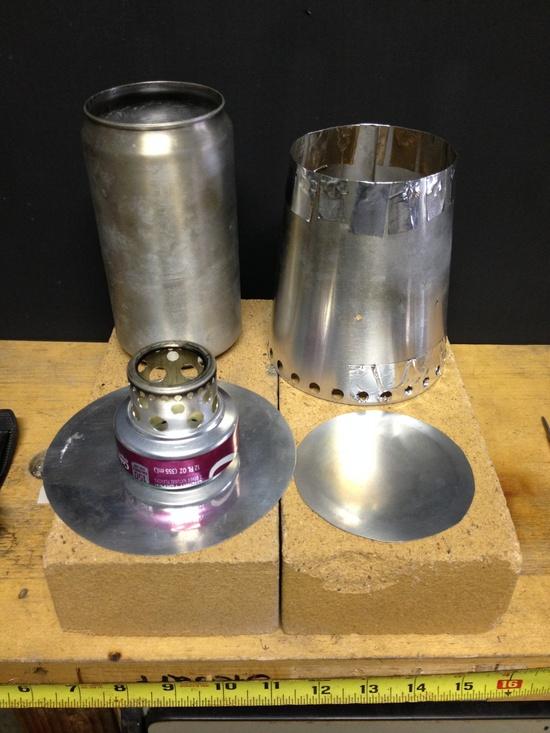
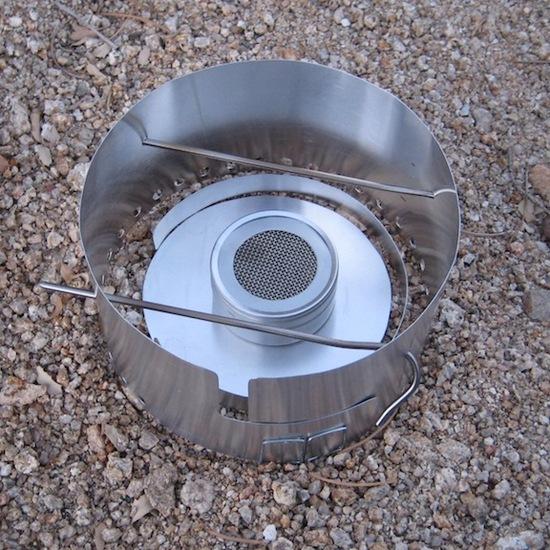
In between testing different fin concepts today, I was mainly working on some other ideas. This is the best combination I've been able to cobble together for the purpose of efficiency:

Tight-fitting (1/8" clearance) polished Al windscreen
Oversize polished Al pot lid
Polished Al base sheet
GOLD Gear SUL 2.5 stove (no jets)
"Dog Ugly" rough brushed, annealed, BPA-free Fosters can
500.o g of 70.0* F Brita-filtered water
11.84 g (15.00 ml) Klean Strip denatured alcohol
61.9* F air, fuel & surface
29.91 inHg barometric pressure
40% relative humidity
No wind
"Boil" = 212* F (high temp = 213.5* F)

setup
Weight of system as tested = 82.6 g = 2.9 oz
(The aluminum tape is from some windscreen concepts I've been working on)

8:13 min boil, 9:38 min burn
8:20 min boil, 9:50 min burn
8:15 min boil, 9:32 min burn
8:18 min boil, 9:43 min burn
8:06 min boil, 9:46 min burn

Average boil = 8:14.6 (max deviation = 14 sec = 2.8%)
Average burn = 9:42.8 (max deviation = 18 sec = 3.1%)

Efficiency = 65.8%

The system is practical in the sense that it is packable. Everything will fit into a Fosters can. But it is not ideal for field use because no-pressure stoves and windscreens with holes all the way around are greatly affected by even gentle breezes. Lots of experimenting to do on low-pressure jetted stoves and windscreen concepts.

There was an article or previous thread on the specific subject of wind-testing alcohol stoves and windscreens, but I can't seem to find it.

James Marco BPL Member
PostedApr 13, 2014 at 2:34 am

Roger and jerry seem to have it right. The mechanical connection for the fin sheet is likely the loss. These are often welded on, insuring good heat transfer. Looking at your set-up, only the very tips of the valleys are in contact with the pot. Ideally, they should be in full contact, ie, a flattened area where welds are placed. Placing a second ring of exchanger material, over the first and lining up oposite with the first, will force all the heated air by the heat exchanger promoting higher heat scavanging. An outer wall, heat screen will force any residual heat back to the pot walls, above it. Don't forget, that heat travels from high concentrations to low. Your job is to insure it travels to the pot/water.

Jerry Adams BPL Member
PostedApr 13, 2014 at 7:13 am

What I like best about BPL, is when David says he's done with fins, but people keep giving suggestions : )

This being backpacking light, you can't afford to have two layers of metal, it'll be too heavy.

If the fins go below the level of the flames, then most all the hot gases can be directed between fins and pot.

If there isn't enough cross sectional area for all the hot gases to flow through, then they will "back up" and start flowing under the fins and around on the outside.

You can see this happening in a shadow (if you can't afford a Schliern setup).

If you have a sharp fold in the aluminum, and press it against the pot, there is enough surface area to conduct heat.

I have measured 10% improvement in efficiency. But that's for a canister stove. For alcohol maybe there's not as much hot gas coming from the flames so you don't need as much cross section area between fins and pot?

But the measurement is tricky, probably +-10% : ) Also, my oatmeal burns onto the pot where the fins contact the pot so I know it's doing something. Also, I've gone down to 0.82 ounces per day on trips, from 0.9.

David Gardner BPL Member
PostedApr 13, 2014 at 10:39 am

I'd be happy to ship my various fin configurations to whomever wants to try the variations suggested.

PostedApr 13, 2014 at 3:09 pm

When this is done with canister stoves, it's my understanding that the fins are limited to the burner, flame, and pot. There are actually very strong cautions about not enclosing the canister due to thermal feedback and overheating the fuel supply.

Alcohol stoves have a self contained fuel supply. Anything done to control the burn chamber must factor in the effects on the fuel as well. Finning a pot like all these "tips" would suggest, constricts the burn chamber too much. I can't imagine this ever working very well, unless the stove was designed with an external fuel supply, like a minibull system for example.

This is why I got so excited over the cone, as it incorporates a large burn chamber, yet funnels exhaust around the can, drawing the heat out of the fuel area in an almost venturi type way. Using fins in the exhaust column of the cone might be helpful, but possibly too heavy, as has been noted. It would be necessary to make sure and not obstruct the flow of the exhaust as well, or backpressure would overheat the burn chamber again.

This concludes my armchair observation :)

David said "But it is not ideal for field use because no-pressure stoves and windscreens with holes all the way around are greatly affected by even gentle breezes."

I tried my setup out on my porch on a gently gusting 40 degree day. No way to judge windspeed, but my wind chimes were playing pretty well. I was at about 50% efficiency. I thought it performed quite well in a cold, mild breeze.

Jerry Adams BPL Member
PostedApr 13, 2014 at 4:32 pm

If you take the cone, and bend it to make fins, keeping the same cross sectional area for the exhaust gases to flow through. Then it won't obstruct the flow.

The cone will get hot, so if it's bent into fins, some of the heat will be conducted to your pot.

Just armchair observations : )

PostedApr 13, 2014 at 7:14 pm

David, congrats on the high efficiency scores, 66%, wow. And thanks for posting the "best of" setup. Which formula were you using for efficiency testing? The "open class" barometric one?

One other question: When polishing your flashing, are you having to first remove some sort of applied protective surface (enamel? urethane? lacquer?) and if so, what's the best way of doing it?

When it comes to modifying screens for windy conditions, one mod you might want to try is a simple, small inner ring at the level of the holes on the outer windscreen. On the photo below I was testing a scrap that wasn't large enough to make it all the way around so I "pointed" it into the wind coming from the right of the photo. Worked well in the field but haven't tortured it in the lab yet.

starlytestove

PostedApr 13, 2014 at 7:31 pm

Also: the idea of louvered "holes" or slots holds some promise, like vintage sports cars had in the hood. Would provide the same sort of free flow with blocking direct wind like the inner circle would. (Bulkier windscreen though.) I recollect that Zelph was even making some directional louvers, that were offset diagonally, and thus the flame would suck in air and swirl, creating a flame vortex. I lost track of his experiments and don't know what came of it, perhaps he'll chime in.

David Gardner BPL Member
PostedApr 13, 2014 at 7:55 pm

Delmar,
I used both the regular and the advanced formulas to calculate efficiency (thanks Glenn for furnishing copies of both). Didn't seem to make any difference which one I used, perhaps because my elevation is virtually sea level and the barometric pressure was so close to 1 BAR.

The aluminum flashing that I originally used for windscreens, base sheets and pot lids came from the local hardware store with a coating so thin that I didn't need to use anything to get rid of it. Just put the polishing wheel on and wham, it shined right up. Unfortunately when I went recently to pick up some more flashing from the same store, they didn't have the same stuff and I have to wire brush it first. Total PITA. Found a vendor that sells uncoated aluminum sheet, but their minimum order is $100 and I couldn't justify that for a few experiments. Perhaps if I go into production it will be worth it.

I like the inner ring idea; will have to give it a try. If it worked well in the field it should work even better in the lab. Much simpler than some ideas I want to try, such as a shallow inverted inner cone with many little holes in it to act as a baffle. The first experiment I want to try is to put the same number of holes as I would normally put all the way around, but put them all on one side so the non-hole side can be pointed into the wind. But before I do that I need to get an anemometer so I can measure the wind speed from the fan I'm going to use and duplicate the conditions between tests of different systems.

Would like to try louvers too. Need to pick up a louver making device.

Regrettably, I have to move my home, office and shop by May 1, so I will be taking a hiatus from testing for awhile.

PostedApr 13, 2014 at 8:29 pm

> Didn't seem to make any difference which one I used,

Which is actually good news; in your conditions they should be giving you very similar results! If they didn't I'd be worried.

> I have to wire brush it first.

I suspect I have something similarly coated from HD; will probably try some acetone on it first.

> If it worked well in the field it should work even better in the lab.

Don't know, no control group afield! The stove was new, too, so I was messing with multiple variables simultaneously. (Bad.)

> put them all on one side so the non-hole side can be pointed into the wind.

I tried that for a supercat windscreen and it was a big fail for boil times (which was all I measured back in the dark ages). But a supercat is an inefficient, air-sucking stove so YMMV; your stove doesn't seem to be the heavy breather that the supercat is. I had a very assymetrical flame….all the flame migrated to the "hole" side of the screen and only half my pot would boil! So I will be interested to see if you can make that idea work.

Clearly this stove tuning is a heavily moderated process…you can't get just one thing right, you have to get a whole bunch of things right…as has often been said, it's not just a stove, it's a system. Pot, screen, stove, lid, they all have to cooperate.

Sorry about the move–not fun–will see you on the far side of that.

David Gardner BPL Member
PostedApr 14, 2014 at 1:17 am

Delmar,
Great ideas about the internal ring and the louvers. The aluminum radiator fins I was using have very tiny little louvers in them, so I made an inner ring of them which fits tight to the inside of the windscreen at the base, right at the holes.
top
bottom

Seems to work well, though I only had time tonight for two test burns. First, 6 minutes to boil 500 g of 70* F water with 15 ml of fuel, and impervious to me blowing at the holes in the base of the windscreen. Second with a box fan blowing at the system. Though I have no idea what the wind speed was, it was certainly a stiff breeze. 7:05 minutes to boil with 19 ml of fuel.

Ben H. BPL Member
PostedApr 14, 2014 at 11:10 am

Great work David. I'll give my arm-chair analysis of your results (though most of this has been covered by others). In order for external heat fins to work, you cannot have increased thermal resistance into the pot greater than the amount of additional heat you are recovering. The fins need to be attached directly to the pot. Preferably manufactured as part of the pot, or brazed/welded on. Pressing the fins or gluing them on will not work, because any additional heat you have absorbed from the exhaust gas will be stuck on the fins and radiating away in all directions. If someone can develop a good attachment method for fins on a Foster's can, then the fins need to be effective at gathering as much of the heat from the exhaust gas as possible. That is making sure your exhaust gases are flowing through your fins as much as possible. Finally the system can't screw up other parts of your system that have already been optimized (gas flow into the combustion area, thermal feedback to your stove).

If you want to improve efficiency of your system, look for places where you are getting heat loss. What is the hottest external part of your system? The exhaust gas? The windscreen? The escaping vapor from the top?

Viewing 25 posts - 51 through 75 (of 137 total)
Loading...