Topic

Managing wet feet

Viewing 25 posts - 51 through 75 (of 102 total)
Roger Caffin BPL Member
PostedJul 3, 2009 at 3:04 pm

Hi Dean

Yes, I have seen that photo of an extreme case of trench foot. Yuk. :-)

But the question I was asking was about purely wet feet. A little research will show that trench foot is not really due to feet just being wet. What evidence there is seems to require coldness, such that the blood flow through the foot is reduced. This is of course what extremities do when cold. Tight footwear seems to add to the problem: it also helps reduce blood flow. Furthermore, the damage seems to be *inside* the foot, where everything is already 'wet'.

You wrote 'Prolonged dampness- most significantly when combined with cold- causes all sorts of foot problems.' I suggest that it may be the cold (and loss of blood flow) which is the dominant factor here, not the wetness. After all, one side of the 'outer layer of squamous epithelium' is already wet.

During WW II the UK military experimented with putting whale oil on soldiers' feet, to prevent the skin from getting damp. This is similar to using Bodyglide or Hydropel (spelling?). However, what assessment I could find was that the whale oil simply made things worse. Possibly it prevented the skin from drying out at all, by eliminating all perspiration.

So let's revert to the first photo, of a pruney foot from wearing some sort of hermetic bicycle shoe. Yes, it looks white and pruney. But what damage was done? None as far as I can see.

I have had wet pruney feet for days on end, with no damage. But my feet did not have any restriction to the blood flow and were not cold. Many others can quote the same. If we were to use an evidence-based medical approach rather than relying folklore, we would have to say that warm pruney feet with good blood flow have not caused a problem.

That would leave open the question of what damage is done to a foot by a long period of cold with restricted blood flow. Sounds like a bad thing to me.

Perhaps your experience in Texas had other causes than just the water?

Thoughts? Documented research?

Cheers

Brad Groves BPL Member
PostedJul 3, 2009 at 3:48 pm

Roger, I'm thinking that your observations on wet feet are practically-based… but more folk-loric than medical/scientific, evidentiary data. Personal experience does not equal scientific data. I think there's been lots of science supporting "wet feet=damaged feet." The difference, I believe, is in the details that we've already pretty much all agreed on… making sure your feet are clean and dry at the end of the night.

If personal experience and observation somehow constitutes scientific data, then I could add a bit of counter-data that wet, warm, non-squeezed feet can indeed develop health problems. I've had all sorts of fungal problems in even 70*F+ temperatures.

Just another way of approaching it. The reality is probably that middle ground we keep mentioning, then studiously ignoring. Feet that are wet for a little while, then dry out, are probably ok. Especially if they're dried out and cleaned at night, particularly if placed into cleaned socks the next morning. I suspect that it's safe to argue that mesh trail runners will not only facilitate faster drying, but will also hold in less "funk" and heat. Conversely, an eVent-lined or all-leather boot will keep your feet drier in moderate conditions with non-boot-topping puddle-splashing and so forth.

Lastly, I think it'd be pretty much impossible to argue that clean, dry feet makes you more susceptible to foot health problems.

Roger Caffin BPL Member
PostedJul 3, 2009 at 5:29 pm

Hi Brad

> I think there's been lots of science supporting "wet feet=damaged feet."
I hear you and Dean, but so far no-one has produced objective published research data which specifically targets this question. I am looking for published medical research references. Do they exist?Genuine question.

> Personal experience does not equal scientific data.
That is not entirely correct. If someone claims 'All swans are white' and I see a black one, then my observation does constitute valid scientific data refuting that claim.

If someone claims 'wet feet are bad for you' and I go for days with wet feet without any harm, then my experience does invalidate the claim – at least as it stands.

> I've had all sorts of fungal problems in even 70*F+ temperatures.
And you will probably get even more at 90 F! That's typical of fungal growth. However, while one gets fungal growth on feet in hot sweaty conditions, my experience over many trips and many weeks has been that fungus problems disappear under genuinely cool wet conditions. Those conditions are not suited.

> Feet that are wet for a little while, then dry out, are probably ok.
Oh, I think we are all agreed on this! :-)

Cheers

PostedJul 3, 2009 at 6:01 pm

Look what happened to this poor shlub!duckfeet

He got wet from sweaty goretex, and the gortex took so long to dry that, well, just look at him for Pete's sake!

Dean F. BPL Member
PostedJul 4, 2009 at 3:10 am

>> A little research will show that trench foot is not really due to feet just being wet. What evidence there is seems to require coldness,

Absolutely- as I said. When your foot suffers an injury from being wet and WARM it is called immersion foot. Though to be fair there is a lot of disagreement about definitions regarding this subject. Some people consider trench foot and immersion foot to be synonyms, and some consider trench foot a sub-class of immersion foot.

>> That would leave open the question of what damage is done to a foot by a long period of cold with restricted blood flow.

With a dry foot the typical cold weather injury is called frostbite. :o)

Sorry. I'm being silly.

>> Tight footwear seems to add to the problem:

Again- as I said.
You're really preaching to the choir, here, Roger. :o)

>> I suggest that it may be the cold (and loss of blood flow) which is the dominant factor here, not the wetness.

Yes, for trench foot and particularly frostbite. Trench foot is considered a 'non-freezing cold-weather injury' associated with prolonged wetness. I don't think that I said this specifically, but I certainly implied it.

>> But what damage was done? None as far as I can see.

Then you need new glasses. :o) Sorry- being silly again. Seriously, though, that guy may not have been able to walk very well on those feet. And if he could, then he wouldn't have been able to if he'd left his feet wet for a bit longer. That's what my feet looked like during that exercise in Texas, and I could barely shuffle on them due to the pain. I don't think I was wearing restrictive foot wear at the time- in fact I recall being annoyed because they were little too wide. MY biggest problem was that they were waterproof and didn't dry out, actually. Not that they really could have, since the blasted rain never stopped…

>> I have had wet pruney feet for days on end, with no damage. But my feet did not have any restriction to the blood flow and were not cold.

Again- that's what I said. I.e. that it all really depends upon conditions. Yes, brief (whatever that means according to conditions) wetness, as long as you dry your feet at some point, is tolerable. However, if you leave your feet soaked long enough- regardless of how warm it is and how good the bloodflow- eventually you will get immersion foot or grow potatoes between your toes or something.

And, I'm sure you let your feet air out and dry a bit regularly, didn't you? Be honest. And why did you do that? Because you know what you are doing, and at some level understand that it would be bad to leave your feet wet for too long!

>> If we were to use an evidence-based medical approach rather than relying folklore

Pardon me, I had to chuckle. But Brad has already pointed this out. You said this then immediately engaged in an anecdotal argument. (The equivalent of a lifelong smoker saying "Smoking cannot possibly be a cancer risk factor, because I've smoked three packs a day for forty years and I don't have cancer.") Some people tolerate things better than others (and, with the cancer thing, some people are luckier than others).

>> Thoughts? Documented research?

Right back at ya! You are the one who made the initial statement, after all. Let's see the RCT showing that prolonged warm foot immersion is harmless, Roger! Shipwreck survivors who spent days in the water in the tropics typically can't walk on those injured feet, and often slough the skin. (Actually, the thick skin of the feet is more susceptible to this than thinner skin, because the thicker skin wrinkles more when waterlogged. That's why your finger pads wrinkle in the bath but the inside of your forearm does not. And walking on the folded-over wrinkles hurts.)

>> If someone claims 'All swans are white' and I see a black one, then my observation does constitute valid scientific data refuting that claim.

This is a logical argument, not really a scientific one. Few medical (or even scientific) hypotheses are presented as absolute, like your white swan statement. They are presented as statistics or odds or risk. Your anecdotes are unscientific. Sorry.

>>> Feet that are wet for a little while, then dry out, are probably ok.
>>Oh, I think we are all agreed on this! :-)

No kidding. But at times you seem to be implying that prolonged wetness for any duration is just fine, too, as long as your feet are warm and have decent blood flow. But it isn't. Why do you bother to dry your feet at all, then, Roger?
Certainly cold or blood flow restriction makes it worse, and lowers the threshold at which injury occurs, but unconstrained warm feet left wet for too long will be injured eventually, too. THAT is what I am saying- there IS a line there somewhere. You seem to imply that there isn't.

So, I'm not denying that it is reasonable to wear mesh trail runners, and tolerate wet feet for a bit. But I AM saying that you have to dry them out occasionally if they don't dry on their own, and especially avoid cold feet and tight footwear in combination with wetness. Just as you are saying! Heck, Roger, we agree- we're just getting persnickety about the 'dead cell' thing.

EDIT–

I got on OVID to look up the data you want. As I expected all the papers specifically about warm-water immersion foot are in obscure journals that aren't available for free online. I'll try to get back later this week, after I get back to my library. But somewhat tellingly one of them is even titled "Warm-water Immersion Foot: Still a Threat to the Soldier" and another is just called "Warm Water Immersion Foot." In the few free papers I had access to I found side references to warm-water immersion foot in swimming pool attendants, people wearing non-breathable plastic boots, women wearing high-fashion furry winter boots, scullery workers, and workers tending paper-making machinery (which involves a lot of hot wet pulp). As a plug for Hydropel, one military journal article is titled "Silicone for Immersion Foot Prophylaxis."

Aha. I just found an article on "Pitted Keratolysis", which is a poorly-defined infection of the stratum corneum that can rapidly disable warm wet feet. Various fungi and bacteria have been proposed as causative organisms. Actually it looks like no one has ever really proven that it is an infection- the dermatologists just suspect that it is. I'll have to see if I can find more about that one, too. It seems to be distinct from "jungle rot". And, actually, this may be what I had in Texas, since I recall noticing skin pitting at the time. I'll see if I can find more info.

And, actually, I think we will have a hard time finding an RCT, Roger. We're going to have to be happy with retrospective data. After all, it would be a very hard sell to convince a study participant to stick their feet into a tub of warm water until their feet rot… :o)

Roger Caffin BPL Member
PostedJul 4, 2009 at 4:05 pm

Hi Dean

To clarify: I really am asking for references; I really am interested. If you can get me copies – appreciated.

> This is a logical argument, not really a scientific one. … Your anecdotes are unscientific.
We will have to disagree here. A logical argument is a valid scientific one in the hard sciences. You just have to be sure you haven't left out any hidden assumptions.

> I'm sure you let your feet air out and dry a bit regularly, didn't you?
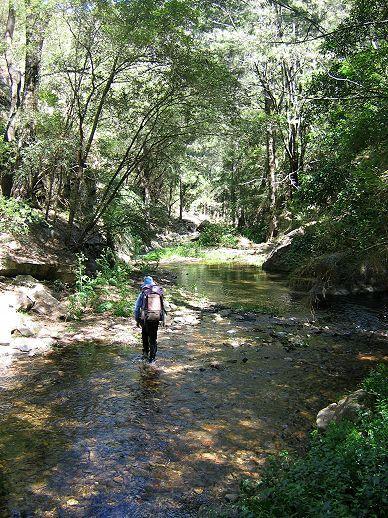
Typical scenario: we put on wet socks in the morning, walk down a river (in the river) all day, then change into dry socks for the night. Repeat for several days. So in this case 'regularly' is once a day. Apart from that, no, we do not take our socks and shoes off during the day.
.
6116S - Jenolan River
Walking down the Jenolan river.

But note that the water around our feet is not stagnant when we are river walking. It gets flushed clean all the time. I have a purely gut feeling this matters. Having wet feet inside non-breathable plastic boots all day – I reckon that would cause problems.

> at times you seem to be implying that prolonged wetness for any duration is just fine,
> too, as long as your feet are warm and have decent blood flow.
Well, yes, that is about what I was saying, although the bit about flushing the water through the socks regularly is probably a crucial element, as is the bit about letting them dry off overnight. We do this and it is OK.

I cannot comment on cases where feet are wet 24 hours a day, or where there is no regular flushing of clean water through the socks during the day. Or cases where the foot is inside an almost hermetic seal. Those are outside my experience, and I don't like the sound of them either!

Cheers

PostedJul 5, 2009 at 12:03 pm

I remember a Canadian wilderness trip in Quebec when a young and mildly experienced paddler in our group wore KNEE HIGH lace up logger's' boots he swore would keep him dry. I was wearing self-draining U.S. military jungle boots with 3 layer Saran mesh insoles and wool/acrylic socks.

I told the young man he's have wet feet within a day or two. Sure enough, next day he had to get into water over his boot tops and he spent the rest of the week-long trip in soggy boots.

THE LESSON: If ya ain't able to garantee dry feet then yer shoes need to be self draining and yer socks had better be mainly synthetic, like acrylic and Coolmax combinations.

Eric

PostedJul 5, 2009 at 12:51 pm

"The syndrome of immersion foot….represents the effects of injury by water absorption in the stratum corneum of the skin of the feet. The taxonomy of this disorder is confusing and the many colorful pseudonyms should probably be dropped in favor of a simple classification based on the temperature of the water and the duration of exposure."

Seems to be one of the problems here: confusing taxonomy?

Roger Caffin BPL Member
PostedJul 5, 2009 at 2:46 pm

> yer shoes need to be self draining
Yes! Goretex-lined shoes are pretty awful when walking down rivers. (First-hand experience.)

> and yer socks had better be mainly synthetic, like acrylic and Coolmax combinations.
Well, I get great joy from the Darn Tough Vermont wool/synthetic blends (Boot Socks, Full Cushion) when river walking. They seem to hold up better than anything else I have ever tried.

Cheers

PostedJul 5, 2009 at 7:14 pm

Since my canoe travel is usually by kevlar-construction canoes, landing on rocks is NOT a good thing. Entering and exiting a canoe for me is a "wetfoot" exercise, usually about knee deep in water. Synthetic liner socks/wool outersocks and shoes that drain are the order of the day. In more extreme conditions (early season when ice is still an issue) you might go for 10/11 inch high rubber boots and try to keep your feet dry, but even then it's very easy to take water over the top of the boots. The portages are just not "civilized"!!!

Upon reaching camp, switching to camp shoes and dry socks is a great treat…and apparently good hygiene as well!!

Adrian B BPL Member
PostedJul 5, 2009 at 10:43 pm

Another vote for just let them get wet, skip the complications, weight and hassle of trying (and invariably failing) to keep them dry.

> I'm sure you let your feet air out and dry a bit regularly, didn't you?

Umm I don't. I walk all day in saturated shoes and socks without any problems. That's not "occasionally" getting wet then drying out, but putting on soaking socks and shoes in the morning and walking in them wet all day (10-12 hours), only taking them off when I stop at the end of the day.

Most of my trips are 2-4 days, but I have walked up to 7 days in succession (Fiordland: very wet ground, all day every day), they didn't really look any different at the end to when I started. I have a bottle of Hyropel which I've never opened, because I've never hit any problems.

If you have problems with pruny, sore soles I think it is something your feet can happily acclimatise to with time. Also the 'unpleasant' factor disappears, to the point now where I probably *prefer* wet feet. I think thin footwear and socks help too, wrapping them up in waterproof leather boots (what I started walking in) in hot sweaty weather on soggy trails/streams seems harder on your feet.

I always have dry socks and dry feet overnight though.

Dean F. BPL Member
PostedJul 6, 2009 at 5:45 am

Well, it is still a holiday weekend for us Yanks. All I could produce so far is a few abstracts- and for some of them I can't even find abstracts. And as I mentioned I'm still waiting on the full papers, of course. Hopefully I'll get them in pdf format or something, so I can send them to you, Roger.:

Authors Full Name: Tsai, T F. Maibach, H I.
Institution: Department of Dermatology, University of California, San Francisco, USA.
Title: How irritant is water? An overview.
Source: Contact Dermatitis. 41(6):311-4, 1999 Dec.
Abstract:
Water is a skin irritant which deserves attention because of its ubiquity. During the Vietnam war, soldiers suffered from painful swollen feet, so-called tropical immersion foot. In occupational dermatology, the importance of water as a skin irritant is especially appreciated. The irritancy of water has been demonstrated by occlusion experiments; occlusion with either closed chambers or water-soaked patches has been shown to produce clinical and histopathological inflammation. Functional damage, as revealed by increased transepidermal water loss, has also been shown. Repeated water exposure without occlusion caused an increase in blood flow on irritated skin; however, clinical evaluation did not show a difference in dryness or scaling. Several mechanisms such as osmolarity, pH, hardness and temperature might account for the irritancy of water. Extraction or dilution of natural moisturizing factors in the stratum corneum is another possible explanation. Occlusion per se also changes the physiology of skin and may trigger the activation of potentially active substances. However, much remains to be done to clarify the risk factors and mechanisms of water-induced irritation.

But, in the interests of full disclosure, at least one other study showed that it can take up to 72 or even 144 hours of exposure to produce a good dermatitis. However, these appear to have been small areas that were kept wet with a tiny cup placed against the skin- not an entire foot, for example. (I've got that one coming, too.) Also, it is a much older paper, so presumably this new review is more complete.

Authors Full Name: Humphrey, W. Ellyson, R.
Institution: Department of the Army, Headquarters, U.S. Army Medical Department Activity, Fort Benning, GA 31905-6100, USA.
Title: Warm water immersion foot: still a threat to the soldier.
Source: Military Medicine. 162(9):610-1, 1997 Sep.
Abstract:
We report a significant incidence of warm water immersion foot (WWIF) in a light infantry battalion during a field exercise. Four hundred soldiers belonging to this battalion were surveyed to determine the prevalence of the WWIF syndrome. One hundred forty-nine soldiers surveyed developed the WWIF syndrome. The affected soldiers had a wide range of disability, ranging from mild discomfort to the inability to ambulate. All soldiers had full recovery within 2 weeks of the injuries. Although the syndrome is self-limited, the loss of these soldiers from combat critically impaired the battalion in its mission. We present this report as a reminder that effective preventive measures should be taken prior to field exercises and deployments.

A couple more that look promising are:

Authors Full Name: Buckels, L J. Gill, K A Jr. Anderson, G T.
Title: Warm water immersion foot.
Source: Research Reports/United States. Naval Medical Field Research Laboratory. 17(5):1-8, 1967 Jun.

Authors Full Name: Catterall, M D.
Title: Warm water immersion injuries of the feet–a review.
Source: Journal of the Royal Naval Medical Service. 61(1):22-6, 1975.

The abstract for the Georgia homeless article has already been quoted. I'll see if the full article is any more revealing.

In general, I'm noticing a strong correlation between the dates of publication of many immersion-foot articles and the Vietnam war. Hmm. :o)

More will follow, as I get the articles in.

PostedJul 6, 2009 at 1:47 pm

I don't think anyone is arguing that immersion foot doesn't happen, just that it seems uncommon when your feet are only wet for less than a day, and provided you are drying your feet out overnight. 72 hours straight with wet feet is a different matter.

And everyone's feet are different. How many people do I know that wear sandals in showers etc…due to recurrent 'athlete's foot'. Lots. But I've never taken any precautions and never had athlete's foot. I suspect Roger's idea that having the water flowing through and constantly rinsing the feet makes a difference.

Roger Caffin BPL Member
PostedJul 6, 2009 at 4:06 pm

Hi Dean

Ah – real published references. Thank you!

As Lynn also mentioned, a common theme in the quoted references seems to be that the water around the skin or foot is **confined**. Either inside leather military boots or cups or whatever. I can (we all can?) imagine that creating a closed environment for 24 hours around a wet foot would cause problems. On the othe rhand we have the practical observations from many walkers in the field that wet feet inside joggers **which drain** do not cause these sorts of problems over several days (also assuming dry feet at night).

These small lab experiments are all very well, and we do need them of course, but some of their results clash with the field observations of so many experienced walkers. We are concerned with what actually works in the field: that for me is the Gold Standard.

And that means that where there is a clash, I will first look at the lab experiment to see whether or not the conditions in it are relevant. I am sure you (and everyone else ) can think of many cases where the lab experiment simply did not have the relevant conditions.

Who knows: we may have identified a key factor in the 'immersion foot' problem? Flushing with fresh (aerated?) water may be critical?

But in the meantime, I look forward to seeing those PDFs.

Cheers

Dean F. BPL Member
PostedJul 8, 2009 at 2:08 am

>> As Lynn also mentioned, a common theme in the quoted references seems to be that the water around the skin or foot is **confined**.

Where did you get this "confined' thing from?

Oops, Sorry. Queen's English:

From whence did thou get this "confined" thing?

:o)

Also, I would wager that in any of these studies "confined" merely means "in footgear" or some simulation thereof as opposed to "sitting free in a bucket of water." I would propose that soggy socks and trail runners count. I make no assertions about foot heath among unshod natives in the Amazon rainforest, though I suspect that their feet dry out when they are sleeping, too.

>> I don't think anyone is arguing that immersion foot doesn't happen,

Well, in essence, yes, I felt that some people were arguing that immersion foot doesn't happen. (That is, if we're defining immersion foot as more like "warm water immersion foot" and as opposed to "trench foot.") The proposed position was that prolonged wetness does not in and of itself damage the skin without also being cold, which I feel is incorrect.

If I'm wrong, please step in, here.

I myself have maintained all this time that brief (whatever that means, according to conditions) wetness probably causes no damage, as long as feet are dried out occasionally. So in this, yes, we all agree. As I have said.
BUT if you encase your feet in soggy socks and shoes for a long enough time (again, whatever that means) then you will develop an injury- I don't care how warm the water is or how well aerated it is or whether it is in a leather boot vice a mesh trail runner.

The concept that skin is not injured by being waterlogged because it is 'dead' is absurd, IMHO. I'm just working on supporting that position. :o) Only the outer keratinous layer is 'dead' anyway- everything deeper than that has a metabolism.

But, well, I'm not a dermatologist or podiatrist. If I'm definitively proven wrong I can accept that. I genuinely invite Roger to produce contradictory data. Heck, I even mentioned the 72 to 144 hour study in the interests of full disclosure, though the methods described sound a bit contrived in that it involved very small areas rather than a whole foot.
But "I've done this for years" or "maybe it's different if the water is aerated and flows around a lot" is not data. It is anecdote or conjecture. I didn't start this whole insistence upon real data, after all- I'm just complying. :o) Heck, if we're being anecdotal, I deal with wet, macerated skin while caring for my patients with some regularity.

Besides, the fact is that none of you who have taken the "I've done this for years" line really have. You all take your socks off and let your feet dry appropriately, even if you put the same soggy socks back on the next morning. So the anecdotes actually don't seem to contradict what I've been saying, anyway. If one of you wants to do an N=1 experiment with warm but soggy socks and shoes worn for 72 hours straight- feel free.

I hope I'm not coming across as abrasive, again. I'm really not trying to- I'm keeping my sense of humor. I may think that Roger is a mad Aussie… but I'm keeping my sense of humor. I hope everyone else is, too. :o) If anything, I just worry a lot that I'm not being very articulate, and that my arguments are thus being misinterpreted. And, of course, sometimes I am so confident of my position that it boggles my mind when others don't come around after I explain things… :o)

But, I guess everyone has that problem, to one degree or another, eh?

P.S. I turned in the request for a lot of the papers I'm interested in only today, Roger, so it may take a while more to receive them. My librarian tends to send them as PDFs, so I can send any that seem relevent to you. (As opposed to massive text dumps onto this forum thread.)

Roger Caffin BPL Member
PostedJul 8, 2009 at 3:00 am

Hi Dean

You are right in that, for many of us who do walk with wet feet for days on end, our experience only covers something like a 12 hour day of wet feet with dry feet in between. Beyond that I cannot say.

Now our experiences may be only anecdotal, but they are nonetheless just as valid a set of real observational data as that coming out from any lab experiment. So any blanket rule for what happens to wet feet must accommodate our experiences.

To write those experiences down explicitly: many walkers regularly have wet feet in porous joggers for 12 hours straight without incurring any significant foot/skin problems, but in general those walkers do have a dry 12 hour period each day too.

Of course I am a mad Aussie! My wife has been telling me that for years…

For the PDFs to come my gratitude.

Cheers
Roger

Dean F. BPL Member
PostedJul 8, 2009 at 5:42 am

>> You are right in that, for many of us who do walk with wet feet for days on end, our experience only covers something like a 12 hour day of wet feet with dry feet in between. Beyond that I cannot say.

But you did say, Roger! If you had made this statement on the first page of this thread I wouldn't even have commented! But what you said was some variant of "wetness doesn't harm skin because skin is dead cells". This is a false statement. I agree with you (as I have several times already) that 12 hours or so of warm wetness without any significant constriction is probably easily tolerable. But I maintain that AT SOME POINT, yes, there would be an injury if you went longer than that.

So, we may be arguing about different things, because you all keep bringing up this "brief periods" argument- which I have been agreeing with all along. I am communicating well what I disagree with? Because it isn't "brief periods." It is the fact that AT SOME POINT prolonged wetness will injure skin, and that thus it is incorrect to say that it is harmless.

>> Now our experiences may be only anecdotal, but they are nonetheless just as valid a set of real observational data as that coming out from any lab experiment.

No, not really. Real study data has very careful controls, and defined variables, etc. These anecdotes remain anecdotes. This does not mean that they are without value, just that they are quite a bit less reliable than study data. If nothing else we are talking about hundreds of different observers? And how many of you took skin biopsies?

But again, we are talking about something different: I'm dismissing all of your anecdotes about 12 hour hikes in wet socks, where you remove them and let your feet dry out over night. That is categorically NOT what I am talking about.

And, thus, why I worry that I'm not being very articulate when you all keep beating this dead horse.

Incidentally, Roger, I PM'd you. I can't figure out how to attach a PDF to a PM, but I've gotten a couple of articles that you might find revealing. They are PDFs, so I can't cut and paste them here, unfortunately. They are the Georgia homeless article, and a review article on the whole immersion foot spectrum.
Essentially, they support what I'm saying- that the stratum corneum can become waterlogged and thus suffer injury, even in warm water. In fact the thicker skin of the sole of the foot is more susceptible to this than thinner skin. Particularly thick skin on the foot is, in fact, an increased risk factor- to be sure to keep your calluses under control. This is also why I don't find the 72 to 144 hour study very compelling: it turns out that the skin tested in that study was on the back, forearm, and lower leg- all relatively thin and thus more water tolerant skin, compared to the sole of the foot. that's why it took so long for the dermatitis to manifest.
But even then, I am supported- eventually an injury occurred.

Heck, I gotta run…

Later.

PostedJul 8, 2009 at 5:45 am

I think I get it!

"Twelve hours of wet feet followed by twelve hours of dry feet" is not the same as Dean's definition of "prolonged periods".

Or, as Mike C indicated earlier in the thread "wet feet are okay", "wet feet at night", (I have a hankerin' that he was implying "on the heels of a day of wet feet"), are not ok.

Lapsing into mad Aussieism or not, I doubt Roger would often forget to dab, pat dry his pedi-tenders.

And if he does forget for prolonged periods? So what. His wife carries him anyway! (Sorry, Roger, I plead low hanging fruit.:))

Roger Caffin BPL Member
PostedJul 8, 2009 at 5:09 pm

> I agree with you (as I have several times already) that 12 hours or so of warm wetness
> without any significant constriction is probably easily tolerable. But I maintain
> that AT SOME POINT, yes, there would be an injury if you went longer than that.
I thin Dean and I have a consensus here. I haven't had my feet wet for longer than one day-time. I cannot speak to anything more than 12 hours per day (but many days).

> > Now our experiences may be only anecdotal, but they are nonetheless just as valid
> > a set of real observational data as that coming out from any lab experiment.
> No, not really. Real study data has very careful controls, and defined variables,
> etc. These anecdotes remain anecdotes. This does not mean that they are without value,
> just that they are quite a bit less reliable than study data.
I think we may be talking at cross-purposes here. For a research paper such anecdotal data is just that – anecdotal. I know the limitations here.

But for real walkers such anecdotal data IS useful, because we know that the conditions encountered will more closely approximate what we will encounter. Lab data may or may not be relevant to field use: I have seen too many stuff-ups in setting up a lab test to make that mistake.

> that the stratum corneum can become waterlogged and thus suffer injury, even in warm water.
> In fact the thicker skin of the sole of the foot is more susceptible to this than thinner
> skin. Particularly thick skin on the foot is, in fact, an increased risk factor-
> to be sure to keep your calluses under control.
Now this one is interesting. We spent overt a month with wet feet every day in France in 2007. Yes, I do mean that: wet socks each day for over a month. That did not give us any problems at all.

But when the weather cleared and we got dry socks for days on end, we did notice some of the thick dead layer on the soles of our feet starting to peel off. That happened especially around the edge of the heel. I guess the stuff was now … surplus to our needs?

However, this does NOT mean there was any damage to our feet. There was no damage to the skin underneath and no cracking and … nothing. Just a dead layer flaking off. There was clean healthy skin underneath. I would interpret this to mean that the dead layer had been protecting the healthy skin underneath.

> His wife carries him anyway! (Sorry, Roger, I plead low hanging fruit.:))
Hum … you'll keep! :-)
Anyhow, I do not dab my feet dry. I may rinse them in a creek before getting in the tent, but I usually let them air-dry. Why pollute the towel? :-)

All very interesting
Cheers

PostedJul 8, 2009 at 5:58 pm

"All very interesting"

Indeed. A sterling example of the kind of informed debate leavened with the occasional good natured zinger that all should aspire to in posts where differences of opinion arise.

Brad Groves BPL Member
PostedJul 9, 2009 at 9:39 am

Just wanted to throw in a concurrent comment that even people who say their feet are always wet gloss over the fact that their feet are not, actually, always wet… they're dry at night. But I guess that horse is long dead.

More to the point, I had the opportunity to do some river walking in mesh trail runners this weekend. Warm, in the 70-80*F range. (We were paddling a river, someone forgot the keys to the downstream car in the one we left upriver.) I sat in the boat a few hours after walking. My feet were itchy and a little sore when we pulled ashore; I had a couple of "hot spots" on my feet. Despite drying in a well-ventilated area, my mesh shoes took almost two days to dry thoroughly (there goes the "they dry infinitely faster than full leather boots" theory).

People have also talked about conditioning your feet to being constantly wet. To some degree that might help build up callouses and "toughness." But then, I don't want to "toughen up" my feet on my actual backpacking trip, either. And then there's the info Dean found on callouses…

Which brings me back to something I said early on: No one can feasibly argue that clean, dry feet will cause foot health problems. However, the certainty of good foot health with wet feet is far less clear.

PostedJul 9, 2009 at 12:35 pm

Twalk Twalk Twalk Twalk

Just to add more anecdote, which seems to be what the OP was asking for, I just remembered an annual event from my silly youth called Twalk (for Twenty four hour WALK). It is a 24 hour orienteering event, and there were two particularly memorable years I participated in where our feet were wet, from start to finish. This was in the "old days" when everyone wore heavy leather boots, and I don't recall anyone dropping out or complaining of immersion or trench foot symptoms. There were many things to complain about in that event, but foot damage (other than blisters) was not one of them…so I'm betting it takes more than just one bout of 24 hours wet feet to really cause problems for most folks.

Dean F. BPL Member
PostedJul 10, 2009 at 12:08 am

>> so I'm betting it takes more than just one bout of 24 hours wet feet to really cause problems for most folks.

Assuming that the water is warmer than 15*C, and the footwear is not constricting then, yes, I would have to agree. At least that's what my reading so far indicates. Also, fresh water is worse than salt water. I have about 18 articles, now, and I've barely skimmed two of them- sorry, I've been busy this week. But I will have a synopsis sometime soon.

I just sent Roger copies of all the articles, so he can critique my interpretations.

And, again, I'm not totally discounting the utility of anecdotal information on this subject. I do view any anecdotal evidence with suspicion, however. Roger, I have been bitten by anecdotal evidence a LOT more often than scientific evidence- which admittedly is far from perfect, also.
But many of these people who say they had wet feet for a long time and that their feet may have looked a litte ugly but they had no other problems… well, that just means that the injury was subclinical and that if things progressed further they would have festered. So they were on their way to the hurt locker, make no doubt. They weren't hurting YET, but I would wager that if you yook skin biopsies you'd see problems brewing.
So, is the anecdote useful? Yes, of course. It is a decent indication of what you can expect to get away with. But you ARE "getting away with it", because if your feet are wet long enough you will sustain an injury.

For what its worth I wear trail runners, and tolerate wet feet for brief periods. No problem. But I remain more paranoid than many others here. Of course, with a prior injury I am at higher risk…

Dean F. BPL Member
PostedJul 12, 2009 at 4:54 am

Ok. I've caught up on my reading over the weekend…

First, I want to point out that A LOT of studies and articles about “immersion foot” are actually about trench foot. That’s why you will find that a lot of them dismiss the effects of water as an etiology and instead try to make the point that trench foot is a *cold* injury. The nomenclature of these foot injuries is hopelessly muddled, to the point that one researcher wrote, in desperation, “The taxonomy of this disorder is confusing and the many colorful pseudonyms should probably be dropped in favor of a simple classification based on the temperature of the water and the duration of exposure.” So, be careful about what you are reading.

Chow et al, Immersion Foot: An occupational Disease, Cutis, Jun 1980; 25(6): 662.
“Warm water immersion foot (WWIF) is a temporarily incapacitating condition characterized by painful, white wrinkled soles. It is due to prolonged exposure of the feet to water resulting in hyperhydration of the plantar stratum corneum. Water-logging of the weight bearing surfaces leads to a thickened, convoluted, rigid skin which is painful on walking. […] WWIF can be produced in volunteers by continuous water exposure for a minimum of nineteen hours with absorption of as little as 37cc of water. Clinically, WWIF is attended with swelling, wrinkling, and pallor of the skin confined to the soles, and does not involve the dorsum surface of the foot[…] On biopsy, there is thickening of the plantar stratum corneum with very little change in the dermis. Treatment involves allowing the feet to dry out[…]”

So, it is PRECISELY the ‘dead’ skin cells that cause the problem! But in warm water and non-constrictive footwear it seems to take almost a day of continuous exposure to produce a clinical injury. Hmm- not sure I’d try to push it, though…

Further:

Taplin et al, The Role of Temperature in Tropical Immersion Foot Syndrome, JAMA, Nov 1967; 202(6): 546-9.
Abstract:
“Eleven volunteers wore a noninsulated boot on one foot and an insulated rubber boot filled with water on the other foot during 72 hours of immersion in swamps. Both feet were continuously wet, but the temperature of one foot of each man was approximately 20F (11.2C) higher than the other throughout the study. Results indicated that symptomatic tropical immersion foot can be produced without any element due to cold injury or heat loss, and that the symptoms occurred more rapidly at the higher temperature.”

I’ll just post that abstract- going through all the data is a bit pointless. My point is that it isn’t just cold water that can cause immersion foot. (This study was done in the Everglades; water temperature hovered just above 66*F, with skin temperature around 74*F in the normal boot and the normal dry-foot skin temperature of 92*F in the insulated boot.) Several of the Vietnam War-era articles bear this out, as well. I’m not so sure I believe that warmer water actually causes it faster, though. This paper is from 1967 when ‘many colorful pseudonyms’ for these various foot ailments existed, so the authors may have had some quite specific opinions about what constituted TROPICAL immersion foot versus other immersion foots. (Feet? Foots? Hmm… And is it 'computer mice' or 'computer mouses'? And what is the plural of mongoose? Mongeese? Polygoose? Hmm…)

LaBonte, Immersion Foot in Scullery Workers, PA J, Spring 1977; 7(1): 29-32.
The investigator describes a case in which a worker develops painful, swollen, red feet after two days of work in a wet, hot, humid environment in a scullery in which he was often standing in water. Nine other cases are mentioned, but no time courses are given. AND he probably took off his wet footgear and presumably dried his feet a bit at night.

Wrenn, Immersion Foot: A Problem of the Homeless in the 1990s, Arch Intern Med, Apr 1991; 151: 785-8.
This is the one that said “The taxonomy of this disorder is confusing… [etc.]"
It includes a decent review of the subject. It goes on to say:
“The pathologic hallmark of immersion foot is waterlogging of the thick stratum corneum of the soles of the feet. Natural creases are exaggerated and new creases are produced causing wrinkling.
”Evidence of absorption of 1 to 2 g of water per hour by the foot (as much as 47mL in 24 hours) has been reported. The amount absorbed depends upon the salinity of the medium, with fresh water resulting in much greater absorption.
“Biopsy specimens of the skin of affected individuals have shown swelling, thickening, and fragmentation of the stratum corneum with variable edema of the upper dermis. In some cases, narrowing of the capillaries of the upper dermis due to swelling or a lymphocytic vasculitis has been observed. This inflammatory response does not correlate with the pH of the media, and no studies have been able to relate the inflammation to active bacterial or fungal infection. Most investigators have concluded that water itself is responsible for the inflammatory changes.
“The thicker soles of the feet are more prone to injury than the thinner skin of the dorsum of the foot. The thinner stratum corneum of the dorsum of the foot provides a much better barrier to water for exposures up to 72 hours. Because the permeability coefficient of the thicker plantar skin is 10 times greater than that of the thinner dorsal skin it is able to absorb more water than the thinner dorsal stratum corneum. The threshold for development of symptoms and signs depends to some extent on the temperature of the water. In warmer water it is somewhere around 48 hours, while in cold water, injury usually occurs earlier.”
“When exposure to significantly colder water occurs, there is the added insult of vasospasm, with its attendant intravascular thrombosis and damage to nerves, fat, and muscle […] The importance of temperature lies in the fact that water conducts heat 23 times faster than air and ‘protective’ vasoconstrictor mechanisms are greatest at the periphery. A vicious cycle of increasing vasoconstriction leads to a progressive decrease in limb temperature and worsening vasoconstriction [etc. etc.]”

The part where ‘exposures up to 72 hours’ are needed to waterlog thinner skin would jive with the other study where the thinner back, forearm, and lower leg skin was exposed to water, and an exposure time of 72 to 144 hours was cited as needed to produce a frank dermatitis. (see below.) But, as you can see medical literature often conflicts- this paper cites 48 hours needed before simple warm water exposure causes an injury, unlike the nineteen hours cited above.

Reitschel et al, Effects of continuous exposure of human skin to water: a reassessment, J Invest Dermatol, 1977; 68(2): 79-81.
This is the one I mentioned, above. In it tiny plastic cups of water were super-glued onto test subjects on their back, forearms, and lower legs, and left in place for 72 hours, scored, and replaced to be checked again at 144 hours. (Recall that the thinner stratum corneum at these skin sites is probably more water resistant than the soles of the foot.) Primarily the results were then compared to a previous study (Willis, 1973). The Willis study had shown “striking inflammation” of all test subjects at the 144 hour mark. In this Reitschel study only half of subjects ever developed a significant dermatitis. It is important to recognize that these investigators didn’t even check for dermatitis before 72 hours, so this doesn’t really give us much of an idea how long it takes for injury to occur. But, it does indicate that something more than just waterlogging of the stratum corneum is probably going on. There are various theories, including dilution of oils and whatnot that are protective to the skin, but the lack of correlation with soap pretreatment would seem to go against that theory.

In the interests of full disclosure, a more useful study may be:

Douglas et al, Silicone for Immersion Foot Prophylaxis, Mil Med, Oct 1972; 137(10): 386-7.
In which volunteers were given a severe immersion stress to their feet, including sleeping with loose vinyl booties over wet socks for up to 10 days. In this study about 50% of untreated feet became ‘casualties’ within 10 days- casualty defined as unable to walk on the foot- and all had some degree of symptoms. The PROBLEM with this study is that the feet weren’t given any stress other than the water- They weren’t hiking. Basically the test subjects were just sitting around with their feet in sacks of water.. But this study also proves something else: I was wrong in thinking that I was unlikely to find a prospective trial in which test subjects stuck their feet into sacks of water for several days! Ha! I found several such Vietnam War-era studies. Interestingly, most of the test subjects were United States marines. I’m not sure what that says about the USMC… :o) Go Army! Beat Navy!
In case you are curious, no casualties occurred to silicone-treated feet within 10 days, though 90% had some degree of symptoms and everyone’s feet were pale, wrinkled, and swollen to some degree. The MDX-4-4078 silicone was reapplied daily. ALL HAIL HYDROPEL!

So as I've said all along- I agree that a day (~12 hours) of hiking in warm wet socks isn't likley to hurt anybody who isn't somehow predisposed to injury. (Prior injury, tight footwear, vasculitis, extra-thick gorilla-man soles, etc.)
Very likely, this timeframe can be pushed to 24 hours with no problem.
These both assume that you dry your feet after the hike, before getting them wet again. After all, when you're hiking 20 miles a day your feet are being stressed by a lot more than just by being wet.
Most of the studies that I found that were done under field conditions seem to favor 48 hours as an absolute limit, assuming that you are willing to tolerate a certain percentage of foot casualties. Some favor 72 hours. Personally, I just wouldn't push it beyond 24 hours with great confidence, except possibly in an emergency situation. I mean- why would you have to, otherwise?

This is for WARM conditions. Make your own call about what is 'warm' and what is 'cold.' I've found nothing but massively conflicting data on that one. One study implied that 15*C (59*F) counts as 'cold.'

I guess we’ll have to wait a while for Roger’s response. He is incommunicado for the next month and a half…

Viewing 25 posts - 51 through 75 (of 102 total)
Loading...