When it's summer and I'm not in my northface gtx running shoes and I am wearing vented shoes, I just apply some sportslick before I traipse though some wet overgrowing meadows, cross a creek, or expect to encounter lots of washington rain. As long as it's not going to be near freezing or below I don't worry about wet feet too much. Just apply some hydropel or sportslick before you start out for the day.
Topic
Managing wet feet
Become a member to post in the forums.
- This topic has 101 replies, 40 voices, and was last updated 6 years, 10 months ago by .
OK, I agree with Jack about wet feet in the snow. A very bad idea! As you can see from the snowshoe photo, I had GTX shoes, a PU/nylon overboot, and Goretex gaiters there. I also had nice warm feet.
Point made!
Cheers
The only time i've had trench foot, was in DRY weather. This was many moons ago, and i was on one of my first multi-day walks.
I was wearing full leather boots in hot weather, and through inexperience and tiredness, i just crashed into my bag every night without removing my socks. After about 3 days, it was like walking on broken glass. Lesson learned! Dry your feet at night! It doesn't matter if the wetness comes from outside water, or inside sweat.
I've never had any bother wearing trail shoes, though i wear Rocky goretex socks for comfort if it is cold and wet.
I've done a lot of hiking (and canoe trips) with wet feet, and I haven't had any part of my feet chopped off yet. However, I have had some pretty funky, fungal-infected (?), itchy feet, too. I think the important thing to remember is to make absolutely sure that your feet get and stay dry once you get to camp. Clean them as well as you can. I've found that I need more than one pair of hiking socks (w/the one pair of camp socks) for a couple weeks, washing them out doesn't seem to work well for me.
I think the VBL oversock idea would be fine for inactive lounging around camp for the twenty minutes or whatever you're getting food together, hanging food, etc. In winter I wear a non-breathable overboot in camp, and absolutely love them. Makes life a lot easier. Instead of bringing a pair of camp shoes, I think that bringing a WPB, or maybe even a simple VBL, sock could be a light and functional way to keep your feet dry… even if you don't get blisters hiking with soaked feet, you probably will get foot rot if you don't get and keep them dry at night.
EDIT: I've just been thinking about socks and wet shoes some more… Historically I've worn unlined leather boots, though I've also worn fabric/leather and most recently some GTX lined (yuck) boots I got a great deal on. Regardless of the boot style, once I've soaked them they've pretty much stayed wet the rest of the trip. For a couple days anyway, it seems like. I've found it absolutely mandatory to change my socks every three days (four at the most) or I do start having foot health problems. I'm sure the hot, wet, steamy, swampy oozy mess in my boots helps the process along! Bottom line, if the boots are going to get funky, I think it's important to bring a few pair of socks instead of one (especially if you know you'll be wading in some way). That's been my experience, with my foot health… YMMV.
It's not okay to have wet feet at night. This is the main cause of immersion foot (AKA trench foot)
The wetter the environment, the more important it is to have DRY sleeping socks.
And – Yes, cold winter weather and wet feet is a recipe for disaster.
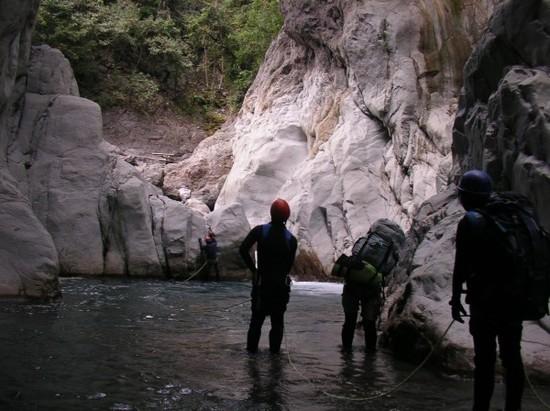
In Taiwan, an activity somehow similar to canyoning is very popular. During the trip we walk upward the stream, and sometimes swim acroos pools or climb besides waterfalls. It is also my favorite activity. In our language, the activity is named after its meaning, "river tracing" since we usually walk along the river to the top headwaters and onto the ridge. In Japanese, I think it is called "river climbing".
See picture below.

Because when doing this activity, sometimes I have to get along with wet feet for more than a week, I have already used to wet feet. We also tend not to bring rain pants sometimes even rain jacket since they may not work well with totally wet clothes. What we need to do is to set a fire and change our wet clothes and put on dry ones after we found a camping site.
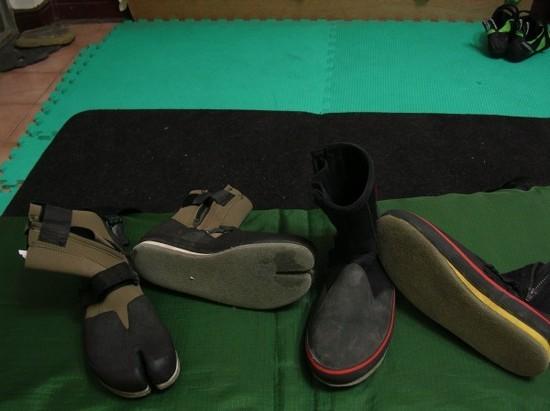
The shoes we wear during this kind of activity is made of neoprene which is the material of diving suits. It keeps our body warm even when we are all wet. In colder water, we wear neoprene socks to provide additional warmth. For a river at a higher altitude, the water is very cold. In that situation almost every part of our clothing are made of neoprene.

neoprene shoes
For hiking here, sometimes I bring this kind of socks and a pair of non-waterproof shoes. It feels much better than wearing wet casual socks and shoes.

neoprene socks
This pair of socks for my size US 11 is about 5 oz. It's not light at all, but it do provide warmth, comfort, and protection for me. But it is notable that it is not breathable at all. So I think for hiking, it is only suitable for bad weather.
I think for weathers not too cold, and no snow, with neoprene socks wet feet can be well dealt with.
I also tried to hike on the casual trail with the neoprene shoes I mentioned. Though it is a little slippery, and not comfortable, after getting accustomed to it It's not to hike with them. Thus, even if I have to hike another two days after river tracing onto the ridge, I don't bring another pair of shoes.
I wear Rocky Gore Tex socks over wool much of the time and take them with me ALL of the time.
Wet vegetation and deep mud are at least as much of a problem in the Olympics as actual rain and I've found the Rocky socks to be very comfortable in my New Balance trail runners.
Low Tyvek booties over wool socks for midnight pees in wet grass.
For winter or snow I add NEOS overshoes.
“What are your favorite techniques for dealing with wet feet when wearing non-waterproof trail shoes?”
I’m always dealing with several stream crossings, rainstorms, floods and swamps. For some reason my trips are just timed badly.
I can’t think of anything more comfortable than backpacking with sandals and coolmax socks. During heavy sweating backpacking a river is a much welcome relief. My feet feel like they’re in paradise AND for about 15 minutes afterwards as the socks dries. When my sandals and socks get dirty, I just walk through a rain puddle to clean them.
Sandal wearing (with socks) eliminates athlete’s foot and hammer toe—- and some other ailments I won’t go into here.
And has been pointed out, take off socks at night so feet can dry if you have been hiking in a swamp.
For 25-45F weather I will use a combination of wool socks, coolmax socks, down socks, and thin newspaper bags.
Crossing a river at 30F is a much different strategy than crossing a river at 80F; I use no sock at 30F but use a sock at 80F.
A nice little bonus: in the morning, you will always being putting on a ‘dry shoe’. Good sandals just dry so fast.
I have found open toe sandals to be the best. Closed toe sandals cause more problems than good.
I’ve done several Rocky Mountain backpacking trips in my sandals and they work much better than my 15 years of boots. That’s according to my foot’s opinion :)
May everyone find their foot zen :)
-Barry
I'm in the wet feet don't matter camp. I've found that having wet feet all day makes them really tough. I wear dry socks to bed or sleep barefoot. At least when I tromp through a creek my feet are clean for a little while. Those days when I don't go through a creek my feet are absolutely filthy. These mesh trail runners are so dirty. I think they NEED to be walked through a creek every now and then.
Can I infer from the discussion here that none of you apply any kind of DWR treatment to your trail shoes, since they will end up getting soaked anyway? Will DWR treatment hold IN water if it leaks in?
I have no plan in wading through creeks (that's what my homemade sandals are for) with my trail shoes. I just was thinking of fending off the occasional shower or two, and wondering if DWR would be a good idea.
It's my understanding that dwr will hurt the "breathability" of your shoes and it will make them dry slowly.
I like to where a pair of merino wool liner socks and Trail Runners when hiking. This combo dries fast,is simple, and very comfortable for me on the trail in warmer condtions.
I would skip the the sandals; you wont need them. Just bring an extra pair of Smartwool Adrenaline crew socks for when you arrive to camp. The next morning swap socks, and you're ready to go. Put your wet socks somewhere they can air out and dry when your sleeping, like the foot of tent, or bottom of bivy/bag. *Most* the time when i wake up the next AM they're good to go=) Also like Rick stated materials or treatments for DWR will tend to dry once their wet very slowly and will also decrease the breathability of your shoes. Leaving your shoes and feet wet=( That's the beauty of breahtable, mesh TR's; they dry fast.
I doubt that DWR treatment would inhibit the breathibility of my largely mesh shoes. Even hiking tshirts are treated w/ DWR. And I doubt that it'd make much difference. And even if it did, it'd wear out within a couple of days. My vote would be to limit your use of toxins.
> none of you apply any kind of DWR treatment to your trail shoes, since they will end up getting soaked anyway?
Very true for me at least. It would wear off very quickly too from abrasion – in hours or less.
> Will DWR treatment hold IN water if it leaks in?
It might hold water in a bit when you hold the shoe up in the air. When your foot is squooshing around inside while you walk, I don't think it would have any effect at all. It won't alter the drying time either.
Cheers
Ashley, David, Roger: cyclists have delt with and solved this problem of short term exposure to wet long ago. Any bike shop will have light over boots, some made of coated nylon with hyplon soles, some made of neoprene for winter use. I have both but could find only the latter. It zips up the back for ease of entry, is about 7" tall, and weighs 150 gm. Made by Gator. I also have something similar in nylon lined in sheeps wool for my x-country ski shoes. So no need to make something…unless you're handy with a sewing machine, of course. Happy trails!
Hey Monty, yes I've checked out cycling overshoes before. But generally they tent to be larger and swallow the whole shoe. And there is not so much problem with the overshoe running under the shoe itself because the user is on a bike. I was hoping to make something which would only cover the shoe from on top. Obviously this makes attaching it a little more tricky, since straps running underneath are also prone to abrasion. But gaitors have the same problem and people get by wearing them for lengthy periods. Anyway, will have to see!
The 'dead cells' argument is kind of disingenuous. Obviously, having wet feet DOES cause problems at some point. Trenchfoot is a real problem, after all, as is jungle rot.
That said, it is true that brief immersion and dampness won't harm you, and any 'icky' feeling is psychological, assuming that your feet dry in a reasonable amount of time. (I won't even TRY to define 'reasonable.') But having wet feet for prolonged periods IS dangerous.
Hi Dean
> But having wet feet for prolonged periods IS dangerous.
Is it really? Can you cite any research supporting this?
Of course I agree that if you create a fungus-friendly environment inside a boot, with warm damp feet as a food supply, then you can grown a real fungus culture. This is well-known.
And it seems that drying the foot off each night may serve as a good enough inhibitor to fungus growth. Seems very reasonable to me.
But does being wet actually harm a foot in itself? If so, how? I note for instance that, apart from the problem of being dead, bodies floating in water for days on end do not seem to suffer any significant skin degradation per se. Prune-skin, yes, but actual damage due to water?
Cheers
Ahh, but I bet if you chopped their feet and your feet off, and swapped them over, you'd have bloody sore feet. I don't think you'd be walking very far.
My understanding of trench foot is that it's a bit like drowning. It only occurs if you stay underwater for a CONTINUOUS period of time. Stick your head up to take a breath, or dry your feet off for a couple of hours, and you're good to go again.
Trench foot also doesn't occur much in summer temps. But a week in SW Tassie in May can get a bit dicey if you're pushing long days and trying to dry your socks by sleeping in them.
I got trench foot while hiking along the PCT in Washington about 10 years back. I can't remember if I started the day with totally dry shoes and socks, but my feet had at least dried out the night before. That day I climbed over several passes. Near the top, it was snowing, and in each valley it was raining. Needless to say, my feet were cold and wet. That evening, I just figured my feet were a little more sore than usual. I checked into a hotel so I could get a shower, and in the middle of the night I woke up in extreme pain, could not put weight on my feet, and found that they were swollen to twice the size of normal and bright red. I had to cut my thru-hike short, and I still have to wear orthotics because of the damage from that injury. So, yes, trench foot can happen very quickly. In my case, it was a day.
However, as has been said before, the problem was more one of cold than of wet. If I had done a better job keeping my feet warm, either with different footwear or socks, I wouldn't have gotten it, even though my feet were wet.
From Wikipedia:
Characteristics
Affected feet become numb and then turn red or blue. As the condition worsens, they may swell. Advanced immersion foot often involves blisters and open sores, which lead to fungal infections; this is sometimes called tropical ulcer (jungle rot).
If left untreated, immersion foot usually results in gangrene, which can require amputation. If immersion foot is treated properly, complete recovery is normal, though it is marked by severe short-term pain when feeling returns. Like other cold injuries, immersion foot leaves sufferers more susceptible to it in the future.[citation needed]
Causes
Immersion foot occurs when feet are cold and damp while wearing constricting footwear. Unlike frostbite, immersion foot does not require freezing temperatures and can occur in temperatures up to 60° Fahrenheit (about 16° Celsius). The condition can occur with as little as eleven hours' exposure. The mechanism of tissue damage is not fully understood.
Prevention
Immersion foot is easily prevented by keeping the feet warm and dry, and changing socks frequently when the feet cannot be kept dry. During World War I,[citation needed] trench soldiers were provided with whale grease and told to apply it to their feet, to reduce the prevalence of this condition; the idea was to make the feet waterproof. It was found, however, that this made the condition worse as it made the feet perspire and absorb even more water. It was also discovered that a key measure was regular foot inspections by officers.[1]
History
Trench foot was first noted in Napoleon's army in 1812. It was on the retreat from Russia that it became prevalent, and was first described by Larrey.[2]
It was a particular problem for soldiers in trench warfare during the winters of World War I[3] and II and in the Vietnam War.
Trench foot made an unwelcome reappearance in the British Army during the Falklands War, in 1982. The causes were the cold, wet conditions and the DMS Boot, which was insufficiently waterproof.
Some people were even said to have developed trench foot at the Glastonbury Festival of 2007 due to the cold and wet conditions at the event. [1]
From a Compuserve web site:
Trench foot was one of the most widespread and debilitating that affected men from both sides of the lines, it is linked with WW1 hence the name "Trench foot". The disease's origin isn't in WW1 but was first noted in Napoleons army in 1812. It was on the retreat from Russia that it became prevalent, and was first described by Larrey. He observed that this condition didn't occur during the freezing cold of the campaign but when the temperature was near to zero degrees with the presence of moisture. Here lies the clue. During the First war men were exposed to Cold but not freezing conditions often up to their ankles in water that was permanently in the bottom of the trenches. The feet would swell, appear red and blood blistered, the pain would be severe, until the sensory nerves had been damaged and would then be numb causing the man to be evacuated hopefully. The treatment would be basically to elevate the limb, some modest warmth and wait.
Note especially under Wiki Causes: 'Immersion foot occurs when feet are cold and damp while wearing constricting footwear.' This is not frostbite.
This problem is not due to the foot just being wet: it has to be cold and with restricted blood circulation as well. And the photos show that the problem is not just on the skin surface: it goes deeper into the foot. That gangrene could result, as it often did, means the blood circulation (and possibly also the lymphatic system) were both severely inhibited.
In fact, I have also seen this stated explicitly: 'It happens when the blood vessels in the feet restrict blood flow to the extreme areas of the feet to conserve heat. Once it sets in it can take several months to heal.' This can of course lead to gangrene.
Mention is also made of a tingling being felt under the skin: that implies problems with the nervous system in the foot. This too implies a physiological breakdown in the interior of the foot.
Could a walker get this? If standing around in cold wet boots for a day or two, maybe. If actively walking in mild weather in light shoes of adequate size, so the blood circulation is not restricted, I very much doubt it. Experience in the field (my feet, my wife's feet, many river walking trips) shows it does not happen under the latter conditions.
Hope this helps
Cheers
"Could a walker get this? If standing around in cold wet boots for a day or two, maybe. If actively walking in mild weather in light shoes of adequate size, so the blood circulation is not restricted, I very much doubt it. Experience in the field (my feet, my wife's feet, many river walking trips) shows it does not happen under the latter conditions."
Or actively walking in restrictive footware. Or just having cold, wet feet for too long. Certainly in winter I make attempts at keeping my feet warm at all costs, which may even mean walking extra distance to cross a river at a bridge, wearing warm and waterproof boots, and sometimes even over-gaiters if I know I will be in snow all day. But *most* of the time, it is enough to allow my feet plenty of circulation (adequately sized footware) and just keep moving. Last summer we spent 7 days straight in heavy rain and cool (<10 C) temps, and frequent river crossings without any problems. Of course we dried our feet out at night…
Of course, the cited article referenced 60*F/15*C as conditions potentially conducive to trench foot. Not sure about everyone else, but that's pretty much 3-season backpacking weather for me… I'm not much of one for dead-of-summer trips.
Hi Lynn
> Last summer we spent 7 days straight in heavy rain and cool (<10 C) temps, and frequent
> river crossings without any problems. Of course we dried our feet out at night…
Yeah, with you. In France in 2007 we spent the first 5 weeks or so with cool wet feet every day. It rained, and it rained, and it rained. But our shoes were big enough that the blood circulation was not impeded at all.
Our problem came when it stopped raining. Then Sue's joggers dried out, the leather outer shell shrank, and the width dropped to 'much too small'. Internal bruising resulted, with internal bleeding to the skin surface at the sole. Problem was solved by buying new wider shoes. Fixed in a day or two. I was very impressed by the speed of healing.
Cheers
> But having wet feet for prolonged periods IS dangerous.
Is it really? Can you cite any research supporting this?
Absolutely. A couple of centuries of well-documented military data on trench foot and immersion foot… a little less on jungle rot. But both have actually been described since antiquity. (The data just isn't very well documented.) There is so much data out there, as a matter of fact, that my mind boggles trying to figure out where to start!
But, let's get a little real here, Roger: I was not challenging the UL dogma that having wet feet for brief periods is pretty harmless. I swear! :o) Dry out your feet at intervals appropriate for the temperature and you're probably ok. I think we are just pursuing a different emphasis, so let's not get all defensive, eh?
Because if I challenge YOU to produce a study that shows that prolonged wet feet are harmless then you will have a much tougher time than I will on the literature search!
What I WAS challenging is the absurd implication that having wet feet is harmless because the outer layer of squamous epithelium is 'dead.' Prolonged dampness- most significantly when combined with cold- causes all sorts of foot problems. If you deny that, frankly, you are delusional- but I don't think that you are denying that. As I said: "Obviously, having wet feet does cause problems at SOME point."
I mean, crap, a simple google search produced this image:

which appears to be pretty modern, in bicycling shoes. Are you going to try to tell me that's NORMAL ??? Even though the outer 1mm or so is 'dead?' Even if things haven't progressed to the point of injury waterlogged skin can get pruney and wrinkly, and you end up stepping on folds of your own skin, which is very painful. Heck, that's not even a particularly bad case. Here is a bad case:

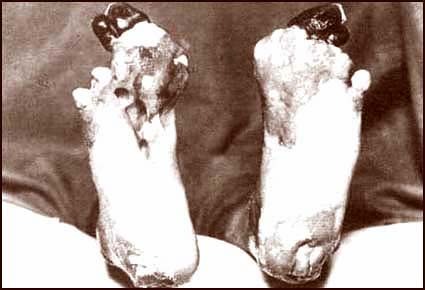
which is, admittedly, an extreme one after days of foot neglect. So I'm not talking about the occasional stream crossing, assuming that your socks dry reasonably afterwards. On the other extreme, obviously none of us would intentionally go post-holing for days on end in near-freezing conditions in mesh trail runners. You'd lose your feet to any of several possible injuries.
I got immersion foot after half a day of wet (extreme rain) conditions during a field exercise in Texas- in AUGUST! It was painful, but luckily a mild case, and resolved by the next day once my feet were dry.
So, there is a line where it becomes dangerous, QED. It is not harmless. We as UL hikers sometimes flirt with that line, but we acknowledge that the incipient paranoia about wet feet that pervades the mainstream outdoors industry is a bit overboard. We all take responsibility for our own decisions, at least in this community, after all. One judgment call is on how fastidious we have to be with our feet in given conditions. Sometime we CAN be pretty lax and suffer no ill effects.
And corpses in the water are dead, Roger. :o) They don't bleed, either, but you can't claim that a deep laceration is harmless!. (A straw man, I know. I'm sorry. If you really want to contest the point I will restate more explicitly.) And, yes, as a matter of fact eventually their skin can look pretty bad…
P.S. I agree that shoes that are too tight can be a big problem, and greatly lower the threshold of injury.
Become a member to post in the forums.