Topic

Sierra Snowpack 2015

  • This topic is empty.
Viewing 25 posts - 176 through 200 (of 234 total)
Jerry Adams BPL Member
PostedApr 7, 2015 at 5:40 pm

fracking, in California, uses 70 millions gallons, according to thinkprogress.org

California water use is 40 million acre feet, 300,000 gallons per acre foot, so fracking uses about 1/100,000th of California water. insignificant

And yeah, in "Gasland" someone lights a match to his drinking water which lights up. But, some drinking water had methane before fracking. No way to know if fracking contributed to that.

What's a shame, is that during the Bush administration, they exempted fracking from a lot of regulations, so it now has a bad reputation – leaking casings, waste water ponds, contaminated ground water,… They have gradually brought this more under regulation. Fracking can probably be done safely, and regular oil drilling has all the same problems.

If you don't like fracking, then you should give up your car and turn off your natural gas heating. And more and more, electricity is made with natural gas so you better shut down you computer too.

brian H BPL Member
PostedApr 7, 2015 at 8:24 pm

i studied water at uc davis in the 80s
i met Marc Reisner there when he came to speak
80% of CA water is used by ag, most of it by alfalfa, rice, cotton, and orchards.
forcing conservation on the 20% while ignoring the 80% is crazy, as it has been for 100 years. Big Biz owns the politics in almost every place you turn these days.

Fracking is a disaster. Much of the end product is for export anyhow. In my neck of the woods for example:
"Gas companies have been working for years on a massive fossil fuel infrastructure plan called Jordan Cove to export fracked gas from Canada and the Rockies through southern Oregon and onto ships bound for Asia from Coos Bay. This plan would involve construction of a new 230-mile Pacific Connector pipeline and permanent 95-foot wide clearcut through southwest Oregon’s forests, farms and salmon filled rivers."

Nick Gatel BPL Member
PostedApr 7, 2015 at 9:48 pm

"80% of CA water is used by ag, most of it by alfalfa, rice, cotton, and orchards.
forcing conservation on the 20% while ignoring the 80% is crazy, as it has been for 100 years."

How about this…

This afternoon I got an email from the neighborhood/busybody/association encouraging me to turn in my criminal neighbors who are water wasters.

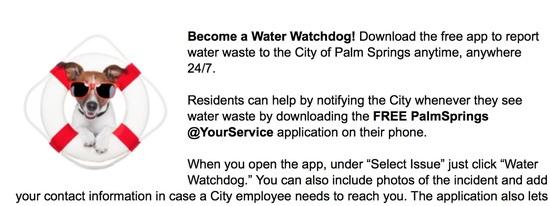
It appears my city now has a "Water Watch Dog" app you can download to your smart phone and use it to take pictures of your neighbors and turn them in to police. If you don't have a smart phone you can use their website or even call the water watch dog hotline.

water watch dog

I guess I am going to rip out what little desert landscaping I have left and plant more grass. However an alfalfa lawn sounds enticing.


These are the same people who passed an ordinance making it illegal for any store in Palm Springs to give customers a plastic or paper bag for anything you purchase. Yep, grocery stores, home improvement stores, drug stores, convenience stores, and the rest charge 10 cents for every bag you need.

We used to bring our own bags into the stores, but now I leave the bags in the car, purchase bags for 10 cents each, transfer my goods to the bags in the car, then return to the store and get a refund on the bags… I just tell them I am unhappy with the product — of course it takes a manager to refund my money and it incoveniences all the other customers — but some are taking my lead and doing the same thing. It's a movement, it's a revolution, it's the anti-nazi-bag revolt :)

Bob Gross BPL Member
PostedApr 7, 2015 at 9:59 pm

Nick, I know that this isn't you. On the news today they announced that Palm Springs had a water usage rate that was three times the average for all of California.

Besides, those disposable plastic bags are good for cleaning up after your water watchdog.

–B.G.–

Nick Gatel BPL Member
PostedApr 7, 2015 at 10:17 pm

Bob,

We have a population a little over 40,000 people and we have 125 golf courses in the area. This of course is a great opportunity to get some free JMT pencils, but the green fees are too steep.

I guess those folks with the 10,000+ sq ft homes probably use a lot of water too.

Yes, those bags make good pooper bags. We have been saving them from the stores for years. But at 10 cents each I bought a roll of the pooper bags for the dog. My dog isn't a water watch dog though.

Bob Gross BPL Member
PostedApr 7, 2015 at 10:40 pm

"My dog isn't a water watch dog though."

Nick, does the dog know the right thing to do with a fire hydrant?

–B.G.–

Tony Wong BPL Member
PostedApr 20, 2015 at 10:31 am

I had heard of capturing the used water from my washing machine as a means of saving water and using it for watering plants.

I have a front loader washing machine and was shocked to find that I was able to fill a whole large garbage can with by directing the drain hose from my sink in the garage to the garbage can.

I simply used a small bucket to scoop out the water and to use it to water my fruit trees.

I am a bit thrilled at finding this "new source" of water for my fruit trees.

A whole garbage can of water seems like a lot of water to me if I have one per tree.

Anyway, just a tip to pass along.

I have heard that there are components in the soap that are like fertilizer for plants as a possible additional benefit.

Wish there was a way for me to capture the water from my shower…..

Tony

Michael L BPL Member
PostedApr 20, 2015 at 10:36 am

Just shower outside with a water house by the trees you want to irrigate….

My parents had the washer piped out to the base of an oak when they built their house.

Tony Wong BPL Member
PostedApr 20, 2015 at 1:15 pm

Michael,

Humm, I like your idea, but I might blind the neighbors with my skinny body showering next to the fruit trees that I have in my front yard.

Maybe if I wear my red latex gimp suit while showering….that might work.

Win-Win!

Tony

PostedApr 20, 2015 at 2:42 pm

if we stop exporting almonds and alfalfa to China the water crisis is almost immediately solved for US residents of California.

Feed from your resources. It's the one thing any functional government must do. Feed your people with your natural resources. Sending 85% of our agricultural water to plants destined for export is not sustainable in a drought.

These farms are huge. Killing them will put 10s-100s out of work. Hundreds of millions, on the other hand, have a stake in using US land, and subsidized agricultural water, for our food first. The very few people who grow almonds will lose. The 20 people doing large scale alfalfa exports will suffer too. Bummer. These people probably had no issue with the government shutdown and furloughs, so it's just their turn to be furloughed.

A molten salt plant can desalinate by heat. California has three things in excess. Sun, coastline, and subsidized farmers growing rice, alfalfa, and almonds in a desert. One of these is not like the others.

PostedApr 20, 2015 at 2:54 pm

"if we stop exporting almonds and alfalfa to China the water crisis is almost immediately solved for US residents of California."

What do you mean 'WE'?
Do you own some almond orchards Willie?
Or are you advocating some kind of NAZI take over of private land?

I am sympathetic to your diatribe Willie, but last time I check the farm land is private property and private enterprize; not government controlled. There is no 'we' involved; it is THEY, the farmers.

Then you will likely advocate turning off their water, I suppose… and I am sympathetic there also. But many of these farms have contracts for water rights. Even if it could be done, you are talking probably 20 years or more of legal battles if the government tries to break these water contracts.

Billy

Jim Colten BPL Member
PostedApr 20, 2015 at 4:16 pm

turning off their water … many of these farms have contracts for water rights.

I know nuttin about the topic but a good friend whose entire long career was spent advising western folks about water use and erosion control tells me that at the end of the day, agricultural water use always loses to residential use whenever the "market" comes calling. They may own water rights or are buying water from another owner but selling the water to residential users will pay better than farming with the water.

Ian BPL Member
PostedApr 20, 2015 at 5:01 pm

"I am sympathetic to your diatribe Willie, but last time I check the farm land is private property and private enterprize; not government controlled. There is no 'we' involved; it is THEY, the farmers."

The irrigated water farmers receive here in Eastern Washington is heavily subsidized by us tax payers.

We also pay millions in federal taxes for their workers.

http://www.keprtv.com/news/local/119296239.html

So despite what the Cliven Bundy types would like to say, farming is not an insignificant source of corporate welfare consumption.

J-L BPL Member
PostedApr 20, 2015 at 5:34 pm

Wouldn't raising the price of water change habits?

I live in Phoenix. My cost of water should be several times higher

jscott Blocked
PostedApr 20, 2015 at 5:39 pm

"private enterprize" indeed. Almond and rice growers have won the lottery, water wise. It's never made sense to grow water intensive crops in a near desert environment. I wouldn't call restricting such crops "a nazi takeover". More like, common sense. Look, we don't allow industries to pollute as much as they want, to take just one example, just because their pollution begins on private property and is brought about by a private enterprise. In a Democracy, we've always struck balances between private enterprise and public weal. In any case, private individuals are being required to alter their behavior or pay fines all across California in order to address the drought. Why shouldn't farmers do the same? It's called problem solving. You look at California agriculture because that's where most of the water use is. Oh and what's left of the fishing industry–another private enterprise–might have something to say about agriculture's sacred water rights. It' all a balancing act.

PostedApr 20, 2015 at 5:43 pm

"Wouldn't raising the price of water change habits?"

Who's water are you referring to???
Here in CA it is quite a diverse set of circumstances.
Some farmers have multi year or even multi decade contracts. You can't just change the contracts unless there are stipulations to do so within the contract.

As for residential water… the prices have and are rising and habits have been changing for many years now. As people use less water the price per gallon goes up because all infrastructure costs remain the same whether you use half the water or now… as well, there is very little savings in non-infrastructure costs you still need people to maintain the system and they have employment contracts and benefits regardless if you half the water usage or not.

Thing are changing, but some of the things will take a decade or more of drought to force the changes. Infrastructure costs are amortized over 30 or 40 years… some water contracts are for that number of years or more.

Billy

Ian BPL Member
PostedApr 20, 2015 at 5:45 pm

"Wouldn't raising the price of water change habits?"

Sadly that's what it's going to take. Here in Washington, we're not getting hit as bad as Cali but it's not good either. I'm making a long term plan to remove 1/3 of my sprinkler heads this year and another 1/3 next, which will leave a small patch of grass for my dogs.

While it'll feel nice to remove a dozen sprinkler heads, they mentioned in our HOA meeting the other night that our common areas have over 17,000 sprinkler heads and roughly 300 control boxes. A couple of us brought up the idea of removing some of the grass and switching to xeriscaping.

As far as they were concerned, as long as there's water in the Columbia, there isn't a drought.

PostedApr 20, 2015 at 5:53 pm

Ian- I'm assuming you're talking about east of the Cascades, correct?

PostedApr 20, 2015 at 5:54 pm

"I wouldn't call restricting such crops "a nazi takeover". More like, common sense.

If you tell that to a judge as a reason to break a contract you will get a good laugh.
The opposing side will have 100 lawyers arguing why it is not commmon sense at all.

"Look, we don't allow industries to pollute as much as they want, to take just one example, just because their pollution begins on private property and is brought about by a private enterprise."

Yes, but the analogy does not hold legal water. There are very powerful laws that were passed to deal with pollution… With water it is the opposite for the powerful farm industry that have long term water contracts… it is THEY who have the law on THEIR side. Of course, laws can be changed. But that will take many years… and it is doubtful that existing contracts would be overturned.

"In any case, private individuals are being required to alter their behavior or pay fines all across California in order to address the drought. Why shouldn't farmers do the same"

Many farmers are getting their water cut… some to zero… the ones that don't have the most powerful water contracts. There is a lot of whining based on missinformation going around. Many farmers are bone dry and not getting any water and going bankrupt.
Though some are indeed huge water wasters.

b

J-L BPL Member
PostedApr 20, 2015 at 5:57 pm

"While it'll feel nice to remove a dozen sprinkler heads, they mentioned in our HOA meeting the other night that our common areas have over 17,000 sprinkler heads and roughly 300 control boxes."

Wow, makes me wonder how many my neighborhood has. It's about half xeroscaped and half grass. I actually don't understand the American preoccupation with a grass yard.

But it all adds up (just like with pack weight). If half the homes in your neighborhood remove most of their sprinklers, then that's a lot of sprinklers gone.

Ian BPL Member
PostedApr 20, 2015 at 6:26 pm

John,

We have a pretty small yard which was one of the selling features for me. Takes me less than a half hour to cut the grass. Hope to get that down to less than five,

I'm researching my options to recycle our laundry water. A full gray water recycle system is a bit too ambitious for us but routing our 15-30 gallons per wash cycle to a sand filtration system and then to a drip line to our trees may be do able. Seems like the washing machine is always running.

jscott Blocked
PostedApr 20, 2015 at 7:50 pm

Billy: all good points. One must respect contracts and laws. Given the state of the drought, I'm not sure why it should take years to change laws…but of course it probably will. Again, California should have learned from the last drought, and the one before that, that growing water intensive crops in our climate is not a good idea. But California ag is powerful–and perhaps rightly so; the state grows a huge amount of food. Perhaps another analogy is Wall Street–banks need regulators to save them from themselves, and the rest of us too. If there's quick money to be had, anything goes until everything goes–down the toilet. The same with crops I guess–until the bottom drops out and there's no water for anyone, some farmers will grow rice, cotton and almonds in the desert until they're ruined, or retire rich. As for these water wasters: Is this what a "powerful water contract" allows? and how are some contracts more powerful than others, that some farmers are left high and dry by contrast. I'm not so sure that the state is helpless in these matters.

My immediate family were all farmers in Eastern Washington–fruit growers; all apples in the end. "Small" farmers. They led very good lives, but in the end giant agriculture wiped them out. In any case, I'm not anti-farmer at all; far from it. My guess is that if someone looked into it, the farm politics of water rights wouldn't be pretty. (that's an understatement.)

I'm disappointed that Gov. Brown's immediate response to the drought is to focus almost entirely on non-agriculture consumption. Hard choices–and not so hard, common sense choices–must be made. Why is it always so hard to rationally address a real crisis?

PostedApr 20, 2015 at 8:22 pm

"As for these water wasters: Is this what a "powerful water contract" allows? and how are some contracts more powerful than others, that some farmers are left high and dry by contrast. "

I'm only know what I have read. But some water rights contracts are with federal dam projects while others are with the state. Some of the contracts go back over 100 years, some in the last year or two. My understanding is that the more recent contracts have lower priority and their water is cut first, before some of the water contracts with more seniority. I'm probably not using the exact legal wording, but you get the idea. Water rights/contracts/distribution etc. is a mix of things that have taken place over the lst 150 years.

"I'm disappointed that Gov. Brown's immediate response to the drought is to focus almost entirely on non-agriculture consumption."

Brown says that is not the case. He says that the mandatory water restrictions are hitting the farmers too (though unequally I'm sure due to the varying nature of their water contracts). Heard him say it on the evening news the other day… you DO believe Jerry, now don't you???

billy

PostedApr 20, 2015 at 8:23 pm

People have to EAT.Crops need water to grow.

Watering your G'damn lawn, filling your swimming pool or washing your car are are LUXURIES.

While I agree that a good percentage of ag water is wasted, the average suburban twit in California wastes about half the water they use.

It's Darwin's theory at work. Congradulations!

Viewing 25 posts - 176 through 200 (of 234 total)
Loading...