


Introduction
During hard exertion, the body can produce sweat faster than it can evaporate. Liquid sweat begins to collect on the skin, and clothing must move that water away from the body through one or more layers.
A few months ago, I evaluated three base-layer garments and found clear performance differences. But one key question remained unanswered:
Which fabrics are most effective at moving liquid sweat away from the skin and into the next layer?
To answer that question, I developed a test specifically designed to track liquid water as it moves through a simplified clothing system. The test measures how much water remains on the “skin,” how much is retained in the base layer, and how much reaches the layer above.
In other words, it answers a simple but previously unmeasured question:
When skin is wet, where does the water actually go?
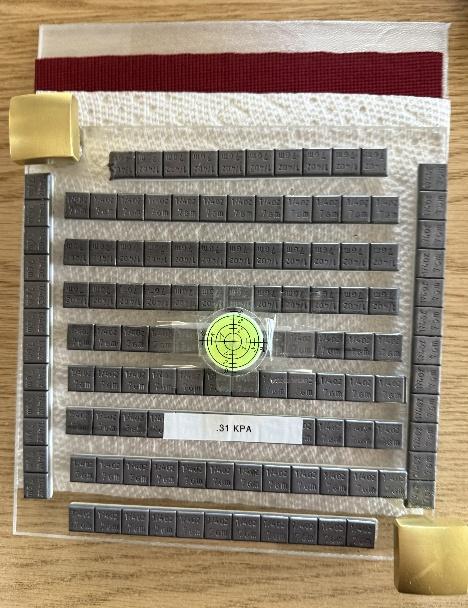
Figure 1 shows the test device used in this study.
As testing progressed, I expanded the scope from three fabrics to eight, representing a broader range of base-layer designs. With that expanded set, consistent patterns began to emerge.
The testing reveals several key patterns:
- Hydrophobic fabrics require sufficient pressure to initiate liquid transfer through their pore structure
- Pore structure strongly influences how effectively hydrophobic fabrics move liquid once transfer begins
- Hydrophilic fabrics rapidly absorb liquid from the skin but do not necessarily release it easily. Transfer depends on sufficient driving forces – primarily the pressure between layers and the receiving layer’s ability to draw in water. As the receiving layer becomes wetter, that ability decreases, reducing transfer. This behavior contrasts with the common expectation that wicking fabrics continuously move moisture away from the skin.
Together, these behaviors help explain a common experience: two garments may both be marketed as “moisture managing,” yet behave very differently once sweat becomes liquid. Some continue to move water away from the skin, while others become saturated and uncomfortable.
This article focuses on understanding why that happens. By tracking liquid water as it moves – or fails to move – between layers, the testing provides a clearer picture of how base-layer fabrics behave under high-exertion conditions.
How to Read This Article:
This article does three things:
- Introduces a new test method,
- Explains the physics of hydrophobic vs hydrophilic behavior, and
- Presents experimental results.
That is a lot, but you will learn a lot about how base layers function.
If you want a quick takeaway read:
- How Hydrophobic and Hydrophilic Fabrics Transfer Liquid Moisture
- Case 1 Results
- Conclusions
For a deeper understanding, read the full text. The appendices provide additional detail. Alternatively, read a section or two at a time and then come back to it. There is a lot here, but I think these tests raise the bar on our insights into how base layers work.
Author’s Note:
The results and conclusions presented here apply to the eight fabrics tested in this study. I do not claim that these findings extend to all hydrophobic or hydrophilic base-layer fabrics. However, the observed behaviors are consistent with well-established physical principles described in the scientific literature, beginning with Young and Laplace (1805) and later formalized by Washburn (1921). These foundational studies describe the capillary physics that underpin modern understanding of liquid transport in fibrous materials.
How Hydrophobic and Hydrophilic Fabrics Transfer Liquid Moisture
Hydrophobic fabrics can get wet, and they can transfer water effectively
Hydrophobic base layers are often described as “staying dry,” and in one narrow sense, that’s true – the fibers themselves do not attract or absorb water. But during hard exertion, many hikers have experienced something that seems to contradict this idea: hydrophobic layers can feel heavy, clammy, and very wet.
The reason is simple but often overlooked. Fabrics are mostly empty space. Even when the fibers repel water, liquid sweat can still collect inside those empty spaces. In other words, a hydrophobic garment can hold a surprising amount of liquid water without the fibers ever becoming “wet.”
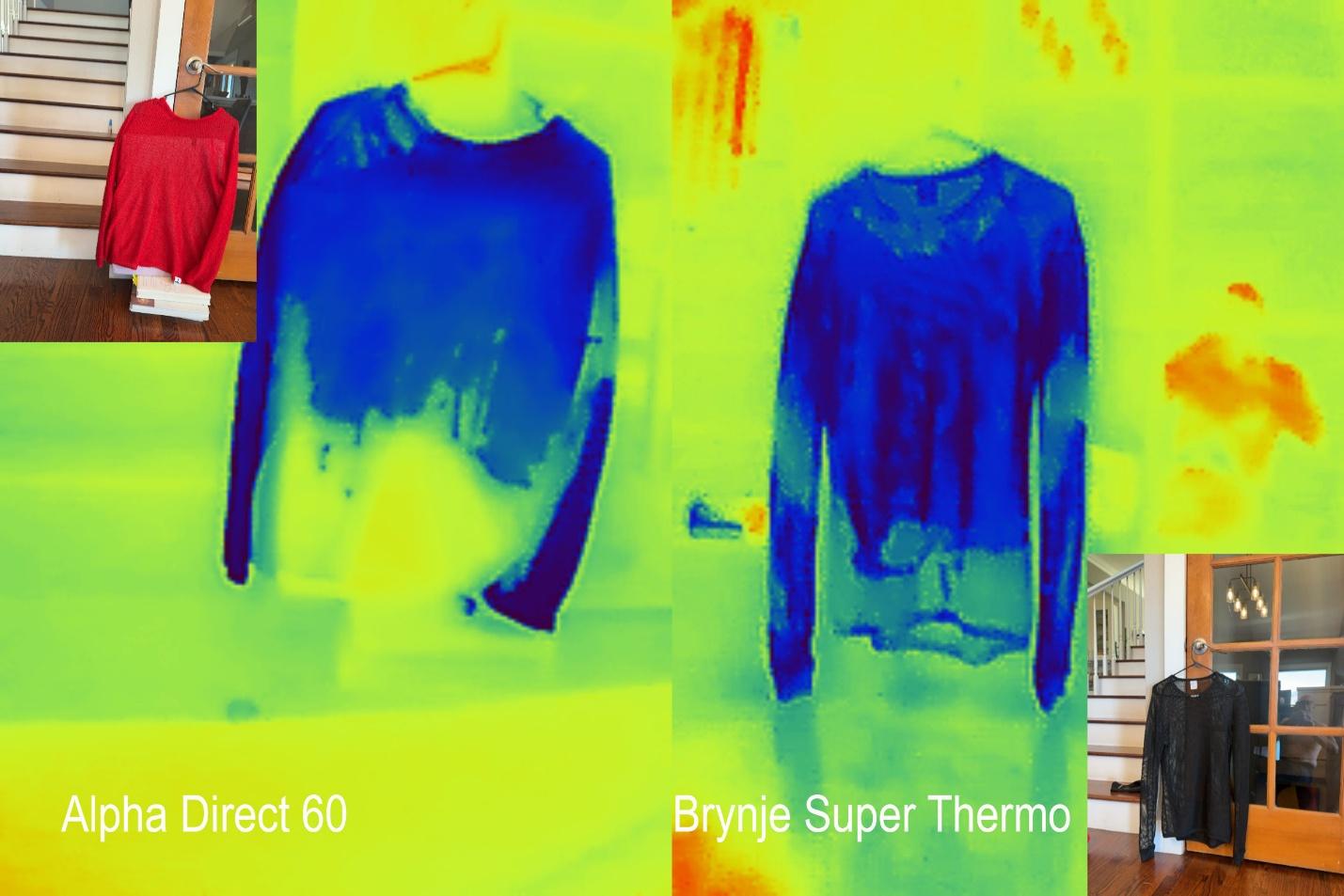
Figure 2 shows this clearly. After high-intensity activity in cold conditions, large amounts of liquid water can be seen within two hydrophobic garments. In the infrared images, darker blue regions indicate areas of high water content. Despite being made from hydrophobic fibers, both garments contain substantial amounts of trapped liquid sweat. The Brynje mesh shirt (right) retained 87 g of sweat (65% of its dry weight), while the Alpha Direct shirt trapped 62 g (55% of dry weight).
Whether a hydrophobic garment stays relatively dry or becomes saturated depends on a simple balance: how fast liquid sweat enters the fabric versus how quickly it can move through and out. If liquid water passes through the fabric as fast as it arrives, little accumulates. If transfer is slower than incoming sweat, liquid gradually fills the pore spaces, and the garment becomes increasingly wet – even though the fibers remain hydrophobic. In that condition, the fabric may feel clammy, heavy, and provide reduced insulation.
In my testing, hydrophobic fabrics do not absorb water through capillary action. That distinction is important. Capillary-driven uptake occurs when fibers attract water molecules to their hydrogen bonding sites. True hydrophobic fibers lack these bonding sites and therefore cannot generally pull water into the fabric on their own.
Instead, hydrophobic fabrics require external pressure to force liquid water into their pore structure. If available pressures are too low, a hydrophobic fabric can act like a water barrier. As pressure increases, that same fabric may suddenly begin to pass water through.
There is a minimum pressure required to force water into the pores of a hydrophobic fabric. The classic work of Laplace and Washburn, cited above, describes how this pressure can be calculated for a single capillary. I’ll refer to this threshold as the breakthrough pressure.
In real use, this pressure can come from many sources: compression from outer layers or pack straps, movement of the body against clothing, tension in tight-fitting garments, friction between layers, or simply the weight of accumulating liquid sweat. Sliding, stretching, and rubbing can generate brief, localized pressures that momentarily force water into pore openings. Until that pressure threshold is reached, water may remain pooled on the skin.
What determines how much pressure is required? According to Laplace and Washburn (cited above), breakthrough pressure depends largely on two factors: the size of the pore opening and the contact angle between water and the fiber surface. There are other factors that influence breakthrough pressure in a fabric, but, as we shall see, our calculations based on pore-opening size and estimated contact angle correlate well with actual fabric performance.
My testing confirmed that the largest pore openings corresponded to reduced breakthrough pressure. Smaller openings require more pressure to force water through them. At the same time, my testing showed that the breakthrough pressure increased with a higher contact angle.
What is Contact Angle?
Contact angle is a measure of a fiber’s resistance to water. It is measured by how a water droplet sits on a fabric surface. When a water drop deposited on a fabric surface spreads out to form a flattened drop, the surface is hydrophilic and supports capillary wicking. When a water drop beads up into a tall dome, the surface is hydrophobic and resists wetting. Contact angles below about 90° show hydrophilic behavior, while angles above 90° indicate hydrophobic or water-repellent behavior. Many hydrophobic base layers fall in the range of roughly 95° to 115°, whereas strongly hydrophilic materials may exhibit very low angles, approaching zero.
Pore Size and Pathways
It is important to note that apparent pore size alone (measured under the microscope) does not determine how easily liquid passes through. The actual pathways inside a textile are three-dimensional and often constricted where yarns cross or partially block pathways. As a result, fabrics that look very open can still resist breakthrough, while others with smaller visible openings may allow flow if their internal pathways are better connected.
This framework helps explain why hydrophobic base layers behaved so differently in the tests – and why they may behave differently in real use. One fabric may transfer sweat efficiently and feel relatively dry during intense activity, while another may allow sweat to accumulate on the skin or within the fabric, leading to discomfort – even though both are made from water-repellent fibers.
Key Takeaways:
1) Hydrophobic fabrics can become wet due to water stored in open pores.
2) In this test, hydrophobic fabrics do not transfer sweat until sufficient pressure forces water into their pore structure.
3) Both pore structure and fiber chemistry greatly influence the pressure required to initiate flow.
4) If water enters a hydrophobic base layer’s pores faster than it leaves, the fabric will retain water and become wet.
Hydrophilic Fabrics: Familiar Strengths, Important Limits
Hydrophilic base layers behave as most hikers already recognize. When liquid sweat appears, these fabrics absorb it immediately, pulling moisture off the skin and spreading it through the fiber and yarn structure by capillary action. This behavior – often described as “wicking” – is discussed in detail in earlier articles, Why Is My Wicking Layer Wet? and How Do Moisture-Wicking Fabrics Work? , which I won’t repeat here.
What matters for this article is a less intuitive point: the same capillary forces that make hydrophilic fabrics absorb sweat so readily also make them inclined to hold on to it.
In a hydrophilic fabric, liquid water is drawn into the pores and distributed through the fabric structure by capillary forces. Once absorbed, that water is not free to move unless another force acts on it. Transferring liquid water to the next layer, therefore, results in a competition between the base layer’s tendency to retain water and the receiving layer’s ability to draw it away.
When the receiving layer is dry, it can readily draw water from the base layer. But as the receiving layer accumulates moisture, its ability to pull additional water decreases. As a result, liquid transfer can slow dramatically – or stop altogether – even while the base layer remains wet.
I observed this behavior across all experiments conducted for this article. In two tests, the receiving layer water absorption capacity was reduced in different ways. In each case, less water was transferred from the hydrophilic base layer to the receiving layer. In these tests, the performance of hydrophobic fabrics was largely unchanged and exceeded that of the hydrophilic samples. In two other tests, the hydrophilic base layers simply transferred less water than the hydrophobic samples (with two hydrophobic exceptions). These results are explored in detail in the results section.
Member Exclusive
A Premium or Unlimited Membership* is required to view the rest of this article.
* A Basic Membership is required to view Member Q&A events


Discussion
Become a member to post in the forums.
Companion forum thread to: By the Numbers: The Tug of Water – Why Some Layers Hold Sweat and Others Let it Go
Our new test data reveals which hydrophobic and hydrophilic base layers are most effective at liquid water transfer, moving sweat away from your skin during high exertion.
Interesting analysis Stephen, though I’m not sure how to practically apply it yet. (maybe a couple more reads). For my purposes, I am more interested in having the sweat/moisture evaporate from my baselayer than pass into the next layer, and in practice, not the test lab, it seems in all cases thinner is better and loosely fitting (not baggy though) is better. I can’t wear synthetics so am limited to hydrophilic fibers. Processing…
Enjoyable read, thanks Stephen.
In field use, the Brynje doesn’t feel wet for me despite the thicker yarn retaining moisture. This might be because so much of the surface is void so there’s far less skin contact with wet fiber than with a more homogeneous fabric that retains similar water weight.
This is a great showing for Brynje because once vapour transmission and a bit of air movement is factored in, total water transfer off skin for it will be much higher than for the tighter weaves, without a significant absorption penalty due to the thicker yarn.
Decades of using the Lifa line up with your results for me. As a base layer, once its wet it likes to stay wet. Mid layers usually aren’t tight so little pressure is exerted to pull water off the Lifa.
Where I find Lifa shines is acting as the receiving layer, as a lightweight mid. I put it over the Brynje, and it pulls moisture away really well. Air movement from activity and wind is usually more than enough to evaporate the moisture off it. If I need a bit more warmth, I add a second highly breathable mid like an octa over the brynje/lifa combo and more than enough air usually gets through to keep skin and Lifa dry. At long stops an Alpha 120 goes over and my body heat is enough to boil the water off the Lifa, I can see steam rising through the combo when its cold.
This article looks closely at how hydrophobic and hydrophilic base layers move sweat off the skin and transfer it to the next layer. The article demonstrates that hydrophobic and hydrophilic base layers use different processes to accomplish that task. It points out that transfers from hydrophilic base layers may be limited by the properties of the receiving hydrophilic layers. Your comments suggest that you only use natural base layers. I presume that means merino wool base layers. The behavior of a merino wool base layer will be heavily influenced by its processing. The cuticle layer covers the exterior of the merino wool fibers. The cuticles are hydrophobic (but can be treated to be hydrophilic). The interior fiber structures are hydrophilic. Merino adds a level of complexity that my test has not addressed yet. I am looking for people’s comments to suggest additional directions for the new testing device, and now I have the first one. So, I will include some merino base layer fabrics in my next round.
I would say the question of fit depends on the type of base layer as well as the layering system. When I am biking, I wear a loose bike jersey rather than a skin-tight one because that fit encourages air to penetrate the jersey fabric and circulate between the skin and the fabric. This can enhance sweat evaporation. In a multilayer system, significant air movement may not occur, limiting convection. A tight base layer can improve contact between moisture on the skin and the fabric of the base layer. For a hydrophilic base layer that will improve initial wetting and subsequent wicking. For a hydrophobic layer, the tightness will ensure that the pressure drive I discuss in the article is readily available to send liquid moisture into and through the base layer. So, loose or tight? For multiple clothing layers, I generally tend towards a snug base layer.
My experiences with wool base layers are same as Steve’s, light as possible and loose fitting. Wool is a greedy sponge, lighter ones hold onto less moisture. Looser ones give some chance of bellowing air and drying out more quickly. Thicker tight heavier ones to me are like wearing a wet shirt, they don’t spill off moisture fast enough to benefit from the tight fit. If I sweat less, tight might be OK.
Wool plays a get out of jail free card, “warm when wet”. I prefer warm and not wet.
Hi David:
What I saw for Lifa was that a lot of water gathered at skin side of the Lifa fabric. However, it could not travel through the Lifa at typical available pressures because the pores are too small. There are two Lifa base layer skews. One has higher air permeability than the other. The one I used here is the lower-air-permeability version. The higher air permeability version will move vapor better but will perform no better for moving liquid water. In the higher air permeability version they double the area of the large pores structures. You can see a triangular pattern of pores in Figure 7. These turn into diamond shapes in the high air perm version. Since the individual pores are the same dimensions, they will still resist water transmission at normal pressures, just like the version I tested. A good layer to wear over Brynje in cold weather, when you want to keep air “trapped” in the Brynje, is the Gore shirt I tested. Unfortunately, Gore has closed Gore Bikewear so the Gore baselayer is slowly disappearing. I bought several more. It works well in this role because its air permeability is less than Finetrack Basic.
One of the important lessons from the testing was the critical nature of the structure of hydrophobic base layers for effective moisture transfer. If the pores aren’t large enough, water transfer won’t happen. Finetrack Basic and Cool and Gore Baselayer recognize this in their fabric design and work very well. I don’t know how many other hydrophobic base layers are available that can match their performance. Lifa does not quite get it right.
Hi Stephen, my Lifa is the higher air permeability version but I agree it overloads with water easily.
Thanks for the lead on the Gore, I’m game to give it a shot. Would that be the “Gore Wear M Base Layer”? I see Gore M Base Windstopper and Thermos available but the regular is scarce. To layer over a Brynje, should it be sized up? Fit looks body hugging.
I’d consider a Finetrack as a fall back. Is the gsm in the table correct? Basic/Cool thickness = 1.5 (.584/.381) but Cool/Basic gsm = 1.5 (75/48). Maybe its the Basic version that is 75 gsm? It’s hard to tell but the Basic also looks heavier from the picture. I’d replace the Lifa with the warmer of the two
Thanks again.
I am 5’10”, 170 pounds. I prefer the extra large. This is the shirt. I wear the XL over Brynje or by itself. It stretches. On Finetrack. Use the Basic. I think the cool is just short sleeve. I have not worn Cool, I cut up the shirt for testing. I have extensive experience with Basic. I have enough experience with Warm to verify that it does not move sweat off the skin. Remarkably, Basic is the lightest fabric of the three. Finetrack is Japanese, not American sizing. It is very stretchy. I wear their largest size which is sort of equivalent to US large. You can see from the data table that Basic has higher air permeability than all except Brynje, so it will provide the highest MVTR but also the best ventilation.
Interesting, that’s the thermo version. I’m 6′ 158 so will look for the XL. Here’s the regular M, much lighter duty. Anecdotal comparison to inexpensive bases here.
For the Finetrack just to confirm, basic = “all season“? XL as well? Thanks again, Stephen.
I checked the box with a new shirt. The Gore is called M BL. It is not the Thermo. Competitive cyclist has the Black for $ 42 and the White for $49. Also, I wear the XXL. Remember, these are bike gear. The XXL is a bit snug on me. Since they are polypro, wash them in cold and hang to dry. For Finetrack, I would use the Basic for three seasons. If you want one for warm weather, they have a short-sleeve version.
Interesting test. I must confess that a lot of the more scientific testing that I read about here goes somewhat over my head. But I appreciate the testing here, and find it interesting.
I’m a bit disappointed that 100% cotton, or perhaps 50/50 cotton-poly wasn’t tested as a control.
Hi J: There are lots of fabrics that can be tested, but I don’t think cotton is a commonly selected base layer fabric among BPL members. What were you hoping to learn about cotton in the context of this test?
Well, I guess a baseline comparison. I’m new to backpacking, but my go-to base layer for any kind if outdoor activity is usually always a cotton-poly shirt. Because that’s what I have.
I’d be curious to see how much better or worse it performs than others tested. (Likewise merino or Alpaca too…) I’d also be interested to see if there’s much difference between 100% cotton, and cotton-poly blend fabrics.
Cotton can take hours to dry.
In mid-summer, not a problem.
In cold rainy weather that behaviour can be fatal.
That is it in a nutshell.
Cheers
Well, that is the oft repeated line, that “cotton kills.” But, quantitatively, just how bad, or how much worse is cotton, than Stephen’s test samples? Would a cotton-poly blend show improvement in water transmission – letting the water go…?
Would Cotton’s high capacity for absorbing & storing water cause an issue with Stephen’s test?
To be clear, I’m not upset with Stephen for not testing cotton, but I am curious how it would perform.
Just how bad would cotton compare? Bad enough for me to invest in a more expensive “performance” base layer?
JAshley73: Some of Stephen’s tests take a lot of time to perform, so he often picks fabrics that are of interest to him. It doesn’t mean that cotton is useless — it just isn’t as good as the selected fabrics in terms of low moisture absorption and easy release.
Cotton is terrific in a hot, dry, desert, where moisture evaporates quickly and cooling is desired. It can be adequate in hot and humid environments. Loose fit allows air movement underneath, which helps.
Cotton t-shirts might be the most common hiking shirt around the world. I have hiked a lot of summer miles in the same cotton dress shirts that I wore for work.
In my experience, poly-cotton isn’t usually as comfortable as plain cotton in the heat. It’s even less comfortable in hot and humid weather. But poly-cotton can be more rugged than lightweight pure cotton, so there’s a tradeoff there.
None of that is a direct answer to your question, of course, but qualitatively: most cotton fabrics absorb more moisture and release it more slowly than the state-of-the-art synthetic fabrics tested here.
Let’s keep sight of what this article is about: a fabric’s ability to remove liquid water from the skin and transfer it to the next layer. It is not about drying time, which we know is primarily a function of volume of trapped water, which in turn is primarily a function of fabric thickness. It is not about breathability. It is not about general comfort. The test results show that hydrophobic fabrics tend to outperform hydrophilic fabrics. It is entirely possible that a fabric that is both hygroscopic and hydrophilic will retain more water than the hydrophilic fabrics I have already tested. I suspect that the receiving layer must exert even more capillary force on a cotton base layer to pull out moisture trapped in the fibers. I will try to find a knit cotton that is similar in thickness to the Delta fabric and include it in future testing.
If I wasn’t clear in my previous posts about cotton, I would at least like to state for the record, that I was asking those questions about Cotton & Cotton-Poly within the context that you just stated. Thanks again. I found it quite enjoyable.
May I suggest that you test the following combo:
I always begin with skin + thin loose fitting base layer (I prefer the term ‘moisture regulating layer’)
If cold enough I add a thin loose fitting base layer.
Woubeir: are you suggesting substituting the silk weight for the paper towel receiving layer that has been used in the current article? Alternatively, are you suggesting adding an additional receiving layer which would then transfer to the paper towel receiving layer?
The Finetrack is NLA right now in Canada, and the Gore with shipping and exchange converts to $100 but is NLA anywhere else. Considering it, thanks.
Commerce in Canada is nowhere near the selection as the US and cost of living here has gotten pretty crazy, worse than the US. Getting harder and harder to justify trying new stuff out.
Good question. Mmmm.
Perhaps an additional layer so that the first Powerdry transfers to the 2nd Powerdry and the 2nd Powerdry tranfers to the paper towel.
And maybe, if you have thicker Powerdry, test this as you did here.
Just to see if my gutfeeling is right and that two thin layers over eachother are more efficient at moistureregulation than one thicker one while being (nearly) as efficient in providing warmth.
I have been playing with polypropylene recently, your article has really useful information, thanks.
I made some gaiters with polypropylene. When I walked through wet brush and rain, the polypropylene stayed dry and no water went through to my pants and socks. These would be very good gaiters.
Reading your article, I think I understand better what’s happening. No pressure from the outside to the inside so no water will go through.
The only problem is that fabric is too low denier so it easily rips. I made another with heavier polypropylene and will try it next.
I made some pants with polypropylene. I think they would be good in rain just like my gaiters. Which is consistent with your data. Testing in future.
I soaked some polypropylene in water and was surprised that it gained 150% of it’s weight in water, I thought hygroscopic fabric didn’t absorb water. Now I see what’s happening.
I have a polypropylene base layer shirt. I’ve worn it a little. Inspired by this article I need to use it some more. This is what your article is more aimed at.
Another possible use for polypropylene is an outer layer when it’s raining. I wonder if rain drops falling on it would mist through it. Probably. I’ll have to wear my polypropylene shirt in the rain. Your testing doesn’t illuminate this. I think. In another article you tried to figure out if rain drops mist through a fabric from the pressure of rain drops, which questioned that as I remember.
On a WPB jacket of mine, in the rain, it wets out, then water accumulates on the inside of the WPB. Then, that water wicks into the pockets and onto my shirt. When I put a polypropylene layer between WPB and pocket, no water wicked through. This is consistent with your data.
I made another jacket with polypropylene liner at pockets, shoulders, and hood. I haven’t tested it yet. Based on your results, I bet water will leak through at the shoulders and get my shirt wet. My pockets should stay dry.
I haven’t found a lot of polypropylene fabric. There’s fabric intended for the under side of upholstery. That is too light for gaiters but probably good enough for shirt. Not sure about pants though.
There’s polypropylene intended for geotex or weed barrier that’s heavier. I made gaiters from that.
Bill Bundy shared a link for a WPB jacket with polypropylene on the outside. Maybe Japan? But it wasn’t available? I wonder how it performs in the rain. It seems like it has a superior DWR without it poisoning us. This article doesn’t help with this.
When I ironed the polypropylene to smooth out the wrinkles, it melted onto the iron. Not to worry, just need to turn down temperature. It probably doesn’t matter that polypropylene has a lower melting temperature than polyester and nylon.
Woubeir: In fact, I had planned on looking at this in the next round. We might already have some insight. With the hydrophilic layers, as the receiving layer gains moisture, its ability to receive additional water from the underlying layer degrades. So, does having more or fewer fabric interfaces help or hinder the water handoff? Is there enough pressure in the system to replace all hydrophilic layers with hydrophobic layers? Would this improve water transfer between layers, as we have seen in the present tests, and would this hold for multiple hydrophobic layers?
Hi Jerry: If you take the advertised polypro shell and place it in the washing maching machine, there will be some water trapped in the shell airspaces when you remove it. At some point, forces are high enough to drive water into the airspaces of the hydrophobic fabric. The smaller the pore openings, the more pressure it will take for this to occur. In principle, one should be able to design a polypropylene fabric to withstand torrential rain. What would that fabric look like in terms of fabric weight, fabric comfort and packability? Maybe you will be able to tell us as you keep trying more fabrics.
Become a member to post in the forums.