


In By the Numbers, Stephen Seeber turns a critical eye towards fabrics and materials by testing for claims, degradation, and more.
Introduction
Not all space blankets are created equal. Even if they look identical to the eye, their infrared wavelength performance may be inadequate. I am in the process of building an instrument that requires radiant heat barriers that are reasonably robust. So, I thought I could cut up space blanket fabric and install it on the device. This provided me with an opportunity to test some space blankets and determine which one had the best infrared reflective properties.
I went to Dick’s Sporting Goods. They had two different space blankets available. They both sold for around $15. The first is made by Field and Stream and is called Survival Reflect Blanket. The package claims it conserves up to 90% of body heat. The second is made by Survival Outdoors Longer (SOL) and is called the SOL Survival Blanket. The same material is used in the slightly larger, and more usable, SOL Emergency Blanket. The package claims it reflects 90% of heat. I purchased both for my test.
How a Space Blanket Works
There are several ways that heat is transferred from your body to the environment. When you are sitting on a cold rock, heat is transferred via conduction through your clothes that are in contact with the rock. The heat from your body can also be transferred by convection which means that heat from your body warms adjacent air, which then carries the heat away. When you are sweating, the sweat can evaporate. Evaporation is the process of changing from liquid to gas, and it requires heat energy which can be extracted from the skin.
Finally, any surfaces (skin or clothing) can transfer energy through radiant exchange with the ambient (as long as the ambient temperature is lower than your body or clothing surfaces). Radiant heat exchange moves heat from a hot surface to a cool surface by means of electromagnetic energy in the infrared (IR) spectrum. This spectrum extends from 0.7 to 1,000 microns wavelength. Heat transfer from the body occurs primarily in the near and middle portions of the infrared spectrum—0.7 to 25 microns.
Infrared energy, like visible light energy, can be reflected. The ability of an object to reflect infrared energy is described by a physical characteristic called emissivity, and it can be measured. A material with an emissivity of 0 is a perfect reflector—it emits no infrared energy as a result of its own temperature, but will reflect any infrared energy that strikes its surface. A material with an emissivity of 1 provides no heat reflection but is a perfect emitter of infrared energy resulting from its own temperature. All real materials have an emissivity of greater than 0 but less than 1. Aluminum foil can have an emissivity of 0.05. This means that it emits almost no infrared energy as a result of its surface temperature, but it reflects nearly all incident infrared energy. Electrical tape can have an emissivity of 0.96. It will reflect almost no incident infrared energy.
If a material that is reflective of infrared is placed between the source of heat (your skin, for example) and the ambient, transmission of heat to the ambient can be minimized and your rate of cooling will be reduced. If the infrared material is placed directly on the skin with the reflective surface facing the skin, reflection does not occur. Instead, conductive heat transfer from the skin will heat the material. If the outward surface of the material has a high emissivity, the heat conducted into the material from the skin will be emitted to the ambient and you will continue to lose heat. Space blankets are often reflective on both sides. This means, where the blanket is warmed through direct contact with a body or clothing surface, the reflective outer surface of the fabric will limit or prevent radiant transfer that results from conductive heat transfer into the space blanket.
The most effective radiant blanket will be highly reflective of infrared on both sides. A less effective heat blanket will be highly reflective on just one side and that side should usually face the cold ambient. An ineffective space blanket will have moderate to high emissivity and will not prevent the maximum transfer of radiant energy.
Well, how can you tell which is better when you buy one? You cannot. Space blankets can have an identical appearance in visible light but can still perform very differently in the infrared wavelengths. The only way to know is to measure the emissivity, which requires, at minimum, a thermal imager.
Analysis
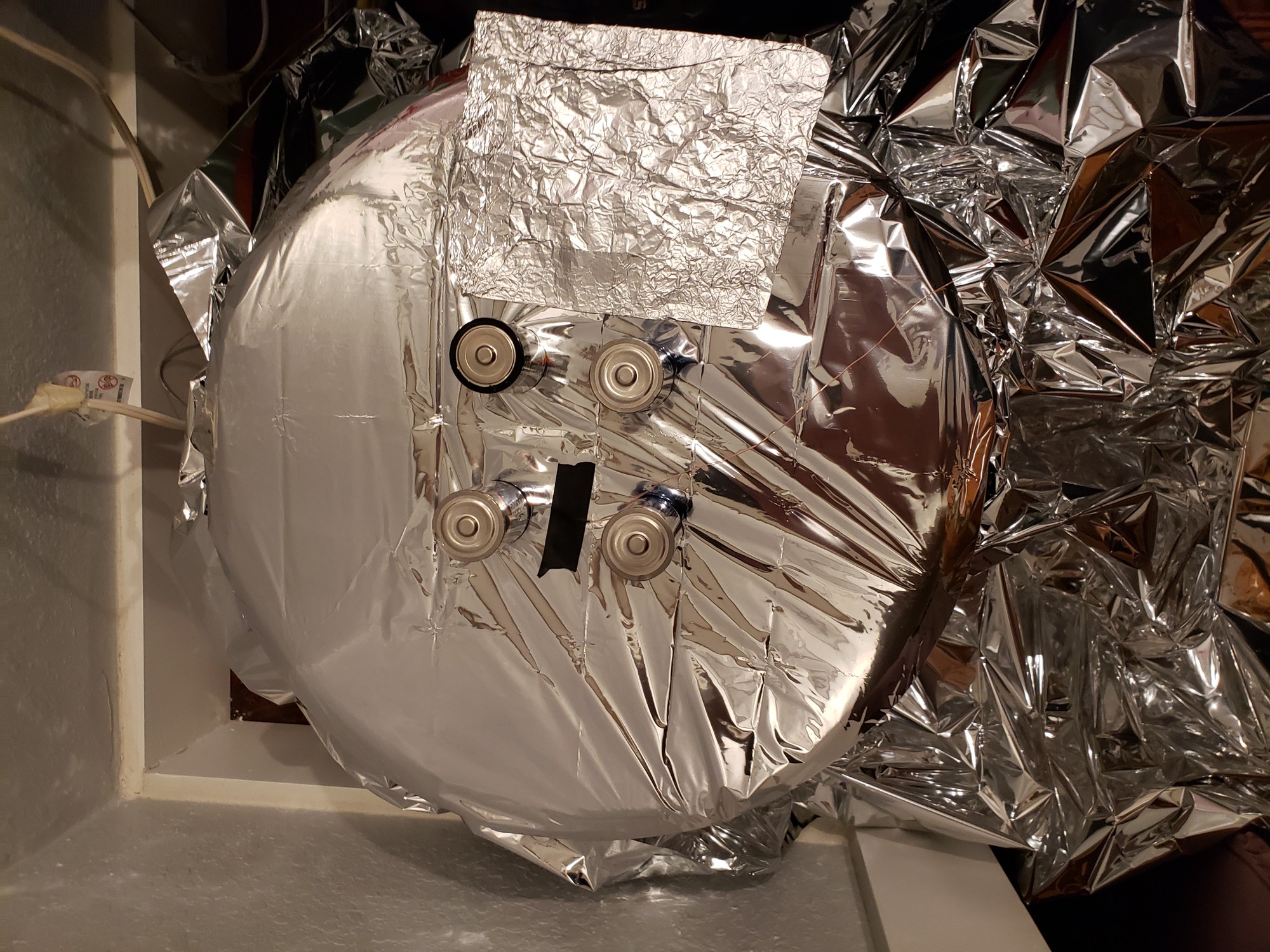
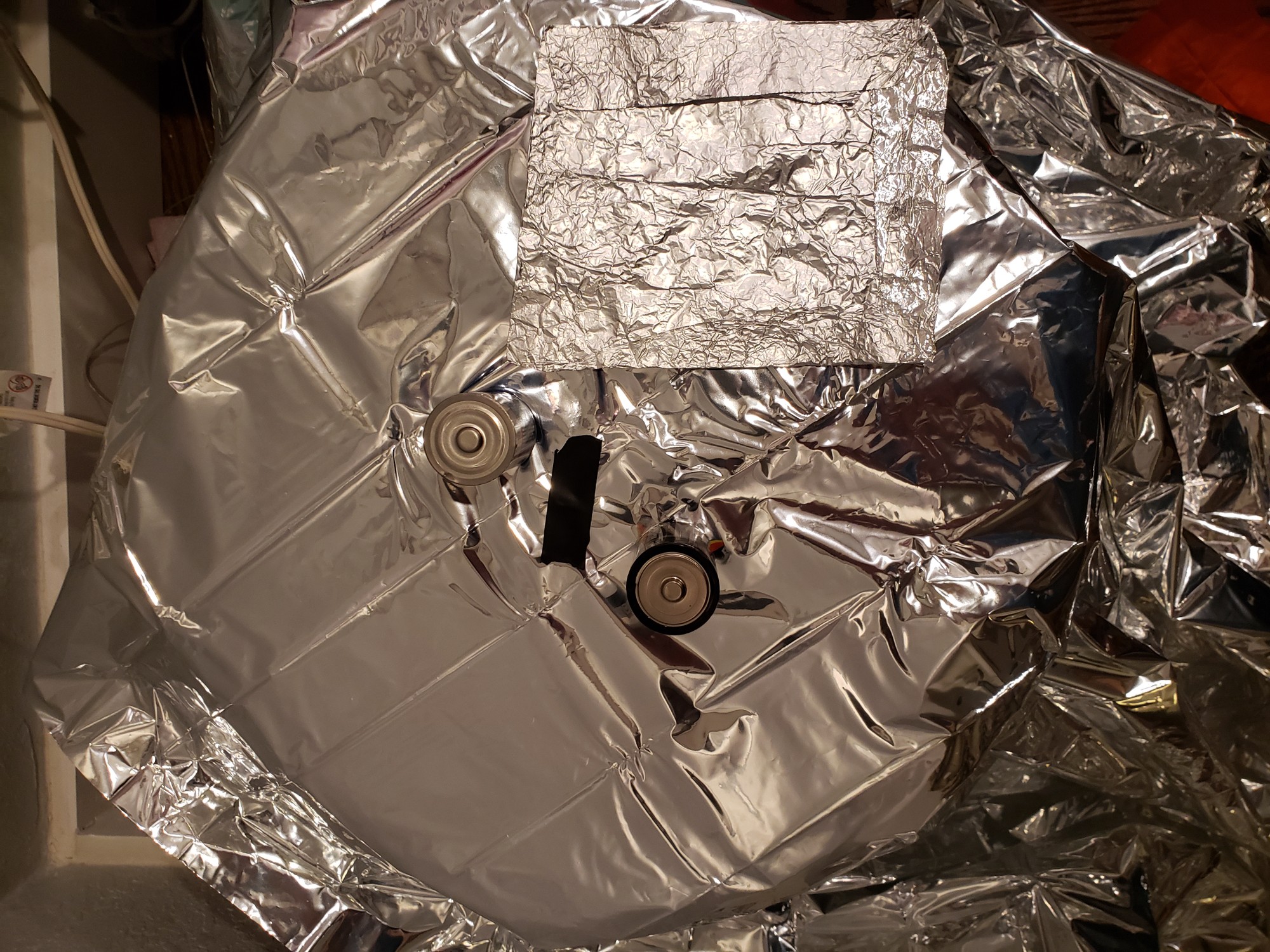
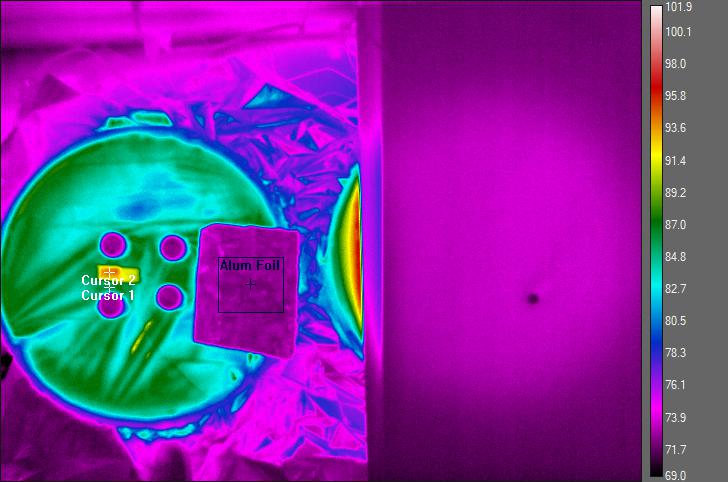
To test them, I mounted the space blankets on a permeation kettle with water heated to 120 F (48.9 C), while the room ambient is around 72 F (22.2 C). Visual inspection shows that both materials have the same appearance. With a thermal imager, a qualitative comparison is simple: A highly reflective object will show the ambient temperature when observed through the thermal imager. To that end, a piece of crinkled aluminum foil is placed on each space blanket. If the infrared image appears warmer than the aluminum foil, then the emissivity is too high for effective blanket performance. We see from the images that the Field and Stream blanket material is not a great reflector.
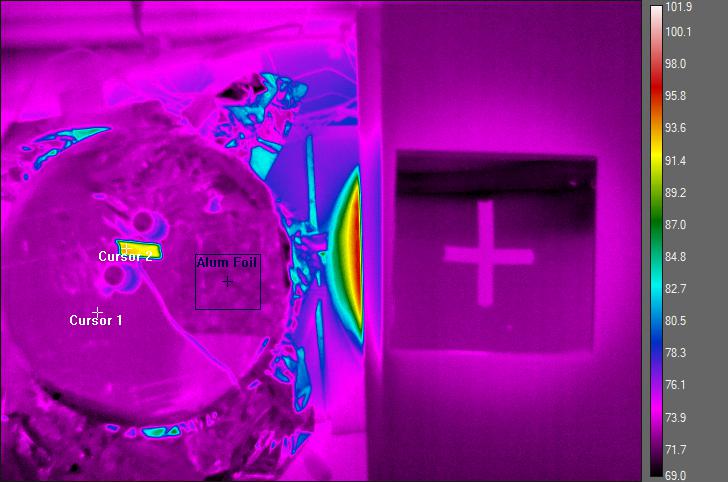
However, we see that the apparent blanket temperature of the SOL material matches the apparent temperature of the aluminum foil. Thus, the SOL blanket will be the better reflector and can be expected to provide good performance.
When we measure the emissivity in 8-12 microns, we find the emissivity of the Field and Stream blanket is 0.64, and the SOL emissivity is 0.13. Therefore, the SOL blanket is a much better reflector.

How to Use the SOL Survival/Emergency Blanket
Both sides of the Field and Stream blanket have a similar finish. The SOL blanket has an orange foil appearance on one side and silver on the other. This is seen in the following image:
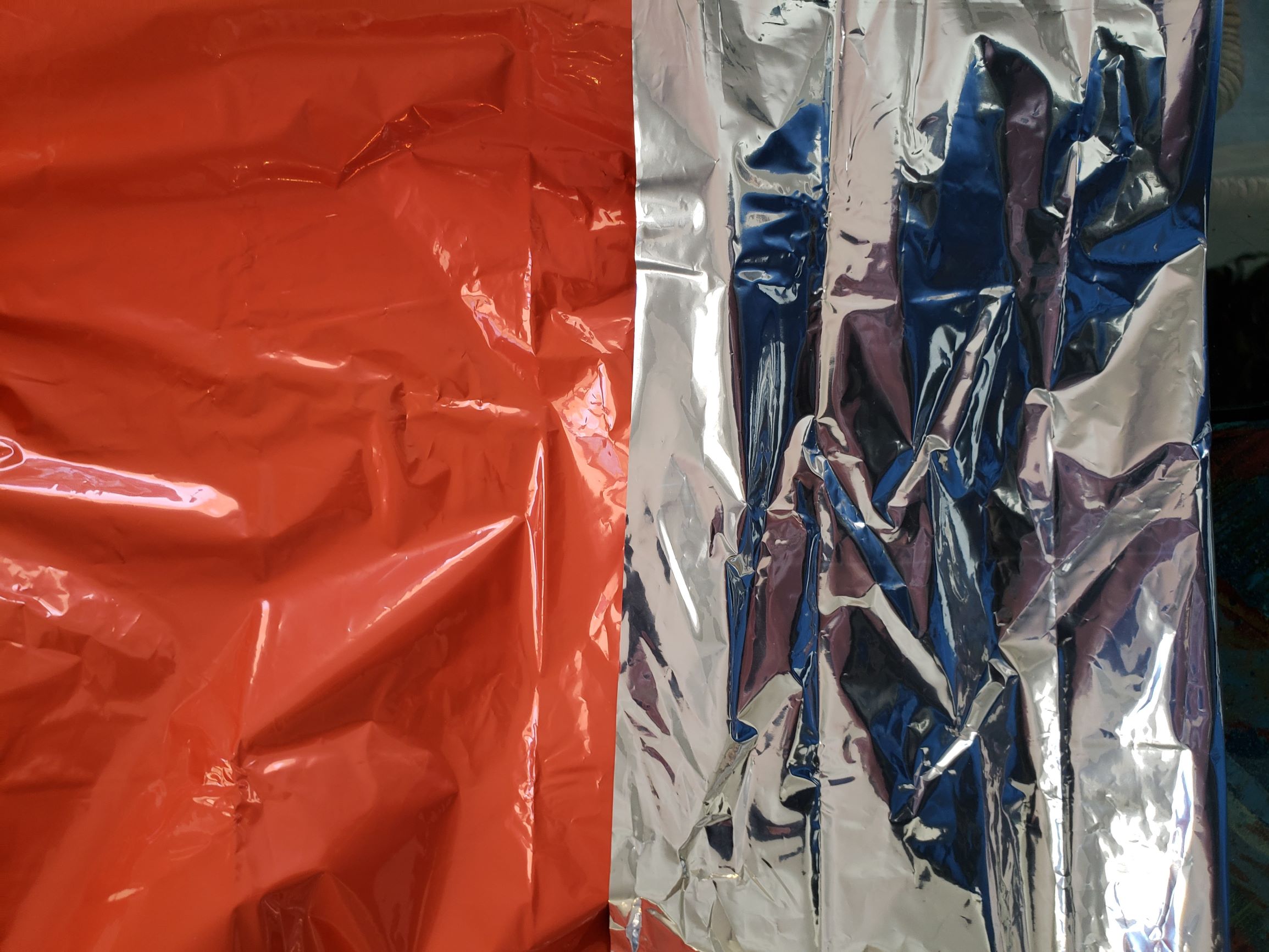
The measured emissivity of the orange side is similar to that of the Field and Stream Blanket. So, the orange side is a poor reflector, compared with the silver side.
I suggest, when using the SOL blanket, the silver (shiny) side should face the ambient (outside) environment. This will provide the lowest possible radiant heat transfer. The product photograph on the package shows two people huddled together wrapped in the blanket with the orange side out. One clear advantage of the orange side out is that visibility is improved if someone is searching for you. A minor benefit of using the blanket with the orange side out is the absorption of some solar gain. However, since the orange side is still somewhat reflective, it may take some very strong sunshine to feel its heating effect.
Never use a space blanket under another layer (unless you want it to function as a vapor barrier). A layer placed over the space blanket would eliminate most of the reduction in radiant heat transfer.
Related Content
- More by Stephen Seeber.
- Read Rex Sanders’ interview with Stephen for the Standards Watch column.
- In the forums: Should I Bother With a Space Blanket?


Discussion
Become a member to post in the forums.
Companion forum thread to: By the Numbers: If You Carry a Space Blanket, Buyer Beware
Stephen Seeber tests the infrared reflective properties of space blankets.
thanks, that makes sense
funny how the two look the same in visible light, with our eyes, but they have different reflectiveness in IR
I wonder how that equates to R value. What R value of regular insulation will give the same warmth as the space blanket?
And then, what is the R value per ounce? Compared to down and synthetic.
What is the volume required?
That’s very interesting! I really like those SOL blankets for groundsheets as well – they’re surprisingly durable, more so than window film in my experience. Totally different from the crinkly space blankets of old.
Thank you, Stephen.
I had one of the SOL blankets tested. Like Erik, I also found it tough and durable. However, after storage for some time (~1 year) folded up, it stuck to itself so badly that peeling it apart ripped loose the orange coating. Messy enough that I tossed it. Maybe a disposable item.
does NASA put their space blankets shiny side out on their space suits?
But which one prevents aliens from reading my mind?
The space blanket itself will have an R-value of approximately zero. That’s not what you asked, but it’s important to understand that an R-value relates to conductive heat transfer and characterizes heat loss (Q) as proportional to the temperature difference between two points: Q ~ (T1 – T2). For the particular case of a typical R-value rated material, Q = (1/R)*(T1 – T2).
How much a space blanket reduces heat loss from your body depends on the temperature(s) and properties of the surfaces “seen” by the space blanket and the view factor(s) between the blanket and those surfaces. Are you facing a clear night sky (effective temperature very low), a cloudy night sky (temp not so low), or the leaves of the trees overhead (effective temperature close to ambient air)? Further, radiant heat loss is proportional (in complicated ways) to the difference between temperatures raised to the 4th power: Q ~ (T1^4 – T2^4).
R-value is just not a good metric to characterize these things’ performance.
yeah, exactly Todd
but at some particular condition, the space blanket will reduce heat loss by some number of watts
and there’s an R value of insulation that would reduce heat loss by the same amount. That would be interesting to know
maybe two conditions – under a clear night sky, and under cover (clouds, tree, or tent – I think those would be similar)
or, another way to tie radiative heat loss to reality would be how many degrees colder would you be comfortable, or survive
a space blanket also reduces heat lost to wind or evaporation – it’s complicated
I’d think it’s more of a continuum. What if you’re camped next to a tree that blocks about half your view of the clear sky? Or a quarter. Or 81.7%? As someone said above, “it’s complicated.” :-)
yeah, that’s why two cases are good, zero cover and 100% cover
then reality would be somewhere between those
Excellent article. I have often wondered about such things. I was surprised that the SOL blanket was considered more effective with the silver side out, orange side in. I use one of those as a simple lean-to shelter in good weather. I will reverse my color scheme.
thanks… Jim
IR reflective materials, when used in clothing or, in this case as a blanket, require an air gap between the skin and the ambient to perform correctly. If the space blanket is in contact with the skin, no IR reflection can occur and convection/conduction will take over as the predominant modes of heat loss. But if the space blanket is worn over clothing or as a layer within clothing, it can work rather well. It was a few years ago and I don’t remember the exact results but when our lab tested IR reflective materials on a guarded hotplate they found that having at least a 0.25″ air gap between the skin and the environment was necessary to generate any kind of reduction in radiant heat loss rates.
Maybe I’m missing something, but if the silver side of the SOL blanket is more reflective than the orange side, wouldn’t you want that to face the warm body that is emitting the IR, i.e. inwards, rather than the ambient (outwards)? You’d want the more reflective side facing out in a hot environment, e.g. desert with no shade…
I understand the difference between the two products being significant, especially if they cost the same. It seemed the F&S was still successful at reflecting some of the heat though. If the scale on your images is an indication, you mentioned the kettle is at 120, while the ambient is 72. The temp in the image with the F&S blanket looked to be in the 82-85 range, only a little higher than ambient. You didn’t show the control image, which I assume would have shown a bright red 120F kettle in the middle. Furthermore, you mention a good air gap between the blanket and the hot body is required for good performance. What was the air gap used for this experiment?
Would the F&S (or Walmart brand, in my case) be more effective than nothing, and if so, by how much? Enough to warrant keeping it around rather than going out and buying an SOL blanket (nice name, btw). These are after all, survival tools, not typically items I am going to use frequently, as as such am less interested in what seems like a relatively minor difference in performance from a survivability stand point (72f vs 82-85f with a 120f hot body). A human body is not 120F, so it is safe to say that the differences between blankets will be less noticeable with a colder hot body.
Also, as was already asked, why would you place the foil side out rather than in, if the intention is to reflect heat back to the person wearing the blanket. Seems counterintuitive.
“wouldn’t you want that to face the warm body that is emitting the IR, i.e. inwards, rather than the ambient (outwards)?”
+1 to that.
On that note, with the blankets stretched on top of the kettle, isn’t the emitted energy we’re observing through the thermal camera a result of conduction through the material?
interesting – Dave answered the question then Ken and Michael asked it, usually, people answer questions after they’re asked : )
Neo air mattresses have a reflective layer inside with air spaces on both sides, that works best
I think one of the SOL products has several layers of reflective material with elastic to create internal air layers
The SOL package shows the person wearing it with the orange side out. I’ve measured crudely and both sides were about equally effective. If I wanted SAR to find me and I was in the open, I’d put the orange side out, otherwise the foil side out because it may be more effective.
They give out space blankets to runners after a race, and to refugees being rescued, so they must be somewhat effective
I think a useful analogy is like if you have a light bulb, it’s hot. You can see the visible radiation and there’s also IR. If you put a space blanket on, it becomes dark. It quits radiating heat away.
Jerry, this forum is weird in that when I replied, for whatever reason, Dave’s response and subsequent ones were not shown. I am not certain what that is all about, but it has happened several times in other threads for me also.
Great string of information and comments. There are so many possible variables that the “correct” answer for any particular situation may still be a bit ambiguous. I find these sorts of articles very useful. Thanks,
^^^
“They give out space blankets to runners after a race, and to refugees being rescued, so they must be somewhat effective”
Or the marketing has been effective.
They would deflect the wind/breeze to reduce evporative cooling, but in direct contact with back, shoulders and arms would provide no radiant loss mitigation. If were sunny a black garbage bag might be more effective.
Michael, maybe it has something to do with the changes in site software, we should expect weirdness
I like your skepticism Greg : )
I think the analogy of a hot lightbulb radiating heat is good. When you put a space blanket over it it no longer radiates away heat like that.
I’ve carried a space blanket around for decades. Never used it. I’ve opened it up enough to verify it’s not sticking to itself, ready to shred into strips. I forget what brand. Pre SOL.
Some additional math for the party:
https://openoregon.pressbooks.pub/bodyphysics/chapter/space-blankets/
Just curious…..would using a space blanket hinder SAR because it would block or lessen thermal imaging?
That’s really good, thanks Mark
“Chapter 93 SPACE BLANKETS”
Oh no, you’ve just given me days of reading material. 93 chapters????
“Space blankets reflect the electromagnetic radiation emitted by your body back to you, rather than letting it escape, thereby reducing the rate at which your body loses thermal energy to the environment.”
No, it doesn’t reflect back, it just prevents you from radiating, but that’s okay, this is just an analogy to help us humans understand. No reason to argue about this : )
“Therefore the space blanket saves you 200 W of radiative heat loss and 1100 W of convective heat loss, leaving only the 160 W of conductive heat loss.”
That’s an answer to my question. What is the real world effect?
By far, in this example, the biggest effect is it stops convection – the wind blowing away heat. A sheet of plastic would do that just as well.
A body generates maybe 200 W of heat if you’re a little active (MET = 2). If the space blanket prevents 200 W of heat loss that’s significant.
160 W was lost due to conduction. Calculated in previous chapter. I don’t know what clothing was worn for that example. But, in this case, with the space blanket eliminated radiative heat loss, you may actually be warm.
Become a member to post in the forums.