


Introduction
The purpose of this article is to present three ultralight water treatment options for backpacking. We chose these three for their diversity and efficacy, and they include a chemical method, a physical method, and an electro-ultraviolet method. We included a video to show each of the three technologies used in the field.
Based on the results of my most recent analysis of internet keyword searches, paid advertising buys from manufacturers, and interviews with industry contacts who work for outdoor gear distributors, the most popular water treatment option among backpackers is still the pump-style water filter. Two of the lightest examples include the Katadyn Hiker (11 oz) and the MSR Hyperflow (8 oz).
The problem with pump style water filters is that they’re relatively heavy, they’re sort of difficult to clean, and they clog easily. And of course, it requires a bit of work to pump the water and prepare it for drinking.
So I’m going to talk about three methods of what we might consider ultralight water treatment: Aquamira, squeeze filters (Sawyer and BeFree), and the Steripen Ultralight.
Aquamira
The one that’s probably the most popular among the hardcore ultralight crowd is a chemical treatment known as Aquamira.
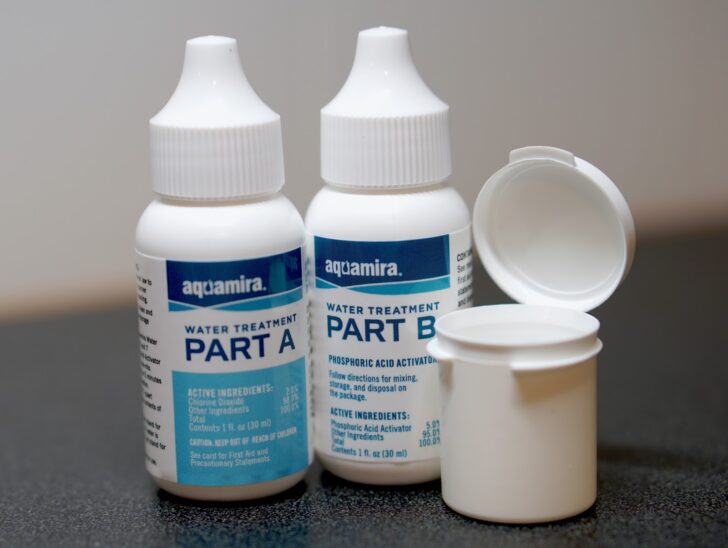
Aquamira is a chlorine dioxide-based water treatment chemical kit. It consists of a 2% chlorine dioxide solution (part A) that is activated by phosphoric acid (part B). The resulting activated solution acts as a water disinfectant by interrupting nutrient transport across cell walls and membranes.
How it works:
- Mix a few drops of part A with a few drops of part B (typically seven drops of each per liter of water you want to treat) in a small mixing cup.
- Wait five minutes for the solution to activate – it turns bright yellow. It may take a little longer in cold temperatures.
- Once it’s active, then you can pour that solution into your water bottle, and then wait 15 to 30 minutes before the water is ready to drink. Longer times are required for cold water, turbid water, or to inactivate cryptosporidium cysts.
The key advantage of Aquamira is that it’s compact, lightweight, and has a long shelf life (typically about four years).
The key disadvantage of Aquamira is that it does take up to 30 minutes to get clean water. And for some types of protozoan cysts like Cryptosporidium, the treatment time is around four hours.
Aquamira Notes and Tips:
- Chlorine dioxide is highly effective against Giardia and less effective against Cryptosporidium. If you suspect that your water source is contaminated with the latter, consider combining Aquamira with a filtration method (below) or use a Steripen.
- Aquamira dosing can be halved (3-4 drops per liter each of parts A and B) if you double the treatment time to 30-60 minutes. Likewise, dosing can be doubled (14 drops per liter each of parts A and B) if you need water fast (8-15 minutes). This principle is known as Chick’s Law and is a bedrock principle in water disinfection.
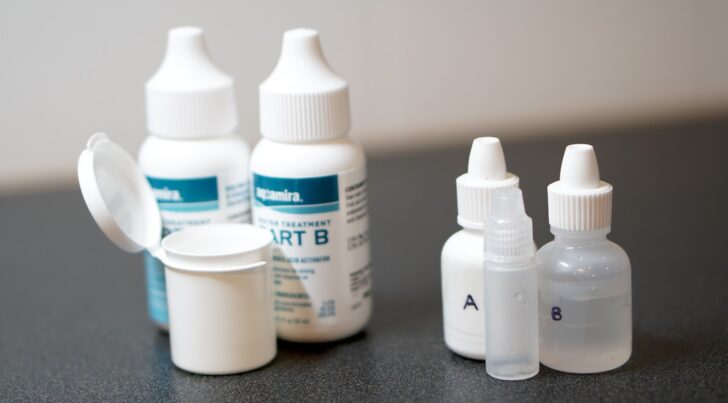
- The newest (since summer 2020) 1-oz Aquamira kits now ship with a closeable cap – this is useful for backpacking! If I know I’m going to walk over a creek soon, I can create my premix, stow the cup in my pocket, and then it’s activated and ready to pour in my bottle by the time I reach the creek.
- For shorter trips, repackage Aquamira parts A and B into smaller dropper bottles, but be aware that drop size in your new bottles may be different than drop size in the stock bottles, which could affect dosing.
The Squeeze Filter (Sawyer, BeFree)
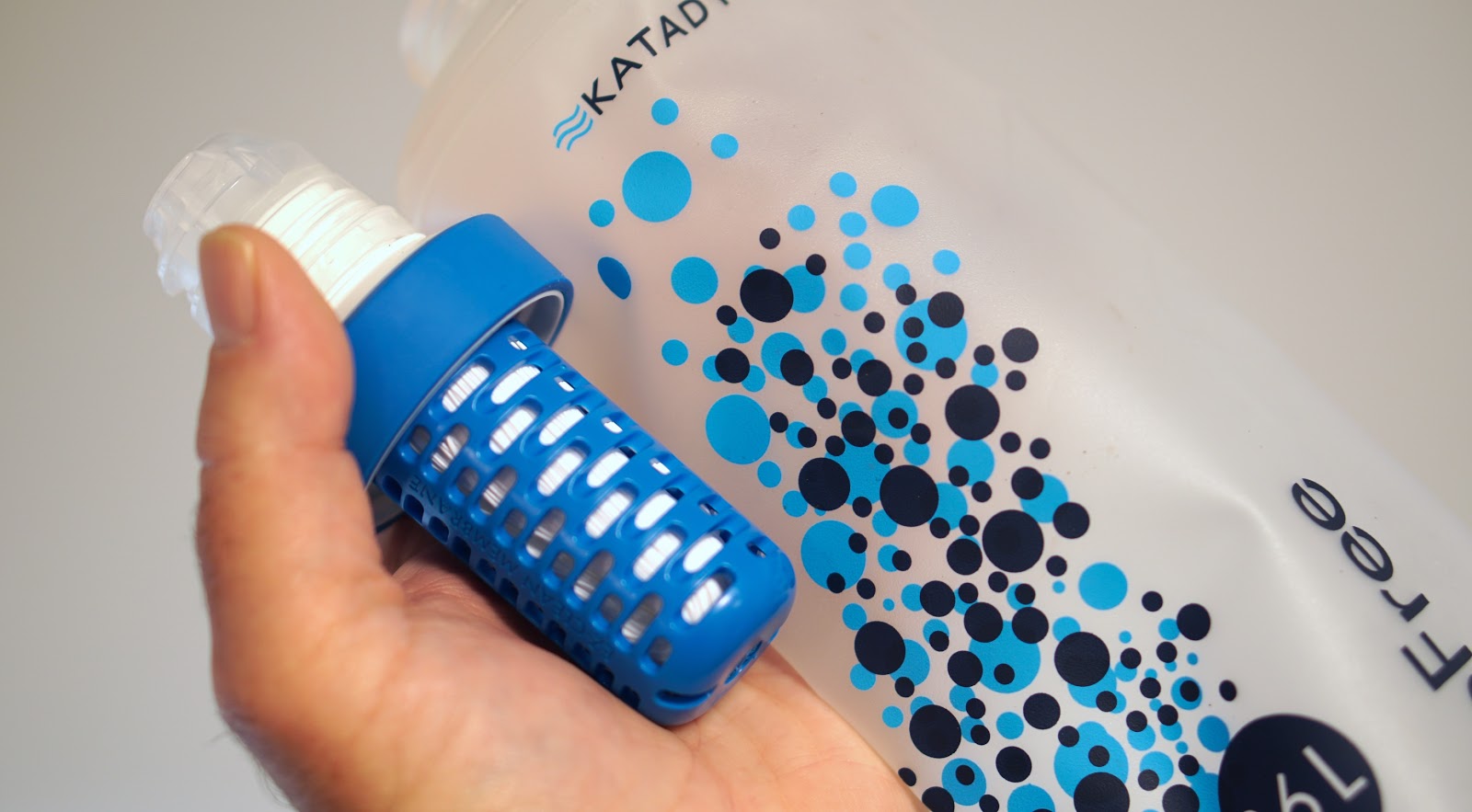
The second ultralight treatment method is a lighter version of a pump-style water filter – the squeeze filter. Instead of a pump, you attach a squeeze filter to a soft or otherwise semi-flexible water bottle and squeeze the bottle to push the water through the filter. Or, you can suck water through the filter, but that requires more effort.
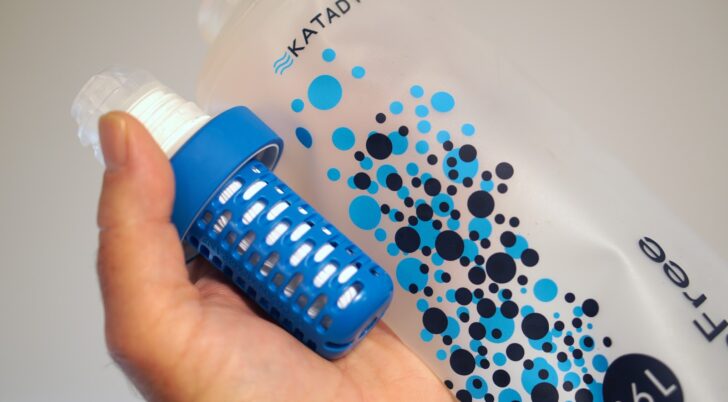
There are two popular types of squeeze filters: the Sawyer Squeeze and the Katadyn BeFree. You can attach a Sawyer Squeeze directly to a Smartwater bottle. This option is popular among thru-hikers. The Katadyn BeFree filter is compatible with HydraPak bottles (like the new HydraPak Flux), making it adaptable to a variety of bottle shapes and sizes.
The flow rate of squeeze filters is relatively fast when compared to pump filters and straw filters. So unlike some of the earlier straw filters and other bottle filters, you don’t get cheek fatigue caused by sucking through a slow-flow filter.
Squeeze filters are one of my favorite water treatment solutions because I get drinkable water right away. If I know I’m going to be in an area where there’s a lot of water, I don’t have to pack any water at all in my backpack. I can just take my squeeze bottle, dip it whenever I reach a stream or lake, and hydrate at those locations.
If you need to carry more water in your pack and you’re using a squeeze filter system, then you can just take a dirty water bottle as extra water storage. When it comes time to drink, and you’re away from a water source, you can pour the dirty water into the squeeze filter bottle and then drink through the filter.
Alternatively, if you want to keep a water bottle as a clean water bottle and don’t want to drink through the filter, you can filter the water through the filter into your clean water bottle and then drink straight from the clean water bottle when convenient.
Squeeze Filter Notes and Tips:
- Flush a solution containing a few drops of chlorine bleach in a liter of water through the filter before storage. This minimizes bacterial growth in the filter, which can cause pore clogging. If you’re on a long trip, do this every couple of days.
- Make sure water is expelled from the filter before you go to bed at night, and store the filter in your sleeping bag if you expect freezing temperatures. Water turning into ice in the filter could cause damage to the filter membrane.
Steripen
The third option I want to discuss is an ultraviolet (UV) light pen, specifically the Katadyn Steripen Ultralight.
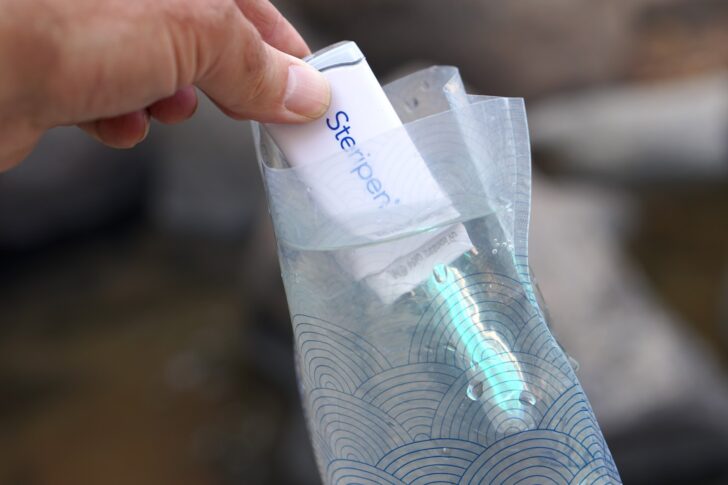
Ultraviolet light disinfects bacteria, viruses, and protozoa. And it’s very effective against all three, and it works fast. Water only needs to be exposed to this lamp for about 60 seconds to be purified. UV light works by damaging DNA inside a cell, which prevents it from replicating. So even if you ingest live pathogens, they won’t be able to reproduce in your body to a level that causes a gastrointestinal infection.
Of course, the disadvantage is that it’s a battery-operated electronic device and is subject to all the failures of such devices when you’re in the backcountry. The Steripen Ultralight is USB rechargeable. I carry a battery pack on longer trips so I can recharge the Steripen (as well as my headlamp, smartphone, and inReach Mini). But generally, the internal battery of the Steripen Ultralight remains charged for 3-7 days, depending on how often I’m using it.
When I use a Steripen, I have an old Platypus bottle that I repurposed as a dipping and treatment cup. It’s very light (< 0.5 oz!) and folds flat, so I can keep both the Steripen and the old Platy cup handy in my accessory pouch without taking off my pack.
One of my favorite features of the Steripen Ultralight is its automatic switch. It turns on automatically as soon as you dip the Steripen’s lamp below the waterline of your treatment container. There are two metal contacts there. As soon as water touches both of those contacts, the lamp turns on. Treat the water for 60 seconds (a built-in time shuts off the light automatically), and it’s ready to drink.
The other thing I like about the Steripen Ultralight is that because this is such a compact device with a short lamp, it works great in solo-size cooking mugs. I use it regularly with my Vargo Ti Bot 700 and MSR Titan Kettle.
Steripen Notes and Tips:
- In cold temperatures, keep the Steripen inside your jacket and sleeping bag to prolong battery life.
- Make sure the USB port battery door is secure to prevent water entry into the port.
- If you regularly use store-bought water bottles like Smartwater, use the Steripen Ultra instead of the Steripen Ultralight. The Ultra is designed specifically to be compatible with narrow-mouth water bottles.
Summary
The following table summarizes each of these three treatment methods.
| Aquamira | Katadyn Befree | Steripen Ultralight | |
|---|---|---|---|
| Weight | 3.0 oz (88 g) | 2.1 oz (60 g) | 2.6 oz (74 g) |
| MSRP | $15 | $40 | $90 |
| Key Advantage | small size | fastest | most effective |
| Key Disadvantage | slowest | bulkiest | most expensive |
Facebook Live Q&A
October 17, 2020:
Where to Buy
Use our GearFinder Search Engine to shop for the best prices on Aquamira, BeFree, Sawyer Squeeze, or the Steripen Ultralight at online retailers.
Related
- Review: Katadyn BeFree Filter
- Review: Hydrapak Flux Bottle
- Skills: make your water treatment process more efficient on the trail with an accessory pouch
DISCLOSURE (Updated April 9, 2024)
- Product mentions in this article are made by the author with no compensation in return. In addition, Backpacking Light does not accept compensation or donated/discounted products in exchange for product mentions or placements in editorial coverage.
- Some (but not all) of the links in this review may be affiliate links. If you click on one of these links and visit one of our affiliate partners (usually a retailer site), and subsequently place an order with that retailer, we receive a commission on your entire order, which varies between 3% and 15% of the purchase price. Affiliate commissions represent less than 15% of Backpacking Light's gross revenue. More than 70% of our revenue comes from Membership Fees. So if you'd really like to support our work, don't buy gear you don't need - support our consumer advocacy work and become a Member instead.
- Learn more about affiliate commissions, influencer marketing, and our consumer advocacy work by reading our article Stop wasting money on gear.


Discussion
Become a member to post in the forums.
@matthew: Let’s try this a different way: does anyone have a Steripen Ultra handy? I’m curious about the min/max diameter of the tapered part.
Try shooting Greg Mahalik a PM. I’m pretty sure he uses one.
@Cameron: I just drop it into a 550 ml pot. No need to seal it to any bottle.
Are you saying that you purify in the pot and then transferring the water to a regular bottle? Or are you drinking and cooking only at water sources?
@Roger: If we need to stop to take on water in the middle of the day – which is pretty rare anyhow….
Carrying all your water for the day sounds pretty heavy. Am I missing something?
Of note, REI has Steripens on sale through Nov. 23. Ive never gone that route and with Katadyns poor service likely never will.
Katadyns service this PM answered a question concerning the charging time of the SteriPen in a 3 hour return. Past issues may have been addressed as mine today is just one.
Mathew, the Steripen ultralight is rectangular. Unless you can find a rectangular bottle, it will not seal in anything I know. No, it does not fit in a Gatorade bottle, Steripen is too wide. It is 34 x 20 mm. I use a cut off Sawyer blue bag for the light cycle, 1 liter, then pour it into whatever container I am using.
Thanks for the lead Dondo!
the widest portion is at the very base of the unit (not really a diameter as the shape is rectangular) is 1.4″, the narrower potion is right before it goes into the UV light portion is 1.1″
There may be a little confusion. It sounds like Mike and Arthur have the ultralight. I think matthew was referring to an older model, the Ultra, which can fit standard water bottles and (hopefully) his Gatorade bottle.
Are you saying that you purify in the pot and then transferring the water to a regular bottle?
That is what I do anyhow.
@Roger: If we need to stop to take on water in the middle of the day – which is pretty rare anyhow….
Carrying all your water for the day sounds pretty heavy. Am I missing something?
Probably.
For most of the year (bar summer), for the two of us, I carry one Rocket-base PET bottle of 1.25 L for the whole day. We drink close to half that as morning coffee around 10 am. We drink very little for the rest of the day and would usually still have water in that bottle when we stop to camp. That’s us. For the two of us, that is not all that heavy.
Now if it is mid-summer and >35 C then different behavior results. In fact, under those conditions we are more likely to be at home in the shade! But if we are out on a long trip and it heats up, then we modify our route to ensure we have access to water by lunchtime. I try to not carry a lot.
In alpine areas here I can always find water. In the local mountains near Sydney you can NOT find water except in the rivers. Creeks may well be dry. Only if we need to camp high (dawn is great on top of a mountain) will we carry about 5-6 L up to the top, but that ensures we can have a good time. In fact, 6 L would allow us to have dinner, breakfast and morning tea before we need to find water.
I realise that for many people, that sort of water consumption might not be possible. It has taken us a few years to train our bodies.
Cheers
Roger, it sounds like our water consumption in camp is similar. 2.5 L is enough water for me for a dry camp. I’ve never really kept track of my consumption on the trail but I know it’s a lot more than .625 L a day. Most days, I’ll fill my .5 L or .75 L bottle several times while hiking, drinking some of it at the source and carrying the rest. I prefer hiking to futzing with gear, so my set up is designed for minimal fuss.
We drink well at breakfast, and drink well at dinner time too. It’s more a matter of being UL and not carrying much water during the day.
See: I managed to get back to discussing UL!
Cheers
Roger wrote:
“I realise that for many people, that sort of water consumption might not be possible. It has taken us a few years to train our bodies.”
Many years ago I lived and played in and around the Mojave Desert of Southern California. I didn’t carry or drink much water during the day. But after decades living on the much damper Central California coast, I was carrying and drinking 4 liters per day in moderate weather. Decided to cut back.
Now I can hike most days starting with just 1-2 liters of water, consuming about 3 liters in the evening, including dinner and breakfast. Carrying less water weight is really nice.
Seems odd that human bodies can adapt to a wide range of water consumption. But many of us can, with a little effort. I am not a doctor, do what works for you, don’t go outside or you’ll die, …
On topic – I carry the smallest BeFree plus some ClO2 tablets as backup. So far I’ve never used the tablets. Works well for me.
Lots of choices. Make one and go backpacking. There is no one perfect water treatment for everyone and every trip.
— Rex
One aspect of water consumption is psychological. Many people fear the very thought of ‘dehydration’ but do not understand what this means. So as soon as they have a dry mouth, they think they are dehydrated and drink – usually from a bite-valve. At this stage they are nowhere near being dehydrated: they just have a dry mouth because they have been breathing (panting) through their mouth.
A USA military test many years ago took a group of trainee grunts (poor guys!) and marched them into the desert. They were kept marching, without water, until they started to drop. (Yes, they were volunteers.) Behind them was a full support contingent. As soon as each one dropped he was given water and monitored for recovery. I forget the exact details, but think that every one recovered in 15-20 minutes to full fitness. There were no after-effects.
I am not suggesting anyone should go to this extreme of course. I am suggesting that most walkers who think they are getting dehydrated are a long way from that state, and would do a lot better if they just shut their mouths and moderated their pace so they were not panting.
Going UL in your walking does not mean you have to have the very latest lightest (and most expensive) gear. But it does mean you should do a lot of thinking about what you are doing. Machismo has no place when handling extreme conditions.
Cheers
Yep. Sometimes.
On the other hand, every year several people die on the local desert trails where I live because they didn’t take enough water. Better to have a too much, than too little, don’t you think?
Ahhh- didn’t know they had an Ultra prior, correct mine is the Ultralight
Sorry, did not read the post closely and got confused on the 10 different types of Steripens.
Once you have had a kidney stone, the dehydration methods described above are a hard sell.
Hi Nick
On the other hand, every year several people die on the local desert trails where I live because they didn’t take enough water. Better to have a too much, than too little, don’t you think?
From what I have read, it may be a shade more complex than that.
I believe people have collapsed from dehydration while walking the Grand Canyon – despite having full water bottles. They did not know their own bodies well enough, and were not drinking when they should have. I could imagine novices having the same problem in the desert.
So yeah, it is not simple.
Cheers
don’t do what Roger suggests, people. Drink more water. Look it up.
that said, where I hike water is readily available. I almost never carry water. Far too heavy.
I remember once seeing a group come in to a camp and unload bags of water from their packs. They’d hiked the same trail as me. The trail followed a river for most of the way. Go figure.
I don’t think there’s such a thing as adapting to needing less water. I would call that “getting used to losing strength and endurance due to drinking less water”.
A few quotes from this on the NIH site: https://www.ncbi.nlm.nih.gov/pmc/articles/PMC2908954/
“getting used to losing strength and endurance due to drinking less water”.
Considering the number of 2 and 3 month long walking trips we have done in Europe and the number of hard extended walks and ski trips we have done in Australia, I have to call BS on this. I suggest it depends more on whether you still bother to get up and go.
To be sure, search the web for info on drinking. A name to include is Noakes, from SA. In particular, I will call total BS on those who claim we need 8 pints a day. People have died from drinking too much water: it unbalances the whole body.
Cheers
“People have died from drinking too much water…
Cheers”
I’m going out on a limb (NOT!) and suggest that when it’s 80% F and you’re climbing 2-3,000 feet (American) to a pass at 12,000 feet, you will NOT die from drinking too much water if you drink down a liter or even 1 and a half liters (gasp!) over three hours. You WILL become at least somewhat dehydrated if you do what Roger suggests and drink nothing at all during this ascent and for the next 4 hours or more.
Roger and I have had this conversation before. He always ends up claiming that people die from drinking water while backpacking. I always claim that not drinking enough water is far, far, far more common among hikers.
If it’s warm to hot and you’re climbing to a pass at altitude, DO NOT worry that you will die if you drink some water. Drink the damn water.
If it’s warm to hot and you’re climbing to a pass at altitude, DO NOT worry that you will die if you drink some water.
Fair enough.
Although 80 F is not that hot for us.
Cheers
Knowing your body is important. On most trips with other people I drink 1/2 as much water most of the time. But there are days I need more. Probably a combination of multi-day exertion, how well I have been sleeping, what I have eaten, etc. The important thing is knowing when to drink. In hot weather I usually stop once an hour to drink and I do stop. I never just keep walking and try to drink as I go — it is just a preference for how I operate.
In cooler weather I may not drink for 3 or 4 hours while hiking. Such as today. It was around 90F and I did a four hour hike with a camera backpack that probably weighed 10 lb. Didn’t drink at all until I got back to my truck.
As far as “adapting” goes . . . I have lived in an extremely hot desert for over 40 years. I spend a lot of time outdoors and worked outdoors in hot weather for many, many years, To me, hot is 117F – 125F. And yes, over the decades I have adapted, which is why I usually consume much less water than my hiking partners. I have gotten dangerously dehydrated 3 times. The first two times over 40 years ago were my learning experiences. The third, about 7 years ago was poor planning on my part and unexpected high temperatures. On this last trip, I knew my limits and could have stopped and rested in the shade for a few hours and then continued to my water source at night, but I knew I could make it to the source without water with some discomfort, but I also was cognizant that I might need to stop and didn’t force march to water.
Thus when someone asks how much water they need on a certain route, it is impossible to provide a good answer, unless the question simply involves, “Where are the water sources.” It is my opinion that too much water trumps not enough, especially in deserts. Water is not an item to try and save weight.
Water is lost through respiration, perspiration, and metabolism.
Metabolic water loss – we generally ignore that, it’s not terribly significant or sensitive to cold vs hot environments.
Respiration is a function of humidity, the HR%AeT at which you are exerting yourself, and temp. If you’re working hard, you’ll exhale something on the order of 50-80 ml/hour. Not a lot.
Perspiration – that’s where the magic happens, and this is where you’ll lose a ton of water. On the order of 10X what you lose from respiration – 500-1500 ml/hour is within the realm of reason.
And this is where adaptation is possible. Note Nick’s experience, being a regular desert-hiker – heat tolerance – reduces perspiration dramatically. Nick may only lose 500 ml of water an hour while hiking fast in hot temps, I may lose 1000 ml.
I find that on long desert treks, I experience noticeable heat adaptation (less sweating) after 5 to 7 days.
”Perspiration – that’s where the magic happens, and this is where you’ll lose a ton of water. On the order of 10X what you lose from respiration – 500-1500 ml/hour is within the realm of reason.”
Not just perspiration, but through evaporation and whatever mechanism you call it. I make this point clear because you don’t have to sweat to lose water. It’s called insensible water loss, and it’s what we lose to the environment each day.
Worse in the desert of course!
Good point @ogilybogil – insensitive perspiration should really be considered another category altogether.
Here’s one of my favorite articles on water balance:
Of course, sweat is included here, but the 450 ml/day = ~20 g/hr is more in line with what you lose to truly insensible (non-sweat) perspiration (evap through dermal layers).
Another fun one here.
Become a member to post in the forums.