


Introduction
The purpose of this article is to present three ultralight water treatment options for backpacking. We chose these three for their diversity and efficacy, and they include a chemical method, a physical method, and an electro-ultraviolet method. We included a video to show each of the three technologies used in the field.
Based on the results of my most recent analysis of internet keyword searches, paid advertising buys from manufacturers, and interviews with industry contacts who work for outdoor gear distributors, the most popular water treatment option among backpackers is still the pump-style water filter. Two of the lightest examples include the Katadyn Hiker (11 oz) and the MSR Hyperflow (8 oz).
The problem with pump style water filters is that they’re relatively heavy, they’re sort of difficult to clean, and they clog easily. And of course, it requires a bit of work to pump the water and prepare it for drinking.
So I’m going to talk about three methods of what we might consider ultralight water treatment: Aquamira, squeeze filters (Sawyer and BeFree), and the Steripen Ultralight.
Aquamira
The one that’s probably the most popular among the hardcore ultralight crowd is a chemical treatment known as Aquamira.
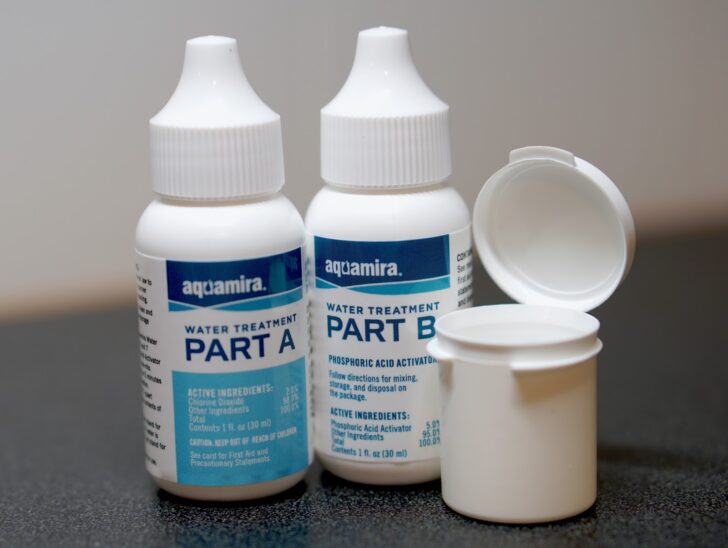
Aquamira is a chlorine dioxide-based water treatment chemical kit. It consists of a 2% chlorine dioxide solution (part A) that is activated by phosphoric acid (part B). The resulting activated solution acts as a water disinfectant by interrupting nutrient transport across cell walls and membranes.
How it works:
- Mix a few drops of part A with a few drops of part B (typically seven drops of each per liter of water you want to treat) in a small mixing cup.
- Wait five minutes for the solution to activate – it turns bright yellow. It may take a little longer in cold temperatures.
- Once it’s active, then you can pour that solution into your water bottle, and then wait 15 to 30 minutes before the water is ready to drink. Longer times are required for cold water, turbid water, or to inactivate cryptosporidium cysts.
The key advantage of Aquamira is that it’s compact, lightweight, and has a long shelf life (typically about four years).
The key disadvantage of Aquamira is that it does take up to 30 minutes to get clean water. And for some types of protozoan cysts like Cryptosporidium, the treatment time is around four hours.
Aquamira Notes and Tips:
- Chlorine dioxide is highly effective against Giardia and less effective against Cryptosporidium. If you suspect that your water source is contaminated with the latter, consider combining Aquamira with a filtration method (below) or use a Steripen.
- Aquamira dosing can be halved (3-4 drops per liter each of parts A and B) if you double the treatment time to 30-60 minutes. Likewise, dosing can be doubled (14 drops per liter each of parts A and B) if you need water fast (8-15 minutes). This principle is known as Chick’s Law and is a bedrock principle in water disinfection.
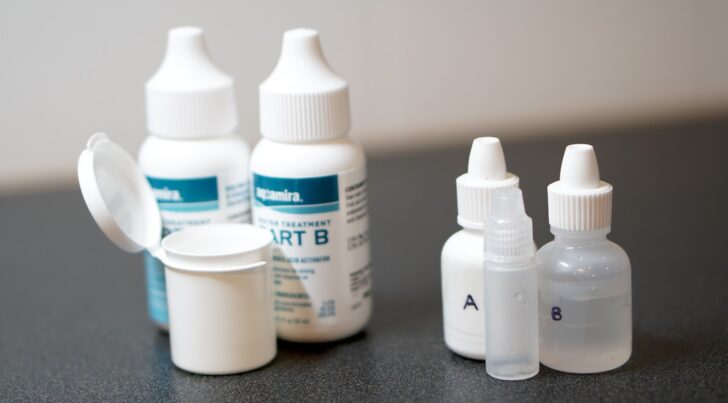
- The newest (since summer 2020) 1-oz Aquamira kits now ship with a closeable cap – this is useful for backpacking! If I know I’m going to walk over a creek soon, I can create my premix, stow the cup in my pocket, and then it’s activated and ready to pour in my bottle by the time I reach the creek.
- For shorter trips, repackage Aquamira parts A and B into smaller dropper bottles, but be aware that drop size in your new bottles may be different than drop size in the stock bottles, which could affect dosing.
The Squeeze Filter (Sawyer, BeFree)
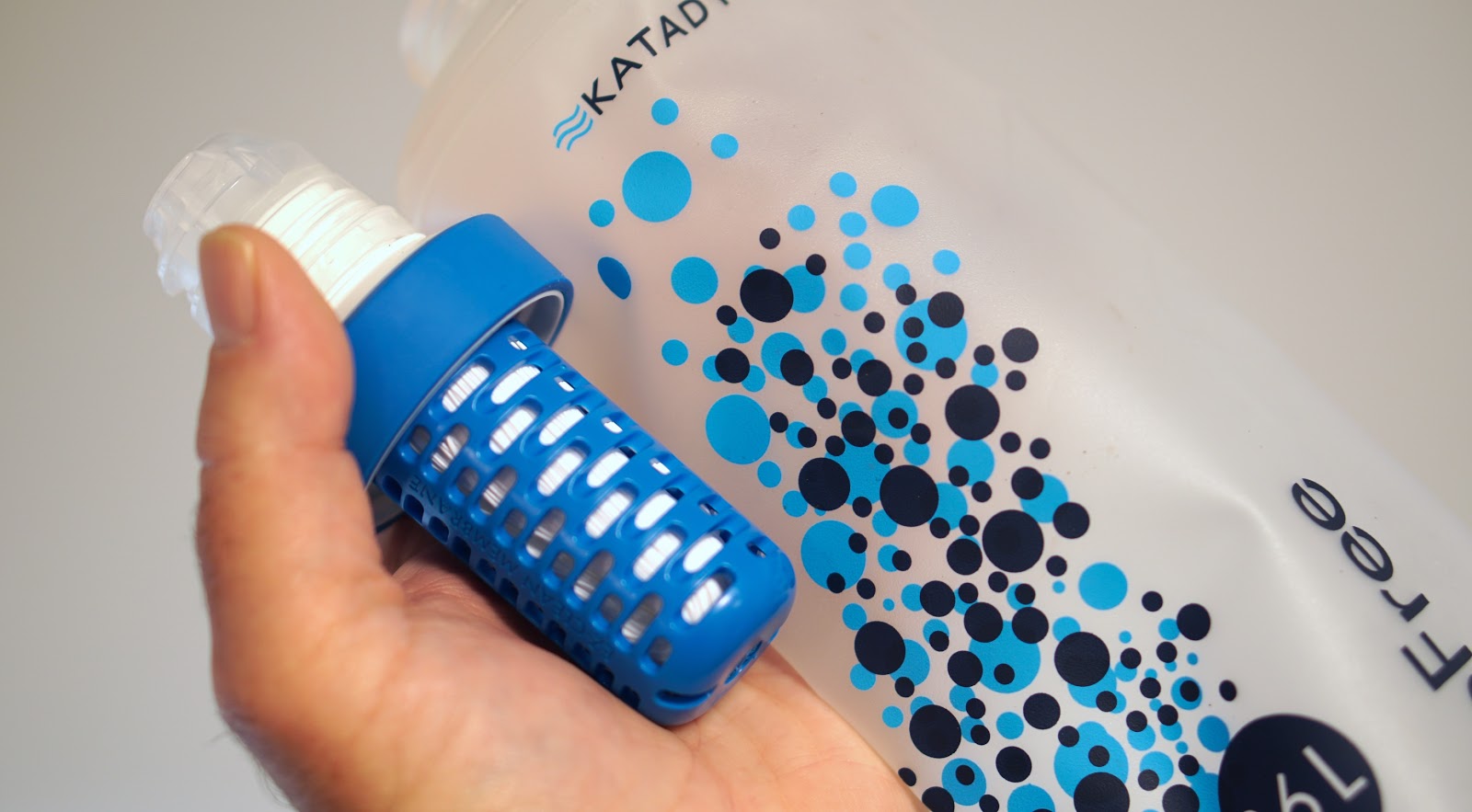
The second ultralight treatment method is a lighter version of a pump-style water filter – the squeeze filter. Instead of a pump, you attach a squeeze filter to a soft or otherwise semi-flexible water bottle and squeeze the bottle to push the water through the filter. Or, you can suck water through the filter, but that requires more effort.
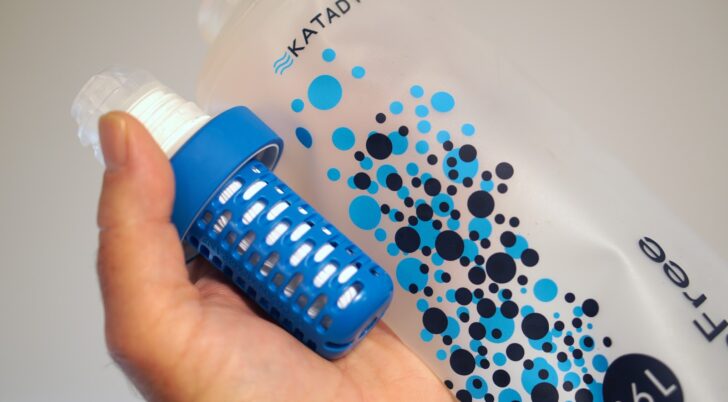
There are two popular types of squeeze filters: the Sawyer Squeeze and the Katadyn BeFree. You can attach a Sawyer Squeeze directly to a Smartwater bottle. This option is popular among thru-hikers. The Katadyn BeFree filter is compatible with HydraPak bottles (like the new HydraPak Flux), making it adaptable to a variety of bottle shapes and sizes.
The flow rate of squeeze filters is relatively fast when compared to pump filters and straw filters. So unlike some of the earlier straw filters and other bottle filters, you don’t get cheek fatigue caused by sucking through a slow-flow filter.
Squeeze filters are one of my favorite water treatment solutions because I get drinkable water right away. If I know I’m going to be in an area where there’s a lot of water, I don’t have to pack any water at all in my backpack. I can just take my squeeze bottle, dip it whenever I reach a stream or lake, and hydrate at those locations.
If you need to carry more water in your pack and you’re using a squeeze filter system, then you can just take a dirty water bottle as extra water storage. When it comes time to drink, and you’re away from a water source, you can pour the dirty water into the squeeze filter bottle and then drink through the filter.
Alternatively, if you want to keep a water bottle as a clean water bottle and don’t want to drink through the filter, you can filter the water through the filter into your clean water bottle and then drink straight from the clean water bottle when convenient.
Squeeze Filter Notes and Tips:
- Flush a solution containing a few drops of chlorine bleach in a liter of water through the filter before storage. This minimizes bacterial growth in the filter, which can cause pore clogging. If you’re on a long trip, do this every couple of days.
- Make sure water is expelled from the filter before you go to bed at night, and store the filter in your sleeping bag if you expect freezing temperatures. Water turning into ice in the filter could cause damage to the filter membrane.
Steripen
The third option I want to discuss is an ultraviolet (UV) light pen, specifically the Katadyn Steripen Ultralight.
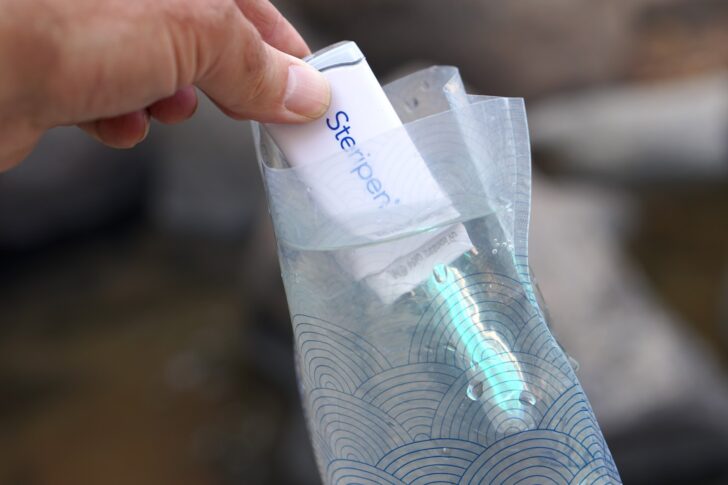
Ultraviolet light disinfects bacteria, viruses, and protozoa. And it’s very effective against all three, and it works fast. Water only needs to be exposed to this lamp for about 60 seconds to be purified. UV light works by damaging DNA inside a cell, which prevents it from replicating. So even if you ingest live pathogens, they won’t be able to reproduce in your body to a level that causes a gastrointestinal infection.
Of course, the disadvantage is that it’s a battery-operated electronic device and is subject to all the failures of such devices when you’re in the backcountry. The Steripen Ultralight is USB rechargeable. I carry a battery pack on longer trips so I can recharge the Steripen (as well as my headlamp, smartphone, and inReach Mini). But generally, the internal battery of the Steripen Ultralight remains charged for 3-7 days, depending on how often I’m using it.
When I use a Steripen, I have an old Platypus bottle that I repurposed as a dipping and treatment cup. It’s very light (< 0.5 oz!) and folds flat, so I can keep both the Steripen and the old Platy cup handy in my accessory pouch without taking off my pack.
One of my favorite features of the Steripen Ultralight is its automatic switch. It turns on automatically as soon as you dip the Steripen’s lamp below the waterline of your treatment container. There are two metal contacts there. As soon as water touches both of those contacts, the lamp turns on. Treat the water for 60 seconds (a built-in time shuts off the light automatically), and it’s ready to drink.
The other thing I like about the Steripen Ultralight is that because this is such a compact device with a short lamp, it works great in solo-size cooking mugs. I use it regularly with my Vargo Ti Bot 700 and MSR Titan Kettle.
Steripen Notes and Tips:
- In cold temperatures, keep the Steripen inside your jacket and sleeping bag to prolong battery life.
- Make sure the USB port battery door is secure to prevent water entry into the port.
- If you regularly use store-bought water bottles like Smartwater, use the Steripen Ultra instead of the Steripen Ultralight. The Ultra is designed specifically to be compatible with narrow-mouth water bottles.
Summary
The following table summarizes each of these three treatment methods.
| Aquamira | Katadyn Befree | Steripen Ultralight | |
|---|---|---|---|
| Weight | 3.0 oz (88 g) | 2.1 oz (60 g) | 2.6 oz (74 g) |
| MSRP | $15 | $40 | $90 |
| Key Advantage | small size | fastest | most effective |
| Key Disadvantage | slowest | bulkiest | most expensive |
Facebook Live Q&A
October 17, 2020:
Where to Buy
Use our GearFinder Search Engine to shop for the best prices on Aquamira, BeFree, Sawyer Squeeze, or the Steripen Ultralight at online retailers.
Related
- Review: Katadyn BeFree Filter
- Review: Hydrapak Flux Bottle
- Skills: make your water treatment process more efficient on the trail with an accessory pouch
DISCLOSURE (Updated April 9, 2024)
- Product mentions in this article are made by the author with no compensation in return. In addition, Backpacking Light does not accept compensation or donated/discounted products in exchange for product mentions or placements in editorial coverage.
- Some (but not all) of the links in this review may be affiliate links. If you click on one of these links and visit one of our affiliate partners (usually a retailer site), and subsequently place an order with that retailer, we receive a commission on your entire order, which varies between 3% and 15% of the purchase price. Affiliate commissions represent less than 15% of Backpacking Light's gross revenue. More than 70% of our revenue comes from Membership Fees. So if you'd really like to support our work, don't buy gear you don't need - support our consumer advocacy work and become a Member instead.
- Learn more about affiliate commissions, influencer marketing, and our consumer advocacy work by reading our article Stop wasting money on gear.


Discussion
Become a member to post in the forums.
There are a couple parts to heat adaptation in a dry climate and less sweating isn’t one of them. Heat adaptation in a dry climate means your body sweats more and sooner in response to an increase in core temperature.
There are multiple sources, but from this one (https://www.sciencedirect.com/science/article/pii/B9780444640741000318):
If someone says they sweat less after 5-7 days in the desert and they consider this as being “heat adapted”, then I think they are sweating less because they have become progressively dehydrated during the trip and have total lower water volume. From the same paper as above:
Increased sweating is a heat acclimation (HA) response (and a good one at that), but it doesn’t get after the core physiological process by which HA occurs. The real benefit of HA is that you become physiological more capable as you adapt to heat. So, for a given amount of effort, your heart rate stays low, your skin capillaries promote better blood flow, thermoregulatory processes aren’t stressed, and thus, you sweat less for a given amount of effort on i.e., day 7 vs. day 1.
Increased sweating comes into play as an HA mechanism when you’re exertion level is high enough (think, closer to your AeT) to stress thermoregulation in order to maintain core temp.
At lower heart rates, HA results in a few really important changes that can actually reduce the need to sweat: more efficient cellular fluid balance, higher plasma volume, and more water retention.
Check out some of the work by Julien Periard and colleagues, they’ve built a pretty good picture of HA across the spectrum of athletic performance.
Getting this back to water treatment options, I ordered the tiny Ultralight model Ryan recommended and then returned it when I realized it only treats in 1L increments. I’d prefer the ability to treat in .5L quantities so I ordered the Ultra instead. Doing so also gives me the option to treat in a Smartwater or similar bottle without carrying a scoop or pot (one more thing to keep track of).
The Ultra is rated for 50L (Ultralight is rated for 20L) and weighs about 2.5 ounces more. This weight is offset by the need to carry extra recharge capacity that I’d need if I was using the Ultralight in the manner I’d prefer on a trip of more than a couple nights and it doesn’t require a scoop.
YMMV
I haven’t played with dirty water or using the sawyer over extensive periods but in my set up with a sawyer squeeze I can filter a liter of water in 1min all for 5.4oz in a gravity set up. so that means i can just stand there for 1 min and gravity feed 1L for 1min.
haven’t seen the quickdraw yet and looking forward to that article.
i’m going to give the tabs a ago again but last time i used them i didn’t have a good experience with them
Looking through the comments I feel compelled to react to two sentiments about SteriPens in regard to
1) I’m using SteriPens for 12 years and had recently a malfunction with my roughly 10 year old SteriPen Freedom. I contacted Kathadyn via their Online Form and received an email reply in less than 2 hours with a clarifying question. Less then 20 minutes after my reply I received an email informing me that they are sending me a replacement unit for free. Since my SteriPen Freedom is discontinued Kathadyn sent me a SteriPen UltraLight which has the same form factor, but treats 1 liter instead of 0.5 liter. In my book that is excellent customer service – not only did Kathadyn respond very fast, but they are also standing 100% behind their (acquired) product even though it was roughly 10 years old in my case.
2) Using a SteriPen with the water bottle that I carry in my shoulder pouch is extremely easy as it fits perfectly on the bottle. All I have to do is set my SteriPen Freedom on the 0.5l bottle for 45 seconds or the SteriPen Ultralight on a 1l bottle for 90 seconds. The photo shows three bottle sizes that I use (16 oz Apple Juice, 20 oz Gatorade, 32 oz Snapple) with SteriPens resting on them. Once I put the SteriPen on the bottle, I take care of other things during the time the water is treated – like taking electrolytes out of my backpack.
I’m aware that newer Gatorade bottles have a smaller opening. Our bottles are 10 years old, fit perfectly, have lasted over several thousand miles of backpacking and are still going strong.
In another thread I mention getting a dud Steripen Ultralight; one email with one follow up phone call, remedied that. My new one has worked flawlessly (as does my 7-8 year old Adventurer!)
Well . . . How do they handle viruses?
BeFree: No
Quickdraw: No
Squeeze: No
UV (Steripen): Yes, to EPA specs
COVID is a virus.
Hum . . .
Cheers
Grayl and 1st need yes, those are the only 2 filters i known of that do viruses but at a weight penalty of roughly 150z…..don’t forget about chemical options as well that take care of viruses.
Covid is very unlikely in water, you have a greater chance of a dead decaying animal upstream then covid
Covid is very unlikely in water
Certainly, but there are MANY other viruses on this planet which can be in water and which can affect us. Dangerous things, viruses.
Cheers
Yup and many more that we don’t know of possibly frozen deep below or else where
…
almost forgot about P&G water purifier or just found out about purinize which both take care of viruses. both light weight
Do they meet the full EPA regulations? URL?
The P&G stuff used to be called PUR. Their web site claims it handles viruses as well as bacteria.
The purinizer stuff may handle bacteria, but it does not handle viruses. It may ‘clean up’ water, but it does not ‘purify’ it.
Cheers
Purinize did not do very well in their own testing:
https://www.purinize.com/pages/product-testing
97% isn’t great, but p&g is 99.999%
Forgot to there is also chlor-floc
Purinize didn’t look bad for most of everything they tested. Crypto was 97% and so far only lab results that showed blue green algae as not detectable. I can personally live with 97% especially where I go and more importantly I’m surrounded by lakes with blue green algae.
I just put the Steri Pen into the top of my Gatorade bottle, turn it on and slowly rotate it until finished. Never invert bottle.
Steripen ultralight
Ryan says twice plus in videos, “Water only needs to be exposed to this lamp for about 60 seconds to be purified.” The lamp runs for 90 seconds for treatment. Does Ryan remove the lamp at 60 seconds? What are his sources for the 60 seconds treatment regimen?
.5 L light is on for 48- 60 sec/ or 1 L for 90 sec
Agree with J-L on this one. The only thing reduced (relating to sweat) in heat acclimatization is sweat sodium concentration. There is also a shift in the onset threshold for sweating, which occurs earlier and at a lower core temperature. Julien Periard in this paper states the same thing, as does the Wilderness Medical Society and the gold standard Guyton Textbook of Medical Physiology.
https://www.autonomicneuroscience.com/article/S1566-0702(16)30007-8/fulltext
https://www.wemjournal.org/article/S1080-6032(18)30199-6/fulltext
It’s never good when an article wants to change definitions of insensible water loss to now include active sweating.
Guyton textbook of medical physiology (2021) states, “Some water losses cannot be precisely regulated. For example, humans experience continuous water loss by evaporation from the respiratory tract and diffusion through the skin, which together account for about 700 ml/day of water loss under normal conditions. This loss is termed insensible water loss because we are not consciously aware of it, even though it occurs continually in all living people.
Insensible water loss through the skin occurs independently of sweating and is present even in people who are born without sweat glands; the average water loss by diffusion through the skin is about 300 to 400 ml/day.”
Here is a good article (leading to 3 more good articles) on heat adaptation.
https://www.outsideonline.com/health/training-performance/how-to-heat-proof-your-training
I didn’t realize that now heat acclimatization (heat adaptation in outdoor environment) is not exactly the same as heat acclimation (heat adaptation in artificial environment).
A heat adapted person will show a lower heart rate (HR), internal body temperature, skin temperature (Tsk), and sweat electrolyte concentration, and increased plasma volume and sweat rate (SR). If you perceive a decreased sweat rate, then you are losing heat adaptation. The increased sweat rate may last up to a month, but other parameters may last longer.
Become a member to post in the forums.