


Introduction
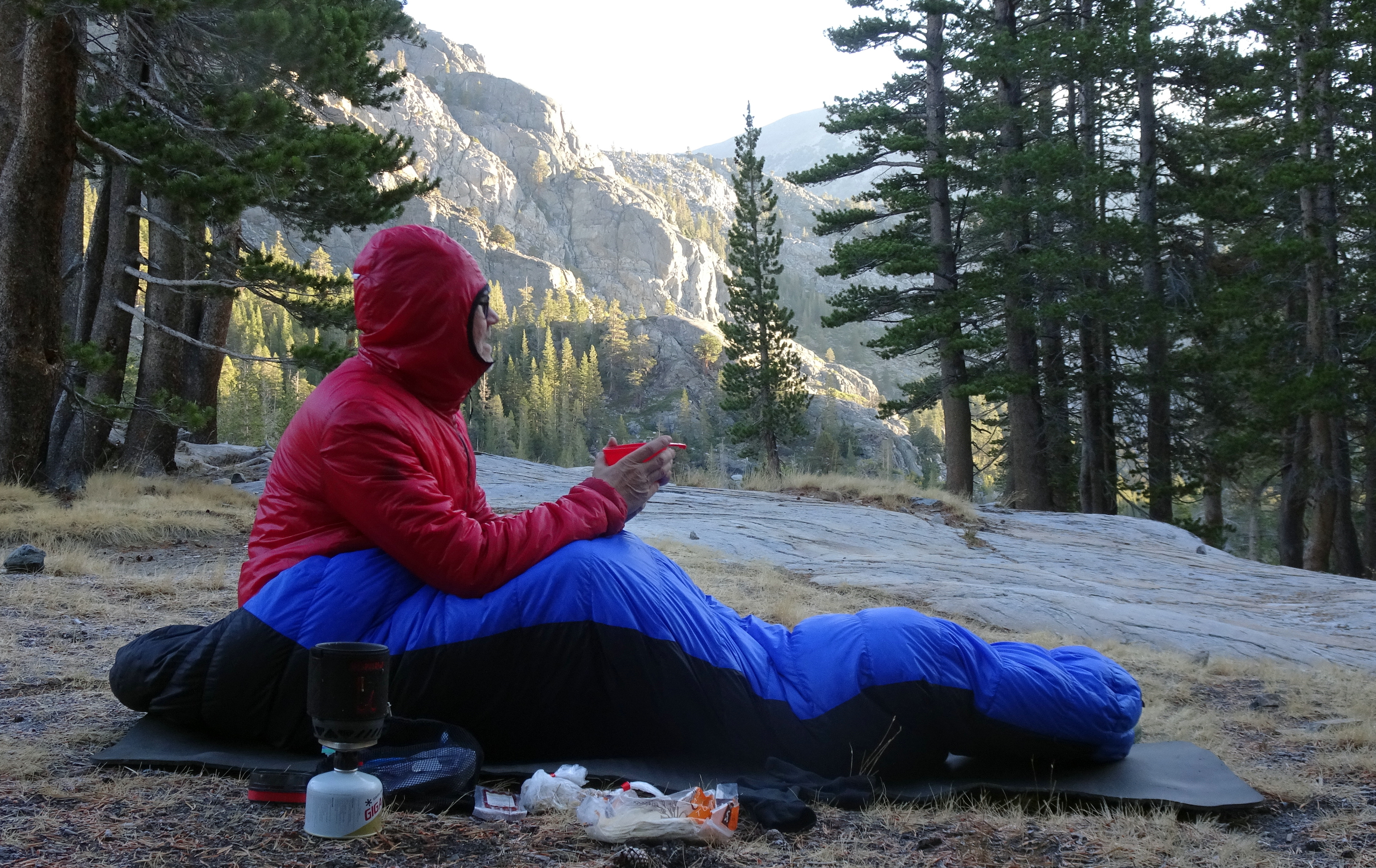
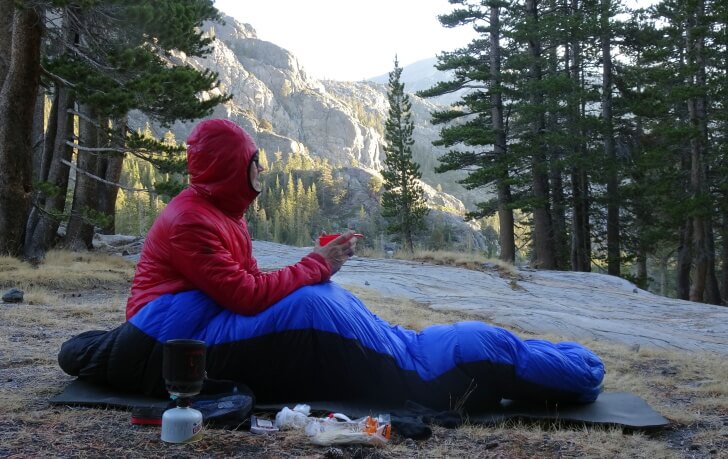
The high route through the Sierras, the John Muir Trail, is well traveled. Thru-hiking the John Muir Trail in October may not be the ideal experience for someone who likes to find his way through wild areas on his own, and thru-hiking the John Muir Trail in mid-summer may pose a challenge for the introvert! But if you hike off-season there might be solitude enough to digest the spectacular mountains. So Jorgen Johansson decided that October in the High Sierra might be a good idea. He also knew that he was flirting with winter. It all turned out to be the greatest mixture of beautiful landscape, sunny days and challenges that he has experienced as a backpacker.
In the snow
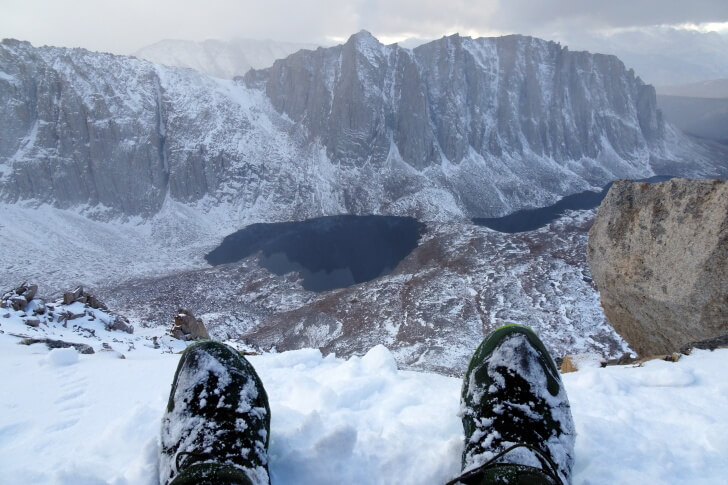
I am halfway up a seemingly interminable rock wall. Sitting on my pack in the snow, I am looking between my feet at a giant cauldron beneath me, towards black lakes and a soaring gray wall, swirls of mist, and patches of snow that only enhance the forbidding bleakness. I am sipping on a cup of water and chewing on some chocolate and cashews. The wall I am on actually has a trail, something hard to believe when I watched it from below. In numerous serpentines, the John Muir Trail is taking me towards its highest pass, Trail Crest. It is October 19. Tomorrow I will have finished my hike.
About the JMT
Why hike the John Muir Trail, mostly called the JMT, in October? It has to do with two things, what the JMT is and what I am. When John Muir founded the Sierra Club in 1892, he probably did not realize that it would be the pattern for the grassroots environmental associations that exist in all democratic countries today. The Sierras of California were John Muir’s cathedral, and he wanted to preserve the most spectacular areas for future generations. Becoming an icon was probably not part of the plan, but when he died in 1914 the crest-parallel trail, conceived by Theodore Salomon, was named after him.

The trail had then been under construction for several decades and was not finished until the completions of the Golden Staircase towards Maher Pass in 1938. The JMT was meant to be a glorious trail through a glorious range of mountains, the Sierras, and it certainly is.
Today these 221 miles (356 kilometers) stretching from Yosemite National Park to Mount Whitney is one of the most spectacular trails in the USA and is hard to beat in any part of the world. It is also one of the most coveted trails and thus heavily regulated. To hike the JMT, you need a permit and during the peak hiking months of July and August, it is usually solidly booked way ahead, even if some permits are reserved for walk-ins.
For a guy like myself, who likes to travel solo across desolate country north of the Arctic Circle, the sound of 3500 hikers a year maximum limit for the JMT, crowded into a few months, is not a dream scenario. But I wanted to see the High Sierra and my experiences of hiking popular areas off-season are good. Hiking in late September and October would mean that permits would be no problem, and there would be few people on the trail. For work reasons, I could not make it before October. I knew this meant flirting with winter, but that is something I have done before and felt confident that at its worst it would likely mean nothing more serious than having a hard time. At its best it could be the hike of a lifetime.
Elevation
Going north to south is the direction chosen by most JMT-ers, and it made sense to me as well. It means a slow build-up of expectations as the scenery is getting more and more spectacular as I went from low country to high. I would have the sun in my face and meeting fewer people would mean the trail would be “mine” to a larger extent.

I would be going from the moderate elevation of 4000 ft. (1200 m) above sea level at Yosemite, to passes near the end of the trip, like Forester Pass, with elevations above 13,000 ft. (4000 m). Starting low should help, because the biggest unknown about the hike was how my body would handle the high elevation.
Member Exclusive
A Premium or Unlimited Membership* is required to view the rest of this article.
* A Basic Membership is required to view Member Q&A events


Discussion
Become a member to post in the forums.
Companion forum thread to: Thru-Hiking the John Muir Trail in the Fall
Jorgen Johansson thru-hiking the John Muir Trail in autumn – a time when snow begins to fall and sunny days still abound.
Gorgeous photos!
Fun read. Thanks for writing it.
Another fantastic read Jorgen.
I really like the down to earth way that you describe your experiences on the hike. Thank you also for the gear details.
nice write up!
Nice trip and nice write-up. Thank you.
But I will say you were lucky with the weather. You could easily have had a storm or two with several feet of snow that time of year. Because of that possiblity I would recommend that anyone doing the JMT that time of year (or late Sept even) should consider doing it South to North as escape routes are easier in the north.
billy
Awesome read, thank you so much for sharing Jorgen!
Great write up as usual Jorgen. Thank you for sharing your adventures with us.
Thanks Billy. Yes, I actually encountered a couple who obviously were well versed in many aspects of the Sierras and they talked of a “Sierra Dump”, meaning two feet of snow or something like, that falling in a very short time. However, what they said was also that this was extremely rare. So I feel that I did not push my luck very much, nor that hiking the JMT in September or even October is something I would advice against.But I would not advice it to unskilled hikers.
Anything can of course happen, but if you let small risks rule your life, you will probably never see or do much. I know very experienced backpackers who do not want to hike Alaska and northern Canada, because they are afraid of grizzlies. IMHO, they are letting the fear of a very small risk rob them of a great experience.
Me, I will most likely be back in the Sierras next October. And I feel fairly confident that the skills I have will be sufficient. Which does not mean I will live forever :-)
Jorgen
” extremely rare”
Jorgen, I have lived in the Sierra for the past 27 years. It is definately NOT rare to have a 2 or 3 foot snow storm in late Sept or early October. I have seen that many times. Which is why when I did the JMT starting mid Sept and ending early Oct, I did it South to North. the idea being that I start with a good weather forecast, but a week out that forecast is very unreliable but at that point I am in an area that is much easier to exit if needed. Whatever risks you, as an experienced hiker, wish to take is fine with me and I would not wish to discourage you from doing so. But we must always remember that here on BPL there are readers who are very new and don’t understand the risks. Just last winter we had a woman go off into winter conditions with ultralight gear and apparently little winter skill. She died unnecessarily, in my opinion,… possibly due to advice and/or perceptions she got here on BPL.
billy
billy
billy
I would just add this:
For those other than Jorgen who might be contemplating an October JMT trip:
Only hikers experienced with winter survival skills should attempt this. Ask yourself, how far can I hike if there is 2 or 3 feet of new snow on the ground? And drifts that could be 6 feet or more in depth when attempting to get over passes. Do I have the clothing and shelter to survive these conditions? Because they can happen virtually over night that time of year. And do I know how to start a fire in those conditions? Would there even be wood available if I am stuck up above treeline? And for each mile along the JMT, what would be my exit route if I got these conditions over night? And if I can’t exit quickly do I have extra food? Or at least a rescue beacon?
Billy
Billy Ray,
I appreciate your concern. And you obviously know more about the Sierras than I do. Now, “rare” is of course a word that can mean almost anything (I perhaps I should have asked the people I met on the trail what they meant more specifically), anyway it would be interesting to have some quantification. If you have seen a 2-3 feet dump of snow “many times” during 27 years, does this mean that it happens on the average at least once every year in September-October. Or every other year, or less? Have you seen it half a dozen times or tens of times during these years? Knowing this would be helpful to me and others.
It is always difficult to know which people will read what on BPL (or anyplace else) and latch onto it, leading some of them to having an unforgettable experience and leading others into things that are way above their heads. Or simply being unlucky, like someone driving the old Route 66, inspired by an article, and getting crushed by a runaway 18-wheeler. This reasoning is related to the “small risks” keeping you from leaving your house, just to be safe., that I meantioned earlier in the tread. If you take it to its extreme you will not be able to write anything about anything to anyone.
I think it is excellent that you, with your knowledge of the Sierras, do point out the skills needed if things get rough up there, late in the season. And I can only say to anyone reading this, that if you do not feel you have these skills, do not brave the Sierras in October.
Jorgen,
I don’t have records. But from memory, I would say on average about 1 in 4 years have early storms in late Sept or the first week of Oct. And from memory, 2 in the last 6 have been that way. I don’t call that ‘extremely rare’ or even ‘rare’ or even ‘unusual’. One deceptive issue is that the Sierra has a reputation for great weather. I can’t tell you how many times I have read here on BPL that it doesn’t rain in the Sierra in the summer and that it’s fine to skimp on rain gear. Yet I have seen it rain for a week straight up there. Much of this kind of talk is promoted by people who do not live in the Sierra and have had the good fortune to not have it rain on them during their few summer backpacking trips. But the reality is that some summers it hardly ever rains; while other summers it rains a lot. And you just do not know which you are going to get.
billy
I’ve got a permit for Cottonwood Lakes on September 9 for three nights. I don’t have experience in more than a few inches of snow. Assuming a clear forecast before I head off that is not a particularly risky trip, right?
For longer trips that tend to outlast the current forecast a good tool to have is in the field weather updates. DeLorme inReach now has such a feature that will let you access geo-located weather forecasts while on your hike. The forecast can take around 20 minutes to download. This could aid in updating your plan with weather trends before committing to going over a high pass. It doesn’t replace the need to come equipped/prepared for winter conditions and route finding/navigation in snow.
Matthew,
Short trips with a good forecast are a much better bet. Still, watch the sky and if you sense a dramatic change it is best to be on the east side of the crest… or the side that your car is parked on.
Many times I have gone out with a good forecast and had it change dramatically for the worse in a day or two. But you can usually tell if something big is coming by noticing the wind change and the cloud types and the humidity. Just a couple of summers ago I was out with a friend for 6 day trip. We started with clear, sunny forecast and warm for week. Third night out I notice a change in the clouds and the humidity and sensed something coming. The next morning it was obvious something had changed. We were equipped for rain, but my friend was not up for it so we decided to hike out. The day after we hiked out it started to rain…. and it REALLY dumped… inches of rain… and it continued to rain for a week… Sierra… July!!! Moral of the story is to be prepared for rain in the summer and snow starting late September. And notice changes in the weather.
Billy
Great article, report, and pictures – almost like I was there (except for being at work reading this). Ditching the crowds for a little snow seems a great trade off (as long as its not a lot of snow though)
Matthew… to be more clear… Sept 9th is a pretty safe bet relative to there not being a significant snow storm (though it can snow in the mountains any month of the year). September is a great time to hike in the Sierra. But from my experience, starting around September 20th or so the odds of a significant snow storm start to increase. By the first week of October there is a significant chance of a significant snow storm in the Sierra so greater caution relative to gear and experience and weather watching is in order.
billy
Cool. Thanks for the responses to my question.
I know that weather cannot be predicted with certainty and I must be prepared for cold/wet/wind/snow. My gear has served me well down into the 20s.
I have an InReach from my 2015 JMT where I used it to pull daily weather reports via that we weather thing but the new firmware update seems like a good option as well.
We encountered some very intense storms in my 6/15-7/4 JMT hike although me missed the dump of snow that hit many people in July.
Thank you for the great read!
You’re one tough dude to sleep on that ccf pad! What a beautiful place, and a writeup to match.
A great trip report Jorgen. Thanks.
Fantastic trip report, I really enjoyed reading it and seeing the photos. Looking forward to doing something like this in the future.
An excellent report and photos, as always Jörgen. Thanks
I really enjoyed this trip report. Well done.
Become a member to post in the forums.