


Introduction
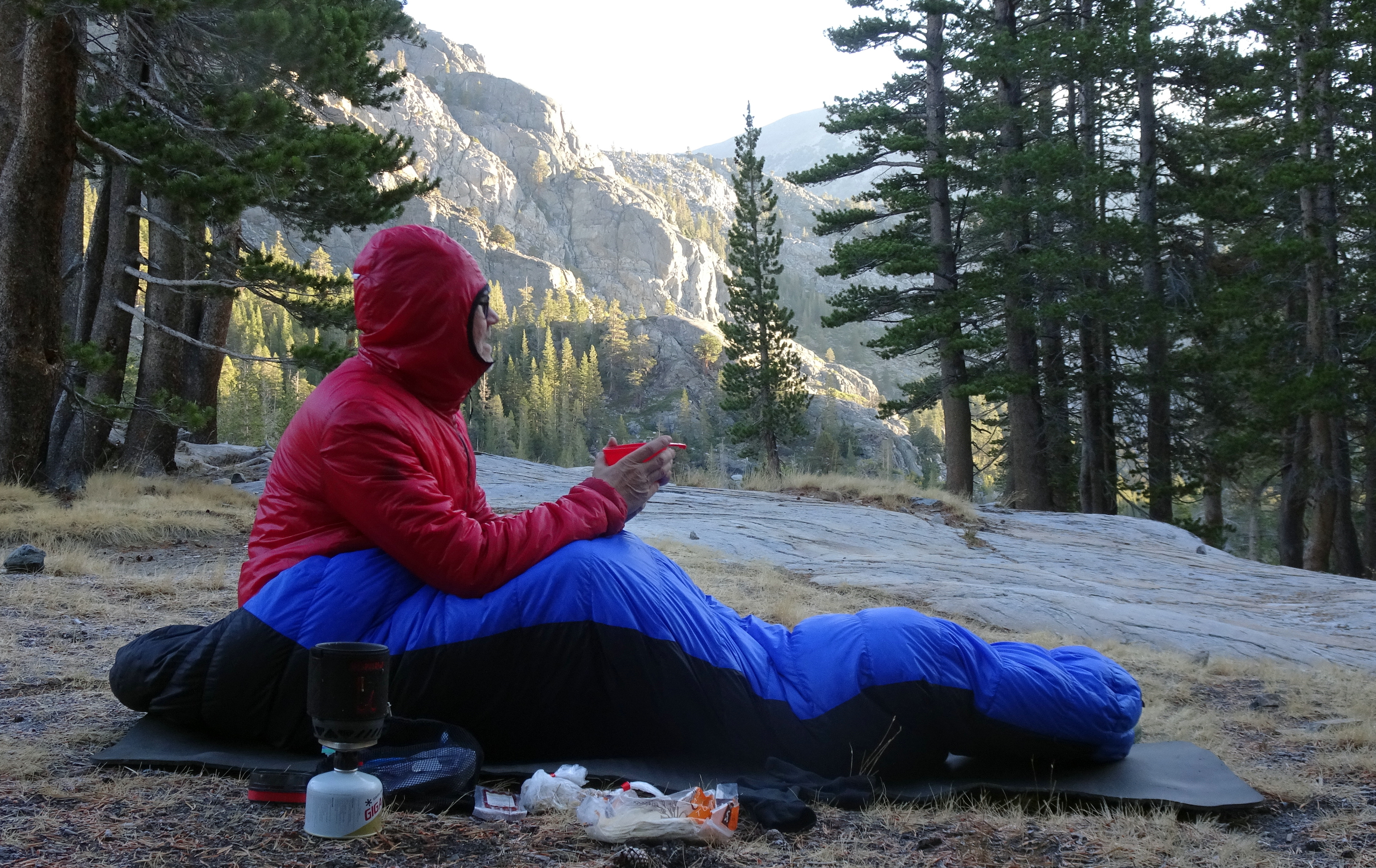
The high route through the Sierras, the John Muir Trail, is well traveled. Thru-hiking the John Muir Trail in October may not be the ideal experience for someone who likes to find his way through wild areas on his own, and thru-hiking the John Muir Trail in mid-summer may pose a challenge for the introvert! But if you hike off-season there might be solitude enough to digest the spectacular mountains. So Jorgen Johansson decided that October in the High Sierra might be a good idea. He also knew that he was flirting with winter. It all turned out to be the greatest mixture of beautiful landscape, sunny days and challenges that he has experienced as a backpacker.
In the snow
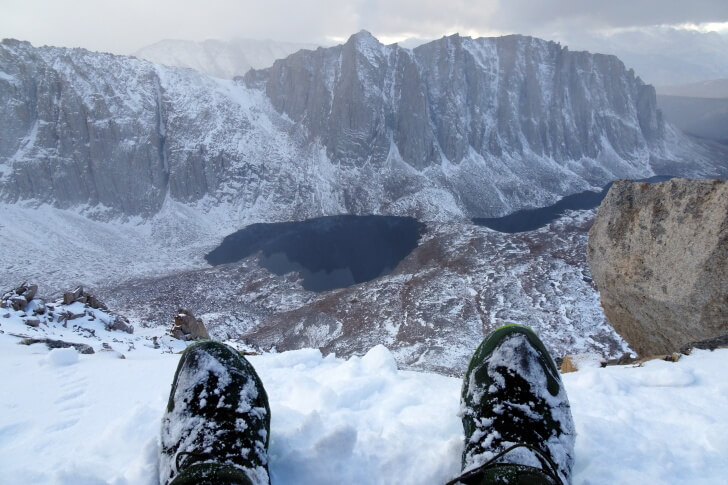
I am halfway up a seemingly interminable rock wall. Sitting on my pack in the snow, I am looking between my feet at a giant cauldron beneath me, towards black lakes and a soaring gray wall, swirls of mist, and patches of snow that only enhance the forbidding bleakness. I am sipping on a cup of water and chewing on some chocolate and cashews. The wall I am on actually has a trail, something hard to believe when I watched it from below. In numerous serpentines, the John Muir Trail is taking me towards its highest pass, Trail Crest. It is October 19. Tomorrow I will have finished my hike.
About the JMT
Why hike the John Muir Trail, mostly called the JMT, in October? It has to do with two things, what the JMT is and what I am. When John Muir founded the Sierra Club in 1892, he probably did not realize that it would be the pattern for the grassroots environmental associations that exist in all democratic countries today. The Sierras of California were John Muir’s cathedral, and he wanted to preserve the most spectacular areas for future generations. Becoming an icon was probably not part of the plan, but when he died in 1914 the crest-parallel trail, conceived by Theodore Salomon, was named after him.

The trail had then been under construction for several decades and was not finished until the completions of the Golden Staircase towards Maher Pass in 1938. The JMT was meant to be a glorious trail through a glorious range of mountains, the Sierras, and it certainly is.
Today these 221 miles (356 kilometers) stretching from Yosemite National Park to Mount Whitney is one of the most spectacular trails in the USA and is hard to beat in any part of the world. It is also one of the most coveted trails and thus heavily regulated. To hike the JMT, you need a permit and during the peak hiking months of July and August, it is usually solidly booked way ahead, even if some permits are reserved for walk-ins.
For a guy like myself, who likes to travel solo across desolate country north of the Arctic Circle, the sound of 3500 hikers a year maximum limit for the JMT, crowded into a few months, is not a dream scenario. But I wanted to see the High Sierra and my experiences of hiking popular areas off-season are good. Hiking in late September and October would mean that permits would be no problem, and there would be few people on the trail. For work reasons, I could not make it before October. I knew this meant flirting with winter, but that is something I have done before and felt confident that at its worst it would likely mean nothing more serious than having a hard time. At its best it could be the hike of a lifetime.
Elevation
Going north to south is the direction chosen by most JMT-ers, and it made sense to me as well. It means a slow build-up of expectations as the scenery is getting more and more spectacular as I went from low country to high. I would have the sun in my face and meeting fewer people would mean the trail would be “mine” to a larger extent.

I would be going from the moderate elevation of 4000 ft. (1200 m) above sea level at Yosemite, to passes near the end of the trip, like Forester Pass, with elevations above 13,000 ft. (4000 m). Starting low should help, because the biggest unknown about the hike was how my body would handle the high elevation.
Member Exclusive
A Premium or Unlimited Membership* is required to view the rest of this article.
* A Basic Membership is required to view Member Q&A events


Discussion
Become a member to post in the forums.
Wow. I can’t believe you did it in October. I had a hell of a time with Forester Pass in June! I too had to go cross country, basically rock scrambling more than half the way up. I think it took eight hours to do the two miles or whatever it is. I think next I do the JMT I may go when you did. I like the idea of less crowds. It was slammed with people when I did it two years ago.
Hi Brad,
My guess is that Forester is much more difficult in June. And the fall in the mountains is always great. The air is fresh and you can see forever.
Jorgen
Thanks to Jorgan for such a well done and enjoyable article! Earlier October is indeed a great time to be on the JMT.
My position on the snow is that a close-to-trailhead trip in September with a good trail such as the Cottonwood Lakes is not very risky even for beginners. A local told me that his rule of thumb was that the FIRST storm is usually not that big of a deal, and it is the second storm usually in mid-October that really dumps a lot of snow and that might be a huge problem for the less experienced. Regardless, it is a remote wilderness and I agree with Billy on his cautioning the less prepared and the less experienced hikers. They could be locked in for days with the wrong equipment and navigation skills could be harshly tested.
I hiked the JMT about 8 years ago and have been up Mt Whitney 9 times from 6 trailheads. Thanks for a great article and pics that took me back to wonderful, wonderful Sierra miles!
Thank you, John. Since I wrote the article I have been back to the Sierras and the JMT half a dozen times. Except for some day hikes, always in October. A perfect time in the most beautiful mountains I have seen.
From someone who has hiked in the Sierra for the last fifty years, I’ll add my perspective.
>> Yosemite National Park does not allow overnight parking on Tioga Pass after October 15, because they are concerned that any cars there might end up spending the entire winter trapped in the snow. Highway passes often close for a few days well before this due to a snowstorm.
>> Because the winter snowpack melts out over the course of the summer, even after a single storm, high passes n the Sierra are likely to have much more snow in early June than in October.
>> It is possible to get hammered by storms on any date in the Sierra. The storms in July tend to be rainy thunderstorms, but don’t overlook the pleasure of quarter-sized hail above timberline for a few hours.
>> Yes, we give a lot of attention to weather reports–and even moreso in the fall.
>> Yes, we often find that conditions vary from the weather reports.
>> As in any good mountain region, prepare for the worst conditions, and delight in the case that you don’t encounter them.
Seems like perfect time! That weather and conditions!
Great report. I have done JMT twice (summer) and it’s calling my name again every time I read about it .
Become a member to post in the forums.