

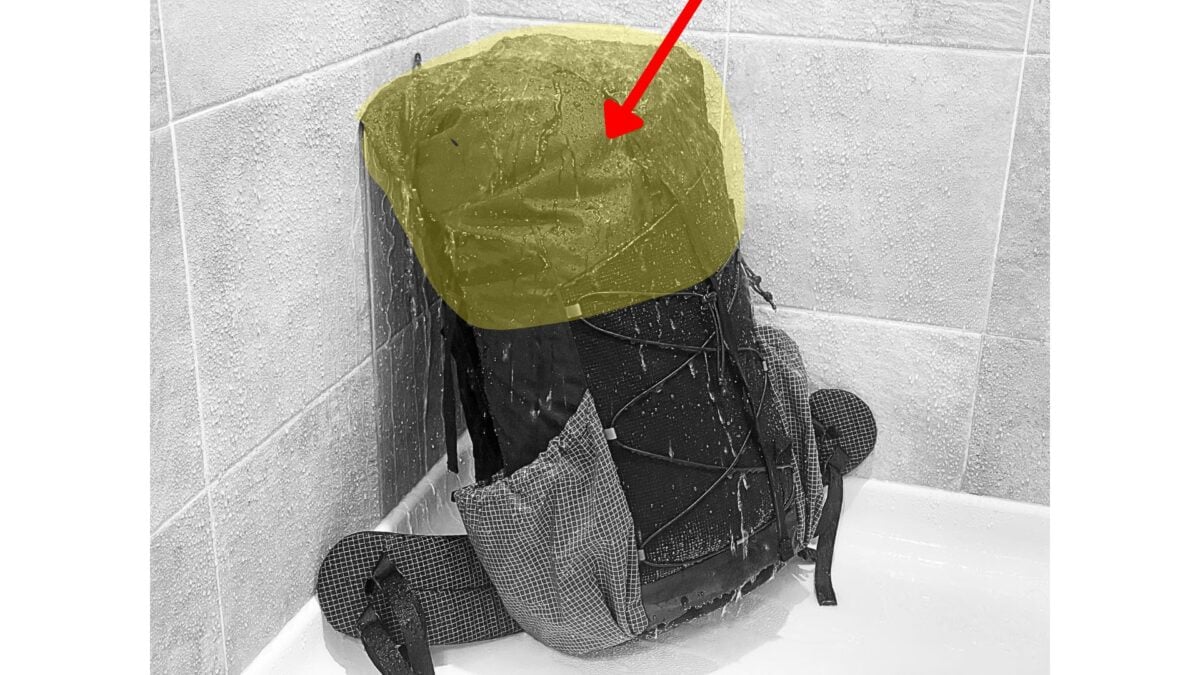

Backpacking packs often ride on the coattails of their fabric specs. Whether it’s abrasion resistance, tear strength, or water resistance, the extent to which a finished product’s performance matches the specs of its fabrics depends on how the pack is designed and constructed. In this context, we use a simple shower test to assess the water resistance of backpacks, evaluating not only their fabrics but also their seams and closures.
Backpacking packs are not necessarily “waterproof.” Even when they use waterproof or highly water-resistant fabrics, water can still enter through seams, stitch holes, zippers, roll-top closures, hydration ports, drawcord collars, and strap anchors. In the field, during sustained heavy rain, a fabric may resist wetting very well, while the pack system as a whole still allows water to seep into the packbag.
Herein, I describe a simple shower-based method to evaluate practical water resistance in a backpack. The goal is not to reproduce every variable of a real storm. Wind, pack movement, body heat, abrasion, shoulder-strap water tracking, and long-duration saturation all influence real-world performance. Instead, this method provides a controlled, repeatable, and practical way to screen for water ingress under a short-duration, high-intensity exposure.
This test is intentionally simple. It uses a household shower, a packed backpack, and a large cotton pillowcase as the internal witness material.
Purpose of the Test
This method is designed to answer one practical question:
After a controlled 30-minute shower exposure, how much water enters the pack’s main compartment?
In addition, the test must provide the minimum viable conditions capable of differentiating the water resistance of different backpacks with materially different water-resistance behavior (fabrics, construction, etc.).
The method is not intended to certify a pack as waterproof. It is a comparative screening test that helps identify obvious or meaningful leakage through construction features such as seams, closures, zippers, and panel interfaces. Moreover, the method is best used as a screening tool to compare different backpacks, not as a predictor of water ingress in an actual rainstorm while the pack is being worn, placed on the ground, sat upon, and intermittently accessed.
Member Exclusive
A Premium or Unlimited Membership* is required to view the rest of this article.
* A Basic Membership is required to view Member Q&A events


Discussion
Become a member to post in the forums.
Companion forum thread to: A Simple Shower Test for Evaluating Backpack Water Resistance
We use a simple and repeatable shower test method to evaluate backpack water resistance that incorporates fabrics, closures, seepage, and material water absorption.
Nice, but what is the practical use for the average backpacker?
Interesting, a couple things about the test. You use Rating Categories based upon visual observation yet, you measure the weight gain. This seems odd that you are using qualitative information for ratings yet include quantitative. It seems that quantitative measures would be better.
You have weight gain of the pack but do not infer a relationship to Rating Categories. This seems odd as the only mechanism to get water into the pillowcase is through the pack. Wouldn’t there be a water flow resistance in series?
Weight is the pillow is interesting. It would be great to know the full capacity of the pillow. If it could store 1000g that is one thing, if it can only store 150 g then you maxed out your metric. Lastly, absorption metrics can be tricky as water in the pillowcase is based upon capillary action. Measure the pillowcase flat and that would be the highest capacity. Holding in vertically, you may lose a lot of water because of the static head (if that makes sense). A quick check would be to add dye to the water and dip the dry pillowcase into the fluid see how high the fluid wicks vertically. My 2 cents.
Practical use – it’s not the test in and of itself – it’s the use of the test as a screening tool (how qualitatively water resistant is a particular pack), and as a comparison tool (one pack’s test results vs. another).
And to Jon’s comments – lots of quantitative limitations of this test if you are trying to get quantitative measures that do more than “screening” or “pack comparison” (see paragraph above).
The capacity of the cotton pillowcase would be a useful normalization metric. I’ll take a look at that. In all the tests in the article, it was well below its capacity.
Packs then that you already own. It should then no to be used to justify you need a new pack. That leads to overconsumption and more waste.
Interesting & worthwhile test. I’m just back from a trip involving a miserable 7 nonstop hiking hours of heavy rain with driving wind gusting to 20mph+ on exposed beach and bluff, carrying a 9 year old, well worn 210 D robic pack w/o any DWR. The robic fabric incl. a lid atop a drawstring closure, yielded a practical test case. While the freshly reapplied DWR coating of my rain gear wetted out and shoes absorbed half an ocean, the stuff inside this old school GG Silverback pack stayed pretty dry, with hardly any water incursion. Inside, I had critical gear in either a dry bag (Schnozzel) or DCF bag, and food in a Bearikade, and all stayed dry, except for very slight incursion in the DCF zippered bag, without any obvious wetness or pooling in the bottom of pack.
So: even a basic, non-waterproof pack worked ‘good-enough.’ And even though I am sure the the robic and padded shoulder straps/belt material absorbed water, I didn’t really notice any extra weight due to water retention. That may be because even if the water absorption was similar to – as bad as – your robic test, say 1&1/2 lbs, I would have eaten about that much food weight with dinner and breakfast – so a wash in terms of actual carry penalty.
What I DID notice was putting on obviously wet, clammy & heavy shoes. But that’s another story, eh?
I have an older Golite pack with grommeted drain holes on the bottom of the main pack body, something I’ve not seen on any newer packs; however, some newer packs do have grommets (or sewn drain holes) on the bottoms of the exterior pockets to eliminate pooling. Anyhow, the pack is always lined with a compactor bag, and as long as I’m not traveling long distance through heavy brush I rely on a rain poncho and/or an umbrella, both of which do an admirable job of keeping the pack exterior mostly dry.
So, the take away is to use a bag liner (trash bag) and don’t worry about the rest?
I use a Nylofume but still appreciate having waterproof fabric on my pack. Every bit of weight loss helps, one reason I went from ursack to adotec for my bear bag
Geeking out. Like the first home computers. You don’t always know what you’re going to find until you find it. If you want to know if a bag leaks, fill it with water. Dry it good.
I have been in heavy, daylong, soaking rain with my Granite Gear Blaze, as well as hailstorms and fast heavy downpours. The interior contents have never gotten wet from the top, although I always keep my essential gear dry in a compactor bag just in case. However, one of the side pockets one time filled with water! Like full to the brim! I think my tent was blocking the tiny hole in the corner of the pocket that was designed for drainage. From that pocket, water was able to get into the main body of the pack.
I took the pack to a local tarp maker and they put holes and grommets in both side pockets for me, for free! I paid them $10 anyway; kind folks deserve something for their talents. Since that improvement, any water has drained and I’ve had no more water getting into the main body. It’s such a great pack that I think even if it became less waterproof, I’d stick with simply waterproofing the contents over trying to find a new pack.
I can’t test it in the shower because we have to haul all our household water! It would cost far more than Ryan’s utility cost!
When it’s hot my pack gets wet inside from sweat. That’s always been the worst case of waterproofness. I put my ground cloth inside to keep any water away from the contents of the pack.
My pack is 200D nylon. Maybe once year I coat it with gear aid tent fabric sealant which makes it more waterproof.
And then I have anything important inside a waterproof bag. belt and suspenders.
Become a member to post in the forums.