

Episode 144 | Trail Steepness vs. Difficulty
Episode Summary
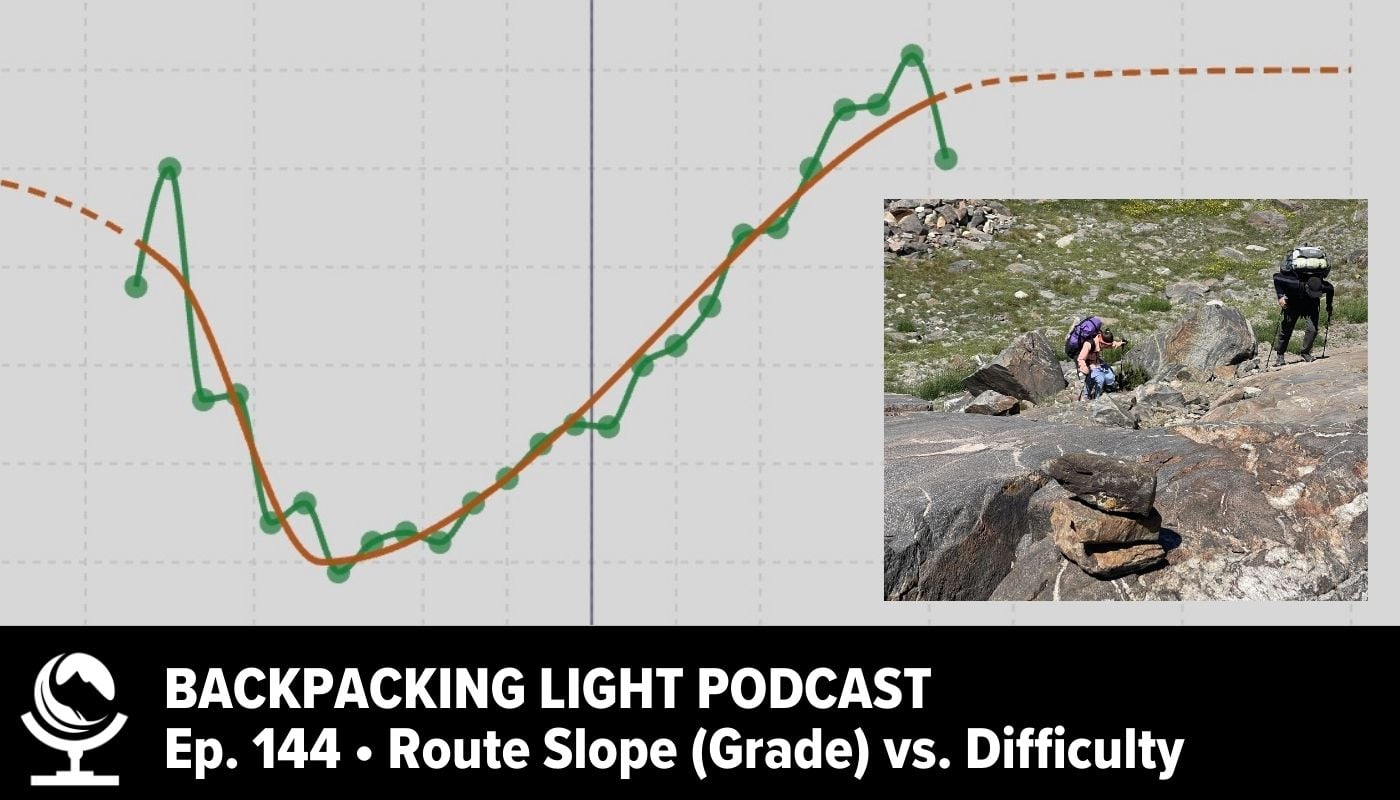
Hiking effort doesn’t scale smoothly with slope. It shifts across physiological regimes driven by muscle contraction type, aerobic limits, gait mechanics, and safety regulation. In this episode, we explain why mild downhill can be most efficient, why steep grades impose nonlinear time penalties, and how modeling human regulation improves trip planning accuracy.
Listen Now
together with Trail Days Online 2026 Sponsors

Trail Days Online is FREE, but you must REGISTER to access the live event, qualify for the raffle (thousands of dollars in ultralight backpacking gear!), and access the event recordings!
Show Notes:
What’s New at Backpacking Light?
- Event: Trail Days Online! 2026 – March 5-7, 2026
- Software: TRIPS – The Backpacking Light Terrain and Route Intelligence Planning System
- Find information about all of our upcoming Member Q&A’s, Webinars, Live Courses, other live events, and more on our Events Calendar Page.
Support Trail Days Online & Podcast Sponsors:

Arms of Andes makes sustainable, high performance outdoor apparel crafted from 100% alpaca wool and made entirely in Peru. The brand focuses on natural fiber performance, ethical production, and single origin sourcing for versatile hiking and travel layers.

The lightest, warmest, driest base layer you will ever own - polypropylene and merino wool fishnet fabrics by Schoeller.

By minimizing your load, enhancing efficiency, and ensuring reliability, we strive to provide a better backcountry experience so you can focus on the adventure, not the gear.

Durston Gear designs premium ultralight backcountry gear from the Canadian Rockies, including its award winning X-Mid tents and Kakwa packs. The focus is lighter weight, simplicity, and protection to improve your time in the backcountry

Since its inception, Suluk 46 has stayed true to mission; provide ultra-light backcountry tools that are expertly engineered to surpass existing material and manufacturing limits, resulting in a product line that boasts ultra-high strength to weight ratios. With a strong focus on R&D in the engineering design field, Suluk 46 prides itself on thinking outside of the box and producing innovative and revolutionary products in the lightest package possible.

Gossamer Gear makes functional ultralight backpacking and hiking gear designed by hikers, with a “take less, do more” philosophy. It’s best known for lightweight packs, shelters, and accessories built to keep things simple and trail-ready.

Igneous Gear designs and crafts ultralight backpacking accessories, often using advanced materials, to help hikers carry less and go further.

Feathered Friends is a Seattle-based maker of premium down sleeping bags, outdoor apparel, and down bedding, handcrafted locally since 1972. It emphasizes high-quality, ethically sourced down and durable construction for backcountry and home use.

Zenbivy designs innovative, modular sleep systems that combine the comfort of a bed with the versatility of a sleeping bag. Built for backpackers and campers, Zenbivy gear emphasizes warmth, freedom of movement, and sustainability.

Enlightened Equipment specializes in ultralight, customizable quilts, sleeping bags, and apparel designed for backpackers and adventurers seeking ultralight performance and versatility.

Tenkara USA is a leading retailer and educator for tenkara fishing, offering rods, lines, flies, and complete starter kits built around a simple “rod, line, and fly” approach. Founded in 2009, it helped introduce tenkara to anglers outside Japan and focuses on lightweight, effective gear for mountain streams.
Featured Gear
This episode features the Garmin Fenix series watches. From the host: “Garmin’s Fenix series watches have been one of the most important tools in my backcountry training and research workflow. I rely on them daily to monitor pace, elevation gain, heart rate, and movement efficiency across mountain days. The longitudinal data produced by these watches has been especially valuable for analyzing metabolic cost in terrain, which directly informed the development of the Metabolic Energy Mile framework. The same datasets also support the modeling behind the TRIPS planning platform, where terrain, load, and physiology intersect to predict effort and travel time in wilderness environments. These watches remain core research instruments for me.” – Ryan Jordan
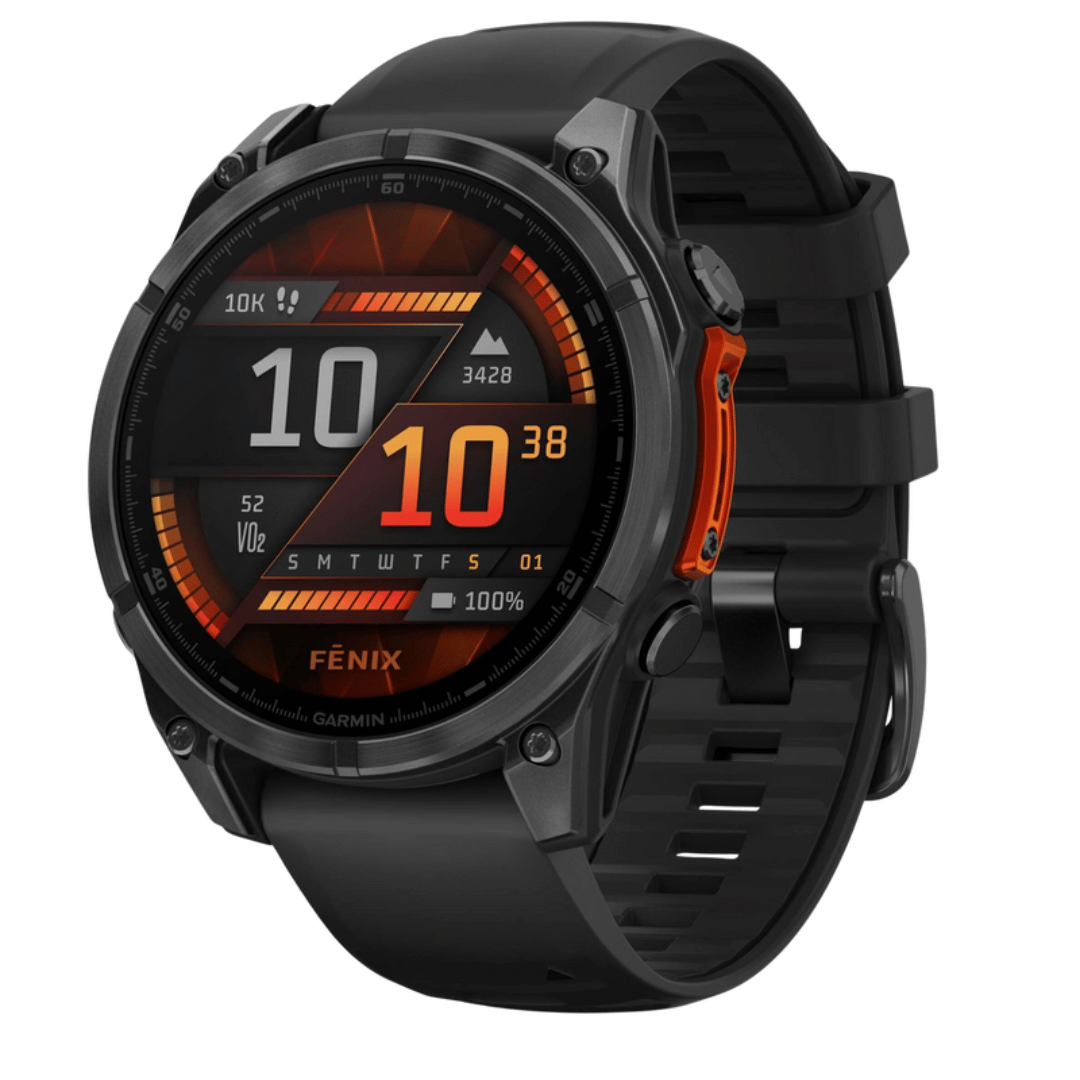
The Fenix 8 AMOLED is the current standard-bearer of ABC/GPS fitness watches. It offers similar guts and sensor technology as the Garmin Epix Pro 2 (including multiband/L5), but with a modified (simpler) user interface and a new codebase. Recent firmware updates in late 2024 have improved responsiveness, battery life, customization features, and usability.
Trail Steepness vs. Difficulty
- Hiking difficulty cannot be accurately predicted using elevation gain and mileage alone.
- Metabolic cost does not scale smoothly with slope; human locomotion shifts across distinct physiological and biomechanical regimes.
- Mild downhill (≈ -5% to -10%) often produces the lowest metabolic cost due to gravitational assistance with minimal braking demand.
- Moderate uphill is governed by aerobic steady-state regulation, where speed is adjusted to maintain sustainable heart rate below lactate threshold.
- Mechanical power output on uphill terrain increases with body mass, pack mass, and vertical velocity.
- Steep uphill (≈ ≥20%) triggers biomechanical inefficiencies: shortened stride, increased vertical oscillation, reduced elastic energy return, and greater quadriceps demand.
- At steep grades, hikers down-regulate effort anticipatorily to prevent excessive metabolic strain, causing nonlinear speed reductions.
- Moderate downhill shifts muscular demand from propulsion to eccentric braking, increasing mechanical stress and cardiovascular demand.
- Eccentric contractions generate high force with lower oxygen cost but produce greater muscle microtrauma and delayed onset soreness.
- Very steep downhill (≈ ≤ -25%) becomes stability-limited, where speed is capped voluntarily to reduce fall risk.
- Transition points between terrain regimes create disproportionate time penalties that smooth mathematical models fail to capture.
- Time estimation errors cluster at biomechanical thresholds rather than across gradual slope changes.
- Aerobic fitness, pack weight, technical skill, and risk tolerance shift individual transition points.
- Backpacking performance is governed by concentric vs. eccentric muscle work, aerobic vs. threshold metabolism, gait mechanics, and neurological regulation.
- TRIPS parameterizes these regimes explicitly using grade-dependent power regulation, braking costs, and stability constraints to improve time and energy prediction accuracy.


Discussion
Become a member to post in the forums.
Companion forum thread to: Episode 144 | Trail Steepness vs. Difficulty
How physiology and biomechanics shape hiking effort across terrain – and why slope doesn’t predict time or energy linearly.
Share an experience where you have been surprised by how long a trail took to hike because of unexpected grade or other types of terrain difficulty.
This was a great podcast. I just got back from a trip hiking on a ridge above the desert. No trail, constant obstacle avoiding, backtracking, coupled with a few very steep sections-1,600ft/mile. On any clearing(not many) I sped up as fast as safe and at the end of 5 hours without a break, I had gone 5 miles. Mentally fatigued more than physically from non-stop problem solving.
Ryan, you speak in the podcast about modeling the relationship between terrain and outcomes of interest (for example, one’s pace) in a non-continuous way. In particular, you speak about the importance of thresholds that mark the transition from one regime to another—for example, from “mild uphill” to “moderate uphill.” But you say little about how to identify these thresholds. Presumably, they vary from person to person. But how do you go about identifying these thresholds when you do your modeling?
The toughest hike that I have experienced was Cinca Terra in Italy (hut to hut trip). Not far but the accents were steep (up to 50% grade) and almost all of it were rough stone stair stepped. They were not uniform in height or width. On the second day, I experienced leg cramps in both legs and that is something I never experienced while backpacking. Once I got some electrolytes in my it helped with the recovery. I thought that it would be an easy trip because “hey, I’m only day hiking”. The week before, we were backpacking the Dolomites Alta Via 1 and that was a breeze compared to the Cinca Terra.
FYI – it would be nice to include chapters (timestamps) in the Podcast
John B wrote:
Excellent question. The main differentiator is this:
Mild = there is a linear response between grade (steepness) and heart rate.
Steep/Severe: there is little meaningful relationship between grade and heart rate because the grade is limiting you biomechanically (e.g., steep downhill) or metabolically (e.g., steep uphill) or both – one or the other or both is at their limit.
Moderate = the transition phase between the two, where ∆HR response starts to become nonlinear as your HR approaches its metabolic threshold or the terrain is limiting your biomechanical efficiency/speed.
Heart rate at metabolic threshold varies (higher for more trained individuals) and is unavailable from watch data. So use ~ 85% as a ubiquitous case?
Interesting. While backpacking I tend to periodically monitor my heart rate when it exceeds 140 bpm, I take a bit of a break and slow down a bit. That tends to be independent of slope or altitude. 140 bpm cap seems to work for me.
Doing a quick google search, their AI provided this:
An aerobic heart rate is the zone where you burn fat and improve cardiovascular endurance, typically 60–85% of your maximum heart rate. For most, this is found by subtracting your age from 220 (\(220 – \text{age} = \text{max HR}\)) and multiplying by 0.60 to 0.85. A 40-year-old’s aerobic zone is generally 108–153 bpm
The age method is pretty approximate. For example it assumes max heart rate is 220-age, which would be 159 for me, but its actually 180. The Tanaka/Gulati method gets closer but still not perfect. I found the best way to find it is HIIT which I try to do a couple times a week and it hasn’t dropped all that much after a year
The different heart rate zone estimation methods can have a surprisingly large variation between them. Karvonen calculation is supposedly the closest for back of envelope. When I estimate zone 2 using the classic method, I get 107 to 125 bpm, Karvonen gives 131 to 143. The Zone 2 Talk test lines up with Karvonen for me.
None of these zone estimation methods really predict lactate thresholds all that well. For that, you need the torture test
Become a member to post in the forums.