


Companion forum thread to: Episode 144 | Trail Steepness vs. Difficulty
How physiology and biomechanics shape hiking effort across terrain – and why slope doesn’t predict time or energy linearly.
Topic
Become a member to post in the forums.
 .
.
Companion forum thread to: Episode 144 | Trail Steepness vs. Difficulty
How physiology and biomechanics shape hiking effort across terrain – and why slope doesn’t predict time or energy linearly.

Share an experience where you have been surprised by how long a trail took to hike because of unexpected grade or other types of terrain difficulty.

This was a great podcast. I just got back from a trip hiking on a ridge above the desert. No trail, constant obstacle avoiding, backtracking, coupled with a few very steep sections-1,600ft/mile. On any clearing(not many) I sped up as fast as safe and at the end of 5 hours without a break, I had gone 5 miles. Mentally fatigued more than physically from non-stop problem solving.

Ryan, you speak in the podcast about modeling the relationship between terrain and outcomes of interest (for example, one’s pace) in a non-continuous way. In particular, you speak about the importance of thresholds that mark the transition from one regime to another—for example, from “mild uphill” to “moderate uphill.” But you say little about how to identify these thresholds. Presumably, they vary from person to person. But how do you go about identifying these thresholds when you do your modeling?

The toughest hike that I have experienced was Cinca Terra in Italy (hut to hut trip). Not far but the accents were steep (up to 50% grade) and almost all of it were rough stone stair stepped. They were not uniform in height or width. On the second day, I experienced leg cramps in both legs and that is something I never experienced while backpacking. Once I got some electrolytes in my it helped with the recovery. I thought that it would be an easy trip because “hey, I’m only day hiking”. The week before, we were backpacking the Dolomites Alta Via 1 and that was a breeze compared to the Cinca Terra.
FYI – it would be nice to include chapters (timestamps) in the Podcast

John B wrote:
In particular, you speak about the importance of thresholds that mark the transition from one regime to another—for example, from “mild uphill” to “moderate uphill.”
Excellent question. The main differentiator is this:
Mild = there is a linear response between grade (steepness) and heart rate.
Steep/Severe: there is little meaningful relationship between grade and heart rate because the grade is limiting you biomechanically (e.g., steep downhill) or metabolically (e.g., steep uphill) or both – one or the other or both is at their limit.
Moderate = the transition phase between the two, where ∆HR response starts to become nonlinear as your HR approaches its metabolic threshold or the terrain is limiting your biomechanical efficiency/speed.
Heart rate at metabolic threshold varies (higher for more trained individuals) and is unavailable from watch data. So use ~ 85% as a ubiquitous case?
Interesting. While backpacking I tend to periodically monitor my heart rate when it exceeds 140 bpm, I take a bit of a break and slow down a bit. That tends to be independent of slope or altitude. 140 bpm cap seems to work for me.
Doing a quick google search, their AI provided this:
An aerobic heart rate is the zone where you burn fat and improve cardiovascular endurance, typically 60–85% of your maximum heart rate. For most, this is found by subtracting your age from 220 (\(220 – \text{age} = \text{max HR}\)) and multiplying by 0.60 to 0.85. A 40-year-old’s aerobic zone is generally 108–153 bpm
The age method is pretty approximate. For example it assumes max heart rate is 220-age, which would be 159 for me, but its actually 180. The Tanaka/Gulati method gets closer but still not perfect. I found the best way to find it is HIIT which I try to do a couple times a week and it hasn’t dropped all that much after a year
The different heart rate zone estimation methods can have a surprisingly large variation between them. Karvonen calculation is supposedly the closest for back of envelope. When I estimate zone 2 using the classic method, I get 107 to 125 bpm, Karvonen gives 131 to 143. The Zone 2 Talk test lines up with Karvonen for me.
None of these zone estimation methods really predict lactate thresholds all that well. For that, you need the torture test
Become a member to post in the forums.
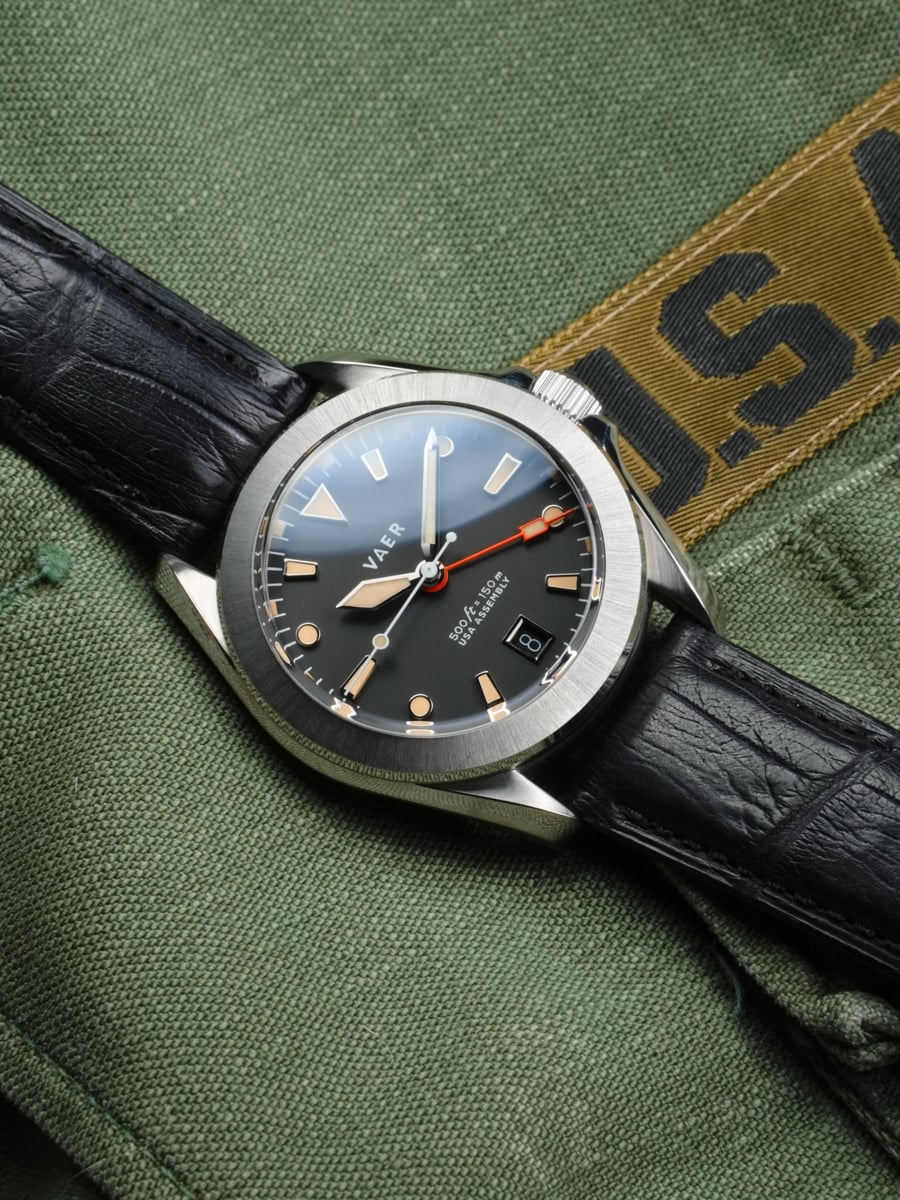 A Cult-Classic GMT Reimagined for Everyday WearInspired by the famously bezel-stripped Rolex GMT-Master worn by Marlon Brando in Apocalypse Now, the G2 Apocalypse turns a piece of 1970s film and watch history into a practical everyday GMT. Its restrained 39mm design pairs a Swiss Ronda quartz GMT movement with sapphire crystal, 150 meters of water resistance, strong BGW9 lume, and USA assembly. The result is an accurate, low-maintenance travel watch with a story collectors will immediately recognize.
 © Beartooth Media Group Inc.
 Loading...