

Episode 143 | Managing Fatigue
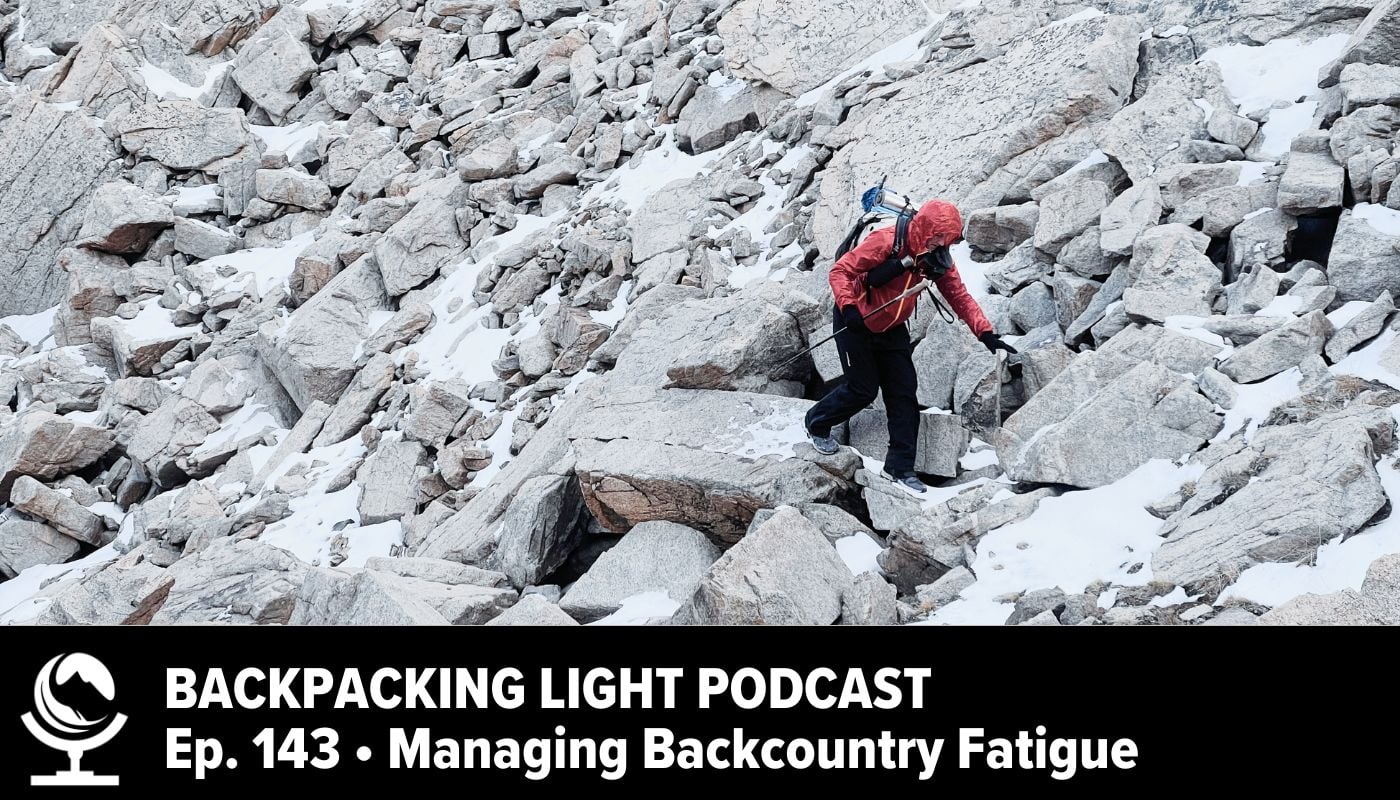
Episode Summary
This episode presents an operational framework for fatigue management in backcountry travel grounded in a non-circular load–fatigue–capacity model. Load is defined as external demand, fatigue as accumulated physiological and cognitive degradation, and remaining capacity as current ability. Risk is treated as the ratio of current load to remaining capacity. The discussion emphasizes field-relevant behavioral levers that reduce load, slow fatigue accumulation, and improve recovery.
Listen Now
together with Brynje

Today’s episode of the Backpacking Light Podcast is sponsored by Brynje, home to the most sophisticated and effective baselayers available - modern fishnet fabrics made with polypropylene or merino wool.
Show Notes:
What’s New at Backpacking Light?
- Event: Trail Days Online! 2026
- Masterclass: Backcountry Weather, Streamflow, and Snowpack Forecasting – New in the Archives!
- Check out our new forums for Member Gear Swap, Member Gear Reviews, and Member Trip Reports.
- Find information about all of our upcoming Member Q&A’s, Webinars, Live Courses, other live events, and more on our Events Calendar Page.
Managing Fatigue
- The difference between load and fatigue
- How to estimate remaining capacity during a long day
- Acute vs chronic fatigue on multi-day trips
- Why descents often create more fatigue than climbs
- Managing cognitive load in complex terrain
- Using time-of-day windows to preserve margin
- How fueling errors affect late-day decision quality
- Hydration and its impact on internal load
- When to shorten a day instead of pushing mileage
- Recognizing early indicators of declining capacity
- Group dynamics and load redistribution
- How terrain choice changes risk without changing mileage
- Recovery practices
Links, Mentions, and Related Content
- Wilderness Skills: The Metabolic Cost of Bushwhacking: Brush Work, Impedance Work, and Hazard Work
- Wilderness Skills: The Metabolic Energy Mile Framework: A Systems-Based Approach to Measuring the Cost of Walking a Mile
- Wilderness Skills: Risk Management for Fringe Season Backpacking


Discussion
Become a member to post in the forums.
Companion forum thread to: Episode 143 | Managing Fatigue
This episode presents an operational framework for fatigue management in backcountry travel grounded in a non-circular load–fatigue–capacity model. Load is defined as external demand, fatigue as accumulated physiological and cognitive degradation, and remaining capacity as current ability. Risk is treated as the ratio of current load to remaining capacity. The discussion emphasizes field-relevant behavioral levers that reduce load, slow fatigue accumulation, and improve recovery.
At what point during a trip do you most often notice fatigue affecting your decision-making rather than just your physical performance?
Which lever — pacing, terrain selection, timing, fueling, hydration, or recovery — has most consistently changed outcomes for you in the field?
Have you experienced a situation where load exceeded your remaining capacity? What signals did you miss, or recognize too late?
Thinking on this I hit the physical wall first. If conditions are good and I’m on familiar trail, I’ll usually grind it out to my intended destination, otherwise I’ll stop at the first suitable spot.
I’ve overextended myself at various times with distance, fueling, and hydration all which impact my overnight recovery. I made a fueling plan change about 15 years ago and haven’t bonked since, and I think I’ve gotten my hydration plan dialed in, but being over ambitious on distance seems to be my Achilles heel and something I don’t recognize until I am in the thick of it.
The “fix” for that is to scale back and rework my hikes as needed.
Great advice in this one.
Hard day cutting snowshoe trails yesterday. The last back loop was just months of deep snow obliterating any signs of prior passage. I kept pressing to a next objective, post holing almost up to my knees in the snowshoes. Heart rate peaking. Stopping. Over and over. Just the next ridge, just the next bend. I eventually came to significant deadfall when this podcast sprang to mind.
I doubled back and made it out before sunset, calves burning and not hating myself for making it any more brutal.
Early on when starting out as a “backpacker”, people probably suffer from FOMO and summit-fever, but with even a modest amount of experience in the unforgiving wilderness, most of us outgrow that pretty quickly. And the people on this forum seem very experienced in general, we know intuitively when we’re about to make a bad decision.
I think that fatigue alone usually doesn’t have so much of a substantial impact on my routine decision-making, but it’s a secondary contributing factor to the challenge of making good decisions when facing adverse conditions, such as bad weather, difficult route-finding, injuries, etc., where the decisions can be hard.
Become a member to post in the forums.