

Episode 99 | How to Hide Your Food from Bears
Listen
Summary
In today’s episode of the Backpacking Light podcast we’re going to learn about how bears smell, and what you can do to hide your food from the nose of a bear.
In this Episode:
What’s New at Backpacking Light?
- Member Q&A Live Stream: Strategies for Hanging Bear Bags – March 21, 2024
- Sun Protection Webinar with Daniel Hu – March 27, 2024
- Submit your testimonials for the 100th episode of the Backpacking Light Podcast by March 16, 2024 for a chance to win an Unlimited Lifetime Membership!
The Cottage Gear Innovation Awards

- Kula Cloth
- FarPointe Outdoor Gear Alpha Cruiser Hoodie
- Durston X-Mid 1P Tent
- Nylofume Liners
- Lifetime Contribution Award – Henry Shires and Tarptent
- Submit your nominations for the Cottage Gear Innovation Awards!
Main Topic: How Bears Smell and What Can You Do About It?
- The differences between bears being food-motivated vs. food-conditioned vs. habituated to humans.
- The science behind food conditioning.
- Comparing the nose of a human, dog, and bear – more olfactory receptors means more odor sensitivity; size of olfactory receptors means more range of smell.
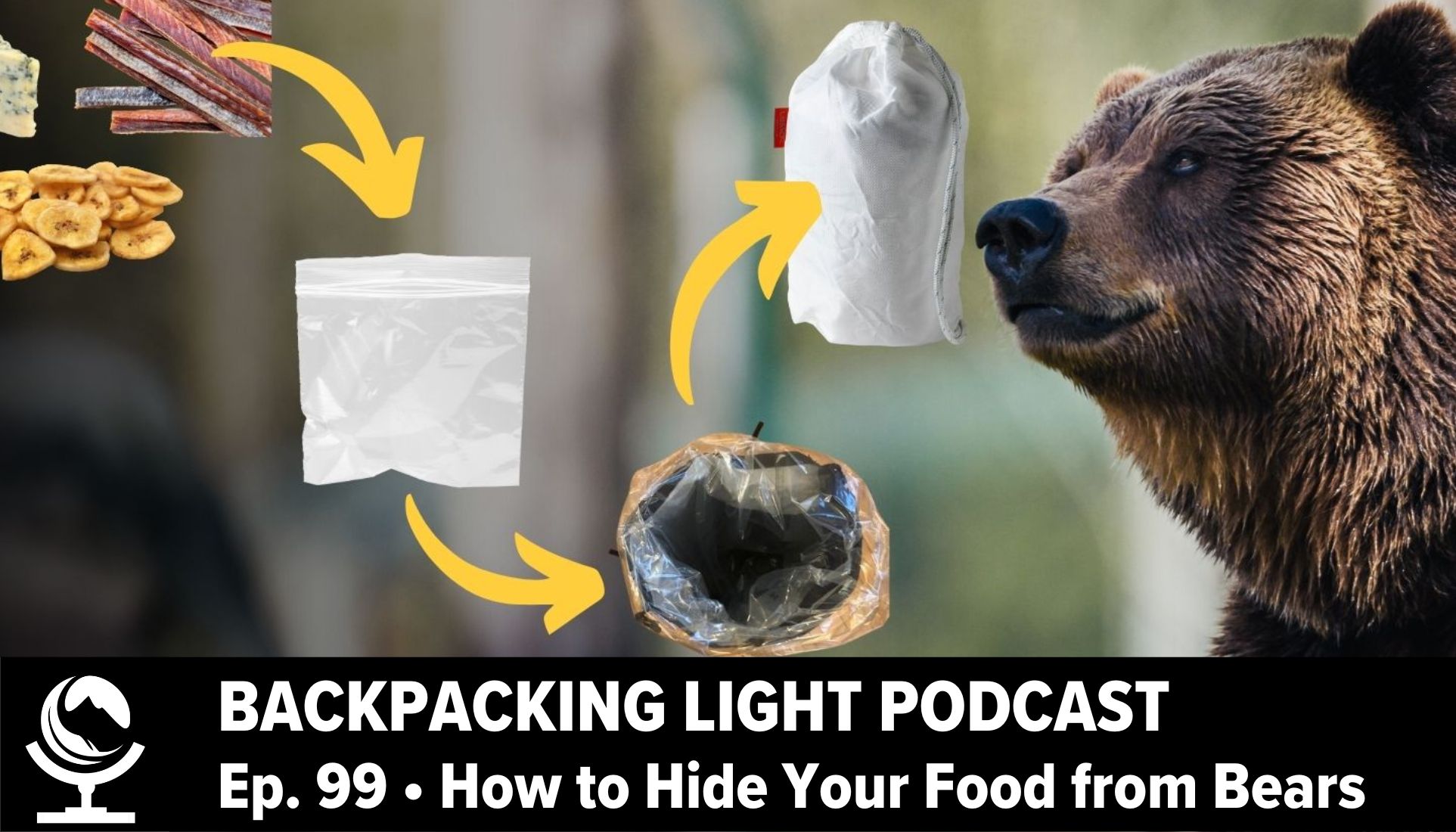
- By storing foods in a system using plastic ziploc bags, mylar bags, and Nylofume liners, and an Ursack or bear canister, you can reduce the range bears can smell the food down to 0.01% of what it would be originally.
- Keep the outside of your food bags odor free!
Links, Mentions, and Related Content
- Skills: How to Use an Ursack
- Trail Days 2024: The Nose of a Bear, by Ryan Jordan
- Webinar: Using an Ursack: Techniques and Supplies for Packing, Using, and Securing an Ursack
Submit a Tip, Trick, or Question
Share your tips, tricks, and questions on the podcast – submit it via email to podcast@backpackinglight.com.
Go Deeper with Backpacking Light
- Sign up for the Newsletter
- Become a Backpacking Light Member
- Follow us elsewhere on the web: YouTube | Instagram | Facebook
How to Subscribe
Apple Podcasts | Spotify | RSS
More Episodes
Backpacking Light Podcast Index
Credits
Executive Producer - Backpacking Light; Show Director and Host - Ryan Jordan; Producer - Chase Jordan; Theme music: Look for Me in the Mountains written by Chris Cunningham and Ryan Jordan, performed by Chris Cunningham (acoustic guitar, lead and harmony vocals, harmonica), Chad Langford (upright bass), and Tom Murphy (mandolin), produced by Basecamp Studios in Bozeman, Montana.
Feedback / Tips / Questions
podcast@backpackinglight.com
More Backpacking Light
Sign up for the Newsletter. Become a Backpacking Light Member.
Disclosure
Sponsorship Policy: Backpacking Light does not accept compensation or donated/discounted products in exchange for product mentions or placements in editorial coverage, including any podcast episode content not excplicitly identified as sponsored content. Some (but not all) of the links in these show notes may be affiliate links. Learn more about affiliate commissions, influencer marketing, and our consumer advocacy work by reading our article Stop wasting money on gear.


Discussion
Become a member to post in the forums.
Companion forum thread to: Episode 99 | How to Hide Your Food from Bears
In episode 99 of the Backpacking Light podcast we’re going to learn about how bears smell, and what you can do to hide your food from the nose of a bear.
I’d be interested in knowing what folks do in terms of “cooking hygiene” to keep food smells off the outside of their food storage bags.
I’m also conditioned to stop at In-N-Out Burger for a caloric reward.
Seriously though, I wasn’t aware Opsacks were that much better than regular Ziplocs. I totally believe it, but Opsacks don’t seem to have much durability. Regardless they’re probably worth the extra expense.
I believe there’s a fundamental mistake in the analysis predicting the distance from which a bear can detect the food inside various containers.
The analysis keys off of the fact that a bear can smell a rotting carcass from 1000 meters away. The analysis then proceeds to predict a bear’s detection of various containers based on the reduction (in percent) of odor concentration associated with that container system.
The flaw in reasoning is that we aren’t carrying a rotting carcass. I believe smelly foods were chosen for the example, but a carcass is really big (and probably more stinky unless they’re carrying some of my favorite cheeses).
Fortunately, the error pushes us towards ultra-conservative which is better than the reverse. Still, I’m often wondering what to do when I’ve just climbed into my bag for the night and I remember the gummy bear wrapper in my pants pocket.
I wonder if bears, in their evolutionary history, have developed an olfactory apparatus that mostly zeroes in, especially, and to a very fine degree, on the far-off faint smell of a carcass.
And I wonder if, upon entering a known human campsite, they simply use their eyes, and being fairly intelligent, simply recognize the obvious food bag or canister, and set themselves to work upon it.
I use Dr Bronner’s scent free soap with which to wash face, hands, dishes, and brush my teeth.
I think for a “table” I’ll use a 1.5 ft square piece of plastic sheeting, to be folded up and stored in it’s own ziploc.
I store rations in their individual ziplocs, each day’s rations in a foodsaver vacuum-sealed bag, all sealed bags stored in a large OPsak, stored in another OPsak, stored in the Ursack, and that stored in a zpacks waterproof food bag, and tie the Ursack in the thickets of the forest, somewhat hidden from an obvious view. Then when all that is done I cross my fingers. I’ll check out the Mylar and Nylofume bags.
I remember reading a study some years ago (sorry, I cannot say where it might exist) that claimed bears quickly and easily recognize things of a color that isn’t natural, like a yellow stuff sack or a bright orange hang line. I very rarely camp in bear country, but I immediately swapped out my “unnaturally colored” kit for a neutral “forest colored” kit and have never had a problem :) I almost always use a PCT bear bag hang.
Yeah…we humans smell. Especially after hiking. If we cook, the odors carry. If we light a fire, it’s the same as putting up a huge sign in the sky: humans, and their food, here. Humans also make a lot of noise and camp within predictable parameters. (Yeah, I know, camping off trail helps but below alpine levels…a bear will find you. they’d find you above alpine levels, but there’s no other food there, so bears tend to stay below.) Bears have an incredible sense of smell–beyond that of a Bloodhound.
I mostly hike in the Sierra. I always assume that, below 10,00 feet, a bear will find me, if one is in the area. I al also assume that bears know they can’t get into my canister, and will move on looking for easier pickings. And this approach has served me well. The bears understand there’s no food to be had in my camp; they move on–the next campsite is larger and folks are careless.
Heading to the JMT in a few weeks, with regards to my BearVault, would you trim a Nylofume bag and use it in the canister or just place the canister inside the bag and twisting the top when your ready to store away from campsite?
Become a member to post in the forums.