I think I would most certainly suffer hypothermia in a case like Murali’s with only thin nylon clothing, even with two layers of it. I simply could not hike hard enough to stay warm like that, and what if you can’t hike for some reason? I’ve been in similar weather in Alaska, for days on end, and wool plays a key role here. I also bring a lightweight balaclava, which has been a lifesaver in bad conditions. My backpack is always heavier here than anywhere else I hike, because I will not leave the warm layer behind. There’s also the necessity of carrying a way to make hot water to drink – as soup, tea, chocolate or whatever. I consider a stove critical. You can spiral down faster than you might imagine, once you are chilled. Vigorous calisthenics or hiking may help, but you may not have that option.
Topic
Reassessing my rain gear solutions
Become a member to post in the forums.
- This topic has 118 replies, 40 voices, and was last updated 1 week ago by .
Did you use the vents much or was everything zipped up tight?
Bill – the Copperfield wind pants or Zpacks wind shirt did not stick to skin during the cold rainy day….the top does do that sometimes when it is very hot in the evening as I am going to bed. The wind pants never seemed to stick. The lanyard trick sounds interesting.
On day 2 of the rainy/cold day –Â I had two wind shirts on – why two? one is strictly a pajama and one was for the cold mornings or summits – so I usually carry two. Pajama one stays in backpack. The other one stays in my pant pockets for summits etc. So I had the two wind shirts on, then puffy and then rain jacket – which is non-breathable nylon rain jacket. After a few miles, had to remove the puffy as I was warming up. So just had the two wind shirts and rain jacket. Since I was moving and knew I was going to a lodge for the night – I used the pajama wind shirt as well. My rain jacket has vents – but never needed to use them as it was cold. Day 2 was slightly warmer.
Day 1 which was much colder and crazy windy – I had an OR Echo hoody and then a wind shirt (has a hood) and rain jacket. I also had a neck gaiter which I pulled over my face which also helped shield my face from the cold. I think my core/head was okay. Just the fingers and toes were numb and causing issues. One of my fingers locked up towards the end and I was getting stiff as well if I stopped hiking to check my phone etc.
Once I got to the gazebo like structure and changed into dry clothes, I got better. It was heaven sent :-) I was dreading putting my tent up in the rain on water logged ground and then thinking how I was going to dry my rain jacket and pants. I could dry them as there were several nails on this gazebo like structure……I set up my tent on one of the two picnic tables inside.
I am going to have to try wind layers next to skin, as well as two layers of them. That’s a light system, and keeping one layer dry is nice. A textured windshirt (like the Pertex Quantum Air in Kor Airshell, OR Shadow, or Airshed Pro or Taslan/Supplex/Airwave) might feel nicer but will weigh more than the absolutely lightest wind layers.
One advantage of WPBs is that they dry while you wear them (after the rain stops or when you get sheltered). They are better at that than they are at moving moisture while you’re working hard. But there’s at least a small weight penalty, and some are not completely waterproof: tradeoffs.
Thanks for the interesting report.
The EE Rainpants, now discontinued, are a 2.5-layer construction. They have a thin PU textured inner coating that is designed, to a point, to be more comfortable against bare skin. The Montbell Versalite rain pants, which I mentioned in my prior post, have a similar inner layer and function similarly.
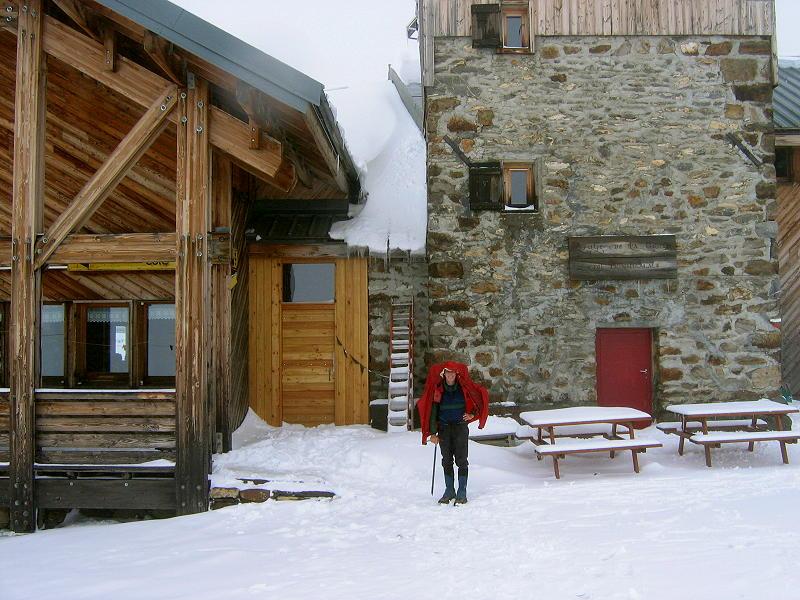
Generally, and especially if we are going uphill, we wear just an MYOG Taslan windshirt. If the weather is bad, we can put an MYOG silnylon poncho over that. It is enough. (We can button the poncho up to block the wind and keep heat in of course.)

Col du Croix de Bonhomme, France, SUMMER

Refuge de Col de Bonhomme – sheltered from the wind of course. Same clothing., but here I am a bit hot.
Cheers
The EE Rainpants, now discontinued, are a 2.5-layer construction. They have a thin PU textured inner coating that is designed, to a point, to be more comfortable against bare skin. The Montbell Versalite rain pants, which I mentioned in my prior post, have a similar inner layer and function similarly.
I’m still casually on the hunt for the “perfect” WPB jacket, but I’ve found that the Mountain Hardwear “Stretch Ozonic” rain pants are a winner. They sound similar to what you described – a 2.5L fabric that wears exceptionally well. The 3/4 length, bi-directional zippers are nice. I leave unzip the cuffs so that they’ll lay nicely over my shoes, and unzip the thigh a few inches for ventilation. I also liked that they were available in not-black colors as well. I got them in Grey.
Mountain Hardwear, Stretch-Ozonic Pants
While I bought them initially to layer over other pants for working in bad weather, I’ve found them to be comfortable enough on their own, that I’ve worn them several times now as my “main” pants when the weather is iffy. My regular synthetic boxer-briefs underneath is all that’s needed for all-day comfort in these, wet or dry weather…
Perhaps it’s because most men (speaking specifically of myself here) have hairy legs, but I find the 2.5L fabric still feels fine, and not clammy against the skin. Perhaps women with shaved legs would feel differently? That said, I could see them being great for women when the base layer is a pair of standard leggings or so.
.
.
I do wish they had (2) zipper pockets, but I get along well enough with just the one. The DWR was a little questionable when I first got them, but to be fair, I ignored the instructions about washing & drying them before wear, and kind of chased my tail there for a while.
I recently did a full re-treat with NikWax spray. Soaked the garment, scrubbed it in, and then sealed it in a zip-lock bag for a few hours to make sure that all of the face fabric was saturated. Then let it air-dry, before a 20-minute “medium” heat cycle in the dryer.
They took forever to air-dry, which I thought was encouraging – knowing that the Polyester face-fabric is hydrophobic, I felt like them wanting to stay “wet” with the NikWax was a sign that the treatment really “stuck” to the face fabric well.
My very quick test with a kitchen-sink’s spray-nozzle showed amazing water-beading. So I’m excited to try these out for real.
.
.
(This also has my brain working again, on the topic of Nylon vs. Polyester face-fabrics, and the Fabric-Hydrophobicity / DWR performance again…)
Well I ran an experiment today. I needed to go up into the mountains to bring back some game cameras I set up to learn more about moose. I decided to wear a rubber Columbia raincoat I found at a thrift store. I would guess the temps were right around freezing. I wore a thin nylon t shirt, a longsleave nylon shirt, and the raincoat. I carried a rifle, and a pack that was maybe 15 pounds or so. I zipped up the raincoat but did not wear the hood. If I had to hike in rain with a non breathable raincoat I would probably wear a brimmed waterproof hat to this was a good test.
I hiked for maybe 2 hours, up and down mountain game trails. I was not moving the whole time. I stopped to shoot a grouse (delicious!), and to take pictures. I did not feel like I was “over heating” as I hiked. Maybe a bit clammy but not warmer then when I wear a normal raincoat.
The big surprise was when I stopped hiking and took the raincoat off. My longsleave shirt was soaked, as in almost wet enough to wring moisture out of. I guess what happened was that condensation built up even though I did not feel overly warm. This was noticably wetter then I normally get in rain gear and I was pretty chilled afterwards.
For comparison, I hiked harder and longer the day before in a windshirt and was sweety enough I stunk but nowhere near that level of moisture on my shirt. I cannot think of a time I’ve hiked in a WPB raincoat and got that soaked from condensation, some but not that much.
I’m back to thinking WPB raincoats are the least bad option. A winter project is to create a relatively scientific test of raincoats in a shower. I think I’ll set up a stand in the shower and leave raincoats in there for a set amount of time over a cotton hoody and then weight the hoody to see how much moisture weight it gained. We have an old and new Goretex raincoat to try, and my newer military surplus raincoat. If I can get an older one to leak I’ll try the Nikwax treatment and test it again to see how much it helps.
This will not test condensation obviously, but at least we’ll know if the raincoats are leaking.
Oh, fun fact. I caught blurry images of a wolf pack on one of my cameras. One wolf is black so it appears to be the same pack I saw last winter. Funny thing is I never hear them howling in spite of spending a ton of time out in that area.
Your wolves know when they’re near people who might shoot them! No howling!
it is so hard to get a shower test that correlates with reality
I like the two field experiments – rubber coat vs WPB. Since there are uncontrolled variables the data is noisy. You have to repeat several times and see if there is a repeatable difference between the two test cases. But, it captures any real world conditions.
Yeah, I think WPB is the least bad option. Some WPBs are better, some are worse.
Hi Luke, that’s exactly what I found leading me to revive this thread. Warm but soaking wet in the 3FUL sleeved poncho (not WPB).
News to me was that having the rain gear over the pack (poncho) so it can bellows and an open front zipper wasn’t enough to avoid getting soaked from sweat with hard work, without the breathability offered by open sleeves and side slits of a true poncho which leave me far drier in the same conditions.
WPB? Waterproof barrier or waterproof breathable (AI definition)? I’ve always, perhaps incorrectly, used the first definition.
There is no single definitive test for evaluating waterproof performance. The typical HH test distorts the fabric so much that it is difficult to interpret its value. I think the real issue is that the test was invented and standardized before WPB fabrics were even considered. The biggest problem with a shower test is that water contacts the fabric as a stream, not discrete, randomly timed drops of specific size and mass. Shower tests are also subject to condensation on the interior. Other industry-standard methods don’t replicate drop speeds because the height of the water-drop mechanism doesn’t allow raindrops to reach the terminal velocity seen in real life. My approach to shower tests can be seen here. My latest article should be published shortly. It reviews the current state of the WPB market and takes a deep dive into breathability mechanisms and tests that may mislead your purchasing decisions. WPB is the least bad option, but there is a wide range of performance options, and you will see the best I have found (and the worst).
I was wrong. A waterproof barrier is I used in construction.
I understand that a waterproof breathable fabric depends on internal pressure to push out water vapor. The fabric should preform best in a closed system with no ventilation whatsoever. Some exercise should increase the pressure, providing maximum breathability. Until the pressure increases.
Like a traffic jam leading into a tunnel . Entropy at the other end with the cooling effect of a ventura.
In the end a rain jacket depends on ventilation. Passive or mechanical. Arm pit zips are an example of both, though often not enough. A bellows will give you a complete change of air. A barrier is much more resistant to wetting out.
I had not thought about the velocity of the rain drops. I remember years ago I walked into a hard rain in West Virginia just to get something out of a vehicle and my shoulders got wet almost instantly. It was some kind of sample raincoat I picked up at a discount store in Denver. I think it was Sierra Designs so not junk. Others times it appeared water proof.
Sierra Designs rain gear varies sharply in quality. Technical pieces from outdoor shops (like the Pack Trench or Elite Cagoule) offer innovative mechanical ventilation and pack-friendly designs, while budget or big-box lines (like mass-market budget items) suffer from low waterproof ratings and poor durability. [1, 2, 3, 4]
I had a Sierra Designs raincoat. I gave it away. They’re still mad at me.
I have a Sierra Designs Elite Cagoule and chaps. Picked them up new on eaby probably 6 or 7 years ago. I’ve still never used them. I like the design though.
I have a pair of REI e-Vent rain pants because nothing else as waterproof breathes as well. Rain pants are notorious for feeling like they are lacking breathability.
Otherwise maybe staying warm while wet is the only option, but with a rain “kilt”. That may mean thin polypropylene base layer pants.
Kuiu preformed well in Stephens testing. The Chugash TR rain pants have a lot of ventilation with 2 way leg zippers. They look and feel more like regular pants than my old eVent pair. Gusseted with articulated knees. Made long for boots. They can drag a little with trail runners. Not a deal breaker.
I tried a 3F skirt. I didn’t find it a good fit. Easy on and off over shoes, but so are the pants. With well ventilated pants, I don’t see much advantage.
Critter Mountain on Etsy is making me a pair of AD pants with a 12″ snapped ankle slit so I can get them on and off without removing my shoes. The rain pants will act as a wind break.
We can talk about kilts next summer. Then I probably won’t care.
Become a member to post in the forums.