


In any but the worst weather, or if I am carrying an axe, I don’t use the sleeves. I let them flap.,
Cheers
Topic
Become a member to post in the forums.
.
In any but the worst weather, or if I am carrying an axe, I don’t use the sleeves. I let them flap.,
Cheers

A four armed man carrying an axe.

Yeah, I sometimes don’t put my arms in the sleeves, so it’s more like a cape.
Well, yes, but two of the arms are a bit floppy.
Which two?
:-)
A poncho just doesn’t work for me going off trail through brush.
I tried an old rubberized raincoat today and quickly got steamed up. I do think vents would have helped. I’d like to try that approach.
To me the dilemma is that if i use the vents while it rains some water will get in. If i don’t use vents I expect to get wet from condensation. So I don’t know if a well vented non breathable jacket is “better” then a typical WPB (at least one that isn’t worn out). But a 8 oz jacket with no DWR to wear out sounds appealing even if it get roughly as soggy either way.
The best raincoat so far has been a 2 pound Army surplus GoreTex. It seems to be made of a heavier fabric and high wear areas have extra layers. Because its pretty stiff it seems to vent out faster when I loosen it up and also sheds water better. It has large vents. If I am going to be living in the rain all day this layer over a fleece is my go too.
But if I am carrying 2 pounds I could theoretically have an 8 oz nonbreathable jacket (AntGravity Gear etc) for down pours or abrasive brush, a cheap “breathable” raincoat that weighs 8-12oz to use when I’m really active and an 8 oz tarp to take breaks under in the rain. That doesn’t fit with my old UL style but I like the flexibility. Or I might just keep buying a $60 surplus raincoat every couple years.

I have a Luke’s Ultralight shell with pit zips that moves the zips more to the arm rather than deep into the body. I seem to recall his reasoning was twofold: 1) ventilation deeper than your shoulder straps doesn’t vent well and causes 2) more leaking. The solution worked really well other than I purchased it in too light a fabric and then had a laundry accident.
Shout out to the Packa for providing such effective mechanical ventilation by floating over the shoulder straps. It’s a wonderful design with absolutely weird sizing imo. It’s have it in 20d (iirc) with taped seams which is the one to have imo but I wish I had it in a smaller size.
I was worried that thick scrub would damage our silnylon fabric, but that did not happen at all. The reason was that everything was so wet that the slinylon fabric just sort of slid off or over the scrub – lubricated, as it were.
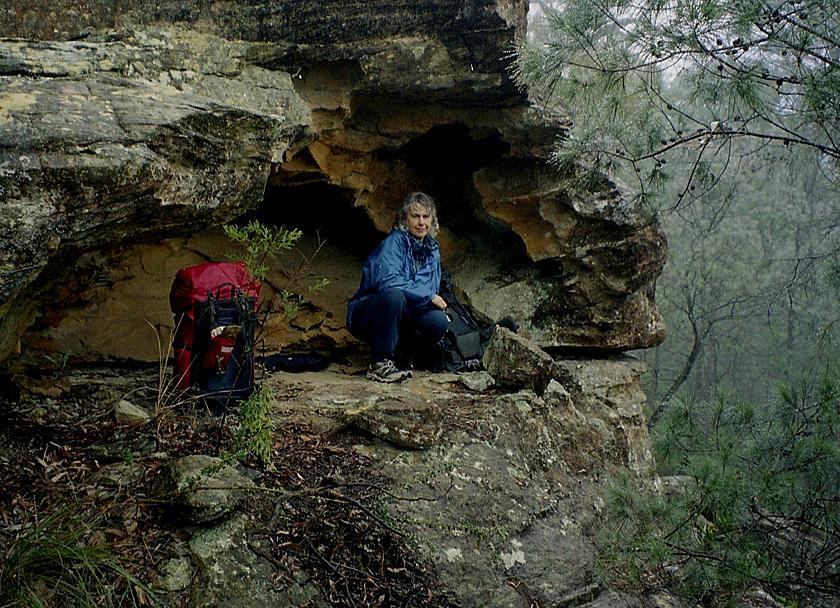
This was morning tea under an overhang, in heavy scrub and rain. We did put more clothing on as soon as we stopped of course. Yes, of course we were wet! But we stayed war.
Cheers
A little projection over the floppy arms. I’m getting ready for Halloween.
I have a couple shells from Luke. It is easy to vent with the zipper positioned on the arm. I have front pocketless zippers on one, but not the other. I realized I missed them. It’s nice to reach interior pockets for warmth or storage. The longer pit zips on the Packa account for this, serving two functions.
I could have gotten a smaller size. I think it would be more like a jacket, while larger is more like a poncho. I could fit two of me into the largeX. I think I’ll learn to appreciate the bagginess.
Better protection over my hands. Very good airflow. I had it outside yesterday. A high UV 78* cloudless day and found it still pretty comfortable with a slight breeze or using it like a bellows.
I do feel like a cliff diver. Especially in cloak mode. Its still more manageable than a poncho.
Terran if you have used Luke’s Ultralight silnylon a lot I’d love to hear your thoughts.
Most reviews I’ve seen of silnylon raingear go something like this
“Great customer service and/or stitches..” nice but irrelevant to the design and then “It kept me bone dry the one day it rained on my big hike” well nice but any quality raincoat could do that when it is brand new.
A good raingear review should tell me…
How active I could be in it before getting sweaty assuming I’m not over dressed. I.e can a normal human hike up a trail in say 60 degrees without getting soaked by sweat?
How long I could use it before it breaks down in some way. This is hard to quantify because there are lots of variables but things do wear out.
Obviously these things are hard to measure but anecdotally I can report the following to help provide a comparison…
With proper layers, all half-decent WPB layers breath well enough that I can hike like a normal human on a trail with manageable sweat in normal temps for Alaska or the Rocky Mountains in summer. Vents help but I’ve survived without them. If I got steamed up on an uphill I could slow down a bit and cool off. This covers multiple WPB coats and serious hiking and outdoor jobs going back to 2006.
I get somewhat wet from sweat and from water working its way up sleeves, through the face opening etc. But this is definitely NOT as bad as an actual leaking raincoat (more on that later).
You can minimize water entry by wearing a brimmed hat over the hood of a raincoat and not using your trekking poles. Pushing through dense brush lets more water in through all openings.
Some raincoats have definitely leaked. Worst was a newer version of the Columbia Outerdry. The original was great, the new one felt different and leaked after minimal use. I felt like i was hiking in a soaked through windbreaker. Noticeably worse than normal.
All raincoats have worn out eventually. Thinner ones go faster. I have Rab rainpants that clearly leak through all the fabric like a non waterproof wind shell after hiking through wet grass. Abrasion is bad obviously and pants get more of it. On the flip side, a 12 or 13 oz North Face jacket worked for multiple short trips 2013-2015 and it seemed to be working pretty well after a long mostly off trail hike in Canada with lots of rubbing on devils club. I think I lost it before deciding it was worn out. I’m sure it leaked a bit but not enough to notice over the normal dampness from sweat and water entry through arms etc
So my conclusion is WPB is not junk but it breaks down for sure and has limits. But good stuff lasts long enough to keep you mostly dry in real rain across multiple trips, probably multiple years for an average hiker.
Where does this leave me? Well I’m going to keep using what I have and treating rain gear as something that wears out after a while just like shoes.
I’d love a long term review of a well vented silnylon raincoat covering long term durability and how condensation compares to a WPB layer under similar conditions. It appears from reviews that silnylon jackets can wear out (not surprising). Whether they could be recoated better then a WPB raincoat is an interesting question. How well they work while hiking in rain (i.e. not fully vented) is a question for me. Roger’s poncho is interesting but I don’t think any poncho would work for the off trail stuff I do. Lots of climbing over logs, crawling etc. Raingear needs to not flop around to work for me.
I have a Pertex and an eVent shell from Luke’s. He had mostly good reviews. That was a few years ago. I believe he passed away.
Not much experience with sylnylon my other than a past tent.
Following the bear trails isn’t bad. When the turn into rabbit trails and you’re crawling through. The cats claw will grab on. I’ll take the buckthorn over the manzanita.
I don’t do much of that anymore. I do think a poncho more so maybe the Packa is much more manageable than my prior preconceptions. Most damage I seem to get on my outerwear is on the arms and cuffs. If I’m crawling under branches, it doesn’t matter what I’m wearing, I’m taking a chance. The sylnylon seems pretty strong.

Yes, people have unfounded fears about ponchos. A belt solves most wind problems—sleeves solve the rest.
And aren’t ponchos standard in jungles? Clearly bushwhacking in a poncho is fine. If you’re concerned about UL fabric, then a military poncho should address that.
I tried a tradituonal poncho for a while. My opinion could be summed up as “terrible.” With or without a belt, water worked in and I got wet in real rain. Sleaves and closed sides would solve that but then we aren’t talking about a poncho so much as a real loose raincoat. A really loose raincoat sounds promising but only on trail. If you have things like loose fitting sleeves, pit zips etc (to get venting) you end up with water working in there if you go through brush or lift your hands over your head.
I have no idea about ponchos in the jungle. Obviously in WWII they were a thing but then GoreTex didn’t exist.
Yep, you are going to get wet. Fact of life.
Cheers
The Packa zips up tight. It cinches at the neck, around the face, and at the waist. It’s extra long and covers the waist with extra length in the back. The arms are long and cover my hands and can be cinched completely closed. While described as a poncho, mostly it’s wide, at least my large is, the sides can be partially opened up. With a two front zipper, it can be worn like a cape. It can be deployed without removing your pack. It looks like a poncho. It’s a jacket.
Roger the poncho was really bad, not the normal soggy from hiking in rain. Ridiculously wet after an afternoon thunderstorm (nothing like you get there or a bad day in Alaska). Your poncho or a Packa would have been way better I’m sure.
Hi Luke
Did it leak perhaps?
Cheers
No Roger , I clearly remember getting wet from the arms inward during a short rainstorm, I think I just had a very narrow strip down the middle of my chest and back that was dry at the end. That poncho was fine when I used it as a tarp.
Part of the problem was I was hiking with poles, more traditional guys with ponchos probably didn’t. So my arms went up and down which lets water run down them, and that upward motion lifted up the sides of the poncho which probably opened up the side for rain to blow in.
Something similar happens with a raincoat (water going down my arms if I lift them) but not as bad.
Hi Luke
I have to agree. There are several major water leak points in any such clothing, be it poncho or jacket. Two wrists leak badly, one neck opening leaks just as bad, and in bad weather water even comes up from the hem.
You are going to get wet.
(Roger)
Cheers
So on my recent outing on the PCT for 42 days – the last 2 days rained like crazy (Sep 1st and Sep 2nd). It was extremely windy and cold as well. I had my Lighthear gear rain jacket and rain pants. Both worked. The only problem areas were hands (had waterproof gloves) and non-waterproof trail runners which were wet. The waterproof gloves were on my regular OR gloves – didn’t work that great as you have to keep removing the gloves for various reasons – filtering water, checking phone, pooping etc…the inner gloves got really wet. So fingers and toes were numb towards the end of the day. Lunch food bars were frozen slightly – it was that cold. Luckily I reached a gazebo like area for the night – so could move around under that structure without any rain falling on me. I thought I was getting hypothermia towards the end of the day…as it was whole day rain and cold wind. I did manage to do 25 miles – in spite of the 25 miles in constant rain/wind, the Lightheart gear worked!
Had dry pajamas (which is really a Zpacks wind shirt and EE wind pants), dry underwear and dry socks to wear for the night. Hung my hiking clothes to dry. But since the gazebo like structure was open to the elements, the hiking clothes never dried – and it was so cold especially in the morning at 4ish AM – that it felt wet still. Didn’t feel like putting on my cold or wet hiking top. So, I actually used my Zpacks wind shirt instead of my regular hiking shirt and then my rain jacket which had dried overnight. I used my puffy as well which I removed after 2 or 3 miles as I was overheating. My EE wind pants went on first, then hiking pants and dry rain pants.
After some 20 miles I reached Callahan’s lodge – where I removed my rain pants and rain shirt. I found my wind shirt and wind pants were completely dry – even though I did 20 miles that day.
So I do think you can wear the wind shirt and wind pants as base layers with rain jacket/rain pants over them and hike the whole day – it should stay dry and even if it got wet, I feel it will dry in no time or overnight in your sleeping bag or under your sleeping bag.
I think that is what I going to do going forward. If it is whole day rain – keep the hiking clothes inside the backpack and just used the wind shirt and wind pants with rain clothes. My pajamas are actuall wind shirt and wind pants. I will just buy an extra pair of wind shirt/wind pants to use as hiking clothes for full day rain days.
Yeah an extra layer of clothes can be worth it at times. I had not thought about wind layers. I like a tight fitting nylon shirt. Body warmth usually dries it fast.
Touch screens: I sometimes wear a stylus on a lanyard around my neck when I expect extended rain or extreme cold. It reduces the number of times that I have to take off my gloves/mittens.
Alternatively, oversized nitrile gloves over thin fleece liners sometimes works on my phone. It’s not super reliable, but often works well enough to get by without removing them. I like 5 mil gloves or thicker… they are easier on/off and more durable.
If I need a bare digit to work a phone or watch, then I usually just pull the glove over my thumb. It doesn’t require special gloves/mittens and is easier than taking the entire glove off.
Does Copperfield/Tachyon stick to sweaty/humid skin? Doesn’t sound as pleasant as more structured fabric (Taslan/Supplex/Ferrosi/Pertex Quantum Air (Kor Airshell/Airshed Pro)/RSBTR Airwave). But it’s super lightweight.
Become a member to post in the forums.
 New Gear with Aluula FabricsLighter, stronger, more abrasion-resistant, and highly water-resistant - explore ultralight backpacking gear made with ALUULA Graflyte fabrics. Engineered for exceptional strength, durability, and lightweight performance, ALUULA Graflyte helps reduce pack weight without sacrificing reliability, making it ideal for demanding backcountry adventures.
 © Beartooth Media Group Inc.
 Loading...