Topic
How does a Quilt’s Pad Attachment System Influence its Heat Loss Resistance?
Forum Posting
A Membership is required to post in the forums. Login or become a member to post in the member forums!
Home › Forums › Campfire › Editor’s Roundtable › How does a Quilt’s Pad Attachment System Influence its Heat Loss Resistance?
- This topic has 35 replies, 11 voices, and was last updated 3 hours, 50 minutes ago by
Terran Terran.
-
AuthorPosts
-
Nov 27, 2025 at 11:50 am #3844549
Companion forum thread to: How does a Quilt’s Pad Attachment System Influence its Heat Loss Resistance?
This study quantifies how quilt pad-attachment geometry affects convective heat loss. Using a controlled thermal surrogate, standardized wind exposure, and time-constant (τ) modeling, we compare free-floating, strap-based, and sheet-and-shingle systems. Results show that tighter pad coupling preserves a substantially higher fraction of still-air thermal resistance, especially under modest side winds.
Nov 27, 2025 at 3:05 pm #3844558That is a great idea. Much easier than, for example, using a guarded test plate
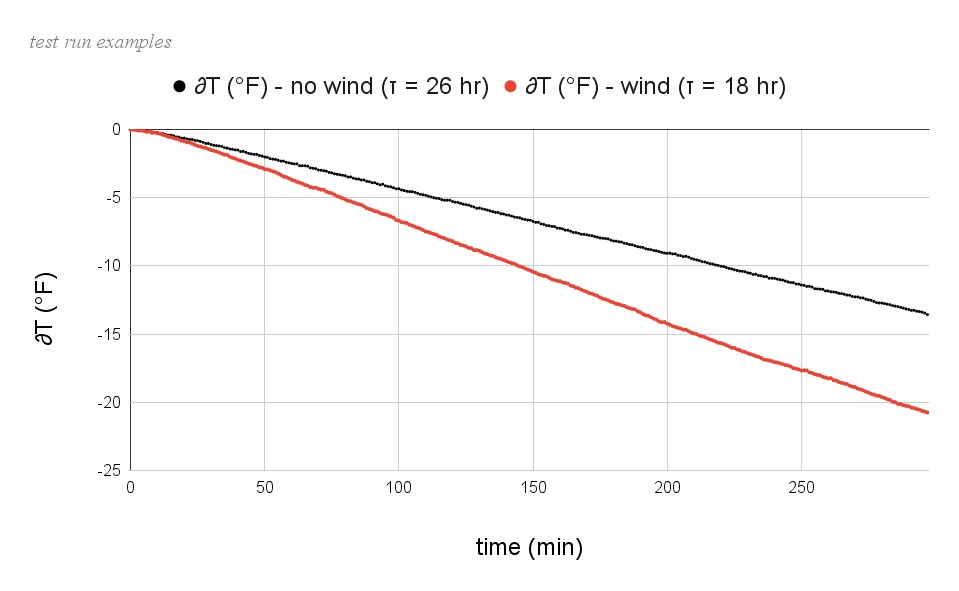
In the section labeled “data processing” you use the upper case greek letter delta (delta T = T res – T amb). In the plot you use the lower case greek letter delta.
I assume those are the same?
Then you say that delta T = delta T0 * exp(-t/tau). That function would have a value = T0 at t=0 and then transient down to a value of 0 for large t.
But the plot has a value of 0 at t=0 and linearly decreases with time.
So the plot is not delta T0 * exp(-t/tau). What is that plot?
So upper case delta and lower case delta must not be the same.
lower case delta must be the log of upper case delta?
Nov 27, 2025 at 3:21 pm #3844560then your tau is the amount of time it takes for the temperature difference to drop to T0 * 1/e
where e is euler’s number, the base of natural logarithms, equals 2.71…
1/e = 0.37…
so tau = the amount of time for the temperature difference to drop to 0.37 * T0
T0 = the initial temperature difference
The R value of the insulation must be proportional to tau?
Mis-use of the term R value which is just conduction heat loss, your tau includes convective, radiation, evaporation
Nov 27, 2025 at 3:42 pm #3844563I just rough measured my torso as 8 x 12 x 26 inches = 1.4 foot^3 = 40 liter. Your bladder is 20 liter.
If you had a bladder the same size as a torso, then it would better measure the effect of air coming in the sides under the quilt. But you’re probably close enough. And then a real torso tosses and turns, but that would be tough to mimick.
I think this is a good job of trying to measure the effect of leakage of air under the edge of a quilt, which seems like a major problem.
Nov 27, 2025 at 8:19 pm #3844566Jerry –
In the section labeled “data processing” you use the upper case greek letter delta (delta T = T res – T amb). In the plot you use the lower case greek letter delta.
There is inconsistent labeling between the plot and the equations in the text. I’ll have an editor provide some clarification in the plot caption to clarify what you’re looking at in the plot. The plot ∂T = (initial reservoir temp at time zero) minus the difference between the reservoir and ambient temp at time t.
In theory, yes, R-value should be proportional to tau, but you are right – that would be a “system” R-value which doesn’t really have any physical meaning outside the process of conduction.
We have a 40L bladder as well but it’s too hard to carry from a hot water faucet to the test location – that sucker is heavy and awkward to move!
That said, we did try a few tests with the 40L bladder, and the relative difference in tau values between two tests (like a control vs. an actual test) was minimal, so we went with easier and faster (20L). At the end of the day, this is a comparative gear systems screening tool, not a physiological modeling tool.
Nov 28, 2025 at 4:51 am #3844568In conclusion, close the window. Simply relying on millions of years of empirical evidence.
Nov 28, 2025 at 7:43 am #3844572that makes sense Ryan
TT – yeah, this article is a bit obscure but it’s helpful to measure how much of an affect leakage under a quilt is. So that you can have the most warmth for the weight in your kit.
Any idiot can build a bridge that stands, but it takes an engineer to build a bridge that barely stands
backpacking quilts have only been a thing for 20 years?
Nov 28, 2025 at 8:32 am #3844573Conclusion. Click the link for a zenbivy. $750 for a 10 degree sleep system. I am clicking elsewhere for a 10 degree sleep system if I am spending $750. It doesn’t appear to save weight over a comparably priced 10 degree sleeping bag. In some cases the bag would be less costly. See Nunatak.
Nov 28, 2025 at 10:18 am #3844575One doesn’t always know what’s useful until it’s necessary. Finding a quantitative difference. Put up for peer review with transparency. Kudos to ZB for sponsoring the research. The acknowledgement did seem to almost appear as a conclusion. I doubt that was the point. It does set ZB apart as arguably a preferable quilt in subfreezing conditions. Above subfreezing, I imagine the difference gets smaller and smaller. Compared primarily to mummy bags at the low temperatures. The weight is accounted for by its features and the sheet, which is actually rather nice. In transparency, I was given a large 10* light bed which I replaced on my own with an xl 10* ultralight bed. On sale. I prefer the light bed, but it’s heavier and doesn’t pack well.
<p style=”text-align: left;”></p>Nov 28, 2025 at 11:44 am #3844579Jerry: My understanding is that Jardine had MYOG plans up in the nineties.
One of the first commercially available down quilts was Nunatak in 2002:
Go to bottom of article and see ‘Updates’
Nov 28, 2025 at 1:02 pm #3844582Yeah, “Beyond Backpacking” is 1992. My edition is 2002. An inspiration to me, affected a lot of stuff I’ve done.
Like the idea of quilts. But drafts from the side have always been an issue in my mind.
I’ve used Ray’s box bottom a lot. Hopefully he won’t be bothered I’m copying him : )
Nov 29, 2025 at 11:38 am #3844631OK, so there is a significant difference in the wind: physic works. No much of a surprise there. Since I normally sleep inside of a tent, I would be interested in the no wind conditions. Since you know the Delta T over T you can calculate wattage loss which would be interesting. Knowing that loss relative to your normal metabolic rate would be valuable. One thing that was not really discussed though was thermal management in that quilts can get too warm, and ventilation is a good thing. What works in colder temperatures may be terrible is warmer conditions. My 2 cents.
Nov 29, 2025 at 2:06 pm #3844635Reality Check. Using Ryan’s numbers and assuming a linear response from the Chart below, I estimated wattage loss

This assumes that the Delts T no wind was 11 F and in the wind 17.5 F.
I used the formula M*Cp*Delta T to get the energy loss and used the 250 minutes to calculate the wattage. The numbers come out as the followingHeat loss no wind – 34 Watts
Heat loss in the wind – 54 wattsAt rest, the body loses heat through four main mechanisms: radiation, convection, conduction, and evaporation. During rest, about 100 watts of heat is continuously produced by basic bodily processes, and this heat loss must be balanced to maintain core temperature
Help that sheds some insights (maybe), My 2 cents.
Nov 29, 2025 at 2:36 pm #3844636since it requires more watts for the same temperature when it’s windy
and since your body always produces the same number of watts when you’re sleeping
something has to give – when it’s windy the minimum comfort temperature raises
that would be the useful metric – for a particular configuration (wind speed, quilt pad attachment,..) what is the minimum temperature you’d be comfortable down to.
Nov 29, 2025 at 2:55 pm #3844637since your body always produces the same number of watts when you’re sleeping
I suspect that this statement is not quite true. The body can thermal regulate to some degree. That is one of the reasons to eat more food when it is cold outside. I think that a clearer statement would be that the body can accommodate a range of heat loss (watts) at some point that becomes uncomfortable. This will depend on upon the individual, but it would be interest to data on the what the limits on heat loss at the border of the comfort zone is for most people. I certainly have a much higher threshold than my wife.
Nov 29, 2025 at 3:35 pm #3844639Google…
Body heat production during sleep
Men: Produce an average of about 90.690.6
90.6
watts of heat.
Women: Produce an average of about 74.474.4
74.4
watts of heat.
Total body: The total output from the average resting human is approximately 100 watts, with sleep being a significant, though lower, part of this energy expenditure.Nov 29, 2025 at 3:57 pm #3844641OK, I think I have a bit of a lead. The term that I think that I was looking for is the Thermal Neutral Zone (TNZ). The temperature range in which the human body feels comfortable.
(Wikipedia) In humans
The thermoneutral zone describes a range of temperatures of the immediate environment in which a standard healthy adult can maintain normal body temperature without needing to use energy above and beyond normal basal metabolic rate. It starts at approximately 21 °C (69.8 °F) for normal weight men and at around 18 °C (64.4 °F) for those who are overweight[5] and extends towards circa 30 °C (86.0 °F). Note this is for a resting human and does not allow for shivering, sweating or exercising. Even with light clothing, radiation and convection losses are dramatically reduced, effectively reducing the TNZ. Hence, a comfortable temperature in a heated building may be 18 – 22 degrees Celsius (64.4 – 71.6 degrees Fahrenheit).[6][7]
Other documents seem to be in agreement that with males, the body outputs about 100 W. What the TNZ indicates is that the body starts to react to the cold below 64.4 to 71.6 F (I assume that below that, you start to “feel cold.” What would be great to see is wattage loss below 60 F, how much is the human body compensating for “cold” temperature. My 2 cents.
Nov 29, 2025 at 4:41 pm #3844643How much is the mind compensating for loss of heat?
I suppose that’s where the “bridge that barely stands” comes into play as the temperature rises and lighter quilts are used. Diminishing returns where the axis point is dependent on temperature rating and actual loft. The manufacturers realize this and plan their baffling accordingly. While I believe a 10* ZB is worth the weight, what about a 20* quilt and so forth? As I’ll perhaps retire my lighter quilt next year, it becomes a real life decision.
Nov 29, 2025 at 6:31 pm #3844646Yeah watts varies from person to person, but for an individual, I’ve read that it’s fairly constant.
This helps build a bridge efficiently, but maybe it’s mainly just geeking out for entertainment.
Nov 30, 2025 at 2:38 am #3844655I would think changes in body mass and/or available fuel would make some difference.
With a 10* quilt, around 43* is where a cold spot starts affecting my sleep. My stage of sleep may have some influence. Shorter deep sleep and longer REM stages.
Nov 30, 2025 at 7:04 am #3844673you must be wearing a sleep tracking device
Nov 30, 2025 at 12:47 pm #3844683Just a guess based on time and dreams. It’s been a lifelong study to which I’ve dedicated my life and have devoted many nights, not to mention the many, many naps.
Nov 30, 2025 at 4:51 pm #3844688It would be interesting to see this test conducted with a quilt that has two clips per side per strap (like Katabatic Gear quilts) or has the strap clips above the bottom hem of the quilt, leaving a panel below the attachment points to help block drafts (like Rock Front, Neve Gear, and others). I would like to see if this is as effective as the Zenbivy system in reducing the effect of drafts/wind. The Katabatic Gear 2-clip system allows some girth adjustment (from the bottom/inner clips) as well as a draft-blocking panel, like Ryan suggested would be the best system. I just don’t know if it would be as effective at preventing drafts as the fabric panel that Zenbivy uses.
Nov 30, 2025 at 6:08 pm #3844691I think as the quilt gets wider, the fabric panels lose importance. Dependent on how much of the quilt comes in contact with the pad. The fabric saves that little bit of extra quilt needed to tuck under yourself to stay in place and stop drafts, otherwise, straps attached higher up above the edge like the RF, I think would work just about as well.
Nov 30, 2025 at 6:51 pm #3844692I’ve been using quilts pretty much since the beginning. After learning how to apply them efficiently I happily dropped the straps, being of the opinion that quilts should be no frills covers, easy to get under – and out from under, with enough warmth to do the job. UL distillation!
I admit the first ten years were rough at times, but I stuck with it (back then quilts were too narrow and notoriously underfilled and under delivering)
Designs have advanced a bit and some makers seems to prioritize shape that wraps naturally and includes low profile edge tensioning. In my mind these features now leaves no excuse for the added hassle and complexity of straps, never mind pad-attach straps.
There’s a time and place for quilts, however. The increased popularity of hoodless, zipper-less bags have shown me that. I can get good sleep down into the teens with today’s advanced quilts, but arguably I get just a little less interrupted rest when using a hoodless bag under 30°F.
So that’s what I have: strapless quilts, and hoodless bags. Very happy with those
I have not tried a ZenBivy but looking at it I’m sure I can rule it out. It doesn’t fill any voids (no pun) I have currently in my setups, and is heavier and more complex
-
AuthorPosts
- You must be logged in to reply to this topic.
Forum Posting
A Membership is required to post in the forums. Login or become a member to post in the member forums!
Our Community Posts are Moderated
Backpacking Light community posts are moderated and here to foster helpful and positive discussions about lightweight backpacking. Please be mindful of our values and boundaries and review our Community Guidelines prior to posting.
Get the Newsletter
Gear Research & Discovery Tools
- Browse our curated Gear Shop
- See the latest Gear Deals and Sales
- Our Recommendations
- Search for Gear on Sale with the Gear Finder
- Used Gear Swap
- Member Gear Reviews and BPL Gear Review Articles
- Browse by Gear Type or Brand.