Topic

How did the Quilt buyer come to accept this?? Misrepresented Gear Specs

Viewing 25 posts - 1 through 25 (of 28 total)
David P BPL Member
PostedApr 17, 2018 at 5:26 pm

This is an email excerpt from an email I recently got from a custom made quilt manufacturer after recently putting an order (I will leave the name of the company out). I did some research and come to find out many people have complained already that quilts are oftentimes signifcantly narrower than the “stated” width that people pay for and come to expect when they purchase their first quilt.

“It’s pretty much industry standard for measurement of quilts to be based on no down in the quilt. Once down is added it does narrow the quilt a bit depending on temp rating but if the quilt is pulled snug it will measure correct. If you want it to measure as close to 55″ as possible filled you need to size up to a 60W. This will provide the extra width to allow the quilt to lay lose and hit min 55″ wide.”

Well when I paid for my quilt there was an upcharge to pay for the 55″ wide quilt vs their standard 50″ quilt.. Now they tell me if I want a true 55″ then I should order the 60″ one? I understand that is common practice but just because something is common practice it doesn’t mean we should accept it now, should we? If I buy a jacket that has an <span style=”text-decoration: underline;”>upcharge</span> for an XXL and then they send me a medium saying if I want a true XXL then I must purchase the 4XL (with further upcharges) that would clearly upset any consumer. How come we let these cottage quilt manufacturers get away with mislabeling their products?

I know this practice is common with tent manufacturers overstating the occupancy, sleeping bags overstating their temperature rating and in general with UL gear manufacturers understating their gear weight (because their gear is obviously weighted in the Moon, right?) but if this is allowed to continue, then where does it end?

David P BPL Member
PostedApr 17, 2018 at 5:28 pm

Sorry for the mistypes. Doing this from a phone sucks

Ryan Smith BPL Member
PostedApr 17, 2018 at 5:41 pm

Interesting. I didn’t know that was common practice. I always assumed the cottage measurements were post-down. Sounds like you’re dealing with a hammock gear maker if they’re offering a 50″ wide quilt.

Ryan

NoCO-Jim BPL Member
PostedApr 17, 2018 at 5:42 pm

“It’s pretty much industry standard for measurement of quilts to be based on no down in the quilt…..”

Did not know that. I suppose it’s posted on their website.

Good to know.

Lester Moore BPL Member
PostedApr 17, 2018 at 5:44 pm

if this is allowed to continue, then where does it end?

I suspect it’s more complex of an issue than is seems on the surface. Until outdoor gear is cut, sewn and manufactured to precision CNC standards (at four times the price), noticeable variations in size and other specs will likely continue. If you make 10 quilts by hand, then you will have a distribution of 10 different weights and widths. You can also measure is different ways (flat, filled with 9 ounces of down, filled with 13 ounces of down, unfilled etc). So which measurement do you select as the formal specification for your product? The lowest, the highest, the mean or median? And what method of measurement do you use for each and every measurement for each of your products? And what group or organization will standardize and enforce  measurement systems and specifications for all the gear manufacturers big and small, some of which are still working out of a garage?

PostedApr 17, 2018 at 6:35 pm

I kinda agree with Lester.

Also, it seems like only recently did we start getting “EN” temperature ratings for bags from the big guys.  Quilts aren’t EN rated.  Some sleeping pad manufacturers don’t publish “R” values for their pads.  Most rain jacket manufacturers don’t want to talk about the difference between MVTR and air permeability, and from what I’ve read, there are different tests that can be run to arrive at MVTR, so they’re not consistent.  Heck, not every manufacturer is even willing to publish MVTR and HH numbers, let alone talk about air permeability.  Same with wind shirt makers.  Tent dimensions are sometimes inconsistent or really don’t tell the whole story in terms of livable space.

Every year new products are launched that are “our most breathable” jacket ever, the warmest, most packable sleeping bag, ever, etc.


Ken Thompson BPL Member
PostedApr 17, 2018 at 6:58 pm

I expect the dimensions given to be that of the finished product. End of conversation.

Bruce Tolley BPL Member
PostedApr 17, 2018 at 7:13 pm

I think Lester made a good point about the variations that enter the steps of the process but the cottage manufacturers should disclose the fact.  For example, for Quilts, MLD states *”ALL Measurements & Weights Are Approximate +/- 5%.” When I asked Ron Bell if it was possible to get the exact width I wanted, he said order the next size up.

Cheers

Bruce

Lester Moore BPL Member
PostedApr 17, 2018 at 7:49 pm

cottage manufacturers should disclose the fact

Exactly – just inform the buyer of the limitations of your measurements and specs, which will ALWAYS be present for any hand-make gear.

I expect the dimensions given to be that of the finished product.

Tighter specs for outdoor gear would be very helpful and ideal. But keep in mind that the dimensions given will never be exactly the same as the finished product. There will always be a RANGE of values for any specification given, not an absolute number. Even in precision manufacturing, such as the making of molds for the manufacture of medical devices, or the drilling of steel rods for rifle barrels, there will always be a plus or minus range, not an absolute value, for every dimension.

The size of the range may be noticeable, or it may not, and that range gets much larger for hand-make gear. If you’ve made any MYOG gear, then you know how challenging it is to maintain the level of precision needed to keep things within 0.5 oz or +/- 0.5 inches over 60″ or whatever dimension. If you go really slow and take 3 times as long, you can make things maybe 50% more precise, but it’s not worth it from a cost benefit analysis.

David P BPL Member
PostedApr 17, 2018 at 8:40 pm

Exactly what I expected myself. I can see variances (or tolerances) of a few percentage points but in this case it’s almost 10% variance. If I paid for 55″ at least give me something like 53″ to 55″. If in doubt these manufacturers should then aim to start with a longer amount of initial fabric if they expect the shrinkage. I don’t understand why they can’t figure out that part. Probably because if they are being true to specs then their product will seem heavier, bulkier, or perform less than the competition who blatantly lie. Honestly, if I was a manufacturer myself I might also go towards the less conservative side of things in order to either stand out or make my product fall in place with the competition.

PostedApr 17, 2018 at 9:02 pm

Mmmm, Lester makes a fair point in general, but it is irrelevant to the OP’s point. Yes, a quilt quoted at 55″ could come out at 54.5″ or 55.25″, etc, that’s variation. But it isn’t “variation” if the manufacturer gives you one measurement and then all the products purposely come out at a significantly different measurement. The manufacturer is explaining to the OP that the product is intentionally going to be only 50″ when advertised as 55″, that is not expected variation due to slight differences from custom crafting, that’s substituting one starting point number for a different one.

Perhaps it’s worth noting that EE states on their website: “Length/Width displays actual quilt dimensions. Measurements are from edge to edge, pulled tight.” So hardly industry standard to see a 10% difference from spec before you start introducing variation from hand crafting.

I do think a quilt laid out in a “relaxed” fashion should be expected to be a little less than quoted specs — as EE says, the measurements are “pulled tight.” I think it also depends on how big/deep the baffles are, and whether they are laid out parallel or perpendicular to the measurement in question. In other words, horizontal baffles will have less impact on width than vertical baffles will (because a horizontal baffle doesn’t have peaks and valleys all along its width). But those horizontal baffles will have a greater impact on length.

Regardless, though, to shave 10% just to get the starting point of where manufacturing variation will have an impact seems substantially off, and it’s not industry standard.

David, you further said, “I know this practice is common with tent manufacturers overstating the occupancy, sleeping bags overstating their temperature rating…” Yes, but those are subjective measurements — maybe you and your partner would be comfortable in a particular 2p shelter by I would not, maybe you’re a colder sleeper than I am, etc. But inches are inches.

Ryan Smith BPL Member
PostedApr 17, 2018 at 9:31 pm


I think as long as everything is disclosed and the buyer is informed, we’re golden.  If the cottage maker in question here disclosed it and the OP missed it – his fault. If they didn’t disclose it and just relied on the OP to “know the standard” – their fault.  Given that the handful of posters in this thread didn’t know, it might not be standard for the casual hiker.

Ryan


Todd T BPL Member
PostedApr 17, 2018 at 9:50 pm

Be truthful about variation, yes.  But in what universe is a down-less measurement relevant?  That make no sense at all.

Paul S BPL Member
PostedApr 17, 2018 at 9:55 pm

Tent floor dimensions seem to be like this too. I have found that the inside dimensions of a tent floor (even with the tent pitched perfectly) almost never measure-up to the manufacturers specs. Reality is always smaller than advertised.

PostedApr 17, 2018 at 10:16 pm

A lot of people don’t read the fine print.

So if one manufacturer posts the “pulled tight” specs and the next one post the relaxed specs, the latter one will lose orders from people that do quick comparisons.

Yes, the second one can add an explanation but see my first comment.

This has nothing to do with my view of what is right or wrong, it is just an observation on the way it is.

Ben H. BPL Member
PostedApr 17, 2018 at 10:33 pm

This seems to be the operative part in the response from the manufacturer:

…if the quilt is pulled snug it will measure correct…

If you don’t pull it snug you can get any measurement.  That is not a consistent way to measure and that is not how you would measure the girth measurement of a sleeping bag.  Based on the comments above regarding EE it does appear to be consistent throughout the industry.  I also note from EE’s website they have a recommended sizing so based on your measurements you can choose the right sized quilt for you.


Jerry Adams BPL Member
PostedApr 17, 2018 at 10:55 pm

“So if one manufacturer posts the “pulled tight” specs and the next one post the relaxed specs, the latter one will lose orders from people that do quick comparisons.”

Good point

If other quilt makers use pulled tight specs, then it’s okay for others.  Put something in fine print about relaxed spec.

Hoosier T BPL Member
PostedApr 17, 2018 at 11:37 pm

This is correct, I have contacted a number of cottage makers and basically all of them use the pre-stuffed quilt shell width as their stated width. Ben’s verbiage is good, the accurate way to measure is to do so before adding compressible loft. I guess I take for granted that I am an avid MYOG member. Knowing that standard fabric width is 58-60”, it’s obvious that none of these guys are gonna have quilts that are 58” AFTER loft.

Hoosier T BPL Member
PostedApr 17, 2018 at 11:45 pm

FWIW, my previous research indicates that hammock gear is the only cottage company I know of that uses lofted width. Loco Libre, UGQ, Zpacks, and EE all state that their width is pulled tight.

Ryan Smith BPL Member
PostedApr 17, 2018 at 11:56 pm

“Knowing that standard fabric width is 58-60”, it’s obvious that none of these guys are gonna have quilts that are 58” AFTER loft.”

You can if you run the fabric horizontal and sew two pieces together at a baffle.

Ryan

Hoosier T BPL Member
PostedApr 18, 2018 at 12:03 am

True indeed but you would see an up charge larger than the standard incrementals for a size where this was needed. Look at EE…$5 difference from 54-58”, then a $30 jump to go to 64” wide.

Graham F BPL Member
PostedApr 18, 2018 at 2:08 am

To add to Hoosier T

“FWIW, my previous research indicates that hammock gear is the only cottage company I know of that uses lofted width. Loco Libre, UGQ, Zpacks, and EE all state that their width is pulled tight.”

Not so, Nunatak is also true to their word. Something I value highly. I don’t work for them and not affiliated in any way. I have stated this here and on the reddit UL before.

EE is (/was?) not- not even when pulled tight.

I have posted this before and own (bought) a quilt made by both makers.

Perhaps EE has changed this. I hope so as the quality on my REV is excellent  and I don’t want to damn them into perpetuity for something they may have addressed.

Hoosier T BPL Member
PostedApr 18, 2018 at 2:50 am

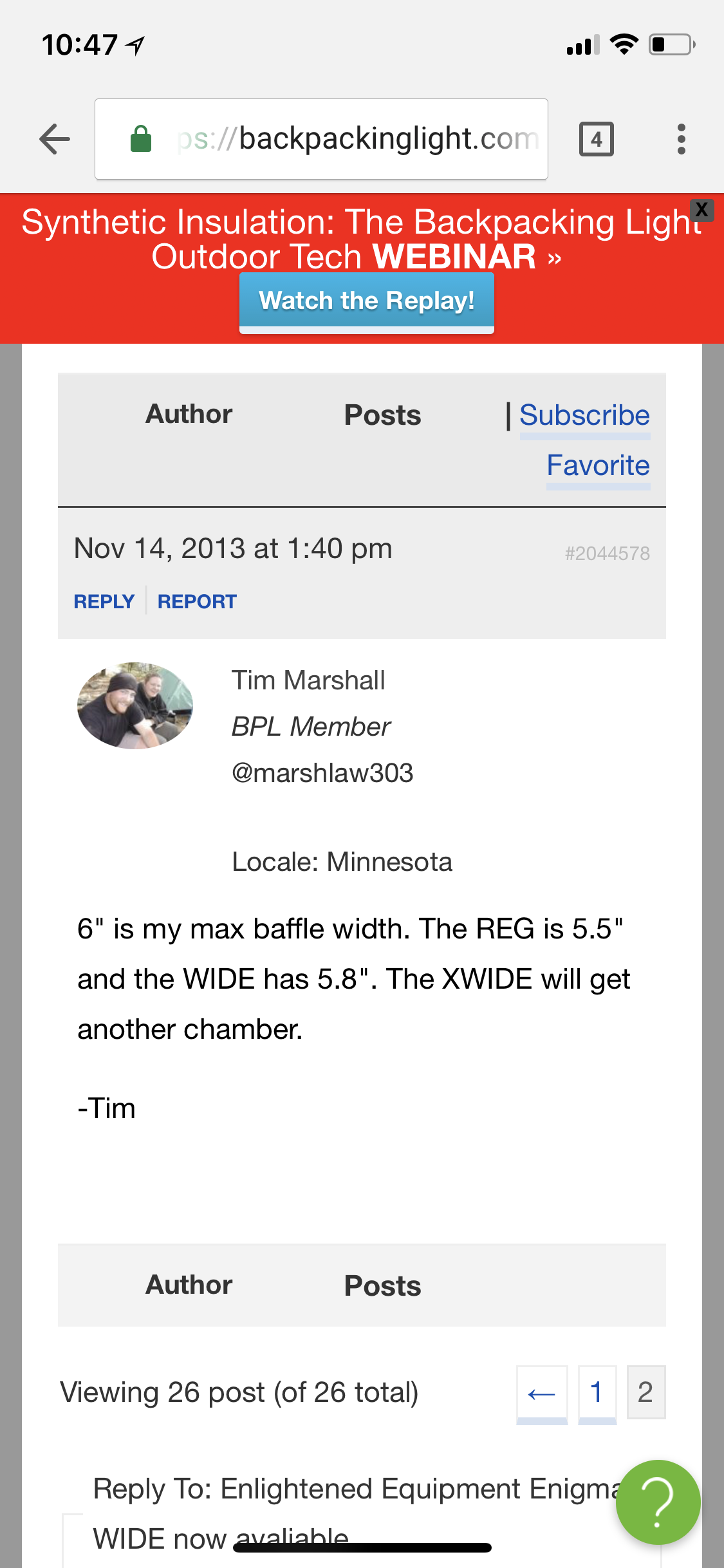
Also found the below post from 2013. As far as I know, EE has always used 5 chambers (10 vertical but the u shape connect them). Tim states the baffle width so take that times 10 and you have the width of the shell before stuffing. After loft you likely lose 4-5” so subtract that from the “stretched” or listed width and you have the real life width.

Viewing 25 posts - 1 through 25 (of 28 total)
Loading...