Topic

Fastpack recommendation

Viewing 22 posts - 1 through 22 (of 22 total)
Henrik S BPL Member
PostedDec 30, 2025 at 2:01 pm

Any experienced fastpackers out there that could recommend a pack?

Leaning towards Zpacks Nero 38 with the vest straps, but have no experience with it. I’d like to have capacity for 3 nights and 4 days – water is easy to find so do not need to carry more than 1 litre.

Thank you for any guidance!

PostedDec 30, 2025 at 11:15 pm

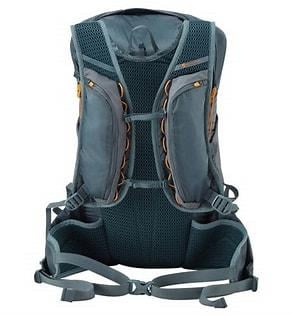
I’m on the hunt as well, after I picked up a Nero w/Vest Harness 2nd hand after reading a review that claimed “best in class” harness/pockets. Here are my impressions of the harness:

  • Not enough dimensionality to the layered pockets to provide usable volume for all of the pockets.
  • Triple-layer design is unnecessary and occupies all the same space, for the most part. Dual layers would be fine, but dimensionality needs to be added to the outer layer(s) or layering doesn’t create usable pocket when one is stuffed.
  • Several ultrarunning-optimized harnesses (albeit none on overnight packs) resolve by more aggressive lateral offsetted pockets, using firmer pocket walls (helps separate hydration from storage layers).
  • Lycra is a poor pocket choice (I know, not intuitive). It expands easily, but collapses under compression (loses shape as the pack is tensioned), transmits bottle movement into harness movement, results in deformed strap profile when bottles are in there, sternum straps must be overtightened to compensate for movement, chest compression results, breathing resistance, etc. Stretch and stability are not the same thing.
  • The pack has a narrow body and “wide strap” that doesn’t stabilize the pack against the back. A true fastpacking pack needs a wider body that becomes more “one” with the harness for stability.

Those are my off-the-cuff impressions about a pack that makes a fine ultralight pack with a poorly-executed fastpacking harness as an afterthought, that really isn’t very usable in practice or stable while running.

PostedDec 31, 2025 at 11:32 am

Some more thoughts that have been brewing all night, gotta spit them out now before I lose ’em:

For runners carrying overnight equipment in a 30 – 40 L fastpacking pack, pack design has to start with the harness – it’s the primary load control system (not the frame or hip belt, which is where most packs start).

At that volume and with some “overnight weight”, the pack tends to decouple from the torso on every footstrike, particularly on descents when cadence increases and ground reaction forces rise (e.g., when running). Most “vest harnesses” on “UL packs” do not perform well – they’re too soft. A functional harness will perform well because it maintains a mechanical connection between the load and the ribcage without wrapping my thorax in tight compression that compromises ventilation!

Geometry: Shoulder straps should be quite wide where they must distribute pressure, shaped to follow the clavicle-to-ribcage line, and tapered where unmodified geometry would otherwise abrade the neck during arm swing.

Material properties: High-stretch strap bodies often feel comfortable under static, low-load conditions, then collapse and deform when the pack is loaded. Under dynamic load, that “stretch” frequently corresponds to uncontrolled relative motion between the pack and the torso. The functional target should be a low-creep structure with a breathable lining, and tightly controlled elasticity only in zones where expansion is required for breathing and small-amplitude movement.

Bounce control: The critical performance test is whether the harness can suppress vertical bounce without requiring sternum closures that are tight enough to limit breathing. This requirement explains why multiple straps across the sternum and upper abdomen need to be used. The purpose of these straps is not circumferential compression but distributed stabilization. A single sternum strap is insufficient to control a running load in the 30 to 40 L volume range; it primarily creates sort of a hinge point (and is not stable). Two, and sometimes three, sternum straps with some elasticity can stabilize the pack while preserving ribcage expansion during uphill efforts and high breathing volume/rate.

Pockets: Large pockets are not the same as functionally usable pockets. On a running-oriented harness, pocket architecture must maintain functional independence. If inserting a full bottle collapses an adjacent zip pocket, the system does not provide “extra storage”; it provides competing storage volumes. If the bottle configuration forces the user to overtighten the sternum closures to mitigate bottle bounce, the system trades breathing function for pocket capacity. In practice, more stable designs assume bottles in the 500 – 600 mL range, prioritize one-handed access and reinsertion while moving, and maintain hydration volume without encroaching on storage space for food, phone, gels, and other high-access items.

Coupling to the pack: At the lower interface, a running harness does not need to act as a traditional weight-bearing hipbelt. Running biomechanics depend on pelvic rotation. A thick, rigid belt resists that rotation and converts that resistance into chafing and motion restriction. A more effective solution is a soft lower wrap that sits around the lower ribs and upper iliac region and functions primarily as a sway damper. This configuration reduces side-to-side pack motion without attempting the kind of vertical load transfer associated with framed backpacking packs. Conventional shoulder straps with stretchy pockets, 2 sternum straps, and a missing hip belt do not make a fastpacking pack!

So in summary, this is what I’m shopping for right now:

  • Vest-like strap geometry with curved profiles, wide contact areas, and tapered neck zones that remain stable during arm swing.
  • Multi-point torso anchoring (for example, upper sternum, lower sternum or upper abdomen, and a lower wrap zone) to limit vertical decoupling. I think 2 sternum straps are fine on small ultrarunning packs, but I’d prefer 3 on a backpacking/fastpacking larger volume pack, with maybe 2 straps coupling the lower vest to the backpack body, unless the lower part of the harness is directly coupled to the body.
  • Sternum straps elasticity vs. vest harness elasticity – breathing can’t be restricted, so there needs to be a (small) amount of give in the harness – much less than you think. If the materials are all elastic, that’s a no-go for the reasons I talk about above. An entirely non-elastic harness that distributes weight across a large surface area is more comfortable than a structurally unsound elastic harness that has to be compressed to the hilt to maintain stability.
  • Pocket architecture with an independent functional volume, so bottle storage does not collapse adjacent storage, and with one-handed access and reinsertion while running. 100% Lycra? No!

The Pa’lante Joey harness works quite well, but this is a small pack. The concepts can be scaled to larger packs.

The Salomon S/Lab Adventure harness/pockets are very well designed. The harness is large, coupled to the pack body exceptionally well, and the pockets are functional. But these are tiny packs.

The fastpacking harnesses on packs like Nashville, Gossamer Gear, Hyperlite, ZPacks – they are not well-coupled to their pack bodies, have dysfunctional pocket designs, and can’t stabilize loads without the hip belt. And if you need the hip belt, then you’re losing out on all the potential benefits of a good vest harness.

Henrik S BPL Member
PostedJan 1, 2026 at 2:05 am

Thank you for both the general input and correction on the Nero. Very interesting read. We have likey read the same review, and the words «nearly perfect» seemed a bit too positive.

I think you have may good points/views, but I’m a bit unsure about running without a hip belt with a load of 7-8kg. Could a vest alone hold the pack with 7-8kg close into the body or would a «tie down» belt placed a bit over the hips be necessary?

After a bit more looking around I think the Rab Veil 30 might be an option. Have you assessed that one?

Haakon R BPL Member
PostedJan 1, 2026 at 4:23 am

I’ve been curious about fastpacks for a while, but not so serious it has materialized yet.

Glad I had the opportunity to read this before going further with this idea. Thanks Ryan for your insightful analysis.

PostedJan 1, 2026 at 11:16 am

I should have clarified my comments on the hip belt more – the purpose on a fastpacking pack is not going to be for load transfer – the pack is going to ride higher anyways, so the hip belt & wings are there to control sway and probably aren’t going to be interacting with your iliac crest much. I like the way the belt on the Rab Veil 30 is constructed – good connection to the pack, rather than just a web belt, which will just be a hinge and allow bounce at that hinge. I haven’t seen the Veil 30 yet but it looks promising!

7-8 kg is a little beyond what I want to run with, but seems like a reasonable starting pack weight where you’re hiking uphill in the beginning of a big mountain route anyways and may not worry about running bounce.

Henrik S BPL Member
PostedJan 1, 2026 at 2:23 pm

Thanks for clarifying – the «load transfer point» is of course a good one.

7-8kg is including 3 kg of food/gels and 1,5 litres of water. I ran a mountain marathon (42km) this summer with 5kg on my back (Osprey running vest), so I am assuming that fastpacking with 8kg (declining as food is eaten) will be ok. But combining running and backpacking is new to me so maybe I’ll eat those words later this year. Assuming I can use my usal gear like the Notch Li, Tensor, and Zenbivy.

How light are you going when fastpacking? If you have a fastpacking gear list that you can share, I’d be very grateful.

The Rab Veil 30 seem to check all my boxes, including waterproof, so ordered one now. Excited.

PostedJan 1, 2026 at 3:14 pm

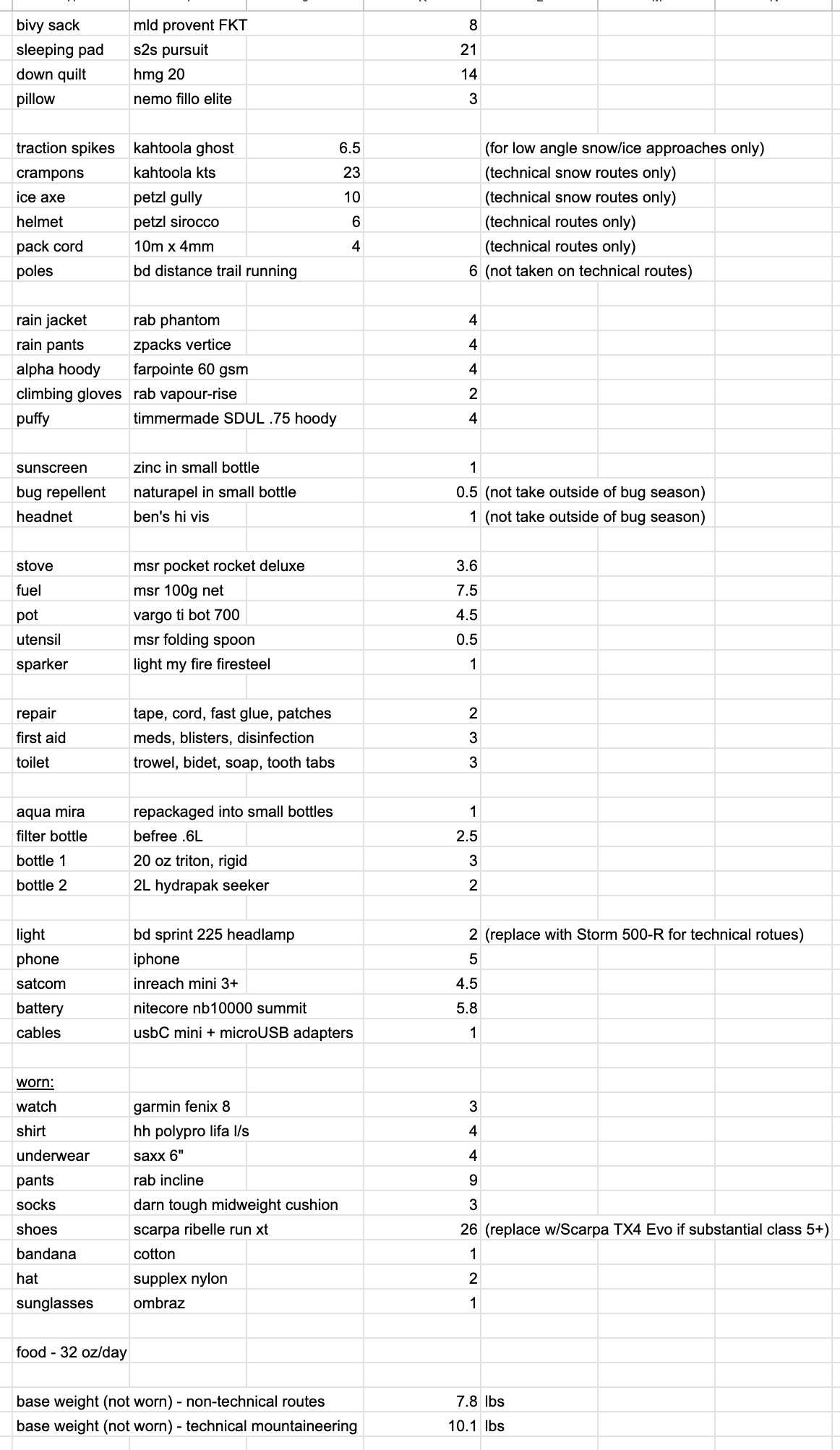
Henrik, here’s a screenshot showing my typical range of fastpacking kits (non-technical vs. technical):

Henrik S BPL Member
PostedJan 1, 2026 at 3:38 pm

Thank you for this – this is very interesting.

(The bivy would scare me – thought of being stepped on by an elk or bitten in the face by a snake would be too disturbing. Paranoia.).

Again – thanks! And if you buy a new fastpack it would be of great interest to know what you went for and why.

PostedJan 1, 2026 at 3:44 pm

I just realized that my backpack was not on there! I’m currently using an atom packs custom 30 with a vest harness, weight is 16 to 17 ounces.

Also the bivy reflects what I like to do for a trip like this – stop and sleep when I need to or want to quit, dictated by my physiology and perhaps daylight. This (inconveniently) doesn’t usually happen in areas where I can easily find a spot to pitch a tent. More context on the bivy for pitch-anywhere flexibility.

Matthew / BPL Moderator
PostedJan 1, 2026 at 4:39 pm

Ryan, How do you like the harness setup on the Atompacks Fastpack? I like how he used two separate adjustment straps per side rather than a V or Z.

PostedJan 1, 2026 at 5:01 pm

yes, the harness is quite good. I do wish the shoulder straps weren’t quite so soft, but it is a pretty stable ride. Not a fan of the pocket configuration. My preference is to have one side with a pretty large bottle pocket plus a stash pocket for snacks, and on the other side, a large zippered pocket and a stash pocket.

Henrik S BPL Member
PostedJan 2, 2026 at 3:05 pm

Dan; are you thinking about designing a Fast Wapta? :)

PostedJan 2, 2026 at 3:25 pm

I’d pick the Montane Trailblazer LT 28 over Rab Veil 30, especially if you don’t carry very much water. The harness straps have ample sized zip pockets instead of bottle holders (like most running packs) and the Trailblazer only weighs 13.8 oz compared to 20 oz for Rab. It gets good reviews for the easy access zip pockets on the hip belt wings. Tempted myself. Adventure racers like them, however for smaller volumes (18L to 24L) Raidlights seem to be the most popular. https://us.montane.com/products/montane-trailblazer-lt-28l-backpack

Anything much over 30L is just too big for running IMO. It’s the threshold point where physics takes over and the pack flops around no matter how well designed it is. That’s why adventure racers and FKT’s demand the lowest volume and lightest gear available (DCF, 7D shells, 900+ fill, etc) which unfortunately means’ it’s also the most expensive.

Nice gear list Ryan.

Paul S BPL Member
PostedJan 2, 2026 at 7:11 pm

The 2 that I would recommend would be the Pa’lante Joey and Nashville Packs Cutaway. Both fit very close to a well fitting running vest or pack. Lots of packs advertise vest like fit, but few really deliver. Hope that helps.

PostedJan 2, 2026 at 9:55 pm

“Dan; are you thinking about designing a Fast Wapta? :)”
I don’t know. Just always learning. There are two main aspects/benefits to a vest, which are the improved chest storage, and how the pack anchors around your torso better.

The storage is appealing. The anchoring I’m not as sure about because 30L is pretty large to try to make the vest the primary load control system. To really do that well we’d probably have to make the pack shorter and wider and then it might work but might still be too large (heavy loads) want to rely primarily on that for load control. We might be able to harvest some of those benefits, but I’m not sure I’d want to move so far as to making the vest the primary load control system at the expense of the hipbelt. A smaller 20L version would be more naturally suited for that.

Henrik S BPL Member
PostedJan 3, 2026 at 3:14 am

Monte Masterson; thanks for the suggestions. The Trailblazer does not harmonize with my preferences for pocket layouts when running. I enjoy using soft flasks with a bit of tubing and no bladder/hoze. The Raidlights look very interesting but it looks like they are a fair bit smaller then what I need with my current equipment (I might be wrong on the 24-30 UL version). If I buy different gear in the future then I might be able to use one of these running packs. But for now I’d like to try to fastpack with the gear I have already. Appreciate you taking the time to provide some alternatives! Ps: do you think it’s the size or the weight (or both) tha leads to flopping?


Paul S; The Nashville in 30l ultra looks very nice and interesting. The price (about 620USD including transportation and 25% VAT) would be ok if I had the chance to test the pack and also have some more experience with fastpacking so I could be certain of what a perfect pack would look like to me. One of the things I love about my Kakwa 55 is that the pocket set-up is static and have learned me how «it should be». I don’t like to buy customized expensive gear as the first item in a new activity, as I need the same form of »instructions» from a fastpack in order to form proper preferences (assuming it’s well designed). The Cutaway will be on my radar later on. The Joey is too small as of now. Thank you for the suggestions!


Dan Durston; It would be interesting. Seems like there are limited options solving the gap between running and backpacking. At least if oneneeds more than 20litres-ish. Maybe that indicates a small market, or maybe it’s too difficult to build a pack that solves the problem. There has to be more nerds out there in the same difficult situation as me (and maybe mr Jordan as well).

PostedJan 4, 2026 at 3:26 am

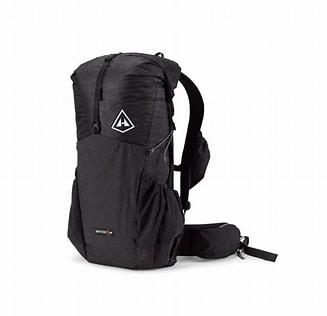
Although not a fastpack per se, the framed HMG Waypoint 35 will be my next purchase. Just the right size for those who have their kit dialed in with the lightest, lowest volume ultralight gear (without bear can). It’s a tad heavier than frameless (23.5 oz), but it eliminates the need to pack everything just right in order to get a good ride. You know what I mean, stuffing a frameless pack too hard makes it overly rigid, and arranging things too loose is even worse. Weight distribution is a concern too; it’s really an art to make the ride comfortable. Yet with a framed pack a lot of the worry is diminished. https://hyperlitemountaingear.com/products/waypoint-35

Terran BPL Member
PostedJan 4, 2026 at 8:59 am

Just throwing this out there. I have no experience with them. A small one man show with some interesting products and customization available

Moosetracks fast pack.

PostedJan 4, 2026 at 10:06 am

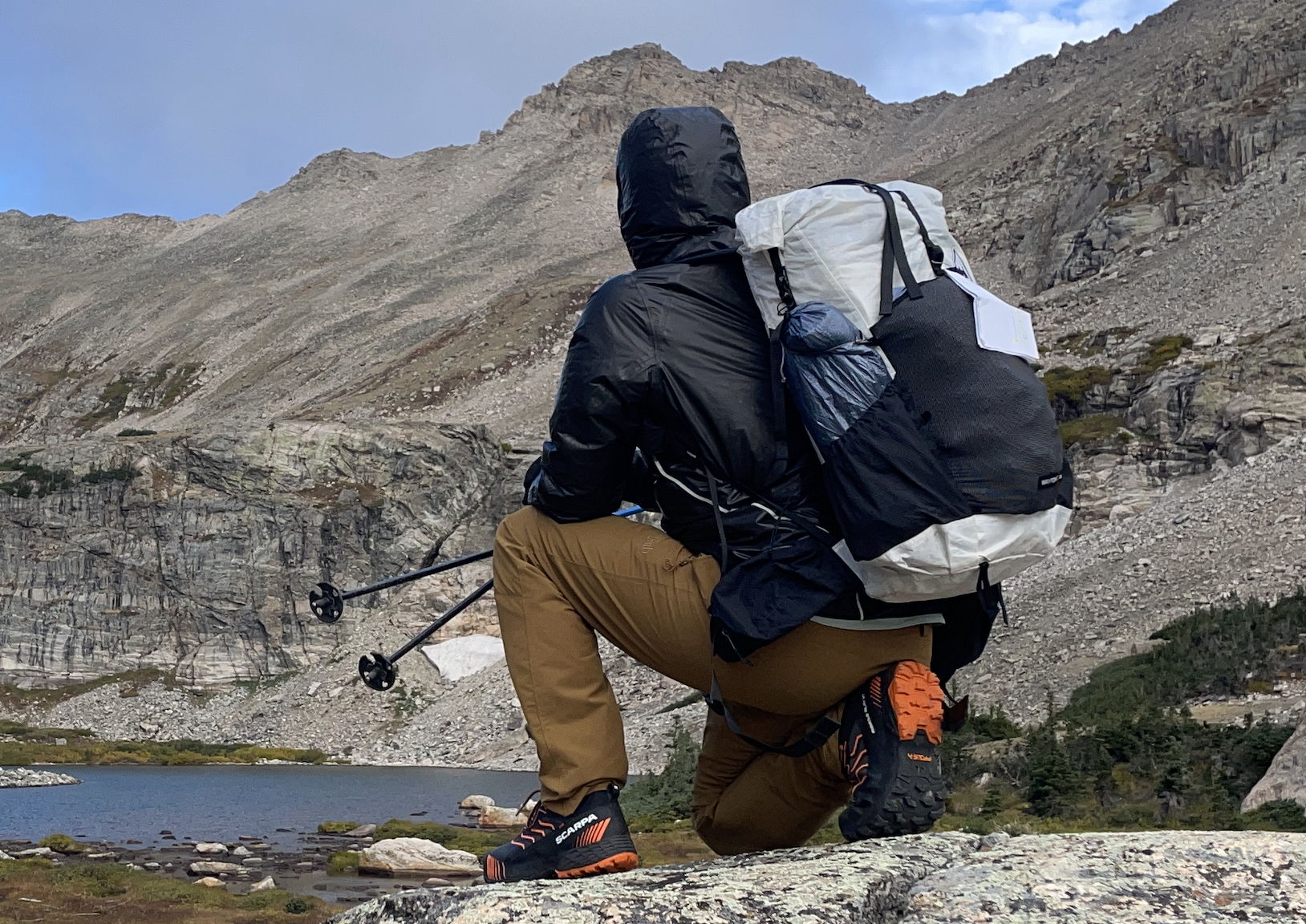
Monte – I’ve used the Waypoint on several trips this year (e.g., here and here), and it’s becoming my primary pack for most short trips.

If this had a vest harness coupled to it (I really like that shoulder strap assembly on the Moosetracks one that Terran posted ^^) – then you could remove the framestay on the Waypoint and have a winning combination.

Viewing 22 posts - 1 through 22 (of 22 total)
Loading...