

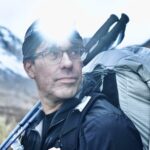
Northeastern Colorado, mid-September. Elevation 11,400 feet. High tundra, wide open to the sky, nothing taller than two-foot willows and small boulders that pretend to be walls against the wind spilling down from the high peaks. We left treeline a few hours ago. Exposure in every direction. It’s cold.

I paid a debt to the afternoon talus. A misstep, a fall, facial impact, lots of blood and drama – nothing catastrophic, but jarring enough, especially in light of what could have been. Injuries do that in the alpine, even small ones. The falling temperatures and fading light reminded me of how the buffer starts to dwindle in the fall. Change of plans. We’d have to stop here and bivy.
By the time the sun slid behind the ridge, the wind had found its rhythm. Gusts poured down the walls of the cirque, slamming into our bivy site with a noise that felt less like sound and more like pressure. My partner and I tucked in early, not because we wanted to, but because the combination of injury, cold, and wind narrowed our choices. I pulled on every piece of clothing I had, over-conservative maybe, but I needed to feel some security that comes with feeling cozy and warm.
~
Sleep came in snippets. Each time I woke, the wind was still there, hammering the bivy, pressing cold into the seams. Sometimes I woke because my nose needed tending – fumbling in the dark with gauze packs, fingers slow, head a little foggy. Sometimes it was just the wind itself, the whoosh and slam, the reminder that we were fully exposed.
In July, that exposure to the wide open sky (sans wind) would be a thrill. But by now, it had sharpened into something else. My midnight mind started to sprint. Will it rain tonight? Will the blood ever clot? Will my body heat keep me cozy til morning? Will I need surgery?
I meditated through it and tapped into something else in an effort to hijack my mind’s 100-yard dash. Daniel Kahneman wrote about slow thinking (Thinking, Fast and Slow, 2011). Gerd Gigerenzer refers to it as risk-sensitive decision-making (Risk Savvy, 2014). I had read the books but my racing brain couldn’t recall the intricacies of their theories. So I focused on something simpler: the discipline of not trying to solve everything at once. Instead: one thing at a time. Adjust my layers. Build a new gauze pack. Drink a few sips of water. Don’t project. Don’t catastrophize. Just do the next one right thing. And once all the next right things are done, just wait. And rest.
At 3 a.m., a gust tore down the slope and rattled the bivy sack hard enough to jolt me awake. My first impulse was panic: What if this is the storm that forces us out in the middle of the night? After a few moments, my mind focused, and I peeked out the little netting window of the bivy sack. Stars. OK, that’s a good sign. It’s just wind.
~
Epictetus teaches: we don’t control the storm, only our response (Discourses, ca. 108 CE). The Stoics would call it equanimity. Today’s psychologists call it emotional regulation. Out here, in the middle of the night, I practice it by breathing, listing all the things that I need to do in the next 30 minutes, and prioritizing the list. And I reminded myself: I was warm. I was safe. I was comfortable. No panic needed. With that out of the way, I could be fully present. Then, I felt it – calm. And out of calm – joy.
George Bonanno makes this point in The End of Trauma (2021): resilience isn’t about toughness, it’s about regulation, i.e., the ability to stay steady during acute stress events. That night was a small training ground for it. The wind didn’t stop. The injury didn’t vanish. The uncertainty didn’t lift. But steadiness kept me anchored until the sky lightened and the alpenglow painted the mountainsides.
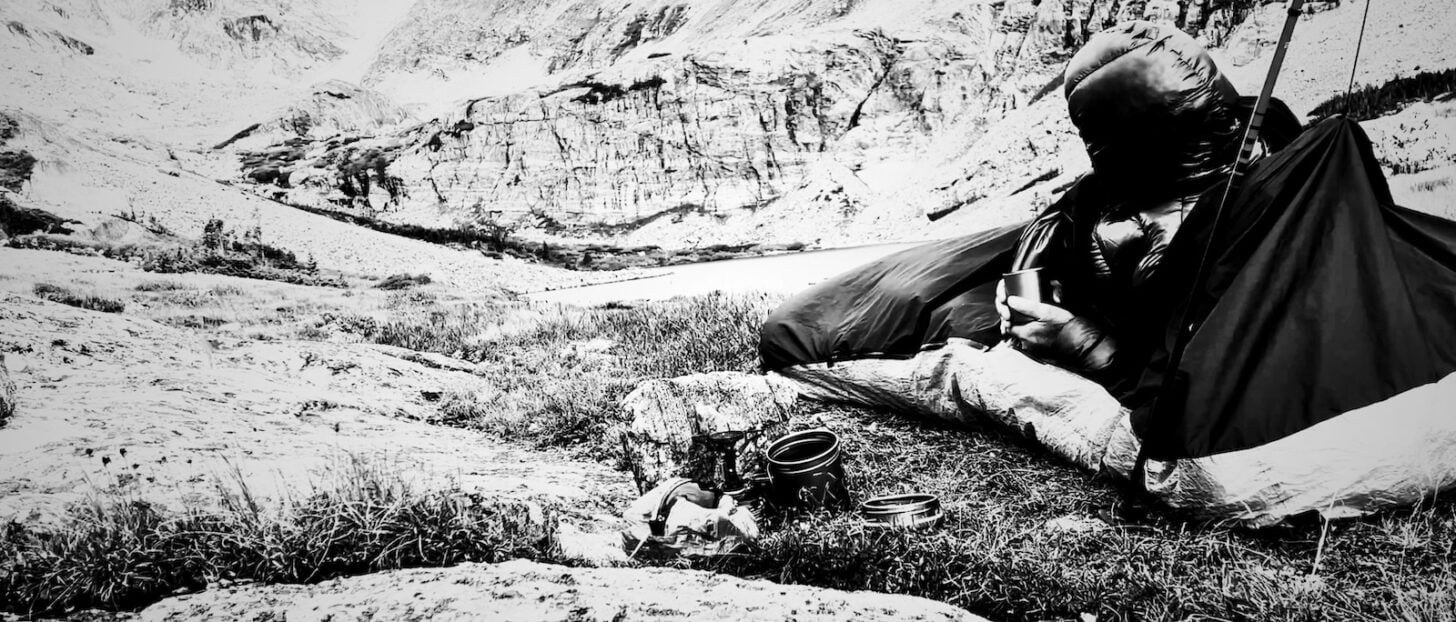
From inside the bivy, I lit my little stove, which was tucked behind a rock just big enough to shield the flame. The smell of coffee rose into the cold air, sharp and comforting. The first sip wasn’t joyful just because it was coffee (you may argue with me about this), but a deeper sort of joy that comes from calm.
Fall in the alpine isn’t generous. It takes away daylight, warmth, and margin. What it gives back is attentiveness. Mental engagement, because every decision matters just a little bit more. Emotional resilience, because the season doesn’t let you get away with a lack of prudence; impulsiveness is not rewarded. Kahneman’s slow thinking, Epictetus’ equanimity, and Bonanno’s resilience all converge here, in a bivy sack hammered by wind in the high Colorado tundra.
The lesson holds beyond the alpine. When life gets chaotic – injury, uncertainty, too many demands stacking at once – the answer is the same: slow down, regulate, do the right thing, one thing at a time. And when joy comes from the calm, relish and rest in it, because there’s going to be more drama around the corner.


Discussion
Become a member to post in the forums.
Companion forum thread to: Wind, blood, and coffee: lessons from the tundra
Exposure, injury, and cold winds turned one bivy into a teacher. Fall in the alpine strips you down – and sharpens attentiveness in return.
Do you roll when you fall?
Love this! Last week had a bit of a harrowing time in the Yosemite back country due to air quality and fires and wind and safety – had to regulate my emotions, but didn’t recognize I was engaged in that task until reading this post. It helped process it all somehow. Thanks! And have borrowed the Bonanno book
Backpacking is often Type 2 Fun: We love achieving something, like a peak or a view that other people cannot see.
But Type 3 gives us the best stories. A few of those over a lifetime is great, as long as everyone survives.
Pretty wild! Reading this just as I am going to sleep for the night.. Hopefully I find myself out there in the storm tucked away in my bivy..
Using InReach to relay images of your face to a medical professional may have brought some mental relief. Self assessment can send the mind racing.
“slow down, regulate, do the right thing, one thing at a time”
Its so critical to follow this that I wonder if there is a way to train ourselves to be more resilient, to instinctively follow this in the way an athlete follows correct form using muscle memory because it may be necessary to call up this reaction in rapid succession even during an accident episode.
What got me thinking of this was my experience with a pretty serious motorcycle accident. As it was unfolding, time slowed way down, options were assessed in rapid succession and a final decision made that probably saved my life.
I could imagine someone finding themselves in a similar situation in a bear attack, or when having footing break loose on a cliff edge, a situation where you don’t have time to sit and let fears and doubts well up.
In my experience, being able to do this comes down to a couple things. The first is preparing as well as you can. I had studied causes and best principles of mitigating motorcycle accidents at the race track and this proved crucial.
I also believe it comes down to having reasonable expectations, but also seriously buying into that. If you engage in an activity with high risk at a low probability, don’t be surprised when that risk materializes after spending enough time at it. Healthy and realistic expectations help the mind stay clear when the chaos hits the fan.
I worked at an airport when I was 14. The lady I worked for had trained pilots during WW2 and was giving me flying lessons. One thing we practiced were power off stalls. She would take the plane into a dive, turn off the motor, and take the key out. Leave me to handle it. Five years later, I started skydiving out of Elsinore. They say don’t jump out of a good plane, they had an old Norseman that barely made it off the ground. We were just gaining altitude when I noticed a little trail of smoke coming from the cockpit, we lost power and you could feel the plane drop. We did have chutes on and bailed out, so the pilot was able to land. I remember it as a time when the brain kicks in. You do what you have to do. The number one rule is don’t die.
So did you need surgery? How’s the injury? I have fallen onto my face on a rock, got a serious concussion and black eye/face. Had headaches for months. Worst was how stupid I felt, just tripping over a pebble.
Fate happens. One part of jumping is you learn to roll when you fall. I bruised up my elbow pretty bad last year, but it saved a face plant on the concrete.
The risk of falling is not only for seniors. Recent statistics appear to show that the chances of falling increases significantly for people over the age of 45. It’s easy to deny this or think it doesn’t apply to you because you are strong and fit, but once your are past your physical prime, your agility, flexibility, and reflexes are not what they were when you were in your 20s. I am guilty of this, and I am trying to learn to be more conservative and careful in the backcountry, where the terrain is challenging and rescue or self-rescue can be difficult and painful.
I do fall a lot more now, starting after about age 50. I don’t really remember falling when I was younger, and that could be because I was just more graceful and agile, or because I fell and don’t remember getting hurt. Now it really hurts to fall, even if nothing is really damaged, but my whole body will ache for a few days. I do yoga three times a week, weight training, and lots of walking with the occasional bike ride or kayak paddle thrown in. I do stairs daily, lots. My balance is excellent if measured by, for example, standing on one foot and putting on my socks and shoes, or by my ability to do advanced yoga balance poses. But all that work doesn’t seem to make my falls less likely as it in theory ought to do. They are random and unexpected. I tripped on a sidewalk last year, no obstacles at all, got another good shiner.
I might have to figure out how rolling would work; when a fall is so sudden, there’s no time to think. Plus, if I trained myself to roll and then fell on a steep slope, would rolling be such a great thing?
I think the being more conservative and careful when out on hikes, especially when alone, is key to my own safety. It means I don’t hike quite as fast, or that I take more rest breaks. I’m super careful on ledges or scree slopes and the like. But S* happens and if I end my days flailing down a mountainside, so be it.
I fall occasionally but no serious injury. Like tripping over a root. Or slipping in mud.
As I get older I don’t have a good balance. I think most of it is my leg muscles are atrophying.
At home – exercise bike, squats, standing from sitting with one leg at a time.
That helps. I can cross streams better and put my pants on better.
I am not sure I fall more, but I sure hit the ground harder. I also have become much more conservative at water crossings.
I’m no parachutist like Terran, but I do automatically roll when I fall, landing on a shoulder and bent arm, with head high (not bouncing on the ground). It was something that I thought through ahead of time, and just did it automatically when the time came.
So far, I haven’t had any injuries doing that. Not even a bruise that I recall. But I haven’t fallen on rocks, either. More likely snow or mud.
I was on Mount Hood. A guy my age came up to me and said that as he gets older, it’s harder to cross streams so he just walks through rather than balancing on a log or rocks. I’ve been doing that myself.
I just met up with him on the Three Sisters. After I crossed a stream just by walking through it rather than on the slippery rotten log.
I hike in cycling gloves. The padded palms are welcome extra protection in case of a face plant.
Yep, this is a real thing. Plenty of established science on this.
No surgery is likely needed, but “two weeks” after is the official timing for this (broken upper and lower lateral nose cartilage on one side). I’ll write up a case study on this, it was a very interesting and fluke sort of accident – I was crossing (flat, easy) talus along a lakeshore (moving pretty fast) and both of my trekking pole baskets got hooked behind me on a lip of “flat, sidewalk talus” as I stepped up onto it, and my momentum pitched me forward. I took the entire force of the fall on my nose, with my hands behind me (why I couldn’t tuck and roll).
Oh dang I cringed reading how that happened. I haven’t ever caught both baskets at once. Hope it’s feeling better.
Hence the old trekking Pole debate.. to use or not to use. Use the straps or not use the straps….
I use poles as they have saved me from crash and fall many more times then not.. but I am always leary of using the straps.. though I do use them.. im always questioning myself about that.
Someone should patten trekking pole straps that auto release when certain pressure applied to them..
Based on this one data point, the inconvenience of dropping a pole and having to bend down and retrieve it would have outweighed the cost of the fall :) I don’t usually use straps on talus, because I’m always shifting them between hands, holding them vs. using them, deploying one at a time for a balance move, etc. This was a weird situation, because of the frequent change between talus hopping and tundra walking. But the main mistake made here was, yes, I was strapped in and should not have been – I cut corners here for convenience and speed, and paid for it.
Yes, just a little bit of “stiffness” in the nose as of this morning, and lots of histamine/allergy-like response because of the mucosal tissue trauma. The body is remarkable in its ability to heal quickly. I’m always amazed by this.
Make sure you also didn’t get a concussion. I got one falling forward and getting a black eye. I only realized it when I had persistent headaches for at least a month afterward, plus a lot of fatigue. I didn’t feel like I hit my skull like landing on the side or back would do, but the face is part of the head too!
Yep, concussion eval then a thorough head/neck palpation were next after dealing with the initial bloodbath.
Become a member to post in the forums.