

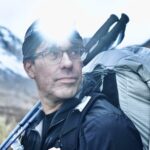
Northeastern Colorado, mid-September. Elevation 11,400 feet. High tundra, wide open to the sky, nothing taller than two-foot willows and small boulders that pretend to be walls against the wind spilling down from the high peaks. We left treeline a few hours ago. Exposure in every direction. It’s cold.

I paid a debt to the afternoon talus. A misstep, a fall, facial impact, lots of blood and drama – nothing catastrophic, but jarring enough, especially in light of what could have been. Injuries do that in the alpine, even small ones. The falling temperatures and fading light reminded me of how the buffer starts to dwindle in the fall. Change of plans. We’d have to stop here and bivy.
By the time the sun slid behind the ridge, the wind had found its rhythm. Gusts poured down the walls of the cirque, slamming into our bivy site with a noise that felt less like sound and more like pressure. My partner and I tucked in early, not because we wanted to, but because the combination of injury, cold, and wind narrowed our choices. I pulled on every piece of clothing I had, over-conservative maybe, but I needed to feel some security that comes with feeling cozy and warm.
~
Sleep came in snippets. Each time I woke, the wind was still there, hammering the bivy, pressing cold into the seams. Sometimes I woke because my nose needed tending – fumbling in the dark with gauze packs, fingers slow, head a little foggy. Sometimes it was just the wind itself, the whoosh and slam, the reminder that we were fully exposed.
In July, that exposure to the wide open sky (sans wind) would be a thrill. But by now, it had sharpened into something else. My midnight mind started to sprint. Will it rain tonight? Will the blood ever clot? Will my body heat keep me cozy til morning? Will I need surgery?
I meditated through it and tapped into something else in an effort to hijack my mind’s 100-yard dash. Daniel Kahneman wrote about slow thinking (Thinking, Fast and Slow, 2011). Gerd Gigerenzer refers to it as risk-sensitive decision-making (Risk Savvy, 2014). I had read the books but my racing brain couldn’t recall the intricacies of their theories. So I focused on something simpler: the discipline of not trying to solve everything at once. Instead: one thing at a time. Adjust my layers. Build a new gauze pack. Drink a few sips of water. Don’t project. Don’t catastrophize. Just do the next one right thing. And once all the next right things are done, just wait. And rest.
At 3 a.m., a gust tore down the slope and rattled the bivy sack hard enough to jolt me awake. My first impulse was panic: What if this is the storm that forces us out in the middle of the night? After a few moments, my mind focused, and I peeked out the little netting window of the bivy sack. Stars. OK, that’s a good sign. It’s just wind.
~
Epictetus teaches: we don’t control the storm, only our response (Discourses, ca. 108 CE). The Stoics would call it equanimity. Today’s psychologists call it emotional regulation. Out here, in the middle of the night, I practice it by breathing, listing all the things that I need to do in the next 30 minutes, and prioritizing the list. And I reminded myself: I was warm. I was safe. I was comfortable. No panic needed. With that out of the way, I could be fully present. Then, I felt it – calm. And out of calm – joy.
George Bonanno makes this point in The End of Trauma (2021): resilience isn’t about toughness, it’s about regulation, i.e., the ability to stay steady during acute stress events. That night was a small training ground for it. The wind didn’t stop. The injury didn’t vanish. The uncertainty didn’t lift. But steadiness kept me anchored until the sky lightened and the alpenglow painted the mountainsides.
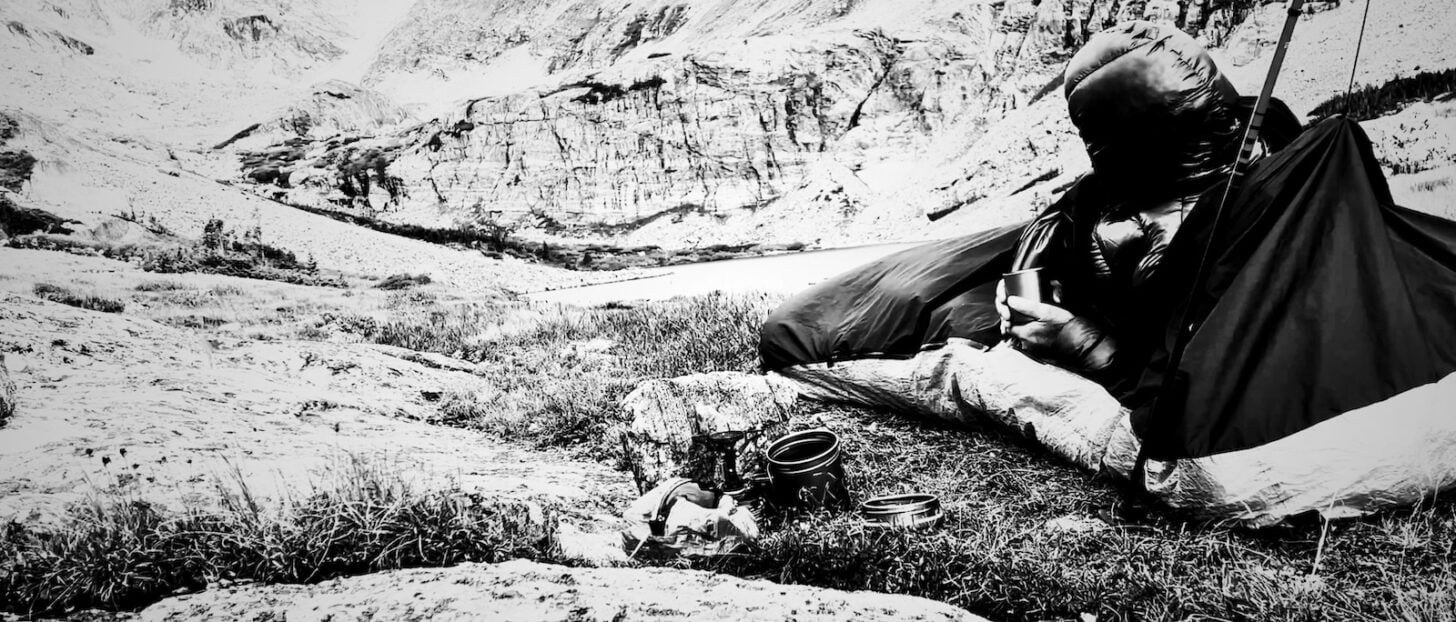
From inside the bivy, I lit my little stove, which was tucked behind a rock just big enough to shield the flame. The smell of coffee rose into the cold air, sharp and comforting. The first sip wasn’t joyful just because it was coffee (you may argue with me about this), but a deeper sort of joy that comes from calm.
Fall in the alpine isn’t generous. It takes away daylight, warmth, and margin. What it gives back is attentiveness. Mental engagement, because every decision matters just a little bit more. Emotional resilience, because the season doesn’t let you get away with a lack of prudence; impulsiveness is not rewarded. Kahneman’s slow thinking, Epictetus’ equanimity, and Bonanno’s resilience all converge here, in a bivy sack hammered by wind in the high Colorado tundra.
The lesson holds beyond the alpine. When life gets chaotic – injury, uncertainty, too many demands stacking at once – the answer is the same: slow down, regulate, do the right thing, one thing at a time. And when joy comes from the calm, relish and rest in it, because there’s going to be more drama around the corner.


Discussion
Become a member to post in the forums.
It’s always the easier stuff, when you let your guard down.
100% – late-day physical and attention fatigue, dropping temperatures -> lower coordination, easy terrain, fixation on the goal (we’re “almost there”)…
Last mile-itis.
Not that it pertains to anybody here, but it pays to be mindful. One doesn’t actually have to fall. Practice in your head so when the time comes, it’s automatic. At all costs, watch your head. The average human head weighs around 5 kg or 11 pounds. That’s 11 pounds dropping over five feet on top of your nose. Ouch! How them Ombraz fitting? Be careful out there. Be careful at home.
I read Steve House’s Beyond the Mountain back in 2013 and his quote, “It’s the easy ground that kills you” has always resonated, especially as I come close to rolling my ankle 1/4-mile from the car nearly every time after a long day or week in the mountains. Glad you’re OK.
I was thinking about this incident while backpacking and it occurred to me that one of my habits might be useful to others. (Glad you recovered OK, Ryan).
If I understand correctly, the reason for the injury was that Ryan’s hands were trapped by both poles being stuck behind him. Without the use of hands or arms he was limited in defensive options, possibly including rolling.
I keep my pole straps loose, as loose as they can be. They can’t slip that way, and it makes it very easy to adjust my grip while walking. It also means that I can drop a pole just by releasing and holding my hand flat for a fraction of a second.
I still use the standard ski-inspired up-through-the-loop-and-down-on-the-strap grip for varied conditions, as well as using the tops on downhills and just straight-through-the-loop to “choke up” on the pole for long uphill sections.
By keeping the strap loose, I can change the grip instantly, which reduces fatigue. But it also means that I can release the pole in the event of a fall, which then allows me to roll and land on a partially bent arm and shoulder.
Sounds just a little TOO exciting. Hope you recover.
Yeah, trekking poles in talus can be dangerous.
Cheers
Become a member to post in the forums.