

In Episode 130 of the Backpacking Light Podcast, I discussed when I think bivy sacks are an optimal choice of shelter:
- When you want maximum flexibility in where you pitch – bivy sacks can be pitched in so many more places than tents.
- When you want maximum simplicity with as little pitching fuss as possible – maybe you are time-limited, or just lazy, and don’t want to fiddle around with a bunch of stakes, guylines, and panel tension (see How to Pitch an Ultralight Tent to learn more).
- When you don’t want to be seen.
These use case scenarios don’t consider one of the key soft-side benefits of using a bivy sack – a benefit that is personally very satisfying to me, but not necessarily practical from an efficiency standpoint (e.g., livable space-to-weight ratio):
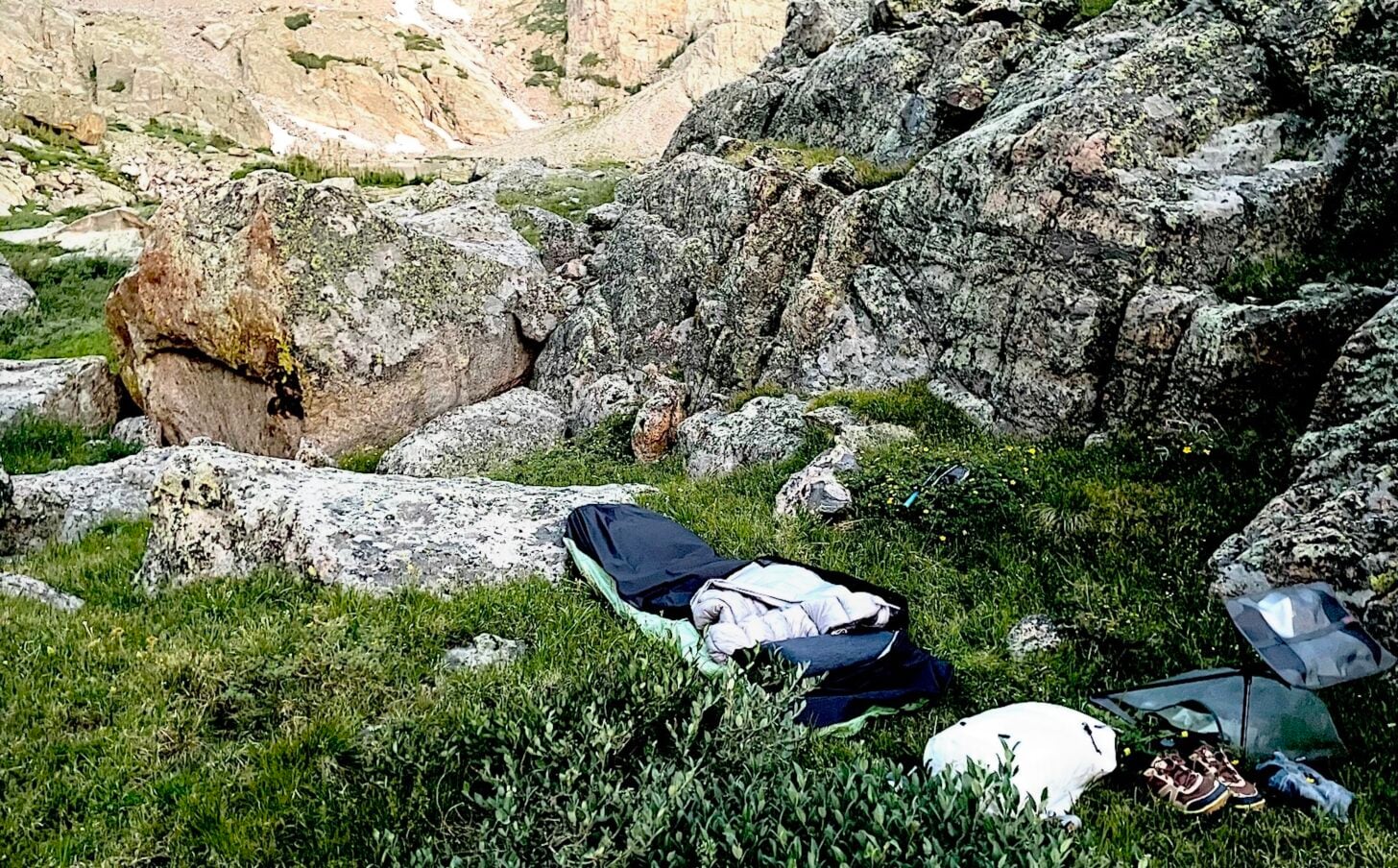
Bivy sacks cultivate a more intimate psychological relationship with your environment, simply because of their ability to afford open-sky views and the feeling that you’re cowboy camping rather than confined in a fabric room with walls and a ceiling.
(Unlike cowboy camping, i.e., not using any type of shelter, the bivy sack gives me enough protection from some rain and bugs if needed.)
It is for these four reasons – pitch flexibility, pitch simplicity, stealth, and intimacy with the open sky – that I find myself choosing a bivy sack over a tent for many trips.
But the trip style I like to do the most dictates that I choose a bivy sack over a more traditional shelter.
I like to get up before dawn, make coffee while still in bed, and then pack up and start walking. After a few hours, I may stop to cook some breakfast, or otherwise just start snacking. Maybe a mid-day nap, or some tenkara fishing as I pass by a lake or cross a trout-filled stream. Often, a longer break in the late afternoon or early evening to cook dinner en route. Then, more walking – until the light goes away.
Finally, wherever I end up at dusk is where I want to camp, like this little gravel pitch amongst towering trees in the Stanislaus National Forest:

Sometimes, it’s near a brushy creek. Other times, on a hillside during a bushwhack, or after scrambling up to a ridge or summit. Occasionally, I may land near an established campsite and call that spot home for the night.
But a bivy sack gives me the pitch flexibility I want to do a trip like this.
And a bivy sack gives me the pitch simplicity to pitch and strike camp quickly.
And a bivy sack helps me stay less visible. That’s just plain, good old-fashioned LNT.
And finally, a bivy sack gives me the opportunity to get out of the house (tent) and sleep under an open sky.
What makes you bivy?


Discussion
Become a member to post in the forums.
Companion forum thread to: Bivy sacks & intimacy with the open sky
What makes you bivy? I choose bivy sacks for pitch-anywhere flexibility, fast setup, stealth, and intimacy with the open sky.
I’ve been following a very good bivy thread over on trek-lite.com. As some state, a minimal tarp with a WPB bivy is logical. For only 3 to 4 oz and 1.3 mm spectra lines it makes riding out a sustained rain (not inside bivy) infinitely better than sitting around with just a rain jacket and rain pants. Sure, it adds a little weight and takes a few minutes to set up, but well worth it IMO. And it’s not as if you HAVE TO set the tarp up, only if you have the time and energy. https://www.trek-lite.com/index.php?threads/bivvy-benefit-bivy-bivi.15143/
Joy first-
1. I only recently started taking a chair; it was a revelation in a way. Ive always sat easily on the ground etc to cook and eat. But the chair let me watch the world for ages – clouds across the moon, trees and grasses moving – I didn’t want to shut myself in a tent.
2. Beautiful places to spend a night (+ sunset and sunrise) where I can’t set up a tent.
Survival/ safety
3. I mostly walk solo off-track. Its often tricky to find space for my tent (tho it has a small footprint) and I have walked into the night to find space which is also sheltered enough.
Plus
4. I like off-track high places- which are often windy. Ive damaged a tent in wind. Im planning a walk along a ridge where there are lots of reports of tent damage/struggles with wind. Ive been thinking how I could use my tent in ‘poles out’ state if I needed to.
and – the recent threads here at BPL helped me take the leap and buy one – was going to make it myself, but fabric costs etc led me not to.
My one night involved a full moon to start and rain to finish. Perfect test.
I was planning to do what Monte suggests with a small tarp. Like onhttps://scramblekit.uk/review/index.php?id=outdoor&post=scramble-geer-mod-ultralight-sil-nylon-tarp-quick-shelter-modular-tent-porch
🙂
(I cant seem to upload a photo)
1. Simplicity for me.
2. The connection to earth and nature all around, below and above at all times.
3. Stealth sleeping is a bonus.
Simple to find a place to sleep pretty much anywhere at anytime. Ridiculously easy and fast to make my bed and also pack up in the morning. Nothing to misplace or break or forget. I am surrounded by earth and all of the elements at all times. I can see all around me in every direction. If needed, I can pretty much sleep unseen or noticed. But it all just goes back to Simplicity and being that much closer to earth and nature for me.
I like sitting under a tarp when it rains or when I need a little shade. It’s good to block the wind. I could go without a tent or bivy, though they both supply a bit of reassurance against bug infestation and bad weather. I like carrying a tarp anyway which makes a tent the heavier choice.
Used a WPB bivy for years. Absolutely loved being out in the open. Hated the condensation. Almost killed me and that was the end of that system.
Yeah, that’s why a more breathable bivy can be good.
Not so good if it rains, but protects from dew and frost
Become a member to post in the forums.