Topic

Bear canisters are silly–at least I think so

Viewing 25 posts - 201 through 225 (of 233 total)
PostedSep 26, 2017 at 11:31 am

In general, you have to hike through highly populated areas to get to the wilderness.  Bears forging for human food will congregate in these areas.  Yosemite Valley – high density, Little Yosemite Valley – high density (plus poorly trained backpackers).  Ansel Adams Wilderness – you will probably never see a bear.  In order to cover the range of bear population densities, proper food storage is required.  In Yosemite & SEKI that means a bear canister.

IMO – too much emphasis is place on low odor methods.  Yes, when your food is stored, it probably works.  You do have to get the food out of the bag, prepare your meal, and deal with the waste, deal with the residual odor on your hands – cookware, wash water, tooth brush residuals.   At that point, your eating environment area can be targeted by those stealthy bears.  More than likely, the spot that you are camping at has probably been used by a previous backpacker (with unknown food storage practices).  I would recommend odor proof sack, just don’t count on them deterring a bear from finding out where you have been cooking and where you have stored your food.  Right now, these are the rules for Yosemite: “Place the container on the ground in a flat, level area 100 feet or more from your campsite.”

my 2 cents

PostedSep 26, 2017 at 11:45 am

Tom K already made some really good suggestions along the lines of best practices if you’re going to go with the low odor/sleep with food route/method. Such as no cook, low odor foods, if you do cook do it far away from where you end up setting up camp, etc.

And as mentioned, there are some areas where it’s just not a good idea to even try to go that route to begin with.

There’s probably not much else to say on this subject, that’s not repeating former points, from this end.


Jacob BPL Member
PostedSep 26, 2017 at 12:03 pm

““No combination of materials and charcoal filtering will completely eliminate odors detectable by a bear, their sense of smell is just too keen.”

That is precisely the question being discussed, with no certainty as to whether what you state is, in fact, true. If you have documentation of reliable testing to prove that, all of us here would sure like to see it.” -Tom K; here you go (J R is right, and I’m not sure how many people actually want to see this…)

I don’t know about the bear facts, but filtering media:

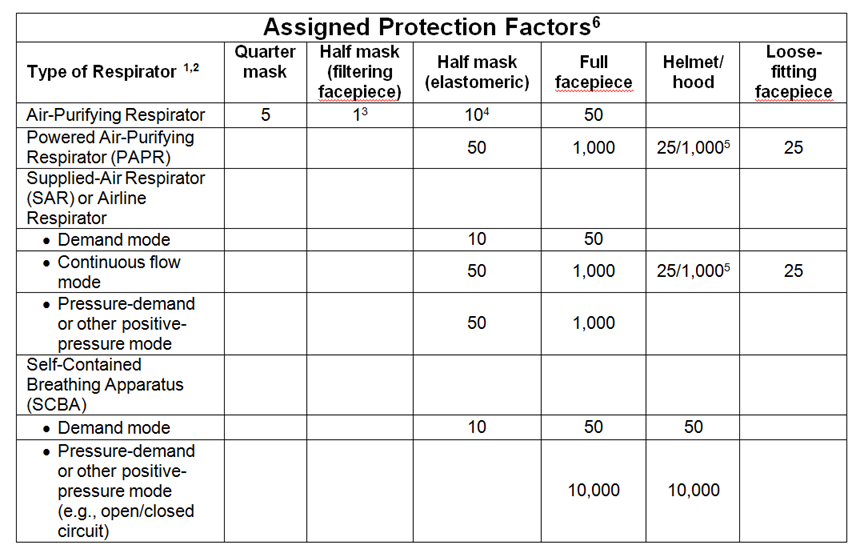
Filtering air isn’t that safe. It works to a certain extent, but you have to realize some nastiness is still getting through, its just a matter of how much. So based on our understanding about bears’ sense of smell, J R is right, bears will simply detect whatever trace makes it through your filtering media.

https://www.cdc.gov/niosh/npptl/respusers.html

https://www.osha.gov/pls/oshaweb/owadisp.show_document?p_id=12716&p_table=STANDARDS

OSHA 1910.134(d)(3)(i)(A)

https://www.cdc.gov/niosh/docs/2005-100/pdfs/05-100.pdf


The air filtering respirators with APF’s of 1000 are using pumps to raise the air pressure above ambient around your face so no outside air gets in. The air filtering respirators with APF’s over 1 are forcing air through filters. A charcoal liner is actually a good description of a charcoal filtering face-piece which would receive an APF of 1, meaning you can safely wear it in conditions up to 1x the limit without a respirator…

Filtering air at hospitals and laboratories is a matter of scale and controlling contamination sources; and its difficult; and they are only filtering certain types of things.

In any serious situation you need to use your own source of clean air (e.g. the fireman’s air canister).

How smells spread is modeled by the diffusion equation and the heat equation, so any quantitative test will be designed to measure the variables in those equations. The same variables NIOSH tests. Even if you designed a quantitative experiment from the ground up testing filtering media against bears smelling food, you would end up calculating values for the same parameters as NIOSH does when considering filtering media against humans inhaling contaminants. Claiming that filtering media will have different efficacy for food odors vs tested contaminants is to ignore the volumes of data collected on all different types of substances and the chemical similarities and differences therein. So based on all the good work done by NIOSH, ACGIH, and OSHA showing why a fireman doesn’t run into a burning building (burning everything from paint to electronics…) relying on any type of air filter or combinations thereof, I’m willing to bet a bear (with 7x the sense of smell than a bloodhound) could smell food through far more activated carbon than you are willing to carry.

(I’m not an expert, take the above with a grain of salt. If you want to learn more about respirators or safety in general, seek out an OSHA outreach training center)

Moreover wouldn’t virgin activated carbon in the wild just soak up all the wilderness smells and become inert relatively quickly? The idea of an electric bag powered by a capacitor that would instantly re-charge with movement/shaking seemed better…

Does no one want to talk about the surprisingly large number of bear can failures??? When I researched this before buying one, everyone said all the popular ones work pretty much 100%, only a couple of failures on older designs, ever. Now some people claim bears are regularly opening them and no one cares to comment? Bears eating food out of 30 bear canisters in 5 years in one area alone, seems to me to be the silliest thing David has brought up…

Tom K BPL Member
PostedSep 26, 2017 at 12:28 pm

“In order to cover the range of bear population densities, proper food storage is required.  In Yosemite & SEKI that means a bear canister.”

You are correct, AFAIK, concerning.  You are wrong about SEKI.  There are any number of routes on the East Side that do not require a canister, Shepherd Pass, Taboose Pass, Baxter Pass, Sawmill Pass, Piute Pass, Pine Creek Pass, Lamarck Col, to name the ones I am personally aware of.

“IMO – too much emphasis is place on low odor methods.  Yes, when your food is stored, it probably works.  You do have to get the food out of the bag, prepare your meal, and deal with the waste, deal with the residual odor on your hands – cookware, wash water, tooth brush residuals.   At that point, your eating environment area can be targeted by those stealthy bears.  More than likely, the spot that you are camping at has probably been used by a previous backpacker (with unknown food storage practices).  I would recommend odor proof sack, just don’t count on them deterring a bear from finding out where you have been cooking and where you have stored your food. ”

Wash hands, don’t cook, don’t use toothpaste, if you do cook, do so a mile or so before you camp, don’t camp at established camp sites, don’t count on odor proof bags in areas with high densities of people and habituated bears.  Use canisters in those areas.  I think both methods have been adequately covered, with perhaps more posting about the odor proof bag technique simply because it is not often used and is, obviously, controversial.  No one here has recommended it for inexperienced hikers, those who are primarily tail hikers, or those who frequent areas with a lot of people and bears.  Let those who hike in remote areas and are experienced take from the discussion what they will and apply it, or not, accordingly.  What I do disagree with, strongly, is any attempt to impose a blanket mandate for canister usage as the only acceptable way.  Without pointing fingers, I have heard a lot of supposition here from people whose experience has obviously been limited to hiking in areas like Yosemite, and who do not seem to realize that there are other areas where vastly different conditions apply, and where other methods of protecting one’s food may be perfectly reasonable.  It follows that a discussion of those methods is, therefore, not unreasonable.  I have also heard a lot of opinions about the odor reducing capabilities of nylofume bags expressed as fact.  I will say one last time that when documented proof of this is presented I am open to being convinced.  Until that time, I will continue to regard them as nothing more than opinions based on preconceived notions.

“I’m willing to bet a bear (with 7x the sense of smell than a bloodhound) could smell food through far more activated carbon than you are willing to carry.”

Activated carbon came late to the conversation, which started out as a discussion of nylofume bags.  When such testing is applied to nylofume bags, I will open to being convinced.


Geoff Caplan BPL Member
PostedSep 26, 2017 at 12:46 pm

Sorry if this was asked above, but is it possible to mask the smell of food with an odour that bears find actively offensive?

Because skimming the thread I’m far from convinced that odour suppression will work well with an animal that can smell a carcass 20 miles away. To supplement the evidence quoted above, here’s an unscientific but apparently careful test of the OpSak quoted from a post on SectionHiker. Not confidence inspiring – and of course a bear’s sense of smell is a couple of orders of magnitude better than a beagle’s.

michael league
Regarding those scent proof Opsacks: I meticulously, carefully sealed an open can of cat food in a ziplock, washed my hands, put on nitrile gloves and sealed that in an Opsack. Then I hid it under one of several clean towels on the tile floor of our family room. Our year-old beagle entered the room, stood still wiggling her nose about 5 seconds, turned to the correct towel and began sniffing directly over the cat food. She had the prize in under 20 seconds. I passed this along to the manufacturer, but no reply.

Jacob BPL Member
PostedSep 26, 2017 at 1:06 pm

” When such testing is applied to nylofume bags” since they manufacture the stuff and you have heard of it for this purpose, I’m guessing some sort of related testing was done, at some point, that gave someone the impression you now have of the stuff.

Find anything related to anything like ‘dispersion coefficient’ of something food related through that material and learn how to apply that information in the diffusion equation and see how well it works. Better yet figure out how to measure that coefficient.

” I will open to being convinced” waiting for others to convince you is choosing ignorance, you have the capabilities to think and figure things out; and share what you find :)

I thought this was an abstract discussion of the downsides of bear canisters…

the biggest potential downside being they might not work? If some bears figured it out in one place doesn’t that mean its just a matter of time before significantly more/all do? I mean given enough time and incentive eventually most humans would figure out a rubrics cube…


Tom K BPL Member
PostedSep 26, 2017 at 1:26 pm

“I’m far from convinced that odour suppression will work well with an animal that can smell a carcase 20 miles away.”

Source(s)? Not sure what a car case is, but for any animal to be able to smell something 20 miles away and locate the source, with all the vagaries of air movement, vegetation, topography, and other odor sources sounds to me on the face of it preposterous.

“To supplement the evidence quoted above, here’s an unscientific but apparently careful test of the OpSak quoted from a post on SectionHiker. Not confidence inspiring – and of course a bear’s sense of smell is a couple of orders of magnitude better than a beagle’s.”

Unscintific, as you admit, and conducted using an OP sack, which differs considerably from a nylofume bag.  I stopped using them years ago due to concerns about the integrity of the seal.  The fact that the beagle identified the smell in 5 seconds leads me to suspect an improper seal, or less than perfect handling of the bag and its contents leading to traces of cat food on the outside surface of the bag.


Ben H. BPL Member
PostedSep 26, 2017 at 1:56 pm

If you could suppress odors with any combination of nylofume, op saks, and activated carbon the $300+ billion illicit drug trade would have figured it out by now.  IMO the more interesting question is can you suppress smells enough that bears don’t think it is worth the reward.  The problem with that is uniqueness of individual bears.

Tom K BPL Member
PostedSep 26, 2017 at 2:02 pm

“Find anything related to anything like ‘dispersion coefficient’ of something food related through that material and learn how to apply that information in the diffusion equation and see how well it works. Better yet figure out how to measure that coefficient.”

Sounds like an interesting proposition.  Care to volunteer?

“waiting for others to convince you is choosing ignorance, you have the capabilities to think and figure things out; and share what you find :)”

Ignoring the snark so typical of those who don’t have much of substance to add to a discussion, let me explain my thinking from the beginning:  Nylofume bags were originally designed to protect food and other household items in situ during fumigation of a house, without having to move everything out of the house, as I explained in a previous post which you obviously did not take the time to read.  The chemicals used in fumigation are highly toxic.  The fact that nylofume bags protect the contents is ample reason for me to conclude that they are  odor proof enough to try in the field.  If it were otherwise, the company that manufactures them would have been subject to lawsuits and severe penalties following injuries to household occupants from the toxic residue.  They are still in business.  Following that reasoning, I decided to subject them to my own unscientific, but very real, testing in the field, as part of a multifaceted approach to protecting my food from the UNHABITUATED bears that are of concern where I hike.  The other facets of my approach were explained above, should you care to review them.  Now you may consider this to be ignorance, but I am satisfied that I have demonstrated  a reasonable ability to think and reason, and a willingness to share my results.  If you want to apply the diffusion equation and dispersion coefficient to nylofume bags filled with food, and share your results, I will be more than willing to very closely examine them with an eye to altering my approach if the results indicate it.  In fact, I look forward to hearing more from you in the near future.  You might also want to include fumigants in your study, on the chance that their dispersion coefficients differ significantly from the foods you select for the testing.

“I thought this was an abstract discussion of the downsides of bear canisters…”

Thread drift is not uncommon, when a related subject is introduced.  Does that invalidate the discussion of the related subject that ensued?

“the biggest potential downside being they might not work? If some bears figured it out in one place doesn’t that mean its just a matter of time before significantly more/all do?”

Possibly.  But if they do, that merely means it’s time to change techniques, just as hanging a bag with a rope tied off to a tree changed to counterbalance, which in turn was improved on by the PCT hang, and now the canister, which has had to be modified a couple of times.  It has always been an arms race of sorts.  We protect, they adapt, we improve, they adapt, and so on.  As has been said many times, bears are intelligent.  So are we.  And so the game continues, an endless struggle between two worthy, determined opponents.


Tom K BPL Member
PostedSep 26, 2017 at 2:22 pm

“If you could suppress odors with any combination of nylofume, op saks, and activated carbon the $300+ billion illicit drug trade would have figured it out by now.”

Maybe they have.  I mean, it’s not like nothing is getting through.  ;0)

On a more serious note:

“IMO the more interesting question is can you suppress smells enough that bears don’t think it is worth the reward.  The problem with that is uniqueness of individual bears.”

My reasoning, albeit unproven by rigorous scientific testing, is based on a strong hunch that enough of the odor is suppressed that, after the dilution that comes with dispersion, it will not be detectable at long enough distances to bring a bear in to investigate further.  There is a world of difference between bringing a dog within inches, or a few feet or so, of an object that may contain a bag of drugs sealed in nylofume, and a bear wandering in the mountains picking up enough scent to bring him in from hundreds of yards or more away to investigate.  When I add a second nylofume bag and a roll top waterproof bag to the setup I am satisfied that I have reduced the risk acceptably, especially given that I do not cook, nor do I carry highly scented food or toiletries.  Anyway, I started out offering my approach as one alternative for those who hike in similar conditions.  It was never meant to be a replacement for canisters for the vast majority who hike in very different conditions, much less the Holy Grail of food protection.  I’m about done here.  Thanks to all for a mostly pleasant discussion. :0)


Geoff Caplan BPL Member
PostedSep 26, 2017 at 2:49 pm

Tom

Here is the 20 mile figure, quoted by the National Park Service. It’s at the upper end of the estimated range, but it’s not unrealistic, particularly when compared to Polar Bears,where the data is better. Bears have the best sense of smell on the planet, so hiding odours from them is surely a non-trivial exercise.

https://www.nps.gov/yose/blogs/bear-series-part-one-a-bears-sense-of-smell.htm

If the poster who ran the OpSak experiment contaminated the sample, it wasn’t for want of trying. And he was in a well-equipped kitchen. Are you suggesting that people would be doing this more effectively in the field? Allow me to be sceptical…


Tom K BPL Member
PostedSep 26, 2017 at 2:52 pm

I do have one more comment, a request, to be precise.

So far David Thomas has been silent, which is a loss to the discussion.  His general intelligence and deep background in Chemical Engineering make him uniquely qualified to comment on the nylofume bag controversy in particular, odor barriers in general, and the related subject of odor compound(gas?) diffusion.  I, for one, hope to hear from him before this thread comes to an end.

PostedSep 26, 2017 at 3:26 pm

Ah Franco, I knew it was too good to be true and that it was just a matter of time, cause you just don’t have the willpower. We had agreed to just ignore each other, and I’ve done that.

No, you did not.
You wrote :
Let me see if I’m understanding this correctly. Bears in general, or most bears, are like AT shelter mice that have little fear/trepidation of humans and will nilly willy run over you in the middle of the night?

that was your sarcastic comment about what I wrote.
If you can’t take it, don’t dish it out.

PostedSep 26, 2017 at 4:17 pm

OP,  come backpacking in New Mexico and you can carry a license to kill a bear from August 15 to Nov 24 (bear pokes bee hive;) and leave the heavy canister at home.  I also follow strategies like Tom K., especially when in deep spruce with few suitable trees for hanging.

The bears I encounter are terrified of the scent of humans…. if not they won’t live long. Average age of hunted bears in NM is 7 to 8 years (nmdgf data): 20 years old is rare but possible when not hunted.

PostedSep 26, 2017 at 4:23 pm

Getting the thread back on track, I too would like to hear David’s opinion.  Masking the smell and visuals should be effective.  I have seen a park ranger place his food in a dry sack and submerged it in a stream with rocks.  I thought that was an interesting technique.

Jerry Adams BPL Member
PostedSep 26, 2017 at 4:30 pm

same thing in Oregon, Washington, Northern California – bears run away when they see humans, doesn’t seem to be a problem getting into food near hiumans

I’ve wondered if hunting has anything to do with it.  Maybe.  Not that I’m advocating hunting.

There was a problem bear in the Enchanted Valley in Olympics.  It started getting into people’s food, so they closed the area to camping.  But that area is unique for some reason, bears have always been close to humans and there are many.  Plus no hunting.  I rounded a corner and one was 30 feet away – I backed out of there, he was threatening me but I think he was just having some fun.  That was just before they closed the area to camping.  This all is consistent with the theory hunting makes bears scared of humans.

PostedSep 26, 2017 at 5:12 pm

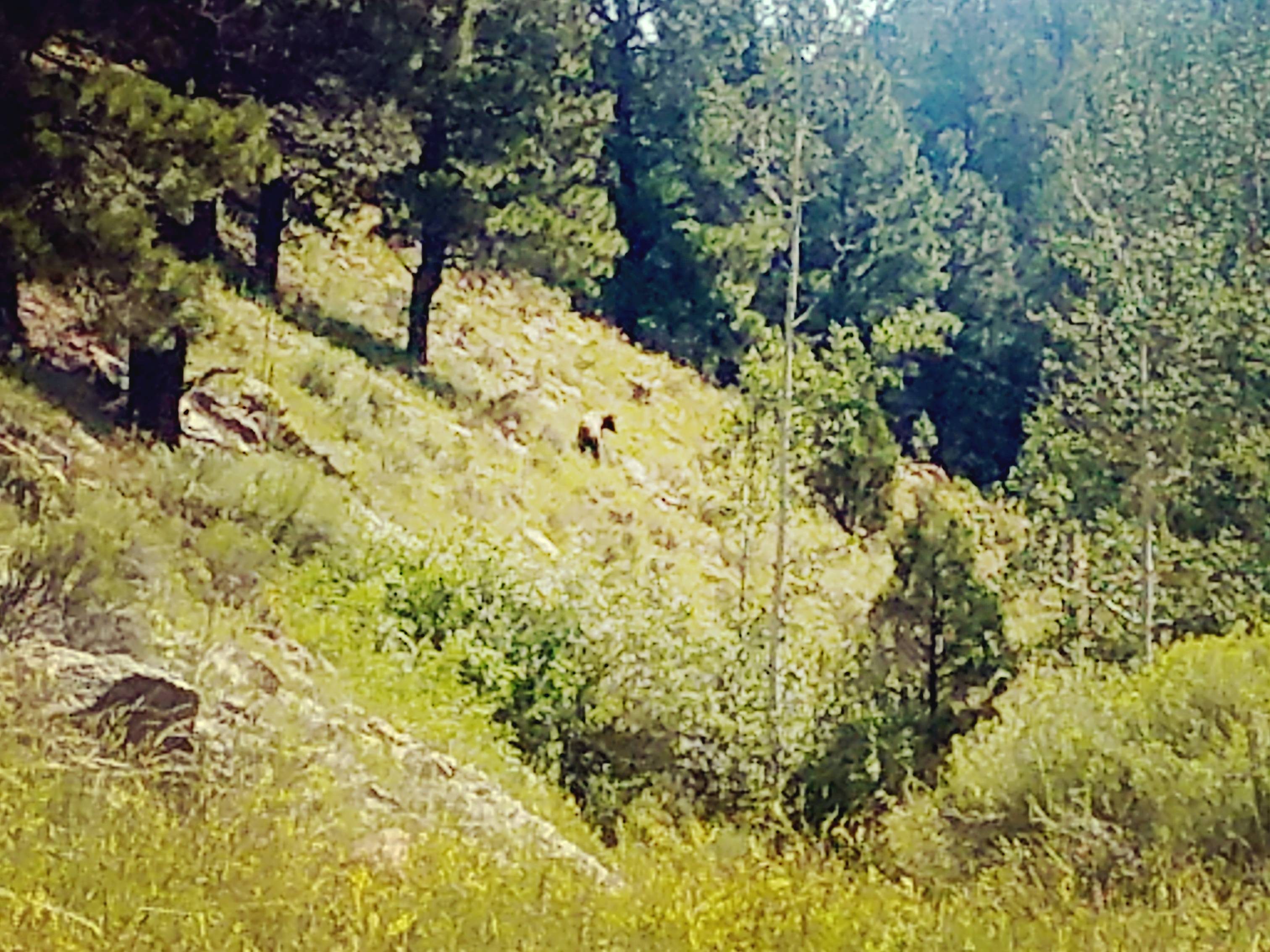
@Jerry,  many states also allow for the use of dogs for part/most of the bear season. They develop a strong aversion to dogs and barking from my experience  in the local mountain range.  Also, in the western US it seems that many many trail users have a canine companion or three with them. I think these two factors combined help explain the strongly aversive behavior of the bears i see each year.  (Pic of a bear that bolted after the wind shifted and revealed my presence)

JMT/Yosemite allows no dogs or hunting, right;)

Tom K BPL Member
PostedSep 26, 2017 at 6:01 pm

@Geoff
“Here is the 20 mile figure, quoted by the National Park Service. It’s at the upper end of the estimated range, but it’s not unrealistic, particularly when compared to Polar Bears,where the data is better. Bears have the best sense of smell on the planet, so hiding odours from them is surely a non-trivial exercise.”
I copied the link over for clarity before commenting.  The 20 mile figure is just an unsupported estimate, at the very high end of the range, and, IMO is of questionable validity for the reasons I mentioned in a previous post.  All of the examples in the article are personal anecdotes/estimates.  That said, 1-3 miles, for a strong scent, like a barbecue or a rotting deer carcass upwind, under the right conditions, I am entirely comfortable with.  However, there is a world of difference between a cookout or a rotting deer carcass and low odor, uncooked food triple bagged with careful handling.  Also, it occurs to me that a Polar Bear following a seal for 40 miles would be picking up scent left by the seal as it moved from place to place, not picking up the scent initially from a distance of 40 miles?    In any case, we are in complete agreement that hiding odors from a bear is a non trivial exercise, with no guarantee of success.  Any system so far devised comes with an element of risk, including the one I use.  But I do feel that I have reduced it to an acceptable minimum for the kind of country I hike in and the few bears that may be found there.
Geoff’s linked article:
https://www.nps.gov/yose/blogs/bearseries-part-one-a-bears-sense-of-smell.htm
“Conservative estimates of a black bear’s sense of smell state that a black bear can smell a food source from over a mile away, while other sources claim a black bear can smell food from over two miles away. A personal account from “The Great Bear Almanac” describes a black bear in California traveling “upwind three miles in a straight line to reach the carcass of a dead deer.” More generous estimates place a black bear’s sense of smell between 18 and 20 miles, which may sound extreme, until you learn that polar bears, the black bear’s cousin, have been known to follow seals for up to 40 miles. ”
“If the poster who ran the OpSak experiment contaminated the sample, it wasn’t for want of trying. And he was in a well-equipped kitchen. Are you suggesting that people would be doing this more effectively in the field? Allow me to be sceptical…”

You are not unreasonable in your scepticism;  I can only say that I, for one, would be at least as careful as the guy who performed the OP sack experiment, beginning with not using an OP sack, which I feel to be fatally flawed in its design.  That is why I use nylofume bags.  My hike and my personal safety depend on getting it right.  In return, I would hope you understand my scepticism at the 20 and 40 mile figures.

Lester Moore BPL Member
PostedSep 26, 2017 at 6:11 pm

I’ve wondered if hunting has anything to do with it.

Most definitely. On popular trails in Olympic National Park with lots of bears (such as the High Divide Loop), bears hardly pay attention to people and are not afraid to be in close proximity. Not far away in the National Forest where they are hunted, every bear I’ve seen runs away like their life depends on it. Seen similar trend in the Cascades too. They are smart animals and learn fast.

Same is true for the mountain goats in Olympic NP – they have killed people and are not afraid of being close to people. They associate people with salt, which they crave. But, a few years ago, Olympic NP instituted new rules requesting that visitors haze goats and throw rocks at them. I was surprised to see how quickly the goat’s behavior changed – they see you stoop over to pick up a rock and they start running away now.

PostedSep 26, 2017 at 6:28 pm

BTW, the manufacturers of those Nylofume bags have not done any tests along the lines advocated here (keeping the smell in) but are aware that some do use them for that purpose.

(I asked…)

Jacob BPL Member
PostedSep 26, 2017 at 6:43 pm


“Ignoring the snark so typical of those who don’t have much of substance to add to a discussion” I went out of my way to supply you, Tom K, with the data and sources regarding filtering media you asked for. If I was snarky towards you it was only because I was trying to not say something mean. I’m sorry if I offended you.

“Sounds like an interesting proposition. Care to volunteer?” I almost did this research for you too, but then realized I already had just spent a bunch of time doing other research for you. Then you put me down for it. Maybe another time, but if you ask with this same tone, I’m probably just going to say no again…

I wasn’t trying to invalidate the odor proof bag discussion, in fact I had just taken part in it.

So Tom K, you were always expecting bear cans to eventually fail? Is this the general consensus? I thought bear cans were an indefinite solution, hence my surprise at their potentially growing failure rate in Yosemite.

jscott Blocked
PostedSep 26, 2017 at 7:37 pm

There must be some sort of failure rate for seat belts too. So…are you going to stop using a seat belt?

Well, yes, if you’re the sort of person who hates seat belts to begin with and is looking for justification for not wearing one.

I suppose we should subject reports of bear canister failure to the same sort of scientific scrutiny demanded of everything else before we take them as fact. Urban legends (well, wilderness legends) and all that. Plus non-reported operator failure (face saving in front of the girl friend.) But again, reverting to common experience, I would claim with confidence that if you use a bear canister properly and it’s in functioning order, you will not lose your food to a bear. This may not apply in Alaska.

Again: Bearikade Scout, 1 lb 12 ounces, smaller than most canisters so if packs very well indeed. Carries 5 days worth of food plus another breakfast. Makes a good stool. And when you suddenly realize at 8:00 p.m. that you need Ibuprofen, or a chocolate bar, or you forgot a medication or want to brush your teeth, voila, there it is in front of you. Not hanging in a tree in the dark. The simplicity is worth a lot in itself; including the simplicity of not having to think about or plan for food and personal protection at all. At the end of the hiking day, you’re done.

Jerry Adams BPL Member
PostedSep 26, 2017 at 7:57 pm

I did Mt Angeles trail in Olympics and that goat was on the trail.  It was at a switchback.  I cut the switchback to avoid the goat.  A little earlier or later a goat on that trail killed someone, don’t know if it was the same one I saw.

I don’t advocate hunting, and I don’t pass moral judgement against by the way.  And am not proposing they allow hunting.

That makes sense to haze them.  It seems like they could do that in the Sierras.  I occasionally throw rocks at creatures that are bugging me like birds or squirrels.  I don’t hit them though.

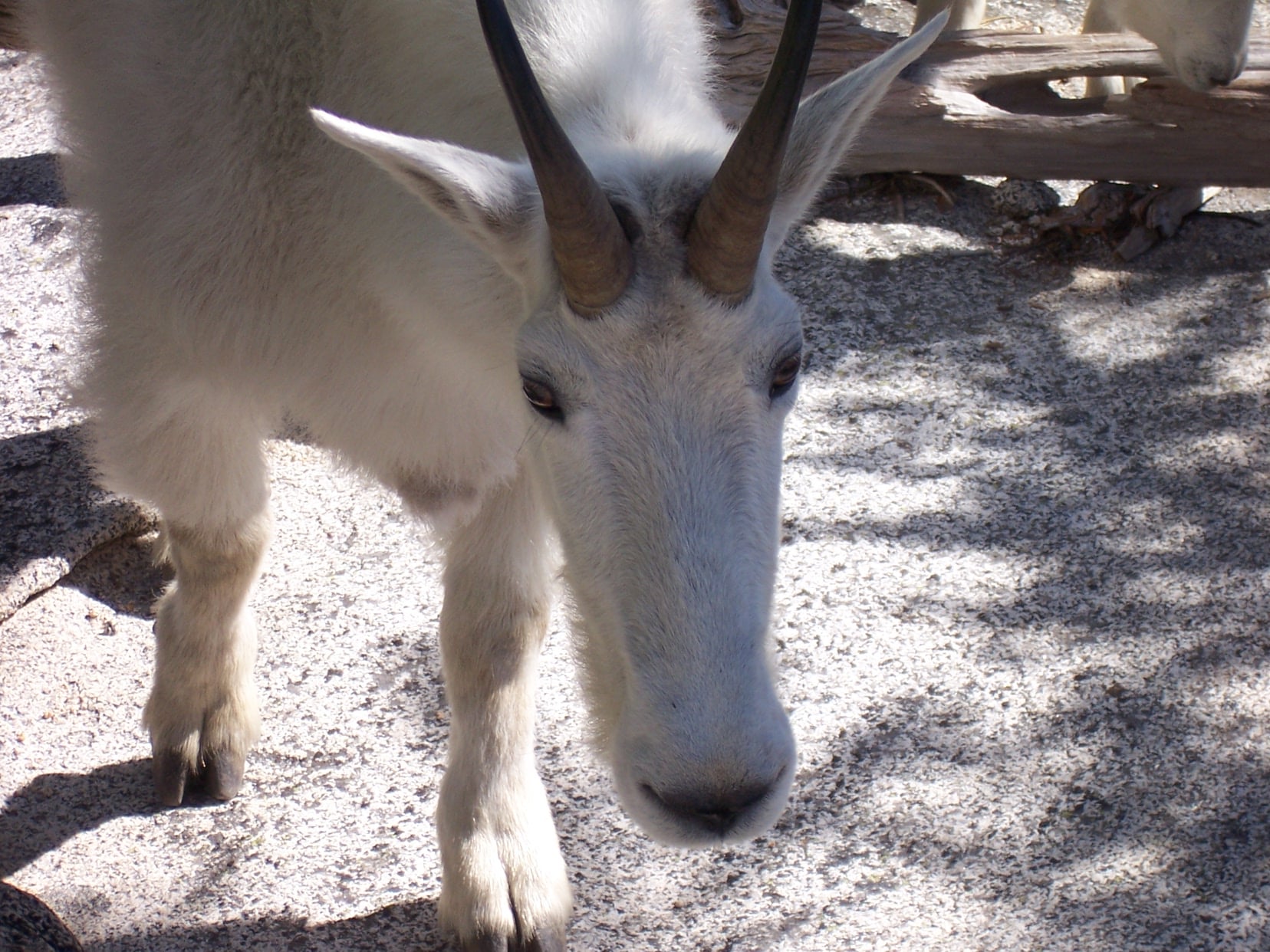
Goats are not fearful in the Enchantments:

This one came right up.  I could have touched it.  I finally shooed it away and it wandered off.

d k BPL Member
PostedSep 26, 2017 at 8:09 pm

“That makes sense to haze them. It seems like they could do that in the Sierras.”

That’s what we are encouraged to do if a bear wanders into camp – bang pots/pans, throw rocks in their general direction (though not “at” them), yell, etc.  A number of years ago there was a ranger program where I think they led dogs around campgrounds in Yosemite Valley evenings and mornings, which reportedly decreased the number of bear incidents.  But I don’t think that’s happening any more, for whatever reason.

Tom K BPL Member
PostedSep 26, 2017 at 8:21 pm

“I went out of my way to supply you, Tom K, with the data and sources regarding filtering media you asked for. If I was snarky towards you it was only because I was trying to not say something mean. I’m sorry if I offended you.”

What got me upset was being called ignorant.  I have been called any number of things down through the years, but ignorant has not been one of them. If that was not your intention, I am more than willing to let bygones be bygones.  But I confess to wondering:  If calling me ignorant was in lieu of saying something  mean, what would mean have sounded like, and why would you have felt that way in the first place? ;0)

Regarding the meat of your post:  The original intent of nylofume bags was for fumigation purposes, thus I have no reason to expect that testing them for the purposes of odor proofing a food supply has been done, and I certainly do not have the expertise/equipment to conduct such tests.  As Franco posted above, the manufacturer has not done such testing.  However, I do not think it unreasonable to assume that if it prevents gaseous molecules from entering the bag, it will also prevent them from escaping, since it is unlikely to be a unidirectional barrier.  The idea of using them for food protection did not originate with me, but when I heard of it I looked up the manufacturer.  When I found out what the bags were used for, it seemed very logical that they would work for preventing food odors from escaping the bag as well.

“almost did this research for you too, but then realized I already had just spent a bunch of time doing other research for you. Then you put me down for it. Maybe another time, but if you ask with this same tone, I’m probably just going to say no again…”

Let’s be clear, Jacob.  You would not be doing the research just for me.  This is a group discussion, and anything you come up with will potentially benefit more than just one person.  I am already confident enough in using the bags to bet my safety and food on them.  I would be very surprised if you found evidence to the contrary but, if you did, I would evaluate to it very carefully, as would a lot of other people, both current users and those on the fence.  I think I have already made a pretty substantial contribution to the discussion and am inclined to let you run with your own suggestion.  Or not, as you wish.  As for my tone in replying to you, it was in the context of your comment about my ignorance.  That no longer being an issue, I will apologize to you in return.  Hopefully that will clear the air on both sides and allow us to engage on subjects of mutual interest in the future without acrimony.

“So Tom K, you were always expecting bear cans to eventually fail? Is this the general consensus? I thought bear cans were an indefinite solution, hence my surprise at their potentially growing failure rate in Yosemite.”

Let’s just say I wasn’t surprised that there were some failures.  Initial design can’t anticipate all possible flaws, so failures were inevitable, IMO.  Bears are intelligent, determined, and resourceful.  As I said, they adapt, we correct for the failure, they adapt, and on and on.  I even saw one photo of a Bearikade after a grizzly got done with it.  Not a pretty sight.  I doubt we’ve seen the last failure at this point.  With this in mind, I also use a nylofume inside my Bearikade when I have to carry it, along with my usual no cook, low odor food, on the principle that eliminating as much odor as possible helps.  But my basic principle is avoidance;  I don’t usually hike where there are many people and, therefore, bears.  Habituated bears.  In that scenario, I seem to have been pretty successful so far with my nylofume bag setup.  Do I think it is foolproof?  No, but I do think I have reduced the risk to an minimal, acceptable level.  For me.

Regarding the general consensus, I don’t know if there is one or, if there is, if it agrees with my personal opinion.


Viewing 25 posts - 201 through 225 (of 233 total)
Loading...