


you won't have the toxic alcohol fumes to breathe with the canister stove.
b
Topic
Become a member to post in the forums.
you won't have the toxic alcohol fumes to breathe with the canister stove.
b
I'm going to go with the Caldera Cone with Starlyte, because of the spill-proofedness (It's a word because I say so!) of the stove itself and the fact that it is then surrounded by a cone that encloses it. Not only that, but the wind blocking factor of the CC is a huge plus over the canister.
RE: Billy Rays comment…carbon monoxide is still toxic.
HTH
KJ

i think that esbit is the safest
KJ… thanks for the reminder… yes you are right, alcohol stoves do indeed put out carbon monoxide as well as the toxic alcohol fumes… good point…
billy
Billy
I was talking about the canister stoves putting out carbon monoxide. Some stoves are worse than others (design dependent – http://www.backpackinglight.com/cgi-bin/backpackinglight/stoves_tents_carbon_monoxide_pt_3.html). In terms of toxicity, all options (ESBIT, Meths, Canister) put off something toxic when burned. Nature of the beast(s). Now if someone did a study of which of the three were worse in terms of toxicity….*nudge nudge – BPL article*
KJ
lol KJ… I'll have to remember to note that it's a joke when responding to yo in the future… no worries…
billy
Billy
I will just note that you are the sarcastic type. This is a good thing in my book. ;O) Kinda hard to tell these things through the Interwebs.
KJ
In my personal tests Jetboil uses 1/2 of the fuel of a regular canister stove, even when used with a heat exchanger pot.
Hi Anton
> In my personal tests Jetboil uses 1/2 of the fuel of a regular canister stove, even
> when used with a heat exchanger pot.
I think you exagerate – rather a lot. Try actually measuring the weights.
My own testing suggests that the heat exchanger pot is what makes any difference. The Jetboil stove itself is no different from most other uprights.
Cheers

canister stove is safer – just turn off valve. and more convenient. and has a lot of power. and depending on how much water you want to boil can be the lightest weight – if you just want to heat a small amount of water then alcohol or esbit can be lighter weight.
my Exponent F1 stove started leaking between stove and canister, producing a bit of a flame ball, but I blew it out and screwed it on tighter, but I think tha was an odd-ball case
I still think esbits are safer. Flamethrower vs tiny flaming cube that can be blown out or stomped out easily.
hmmm… you have a point there
but the amount of power is so feeble it doesn't boil water very good
"Flamethrower …"
Someone here posted a video of several canister stoves being tipped over and righted while in cooking mode. No "flamethrower effect" was observed.
I measured the weights. Specifically, I tested Jetboil (older version) vs Snowpeak LiteMax titanium + Olicamp XTS heat exchanger pot (plus Jetboil's own pot). I used a stopwatch and electronic scales. No matter how I tried, Jetboil beat any other system by about factor of 2 in boil time or fuel consumption.
At that point I gave up and settled on Jetboil. The Titanim weighs 254 grams, hard to beat with any other system.
I don't particularly like Jetboil, the burner build quality is very low compared to SnowPeak, for instance. But fuel economy and weight are good.
***
Somehow I lost the file with data, but I seem to recall that Jetboil uses 6 grams of fuel to boil 2 cups (1 liter? the safe fill level, anyway) of water at ~20C at 5000 feet with light winds. For non-Jetboils even the lightest wind makes a huge difference.
“I don’t particularly like Jetboil, the burner build quality is very low compared to SnowPeak, for instance. But fuel economy and weight are good.”
Scroll down to the last post.
Up close …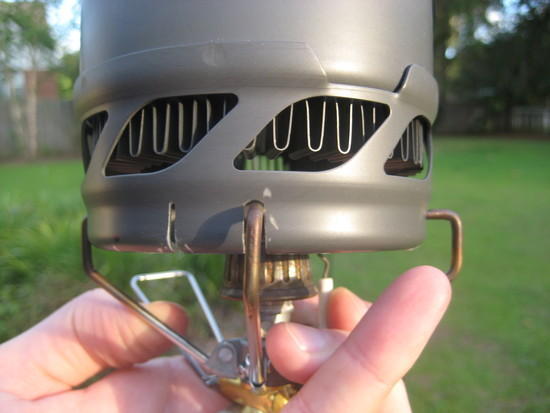
Got a Dremel?
The close-up is not my image, and I don’t remember who it belongs to.
Search for the JB Hack threads to find out more.
Hi Anton
OK, point made, but I suspect that the combination you were using was not effective. To explain:
The Litemax throws the flame out sideways, and the Olicamp pot is not very wide. So the relatively poor performance you found is more of a function of the pot diameter not suiting the stove or flame shape.
The Jetboil burner has no inherent virtue over the rest of the market, but the flame shape does match the design of the heat exchanger pot. So other burners with a similar narrow flame shape should perform equally as well with such a heat exchanger pot; conversely burners which throw the flame out sideways will not perform very well.
Measurements would be of interest.
Cheers

"Olicamp pot is not very wide."
It is wider than the Jetboil Sol. I'll measure the width of my pot later.
I also have the Olicamp heat exchanger pot (paired with Soto ODR1) and have found no improvement with my fuel economy, even when compared to narrower pots. I've tried a wide range of flame patterns.
When I turn the stove up high enough that the flames fill the hxr fins but do not go up the side of the pot, I do get faster boil times in exchange for a decrease in fuel economy per minute. The faster boil time compensates for the decrease in fuel economy so I still end up with .25 oz of fuel burned per boil (.5L 40*F water). My understanding is that the Jetboil Sol uses about half that much fuel.
Edit: Brain fart! Meant .5L not 1L! Corrected above.
That's weird, I use 0.25 oz of fuel to boil 1/2 liter (1 pint) of water – about 40 F.
If I turn it down so boil takes twice as long, I save 10%. I think the hot gases flow slower so have more time to lose heat to the pot.
If I use MYOG heat exchanger wind screen, I save 10% – so I'm down to 0.2 oz fuel per 1/2 liter.
That's in controlled experiments and when I measure the canister before and after a trip, being fairly careful to know how much water I boiled.
.25oz for .5L at 40* is fairly typical for me with the Soto. This is with all of my pots, most of them are mug shaped. The Olicamp is my only HXR pot. I do use the Soto windscreen which helps.
Which stove are you using?
Edit: Changed 1L to .5L.
This would be so much easier if we didn't cling to our obsolete "English" system of measurements. Just because the French came up with the metric system doesn't mean it's no good : )
Soto Windmaster, MSR Pocket Rocket, Exponent F1 Ulatralight – all about the same
I've always used a windscreen. Recently I've switched to MYOG heat exchanger windscreen which helps a little.
I always measure weight of canister before and after each trip. I always boil 4 pints per day = 1.9 liters.
With just windscreen I use 1.05 ounce per day = 0.55 oz fuel per liter of water boiled
With heat exchanger and going slow I use 0.8 ounce per day = 0.42 oz fuel per liter of water boiled
Well the trick is not to watch the water boil for a few minutes all while saying "Ooohh! Look at the pretty bubbles!" ;)
I kid because I care Jerry!
I've found that boiling water with my stove is a modern day Goldilocks story for me. If I turn my flame pattern to WFO, I end up burning .5oz of fuel to boil .5L 40*F of water. Too low and same thing due to the extended time to reach a boil.
Keeping the flame pattern to where it just reaches the edge of my pot seems to be the sweet spot for fuel economy. I prefer to use mugs over pots so I may be using a smaller flame pattern than you.
Edit: meant .5L not 1L.
Roger, I very much agree that all this is about the shape of the flame and how close and confined the flame is within heat exchanger. There's absolutely no magic in Jetboil. In fact, it's built kind of cheap, comparatively. I think every older Jetboil has a failed igniter, for instance.
My personal attempts to build a Jetboil equivalent did not lead to much success. I think in my Snowpeak/Olicamp tests the issue was that the stove was a little too far from the pot. I tried various setups, "inserting" the stove inside the heat exchanger ring, the results got better but still not a match.
For the original poster I just wanted to mention that w/o some good DIY work, Jetboil probably would give better results than a regular canister stove plus separate pot.
Oops! I meant a pint not a liter! Just corrected my posts.
if we just switched to metric life would be easier
this is like slowly pulling the bandage off, better to do it quick and be done with it
I've done some limited testing with a new Jetboil versus my old standby, the Coleman F1 and the Snow Peak 900ml Ti pot.
On a recent trip, under breezy or even windy conditions, the F1 was using on average 15ml of fuel per meal (2-3 cups in the morning for coffee, 12 oz in the evening for noodles.) This is for two people. Yes, I know the breeze kills the efficiency of a canister stove, but the F1 came in second in wind efficiency in the BPL tests a few years ago — second to the Jetboil.
So in my back yard, with no breeze, boiling two cups of tap water, my old setup used 7g of fuel in 3:30, and the Jetboil used 5g of fuel in 2:15 to bring the water to a full boil. Assuming any sort of accuracy on the scale (hah), that's a 40% improvement under windless test conditions. All of it appears to come from the quicker boil time, of course — the F1 was running 50% longer, so of course it used more. I don't know how much difference wind will make for the Jetboil.
So, if I can get 5g per boil, that's 22 two-cup boils from a small canister, or enough for two weeks for two people who need slightly more than 2 cups of hot water twice a day. It's enough for three weeks for a solo hiker in warm weather, having coffee in the morning and noodles in the evening. Not bad, and it'll make a difference on an upcoming hike.
Become a member to post in the forums.
 Brynje Mesh BaselayersBrynje baselayers use open mesh construction to move moisture away from the skin, create insulating air pockets, and help regulate body temperature across changing conditions and activity levels.
 © Beartooth Media Group Inc.
 Loading...