


I will have a beer for you Max,
Don't worry, it gets easier mate :-)
Topic
Become a member to post in the forums.
I will have a beer for you Max,
Don't worry, it gets easier mate :-)

get what fits and works for you … its that simple
and go out and use it … over and over again
the more you yak on BPL about what other people use … the less you use your gear ;)
@Eric: I'm at work. Yakking about backpacking beats doing nothing!
nm
nm
Good insight, Bivy. I knew they were good, but not why.
Picking a pack is so personal, I bet almost everyone gets the wrong pack their first time. The older people on this forum have it easy- back in the day, nearly everyone was suffering!
It took me about 13 months to realize my torso is a Medium and not a Large, despite being 6'2".

I'm the same way on torso. I'm just under 6', but my 5'3" wife is only a hair shorter in torso length than me. For most pack companies, we wear the same size pack–a medium.
And Dave makes an excellent point. Considering a pack's frame in isolation is worthless. It's an integrated system with most elements of the pack itself (shoulder straps, hipbelt, backpanel, etc.).
Right. Carried weight is a whole 'nother consideration.
I mean, I should be the LAST person to have this conversation anyways. On top of my 12lb base weight, I have at least 8lbs of camera gear. I'm the group photographer for my hiking crew AND my school's outdoors club, so if I'm not packin', it's as if the trip never happened…
I liked that article, Clayton. I took a few things out of it.
1: It really brought my attention to torso length, which I ignored until I bought the Gregory (I sized exactly in the middle for a medium).
2. It also reminded me of things like pack durability, which I don't weigh too heavily as of late, but I have in the past.
3. It makes me wish I had used the GoLite Jam as my scapegoat. *evil grin*
I think someone mentioned that a lot of users can get by with only one pack, and I agree. Like I said before, I suspect the Gregory Baltoro 65 might make me scoff in disgust at my $90 Boreas bag, but everyone needs something they can stuff and run with when it's local camping time.
And don't get me wrong, as a frameless pack the Boreas isn't bad. I've shouted it's praises before. Functionality-wise, it's a dream. The absolute perfect number of pockets in all the right places.
>> Second, they hug that bottom piece nice and tight, the concave of your lower lumbar.
While I'm sure some people prefer this, I don't agree that it's the "best" or "only" way. In the end, the point is to transfer weight to your legs via your *hips*, not your spine or back. Frames are usually designed to be anchored at the hipbelt. Some people like that hipbelt to hug higher, in the lower lumbar region, others don't.
I'm not sure whether you've ever tried a ULA pack but you may be surprised; I don't think they're as inconsequential as you seem to think.
+1 on Dave and Clayton.
Also something to consider is the shape of the main bag itself. Many are very similar, but slight differences affect how the carry, how we pack them, and how they sit off the body.
The most different packbag shape I've seen is the Catalyst. Its a wide bag with a very tapered bottom (curving in towards your butt), and it's also tapered from the opening down to the bottom. At first it was tough to pack, until I figured out how my stuff fit the best.
One feature that the Catalyst has that changes how it carries is where the shoulder straps are attached, though I'm not talking about where they attach at the top near the shoulders. The bottom of the shoulder straps doesn't attach to the lower backpanel as many packs do. Rather, they go through the side pockets and attach to the side of the tapered bottom of the pack at a point that is furthest from your body. So its pulling the whole pack in closer to you, not just the back panel.
People's views on framed vs frameless vs lightly will always be different.
Interesting, I didn't know that about the Catalyst. That's an intriguing design.
I also think this discussion highlights how flawed such conversations on the internet can be. I suggest you all come out to Montana this summer and we can hit up Glacier, the Bob, and talk gear as much as we want. Don't tell my wife, but I bet we could even accommodate a small group at our place, as long as some are comfortable sleeping on the floor or in our backyard.
I want Patagonia to make a $1000 pack laced with unicorn hair.
If you're willing to wait, next year's model is rumored to have dragon's tooth zipper pulls.
McHale uses Aluminum 7075-T6 stays. They are not going to compress much, unless you have over 100 lbs in your pack :)
No, I was not suffering back in the day. My first pack was an Antelope purchased in the 60’s. My gear wasn’t very heavy because I couldn’t afford to buy much gear; that is the easiest way to lighten a pack, don’t take much gear :)
My 2nd pack was a Kelty external. Base weight was always under 20 lbs, so no suffering. And I have been using this same pack for 42 years.
Suffering occurs when people bring a lot of crap they don’t need and won’t use.
Read the first two trip reports here. These trips are with the old school gear I used for decades. Base weights under 20 lbs. Hard to suffer with a base of under 20 lbs (which many here classify as “light”) and an external frame pack.
The suffering started in the 80’s when the big manufacturers started selling all kinds of heavy stuff and marketed these goods as required for safety. People suffered because they bought a bunch of junk they didn’t need.
Many of us older folks were light long before Ray Jardine “invented” lightweight backpacking. We relied on skill, not gear.
Dan McHale soloed the JMT unsupported in 11 days when he was about 6 years younger than you. He used an external frame pack with a total weight of 40 lbs, including food and water.
BTW, a guy named Monty (who posts here once in a while) thru hiked the PCT a few years ago with a GG Murmur. Minimal gear and I doubt he suffered, since his base weight was under 5 lbs. Of course the trick pony was to resupply often and know what you are doing.
Experience and skill always trump gear.
Regarding twin stays and David's comments…
I have a lot of curvature in my back. Take a look at the shape of the stays in my McHale packs.
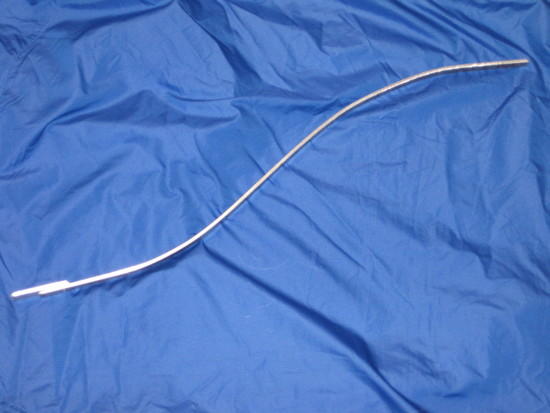
Max:
Apologies to you upfront if I sound annoyed…
You keep writing, to the effect:
"A backpacker today doesn't have to cast off the shackles of heavy packs like they might have had to in 1990. There are a lot of supreme, rolls royce feeling packs at 4-5lbs. Gregory, Arcteryx, McHale, Osprey…. the list grows."
You seem utterly unable to grasp the concept that "rolls royce" feeling packs can be both unnecessary and suboptimal for those who have pared down their pack weight?? Yes, these packs may be a lot lighter than the big haulers 20 years ago, but so what? For many of us, they are still unnecessarily and inaprpropriately heavy!
I repeatedly wrote about the importance of matching the pack with the gear you carry — but then, you turn around and drone on about "rolls royce" packs! Maybe you do need it. Or maybe you don't. The way I read your posts, you are not making allowance for both possibilities at all — but just hell bent on "attacking" UL concepts as if they automatically bring on discomfort!
Let me try again (and again, apologies to you for the annoyed and preachy tone):
1. Match gear volume and gear weight with the proper pack.
2. But, you ask, what's wrong with "a little" extra frame and padding? The rolls royce comfort?
3. Answer: No matter how much a pack pampers your shoulders — even when it is providing comfort that you don't need — your legs and ankles and feet still have to carry the extra (and in this case unneeded) pack weight — every step of the way, every hour of the day, day after day (if a long hike). More comfort is not automatically better!.
And paying more for a heavier pack to provide comfort that we don't need is not the objective here for most of us. And AFTER you've compared using a hefty pack to carry 20 lbs on a long day's hike– versus a frameless pack to carry the same 20 lbs. over the same long distance — you might be converted as well!! Or you might not. But until you ACTUALLY TRY a frameless to compare for yourself — you really, truly haven't the complete exposure to support what you keep writing about — this supposed UL discomfort and this supposed benefit for rolls royce comfort. It all depends, and again, more is not automatically better.
My frameless pack weighs 10 ounces. If I am carrying a heavy load, then sure, the extra 2-3 lbs of an Osprey will make perfect sense. But if I am just carrying 20 lbs — and my frameless is already comfy enough for me to carry all day — then why the hell would I want to throw another 2-3 useless pounds onto my legs and feet to support for 10 or 12 hours?? Makes zero sense to me — and I hope it will begin to make zero sense to you as well.
So, how about holding off your posts and judgment on this matter — and give it some real life field test first??
Rant over. Sorry.
"Don't tell my wife, but I bet we could even accommodate a small group at our place, as long as some are comfortable sleeping on the floor or in our backyard."
I'm gonna need a bed. I really hate to rough it ;)
Re: Skill
Of course. Goes without saying. And I didn't mean to imply that everyone in the 70's and 80's was doing it wrong, but nobody's gonna argue that cuben and silnylon didn't make a big impact.
5lb base weight? Now, that's an impressive feat.
Yep Ben…exactly!!
And what is the difference between carrying a pack that is too small and unsupportive for 30 pounds than carrying a beast…no matter how padded it is…to carry 17 pounds?
What's the point of shouldering a 5 pound pack no carry 17 pounds?
And seriously Max, you really, really need to try one of these packs before you automatically assume they are uncomfortable. You might surprise yourself.
–5lb base weight? Now, that's an impressive feat.–
Not particularly, especially around BPL. I'll bet a lot of us have been that low. My three season kit is around 9 lbs and that's including a Thermarest Prolite and no cuben fiber. If the temps are going to be above 40* (which they normally are when I hike) I can get it down under 8 lbs pretty easily. For me, a 5 lbs pack wouldn't make a difference and in fact is pretty silly considering how much weight it would add to my set up.
I still have a Mountainsmith Phantom (the old one) that's got a curved aluminum frame but rarely use it unless I need the extra space for my bulky winter gear. Even if I'm carrying a bunch of extra gear to stay warm, its still light enough that I don't usually use the frame. I find rolling my Ridgrest inside the pack is more comfortable than the hard plastic framesheet against my back.
Are you aware that most frameless pack users pack the sleeping pad in such a way that it acts as a virtual frame? It sounds like you might think we just stuff our gear in willy-nilly. A Ridgrest is an adequate frame for a 25 lbs load, I've done it on a number of occasions. My Prolite even works fine for 20 lbs loads (maybe more, I haven't had to try yet). That's one of the big reasons I haven't switched to a Neoair, they don't seem like they'd make very good pack frames!
Adam
I have a frameless pack, my Boreas hasn't had the frame in it since the day I bought it and it's been on six trips. That's my point of reference. It's LESS comfortable with my baseweight and a weekend worth of food than my Kelty, which is by no means a stunner.
Real life conversation and internet forums are different things. My "Rolls Royce" comment wasn't groveling at the quality of 5lb packs. Rather, it was a semi-sarcastic reminder that those heavier packs have some of the most time put into them in terms of improving comfort, since they're used by the majority of "traditional" backpackers with 50lbs of creature comforts. By design, they're anatomical and overbuilt. Very different from a Kelty frame bag from the 80's (whether that's a good thing or a bad thing is subjective!)
I can only say so many times that I agree that frameless packs are great for frameless pack loads. I've been practically preaching from the Ben 2 World playbook. That doesn't change the fact that realistic loads for a lot of ultralighters extend past this margin by the very nature of food and water.
I'm not the only one saying it; ditching a hipbelt on a 20lb load will eventually hurt your back. it isn't designed to carry like that. Your hips and legs, however, are. Stays or frames of some kind can be pretty critical, and I do see them get disregarded for a few more ounces.
Now, not to go on my own rant, but…
Ben. Don't take me bringing up fringe topics, devil's advocating, and touting around vague generalizations as me ignoring your posts. I'm trying to approach this from a lot of different angles. You are CORRECT when you say to pick your gear, then pick your pack, but it's not as simple as that.
It's a little annoying that you need to be an expert to have a conversation around here. I don't think it's unreasonable to make assumptions if you're getting your information from experience and good sources. I don't think it's wrong of me to bring up the topic just because I haven't finished a loop of the United States. If I was trying to compare ice axes, that'd be a different story, but I have worn a lot of backpacks and walked a lot of miles in the woods. I know enough to have a conversation, and that's all this is. It's more than a little annoying to have a constant reminder that I'm not 55 with the world under my belt. I know a lot of people doing this 30 years who probably know less than I do about the ground they walk on. If you think you know better than me, politely educate rather than dismiss. I give out the courtesy to people who know less than I do without hesitation; it's easy.
Nobody reads the thread (nobody reads this!), they skip to the end, but I've said several times that I'm not trying to convert or condemn. I'm trying to pull concepts that never get talked about into the light to better my understanding. Shoes and packs are subjective, so nobody ever judges, but it's not wrong to talk about best practices.
The article that Clayton linked (http://www.backpackinglight.com/cgi-bin/backpackinglight/how_packs_work.html#.UUTjxFvwKp2) talks about how the Jam was built to be super light and then slowly added 11 ounces worth of features that backpackers deemed necessary. Is it ridiculous to think that some of the sub-1lb packs made today are inadequate? Hardly! Everyone sees another ounce drop off the scale and suddenly, the long-term health of the spine is a little less important. This disregard for basic load distribution exists. I'm confident in it. I see it with some custom made packs and some traditional ones. Hell, my very own Boreas is a good example, despite being excellent with smaller loads it fails at a thru-hike load.
I said it once, I'll say it again. Nobody's gonna change their minds. Except, maybe, myself and other "beginners" (I'm getting past that)- and that's the point.
Jeez, guys. When I finish recovering from Surgery #3, I'm gonna see you on the big trails. Then I'll be twice as bullheaded…
I didn't pick the Gregory because I've got some misconception that it's the rolls royce of packs, and magically solves issues.
1. Camera gear requires a totally different suspension setup than a tent and a sleeping bag. These things are heavy and small, so a fullbody DSLR torquing around on the front of a GoLite Jam isn't gonna work. Tripods alone are like strapping a piece of firewood onto your back. My needs ≠ your needs, even if the weights are the same. I need a strong, active suspension for comfort.
2. Because I'm a photographer and a "camp mom" for lots of student groups, quick access to lenses, first aid kits, tarps, snacks, etc. means I value extra pockets a lot higher than most people do.
Looks to be my pack, but it's NOT necessarily everyone else's pack, and honestly, it's very separate from this conversation. It's a good example of a good suspension system, but as many people have said, the vastly lighter ULA packs do just as well with the 30lb loads we're primarily talking about, if not better.
Adam, yep on the sleeping pad frame; I do it myself. And yeah, 5lbs is impressive for a thru hike. Usually when I think 5lbs, I think of someone spending 2 hours every night cutting up branches for their bush fire, lean-to, and sleeping pad :P
I know it's pretty easy to get to with a tarp, quilt, foam pad, and alcohol stove, though. I just admire people who commit to it for a couple thousand miles.

"My frameless pack weighs 10 ounces. If I am carrying a heavy load, then sure, the extra 2-3 lbs of an Osprey will make perfect sense. But if I am just carrying 20 lbs — and my frameless is already comfy enough for me to carry all day — then why the hell would I want to throw another 2-3 useless pounds onto my legs and feet to support for 10 or 12 hours??"
Same here – pack weighs 12 ounces, most I ever carry is 20 pounds or maybe rarely 22 pounds – pack is fairly comfortable – no reason to have heavier pack
Hip belt weighs maybe 2 ounces. Good enough to put weight on my hips.
If I was to do JMT – base weight 12 pounds, bear canister 2 pounds, 6 days of food = 10 pounds – 24 pounds total – maybe my frameless pack will be insufficient
Or I was looking at a hike with no water so 2 days of food and water = 26 pounds total – again, maybe frameless pack is insufficient
It was said earlier but there's no expectation that it'll get read. We're including the JMT/PCT/AT/LT kind of weight, just because:
A) If you don't include a few days' food and water, the whole forum can use REI Flash 22's or less.
B) Food and water have a (semi) constant weight, so it's more universal to think about
C) It's a realistic reason to need good suspension because a bad suspension or incorrect distribution over 1,500+ miles will leave you very hurt, possibly for a long time. Talked with a lot of people about this, I know hikers who never lost their back and knee problems.
Edit: I should say, I am basing everything off of this. It's a free country, you can brag about 0lb packweights on 3 hour hikes if you want! :D

ULA packs.
ULA has somehow made a pack that is very durable and carries well while still being light. I have carried up to 30lbs in my ohm 2.0 and it just melts into my back after a while. I don't even notice it there. And it weighs under 2 pounds.
Wow this thread is racking up the responses quick! I just got my multi-night gear down below the 15 lbs mark with the completion of my MYOG quilt. My backpack (2012 Golite Quest 65L) weighs a lot more than it needs to but I love the frame design and is really comfortable for me, also got it for less than $100.
Become a member to post in the forums.
 New Gear with Aluula FabricsLighter, stronger, more abrasion-resistant, and highly water-resistant - explore ultralight backpacking gear made with ALUULA Graflyte fabrics. Engineered for exceptional strength, durability, and lightweight performance, ALUULA Graflyte helps reduce pack weight without sacrificing reliability, making it ideal for demanding backcountry adventures.
 © Beartooth Media Group Inc.
 Loading...