


Is there any more information on the British hiking system? I have found some success using the umbrella and wearing my Golite Tumalo top and having the pit zips and pockets open to breathe.
Topic
Become a member to post in the forums.
Is there any more information on the British hiking system? I have found some success using the umbrella and wearing my Golite Tumalo top and having the pit zips and pockets open to breathe.

I long ago gave up trying to stay dry in heavy rain. Even if I could keep the rain off my own sweat will soak me and there is no way that sweat will evaporate in a heavy Pacific Northwest USA rain.
So I use a closed cell foam coat (float coat) as my insulating layer, raincoat and partial sleeping pad. The closed cell foam absorbs very little water and retains most of its insulating value when wet.

No free lunch! A lot of my hiking is in cold, high humidity conditions, with lots of drizzle. The air is saturated, the brush is wet, and your perspiration has nowhere to go. I use a trash compactor bag to keep my insulated stuff dry and use a poncho or a rain shell with all the vents open. I don't care what breathable fabric is used, it is simply overwhelmed by my perspiration and the soggy air. Having a dry base layer available is mandatory. Synthetic fill and fleece are superior to down in those conditions. I can't depend on sunshine to dry things out either, so a wet multi-day trip can be a challenge. It's part of the deal here.
I agree with Dale. Tactics in rain forest hiking need to account for the wet. Breathable fabrics often fail. Sometimes you may be better with Helly Hansen Impertech and good vents in very wet weather. Although recently I have been trying eVent fabrics with some luck so far.
I have retired all my down insulation for the most part. After many days of rain it just absorbs too much moisture from the air so you are better off with synthetic. Starting a fire is also not always an option to dry things. Finding and collecting dry wood can be difficult and expose you to more rain. Sometimes you just need to hole up in a good tent and stay warm and dry as best you can.
The worst is rain and cold temps. The air is saturated and getting wet can become a serious situation. It's one thing to get wet in a summer shower when it is 80 degrees out and will be sunny soon. It's another when it is 40 degrees with temps falling to 35 and remaining wet and cold for many days on end. It tends to make you a more conservative hiker when it comes to carrying gear.
In general:
I don't carry any rain gear that isn't 100% waterproof. I don't care if it is heavier than lesser rain protection.
I dislike ponchos because they allow rain to blow in from the sides or flap around in the wind.
Ditto for pack covers. I use a trash bag liner for my pack.
I carry and use an umbrella. It makes a huge difference when hiking in forests with no wind to worry about but lots of rain.
A wide brim hat is also more comfortable to use than a jacket hood for extended use.
I use a tent from Hilleberg with double walls to limit contact with inevitable condensation. I don't trust other shelters to provide adequate protection. I also would never have my shelter also double as my rain gear (e.g. Poncho as tarp). I want to have a tent that I can go into to get and stay dry no matter how bad the rain is.
I use all synthetic insulation and clothing.
Underwear and socks are merino though.
I use a synthetic sleeping bag. It goes in its own waterproof stuff sack.
I have an extra set of dry socks and undergarments to wear in the tent.
A microfiber towel is handy for drying things off.
A tarp could be handy to setup outside your tent for a sitting and cooking area. Although I don't normally use one.
Doing the above I can normally stay pretty dry in extended rain.
I just try and stay damp/wet and warm with the minimum of clothing. Currently above the bush line I use Rab eVent leggings and smock. I wear light shoft shell trousers under the leggings and have found this to be a superb combination. Under the jacket it is a merino base layer, combined with a 100 weight fleece if needed (haven't needed to yet). However, even if I don't wear it during the day, the 100 weight fleece is wonderful to put on under my BPL Coccon after a long wet session.
In warmer weather or below the bush line I am planning to experiment with a rain skirt. I have used the Buffalo pile/pertex system in sustained heavy rain before. It works well, but I found you need to keep moving to keep warm. Overall I am a bit wary of any system that requires you to hike hard all the time to keep warm. This can work very well at times, but poor terrain and challenging navigation can mean that your pace slows and you start to cool.
Some people love Paramo for cold wet weather, but others have found it leaks.
Don't bother. You won't succeed anyhow. Focus on staying warm.
Cheers
Since staying dry in a continual rain and/or damp environment when it is cold is a fallacy, what do people suggest to stay warm? Fleece or synthetic insulation layers, quick drying base layers, wool socks, a change of these, a synthetic sleeping bag, heatsheets?
"what do people suggest to stay warm?"
How about a nice warm wood fire?
I was on a snow-camping trip one time, and somebody brought along a Pine Mountain fire log. At nightfall, it was lit. It produced a lot of light, but not much heat. It melted its way down through about four feet of snow before it went out, but that heat couldn't be utilized.
–B.G.–
Read the thread Brett. Plenty of suggestions.

+1 Ken : )
Yes, I understand that. It was more of a query to see if there were some more groupings or ideas rather than a shotgun effect.

Sounds like it is a whole different ball game in the northwestern US and Down Under, than is the case in Colorado and New England in the US. So much to be learned from this site. Kudos for getting (and staying) out there in such more challenging weather. Maybe someday the ultimate WPB will arrive to keep you dry.
Hi I live in the SW UK, where it rarely gets cold but does tend to be pretty wet and windy.
Until a couple of years ago I was going with the fleece and pertex approach, this worked well for me until in July 2010 I was walking accross Dartmoor in heavy rain and strong winds. The temperature was about 50oF, but the 40-50mph winds made it feel much colder. The wind was driving the cold rain strait though 2 pertex layers (a Montane featherlight and lightspeed jackets) a micro fleeca and a baselayer and onto my skin. Whilst hiking (fast) I was just cold, but as soon as I stopped I started shivering uncontrolably and could therefore not stop and rest or eat. I was very concerned that if things got worse or if I could not continue I would be in serious trouble.
After that experience I bought a Montane lightspeed H20 jacket http://www.montane.co.uk/products/men/shell/lite-speed-h2o-jacket/164 and a cheap pair of waterproof trousers http://www.mountainwarehouse.com/mens/clothing/waterproof-trousers/pakka-overtrousers-p2629.aspx?cl=NAVY. I have twice since been out in poor conditions using these new items and have found they make an incredible difference.
The first occasion was in August last year, the rain was heavy and the wind was moderate, nothing like the year before, but I would have been soaked to the skin in fleece and pile. I wore just a base layer under the water proofs and although wet with perspiration I was comfortable, I think the big difference wa that I was being soaked by warm sweat, not cold rain. When I stopped and put up my tent I put on a fleece layer over my base layer (having taken off the waterproofs)and they were dry very quickly.
The second occasion was in January when I was hiking in 40 mph winds at 40oF with a mixture of rain sleet and hail, again I wore just a base layer and the waterproofs. I was just cooler than comfortable, but experienced no humidity inside the waterproofs. When I stopped for a break, I put on a snugpack jacket http://www.snugpak.com/index.php?MenuID=93-104&ItemID=101 with a cheap water proof http://www.snugpak.com/index.php?MenuID=93-104&ItemID=101 over the top. With this on I was comfortable even when sitting around for a half hour break.
The Lightspeed H20 is not very breathable MVTR or 6,000g/m²/24hrs. Montane have just brought out a new jacket http://www.montane.co.uk/products/men/shell/minimus-jacket/412 using Pertex sheild plus which is much more breathable MVTR of 25,000g/m²/25hrs. It would be interesting to see how much difference this would make in the warmer conditions. I am convinced that if cool enough, the best way to avoid moisture inside your shell is just to make sure you don't sweat by controlling your temperature! When my light speed wears out, I will try a more breathable jacket, but for now am happy with my system.
With regard to other equipment I have found that my down quilt is great if the weather is dry, or if you are only out for one night, but if it is wet and you are out for a number of nights, I find it looses loft and warmth. I am going to be making myself a climashield quilt for this winter.
At the moment I use a Tarptent squall, which I have had for nearly 10 years. I have found it to be a great shelter. It has stood up to winds which I would never have guessed it would when I bought it. The only issue I have with it is that it is a bit of a wind tunnel, and this makes it a bit of a chilly place to be in a storm. I am thinking of either some sort of mid shelter or TT Notch or Stratosphere for it's replacement.
I have never used buffalo clothing, but had one of their bags years ago. The bag did not wrk for me, and although the clothing sounds like a great idea, I have never met anyone who uses it in a backpacking situation.
Paramo clothing has a very loyal following over here, but most find it too warm to wear outside of winter, and you have to be very fastidious with keeping the DWR in good condition otherwise it looses its waterproof qualities.
Hope that was of interrest!
James
Well, what makes us cold are a) strong wind cooling wet clothing and b) cold rain rinsing over our bodies.
Our solution, which works very well for us, is to use a silnylon poncho over pack and body. Yes, we get wet, but as OP commented, the wetness is my warm sweat, not cold rain. OK, and keep walking!
We seem to generate a little warm fug inside the poncho as long as it is not really wrapped around our arms, sucking body heat away. We often walk with our arms folded across our chests and the poncho sleeves empty. What with the pack iside the poncho, we do stay OK even in the snow.
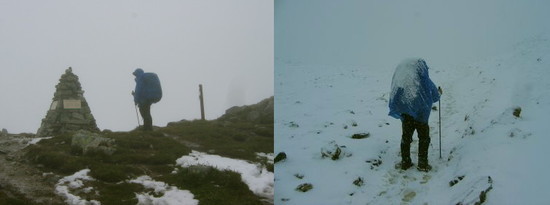
Near Mont Blanc on separate days. Yes, we were warm inside the ponchos. Note: while it was sub-zero on the right, on the left it was sitting at ~0 C and we had experienced torrential rain turning into snow. The ponchos kept the wind and rain off.
Cheers
Not lightweight but Very durable and very dry
$20 construction bibs.
$30 construction coat
$20 Super wide brimmed hat + umbrella though I will be honest I haven't used an umbrella but twice and honestly my hand got tired of holding the bugger.
If no wind hike in bibs and wide brimmed hat. Unlike pants, bibs let all of the sweat of your legs, butt, crotch out and therefore you don't sweat yourself to death. Of course add a waterproof top over the bibs and this is not true. Your arms will get wet and the fleece you are wearing, but otherwise you can hike as fast as you like and stay "dry" in a torrential downpour except your arms which will get soaked. To "dry" fleece, take off wring out, shake hard, put back on and it will be dry in an hour flat. Must keep your body temperature up by eating, setting up camp, dry layer underneath and waterproof parka under this then wet fleece over to dry, using body heat to dry it.
With the above you can sit, kneel anywhere you like and are guaranteed it won't rip or leak through. Beware extended kneeling on sharp gravel as this can over time puncture holes. No its not lightweight, but if you need to get out even in poor weather, which I do often, as otherwise I go bat crazy being cooped up inside, take the ol' beater gear and enjoy.
Being wet is miserable. The above is just one way to get around this. Also works as trail crew wear if you wish to give back.
Fug? Must be a British or Australian term?
Googled it:
"the stuffy atmosphere of a poorly ventilated space; also: a stuffy or malodorous emanation"
Very good Roger : )
I haven't read that article in a long time- thanks for posting it :)
the one really good tidbit I pulled out of that article (amongst many) was "Use slightly warmer, but well selected, clothes and sleeping gear than for dry conditions in similar temperatures."- we all like to push the envelope a little w/ our clothing/sleeping system for the sake of dropping weight, it makes great sense to resist that urge if the forecast is for sustained rain (and cool temps)
and agree w/ the many others voices that staying dry isn't the goal, as it's impossible in sustained rain- staying warm is the goal
btw this should probably be moved to Philosophy and Technique vs Gear imho
Lots of spot-on comments here!
More of basic techniques and philosophy than gear… but always plan on the weather changing.
NOAA will show you what is coming your way, rely on it.
Fleece and DWR always works.
Set up your tarp before the rain begins.
Keep your pack/sleep system dry.
Just yesterday I had hiked the 10 miles out to a local wma, there were a few car campers out there. I knew that a front was coming through last night and timed it just right. 50+mph winds, 2" of rain within 45 mins, temp dropped from 89 to 65 degrees. They left for home in the middle of the squall, I just hunkered down under my Roger Alsborg tarp (thanks Roger, I love this tarp!). Had the place all to myself after the rain passed. A cool but quiet night.
So it looks like it comes down to two decisions for continuous rain or dampness in colder temps. Wear a WPB jacket and pants to keep the rain out but the system acts more like a vapor barrier keeping the perspiration inside and you get a warm and damp microclimate to exist in. This will have the warmth stripped away if the winds are strong. Or more like Roger's article (which I actually did read and liked a lot) and post which uses the basis where you are going to get wet so you should try to stay warm. I would like to know more about Roger's layering system with this. It seemed that when he stopped he would just change into his thermal layers.
Roger wrote, "Don't bother. You won't succeed anyhow. Focus on staying warm."
Fine when you are moving uphill, but when everything is soaking, you have 90% humidity at 45F and you stop, you need some dry stuff. It can be miserable, if not dangerous. With no direct sun and living at the dew point, nothing gets dry. Your base layer may dry from body heat, but thicker stuff like socks and insulation can turn into cold soggy torture devices. And that is in the summer :)
If it's cold, windy, and raining, and you stop for a rest, you don't want to put on your dry insulated layers and get them wet too
If the conditions are marginal like that, don't rest but get to where you're going and set up shelter and then put on insulated layers.
Hi Dale
> but when everything is soaking, you have 90% humidity at 45F and you stop, you
> need some dry stuff.
Not arguing with that. My point is that you should not wear the dry stuff while moving. Keep it dry inside your pack, for when you do stop for an extended period.
What to do if you want to stop for just 5 minutes? No answer – except for don't do it. I can't think of any other solution.
Cheers
In my experience down here in FL, it's unlikely that you'll stay dry in pouring rain and very humid conditions. Therefore, your rain gear has to be selected to keep you warm, but not so warm as to make you overheat.
This is one of the reasons that I prefer a poncho. Due to the fact that it rarely rains down here below 50 F, a poncho allows enough airflow to keep me from overheating even in 80+ F temps while still offering enough of a vapor barrier effect to keep me from freezing in ~50 to ~60 F temps. Sure, it's floppy in the wind; that's one of the reasons that I carry ~20 ft of extra mason's line in my ditty bag. Tie it down around the waist if things look like they're going to get windy and nasty.
Plus, the poncho–for me, at least–is a multi-use item. It's rain gear (sorry, being redundant), a pack cover, a footprint for my hammock, a sit pad for when I stop, an emergency bivy if I get forced down away from my full kit, and a beak for my hammock tarp if the rain is really blowing. I pay a weight penalty for an heavier poncho to be able to do all of this instead of using one only rated for rain gear, but it actually comes out about even in weight versus carrying a separate piece of gear to do all of the above. And it packs down smaller.
Hope it helps!
Edit:
I suppose I should talk about it as part of a system for warmth. My hammock, insulation, and sleeping clothing (at a minimum, a longsleeve merino shirt, a wool watch cap, and a pair of acrylic socks) are kept in a water-resistant sack. None of that comes out until I have the tarp up well enough to keep it from getting wet by even wind-blown rain.
While that stuff is going to get damp from the humidity, I don't use down (mostly due to cost concerns, but also because synthetics work better, if not well, when damp), and I avoid letting it get soaking wet. Which means that it should perform within five to ten degrees of its rated temperature range–as long as I've had enough to eat.
Which is another thing: when it's wet out and cool, high-calorie, high-fat foods are worth their weight in gold. If you find yourself getting cold, eat something! It'll help, more than you might think. Which is another portion of the system for keeping warm.
Finally, very little beats a good fire to keep you warm. Hopefully, it'll never get to the point of needing a survival fire, but if it does, make sure you know how to get one going and keep it going. The best weight-saving (and life-saving) tool you own is right between your ears.
Hope it helps!
"when everything is soaking, you have 90% humidity at 45F and you stop, you need some dry stuff"
Preach it Dale. So true.
"socks and insulation can turn into cold soggy torture devices"
Ah, summer in the cascades!
I never regret my dry long johns for sleeping in. The weight is worth it. :)
When its chilly and wet all day (9mos. in PNW) I put a fleece layer OVER my insulation and UNDER my shell to give the little waters a place to condense, or conjugate, or coagulate, or whatever tickles their fancies.
Become a member to post in the forums.
 New Ultralight GearSee the latest releases in ultralight cottage-brand gear from small makers.
 © Beartooth Media Group Inc.
 Loading...