Topic

Unmanageable wetness this weekend

  • This topic is empty.
Viewing 25 posts - 51 through 75 (of 105 total)
PostedOct 5, 2011 at 5:09 pm

I was wondering how a cuben fiber quilt* (i.e. from Tim Marshall) would perform in these conditions. I would think that it would behave like a water proof bivy along with a VB inside your bag. One could even wear damp/wet clothes inside the quilt and it doesn't seem like the down/synth could ever get wet.

I have wondered though if the insulation in a cuben quilt* could somehow wet out under specific conditions. For example, high temp and/or high humidity air being introduced into the quilt during lofting and causing condensation on the inside of the outer layer which would have cooled down during the night.

Any thoughts? Any cuben quilt users have any experience with this?

* edit: For the purpose of this discussion (and to keep it simple) let's assume Tim's updated quilt style (full cuben shell with resealable inflation tube at bottom)

Jeffs Eleven BPL Member
PostedOct 5, 2011 at 5:13 pm

Cuben quilt performance-

My guess: Full cuben would be good. Momentum or the like- same problem. His bivy was Momentum- one extra layer (SB shell) wouldn't matter.

Thats my guess.

edit- cuben with momentum strip (a la Epiphany) is what I am referring to

Dale Wambaugh BPL Member
PostedOct 5, 2011 at 6:06 pm

I've lived with this for decades in the Cascades and Olympics and it's why I don't use down insulation. It is what I call the "cold sauna," with low temps, precipitation and high humidity. It is bad enough with a double wall tent and no bivy. My best advice is to create all the ventilation possible. It isn't uncommon to wake up soaked with dew, even on nights with no rain. You can pull it off with synthetic fills most of the time, but down turns into goose cement, and with dark rainy weather, there is no way to get it dry and lofty.

Even day hiking is a toss up between getting wet from light precip or perspiration. Many times I have been hiking in a cloud. The best breathable rain gear is of no advantage; features like pit zips provide more relief. A couple weeks ago we were day hiking in 90% humidity, temps from 55F-60F and light precip. I needed a squeegee more than a rain shell! What I really needed was a simple umbrella.

PostedOct 5, 2011 at 6:18 pm

After reading all the above interesting discussion, I looked up some info on dewpoints and found some good stuff. If we assume that near your skin the air is 75 degrees and 60% relative humidity, that air can only be cooled to 60 degrees before condensation will occur. So the dewpoint is not only within the insulation, it is well within it. In fact, if you are wearing warm clothes inside the sleeping bag, the dewpoint is probably just barely into the bag. This situation would be different if the air was drier outside the bag, but it looks like in humid cold conditions you are going to have moisture condensing in your insulation unless you go with a VBL.

James holden BPL Member
PostedOct 5, 2011 at 8:52 pm

you can move the dew point outwards … by using a layer on top of yr bag … ie synth jacket over the bag …

i noticed MLD is now making a light synth quilt for 11 oz … for low temps this may be a better idea than a bivy …

or for all you MYOG bums out there, im sure you can come up with some superlight bag cover with light insulation inside

PostedOct 5, 2011 at 9:29 pm

I see that Eric – I may need to add a Spirit 48 to the gear fray.

M B BPL Member
PostedOct 7, 2011 at 6:46 pm

Very good discussion on moisture management issues in high humidity environment.

Roger Caffin BPL Member
PostedOct 7, 2011 at 6:55 pm

Hi Mike

> In such humid (cold) conditions, the outside of the bivy will become soaked which
> prevents it from breathing and traps all condensation inside. Since this was not a
> waterproof fabric like Event, the condensation that accumulates on the outside of
> the bivy can also pass back into the bivy and into your sleeping bag adding to the
> moisture build up considerably.

Well, I agree that can happen, but whether it applies in this case is not clear. Personally, I suspect that the condensation happened on the INSIDE and was due to the sleeper's sweat going outwards and condensing when it hit the cold fabric of the bivy sack.

OP has pointed out that without the bivy sack the surface of the quilt would have been the cold surface, and that the condensation would then have happened inside the quilt. Yep, very true. The end result would have been the same!

Double-wall tents …

cheers

Jim Colten BPL Member
PostedOct 8, 2011 at 1:27 am

I don't have this problem when I use one of my double wall (with inner mesh) tents.

Help me understand the ways a double wall tent makes a difference here. Some possibilities:

  1. Avoiding moisture transfer from brushing against condensation on the underside of the fly and (up to a point) condensation dripping from the underside of the fly.
  2. The tent's inner walls being a barrier to wind blown fog.
  3. An enclosed tent holds heat better than a tarp (the old rule of thumb that the inside of the tent will be 10*F warmer than the outside on cold nights) thereby keeping the inside temperature above the dew point. Wouldn't that help be limited to only when the each night's conditions (temp and dew point) happen to be in "just the right combination"? Or are they typically in that range whenever it's cool/cold and near 100% humidity?

Anything else?

Note: not disputing Mike's experience, just looking for a more complete understanding.

PostedOct 8, 2011 at 1:40 am

I would say you nailed it Jim, but i would rank your reasons in the opposite order. Pushing the dew point out to the inner tent wall most important. The other 2 can be simply dealt with by a decent water resistant shell on the bag.

M B BPL Member
PostedOct 8, 2011 at 6:18 am

Ventillating a shelter with 100% relative humidity cold air…wont do much for you, except cut down on internal surface condensation while making you colder, and potentially having a dewpoint inside your insulation.

Would seem that minimal ventillation in a single wall shelter might work to keep temp up , but the walls/roof will have severe condensation. But that might be preferable in calm conditions if it keeps it from occuring withing sleeping insulation. Might also depend on the surface area of tent being large enough to condense/remove moisture as fast as it is being produced.

Double wall obviously best to combine some ventillation with dead air insulating space.

t.darrah BPL Member
PostedOct 8, 2011 at 6:55 am

I will post the same product information of the "Gear" forum but wanted to mention this here as being relevant to the subject.

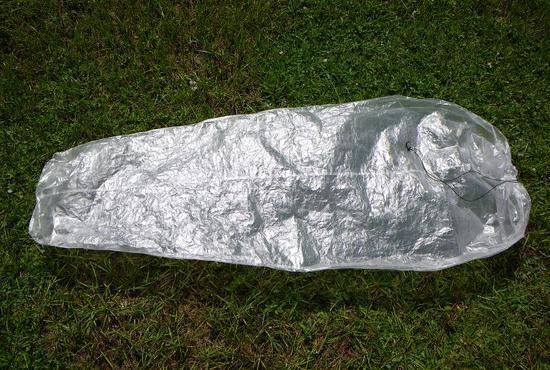
I have been working with Joe at ZPacks to complete the design and make available the "CloudLiner VB".

CloudLiner VB

The description from my TrailLite Designs site:

The CloudLiner-VB is a vapor barrier designed to be used as part of a winter sleep system. Made using ultra light non-breathable cuben the CloudLiner helps control moisture vapor from entering the insulation of a users UL quilt or sleeping bag.

Weight (size regular): 1.5 oz.

James holden BPL Member
PostedOct 8, 2011 at 7:21 am

if i need a VBL i just carry a heatsheets bivy at 4 oz

the problem with a VBL is that is is uncomfortable for some at temperatures above freezing, though they still work

one thing to keep in mind is that once you add up all these goodies (double wall, vbl, overquilt, nalgenes, etc …) or even use them individually … you do have to ask yrself is it worth it and the fiddling than just to get a synth bag/quilt …

and en-rated 20F cats meow or other equivalent bag costs $130 and weights 1200g .. thats 200g more than a helium at 1/2-1/3 the price … and of course there are always the MLD quilts …

not to say synth wont get damp, but you can usually dry off that dampness with body heat and a nalgene … and you can wear your down jacket/pants inside (moves the dew point to the synth bag, rather than the down bag otherwise)

as the OP found out, synth can save yr azz if you make mistakes, or the weather gods eff you over

i think i hear a few kitty cats purring ;)

t.darrah BPL Member
PostedOct 8, 2011 at 8:20 am

"one thing to keep in mind is that once you add up all these goodies (double wall, vbl, overquilt, nalgenes, etc …) or even use them individually …"

My complete winter shelter/sleep systems weighs less then most double wall shelters;

MLD cuben SoloMid = 9 oz (not counting stakes and hiking poles)
MLD event Soul Bivy = 12 oz
Nunatak epic arc Expedition = 34 oz
CloudLiner VB = 1.5 oz

Total = 56.5 oz (3 lbs 8.5 oz)

This is a storm worthy and effective solo UL winter shelter/sleep system for the conditions I hike in.

PostedOct 8, 2011 at 8:37 am

"This is a storm worthy and effective solo UL winter shelter/sleep system."

I would change that to "This is a storm worthy and effective solo UL winter shelter/sleep system for the conditions i hike in."

PostedOct 8, 2011 at 8:42 am

"But that might be preferable in calm conditions if it keeps it from occuring withing sleeping insulation."

I would agree with this Martin – especially with what I encountered.

PostedOct 8, 2011 at 8:46 am

"as the OP found out, synth can save yr azz if you make mistakes, or the weather gods eff you over"

True Dat!

Years ago I read several articles completed by Dr.J (Ryan Jordan) espousing the merits of synthetic insulation. Last weekend, synthetic insulation was a Godsend and kept me out of true hyperthermic conditions. Although the synthetic insulation did get a bit wet (evidenced by the massive internal condensation in my down quilt and bivy), I did not notice much of a drop off in warmth from the syntetic garments. The quilt and bivy were very, very wet in comparison.

Stephen M BPL Member
PostedOct 8, 2011 at 8:53 am

Hi Mike,

Hope all is well.

Does your Warmlite have the liner or is is the single skin one?
Any idea of the temperature the night you had the really bad condensation?

Cheers,

Stephen

PostedOct 8, 2011 at 8:57 am

Awright Stephen. :)
I'm guessing maybe 5 or 6C.
It was a 2R. (double skin) The Stephensons tents create a warm micro-climate, so any dewpoint is going to be outside your sleeping gear.

Stephen M BPL Member
PostedOct 8, 2011 at 9:03 am

Alright Mike :-)

5 to 6C sounds like a balmy Scottish Autumn ;-)

I am on the search for a Winter tent for when I move to the US at the moment (have an add posted for a Soulo) but I keep on coming back to the Warmlite.

Will have a closer look at them.

Cheers,

Stephen

Joe Clement BPL Member
PostedOct 8, 2011 at 9:25 am

So when is someone going to come out and just say Ure is a wuss?

Roger Caffin BPL Member
PostedOct 8, 2011 at 2:52 pm

Hi Eric

> once you add up all these goodies (double wall, vbl, overquilt, nalgenes, etc …) or
> even use them individually … you do have to ask yrself is it worth it and the
> fiddling than just to get a synth bag/quilt …
>not to say synth wont get damp, but you can usually dry off that dampness with body heat and a nalgene

I understand what you are saying, but I have to disagree with the idea that a synth quilt will solve it all. In fact, good down may resist wetting out better than synthetic insulation, as was shown in an article on jackets some time ago. But it gets more complex than that.

Yes, damp down does lose more insulation value than synthetic, but only if it gets to that damp state. If you can avoid that down is better, and good down can be hard to wet out.

Down can be dried off just as fast as synthetic in my experience.

That's just the start. Other wider factors come in. they include;

If you use a good double-skin tent under 'mild' conditions and can keep the inner tent just a little bit warmer than the outside, you may well manage to keep the dew line outside the inner tent. The slight temperature benefit of the inner tent can mean that all the moisture is trapped by the fly. The inner tent can then usually block any drips.

If you have two people inside a good double-skin tent you have a far better chance of managing the conditions as you have twice as much heat supply in an only slightly larger volume. I guess that having three people would be even better, although I have little experience there. Adding an all-night candle can also work by just adding a couple of degrees to the inside, as above.

Even in way sub-zero conditions when there is no chance of 'water' condensing because it goes straight to frost/ice, having two people close together seems to keep the frost line outside the quilt. Plenty of times I have scraped frost off the outside of our quilts without seeing much loss of loft on the down inside. That's over several nights.

One thing I will hold to though: you can't do multi-night trips in extreme conditions with the same UL gear you might use in the desert in summer! The definition of UL has to adjust to the conditions.

Cheers

Viewing 25 posts - 51 through 75 (of 105 total)
Loading...