Topic

Carrying Your Sh*t

Viewing 25 posts - 26 through 50 (of 73 total)
Roger Caffin BPL Member
PostedApr 23, 2009 at 8:49 pm

Hi Tom

> The whole point of the exercise is to get the amount of food carried down to the
> minimum adequate for a safe, happy, heathy trip.
Of course!
All that is left to discuss is what food and what minimum weight! A trivial matter … :-)

I find that 750 g (26.5 oz) per day of dry food is required when I am working fairly hard in cold weather. That does not include a lot of fats, but it does include butter, cheese (great stuff), nuts and a small amount of hard sausage. I don't go very far on replacing carbo with fats because I think my guts need a certain amount of fibre to function correctly.

I remember discussing this matter with a guy who claimed to walk on less than 500 g (12 lb?) per day of cheese, salami and energy bars. It turned out that he was normally rather fat, and on a typical 4 – 5 day trip lost at least 300 g of body fat per day. Yep: he was supplementing his carried food with his internal fat. OK, but rather an unhealthy way to live imho.

Cheers

Robert Blean BPL Member
PostedApr 23, 2009 at 8:57 pm

"I am sure you could get down to a pound a day if you want to drink protein and energy shakes, but …"

Take a good look at the contents of those — unless there is significant fat in them, that would actually be a pretty heavy way to carry your calories. I would expect the powdered or gel form of those to have little fat, but I have not taken a look.

— Mv

PostedApr 23, 2009 at 9:07 pm

Good point Bob. Overall caloric intake is important, and fat is a major contributer (in my best Homer Simpson voice…"mmmmm faaaaat"). I've just seen some interesting claims about what people bring for sustenance. I like to balance flavor and tummy happiness with food weight.

PostedApr 23, 2009 at 10:02 pm

I guess I've just been discouraged recently by how heavy my pack feels full of food and water. When I take out the food and water, my pack feels featherweight in comparison. When I lay out all my food, water, and gear, I start to question why I've put so much thought and research into, say, a $300 tent that will save me 6 oz, while simply pulling 2 Snickers bars out of the pack would accomplish the same thing. But I am far more likely to add a half a pound of emergency food than I am, say, an emergency wp/b bivy of the same weight. I guess the discomfort of hunger is greater than the discomfort of a small tent. If only we could digest grasses like cows…

Dean F. BPL Member
PostedApr 24, 2009 at 4:42 am

I feel the opposite about the Snickers/bivy conundrum.

Unless you are hiking in very cold conditions where you need the calories to keep yourself warm, you are unlikley to die from missing a few days of eating. (Water is another matter.) The conventional wisdom among critical care provders- not wholly accurate- is that one can starve for up to 5 days with no long-term effect. (Water, on the other hand, is a different matter.) And if I do run out of food then at most I might be uncomfortably hungry for a day or so. I thus try not to carry extra food "just in case."

On the other hand if I can't get a decent night of sleep then I am miserable the next day, thus essentially ruining the whole point of my backpacking trip, so I'm willing to accept carry a little extra weight in sleeping system.

PostedApr 24, 2009 at 4:22 pm

"I find that 750 g (26.5 oz) per day of dry food is required when I am working fairly hard in cold weather. That does not include a lot of fats, but it does include butter, cheese (great stuff), nuts and a small amount of hard sausage. I don't go very far on replacing carbo with fats because I think my guts need a certain amount of fibre to function correctly."

Hi Roger,
If we're talking cold weather, I would be right about where you are in terms of weight. One's calorie requirements definitely go up in cold weather, especially if working hard(e.g. deep snow). When I mentioned 1.25#/day, I was talking about typical 3 season trips in the Sierra or Cascades. I always try to get 18-20 grams of fibre/day in my meals. Most "authorities" recommend 25-30 grams, but for trips up to 10 days I seem to do OK on 18-20. I get lots more than that at home.

"Yep: he was supplementing his carried food with his internal fat. OK, but rather an unhealthy way to live imho."

I don't thinks it's unhealthy as long as you don't start depleting the fat around organs, such as the kidneys and liver. I have been supplementing my carried food with purposely gained body fat for years now with no ill effects that are apparent to either me or my doc. It's one of the primary ways I lighten my pack and reduce volume. Reducing my food volume is one big reason I will be using an Ohm on 10 day trips this year, which in turn knocks 11 oz. off my pack weight. Body fat is meant to be used as a food source when other food sources are unavailable, and in any case is routinely metabolized when one is active, in amounts varying inversely with the intensity of the exercise. If I remember correctly, Roman, Jason, and Dr. J relied on stored body fat as significant source of calories in the initial stage of their Arctic1000 expedition, by the same logic. Historically, animals, including humans, have depended on stored fat to get them through the lean times between seasons of plenty, or between kills. For relatively low level, sustained activity, it is the best fuel. The main issue with using fat as a primary fuel is getting enough carbs to keep the Krebs Cycle going. My 2 cents.

PostedApr 24, 2009 at 4:55 pm

Another perspective from

http://andrewskurka.com/advice/nutrition.php

"Fattening up" before your hike
This is a bad idea, though admittedly very tempting. True, you probably will lose the pre-hike fat that you purposely put on — and then some. But, until you lose it, you have to carry it. All weight (whether it's in your pack or on your body) requires energy to carry over hill-and-dale, and it puts stress and strain on your body. More weight equals more energy needed, and more stress and strain on your body. Unless your body fat is dangerously low, my recommendation would actually be to lose body mass before your hike — it will improve your comfort, mobility, and hiking pace; and you can maintain your body weight by simply carrying more food with you or by eating more in towns.

James

PostedApr 24, 2009 at 4:58 pm

I don't know, it sort of seems to me that you are carrying the weight regardless with this approach. I'd rather maintain a healthy weight and carry the calories on the outside. Unless I'm missing something here. Are you saying that you have to ingest a lot more food weight to generate the same number of calories as compared to stored fat? I suppose it would depend on what types of food you carried.

PostedApr 24, 2009 at 6:53 pm

""Fattening up" before your hike
This is a bad idea, though admittedly very tempting. True, you probably will lose the pre-hike fat that you purposely put on — and then some. But, until you lose it, you have to carry it. All weight (whether it's in your pack or on your body) requires energy to carry over hill-and-dale, and it puts stress and strain on your body. More weight equals more energy needed, and more stress and strain on your body. Unless your body fat is dangerously low, my recommendation would actually be to lose body mass before your hike — it will improve your comfort, mobility, and hiking pace; and you can maintain your body weight by simply carrying more food with you or by eating more in towns."

One way or another you have to carry your calories, with all the stress and strain that involves. The advantage with stored fat is that you don't have to digest it, which also requires energy that could otherwise be used for hiking. It won't work for a whole trip, at least not most, but it's a good way to start out, IMO, especially if you are going where there aren't any towns to regain lost weight in.

In my particular case, if I lost body mass I would be in the danger zone before I even hit the trail. Pretty much an individual thing, it seems.

PostedApr 24, 2009 at 7:02 pm

"Unless I'm missing something here. Are you saying that you have to ingest a lot more food weight to generate the same number of calories as compared to stored fat?"

I don't know off the top of my head how much more food, but there is a penalty in that it requires energy(calories) to digest food. Also, stored fat is more readily available, time wise. It takes hours for dietary fat to make it to the muscle cells whereas body fat gets there in a matter of minutes.

PostedApr 26, 2010 at 8:55 am

Hey I definitely understand the concern about durability while packing it out. I also believe a product like this should not take up a lot of pack space and still be convenient to use. I have tried Wag Bags before and I don't like them because you have to carry a bucket or their foldable commode with you everywhere. I have recently discovered a new disposable toilet product called The Biffy Bag. It comes in a small package and can be used comfortably standing without the need of extra equipment. It also has a virtually puncture proof containment bag for preventing leaks. I really like this product and if you enjoy having peace of mind you should check it out.

PostedApr 26, 2010 at 9:11 am

In some cases – the trail to Whitney for instance, or along a stream in slickrock country, too many people, even when "careful, thoughtful, LNT, etc, just overwhelm the area.

There simply is not enough area/dirt/rock/ etc to day-after-day properly dispose of solid waste.

We're loving it to death, and really stinking up the place, among other things.

Edit: Jeff (below) – ya, caught that. I was incorrectly responding to the "drift" back to the OP.

Jeffs Eleven BPL Member
PostedApr 26, 2010 at 9:13 am

Actually the energy debate was the thread drift… The OP was talking about Poo.

Greg that was a sneaky edit, totally changing your post, and all…

PostedApr 26, 2010 at 9:43 am

I haven't had to do this, but if I did, I think I'd consider one of the larger aloksaks. Perhaps even double-bag (two aloksaks). Put a bit of whatever chemical will harden the stuff up in there, do your business on the ground, scoop it into the aloksak, seal, put in another aloksak, seal. Seems to me this would be quite durable and odor free. Haven't even looked into the other solutions though, so don't know how they compare.

Michael Crosby BPL Member
PostedApr 26, 2010 at 9:51 am

From Leave No trace website:

"________________________________________
HUMAN WASTE
Proper disposal of human waste is important to avoid pollution of water sources, avoid the negative implications of someone else finding it, minimize the possibility of spreading disease, and maximize the rate of decomposition.
In most locations, burying human poo in the correct manner is the most effective method to meet these criteria. Solid human waste must be packed out from some places, such as narrow river canyons. Land management agencies can advise you of specific rules for the area you plan to visit.
Contrary to popular opinion, research indicates that burial of poo actually slows decomposition (at least in the Rocky Mountains). Pathogens have been discovered to survive for a year or more when buried. However, in light of the other problems associated with poo, it is still generally best to bury it. The slow decomposition rate causes the need to choose the correct location, far from water, campsites, and other frequently used places.
CATHOLES
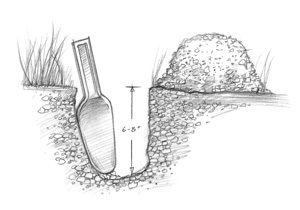
Catholes are the most widely accepted method of waste disposal. Locate catholes at least 200 feet (about 70 adult steps) from water, trails and camp. Select an inconspicuous site where other people will be unlikely to walk or camp. With a small garden trowel, dig a hole 6-8 inches deep and 4-6 inches in diameter. The cathole should be covered and disguised with natural materials when finished. If camping in the area for more than one night, or if camping with a large group, cathole sites should be widely dispersed.
Perhaps the most widely accepted method of backcountry human waste disposal is the cathole. The advantages are:
they are easy to dig in most areas.
they are easy to disguise after use.
they are private.
they disperse the waste rather than concentrate it (which enhances decomposition).
it is usually easy to select an out of the way location where you can be certain no one is going to casually encounter the cathole.
SELECTING A CATHOLE SITE:
Select a cathole site far from water sources, 200 feet (approximately 70 adult paces) is the recommended range.
Select an inconspicuous site untraveled by people. Examples of cathole sites include thick undergrowth, near downed timber, or on gentle hillsides.
If camping with a group or if camping in the same place for more than one night, disperse the catholes over a wide area; don t go to the same place twice.
Try to find a site with deep organic soil. This organic ma al contains organisms which will help de pose the poo. (Organic soil is usually dark and rich in color.) Refer to the jars used to demonstrate decomposition. The desert does not have as much organic soil as a forested area. (See number 2 under Digging a Cathole below.)
If possible, locate your cathole where it will receive maximum sunlight. The heat from the sun will aid decomposition.
Choose an elevated site where water would not normally during runoff or rain storms. The idea here is to keep the poo out of water. Over time, the decomposing poo will percolate into the soil before reaching water sources.
DIGGING A CATHOLE
A small garden trowel is the perfect tool for digging a cathole.
Dig the hole 6-8 inches deep (about the length of the trowel blade) and 4-6 inches in diameter. In a hot desert, human waste does not biodegrade easily because there is little organic soil to help break it down. In the desert, the cathole should be only 4-6 inches deep. This will allow the heat and sun to hasten the decay process.
When finished, the cathole should be filled with the original dirt and disguised with native materials.
Cathole

CATHOLES IN ARID LANDS
A cathole is the most widely accepted means of waste disposal in arid lands. Locate catholes at least 200 feet (about 70 adult steps) from water, trails, and camp. Avoid areas where water visibly flows, such as sandy washes, even if they are dry at the moment. Select a site that will maximize exposure to the sun in order to aid decomposition. Because the sun s heat will penetrate desert soils several inches, it can eventually kill pathogens if the poo are buried properly. South-facing slopes and ridge tops will have more exposure to sun and heat than other areas.
LATRINES
Though catholes are recommended for most situations, there are times when latrines may be more applicable, such as when camping with young children or if staying in one camp for longer than a few nights. Use similar criteria for selecting a latrine location as those used to locate a cathole. Since this higher concentration of poo will decompose very slowly, location is especially important. A good way to speed decomposition and diminish odors is to toss in a handful of soil after each use. Ask your land manager about latrine-building techniques.
TOILET PAPER
Use toilet paper sparingly and use only plain, white, non-perfumed brands. Toilet paper must be disposed of properly! It should either be thoroughly buried in a cathole or placed in plastic bags and packed out. Natural toilet paper has been used by many campers for years. When done correctly, this method is as sanitary as regular toilet paper, but without the impact problems. Popular types of natural toilet paper include stones, vegetation and snow. Obviously, some experimentation is necessary to make this practice work for you, but it is worth a try! Burning toilet paper in a cathole is not generally recommended.
Toilet Paper in Arid Lands: Placing toilet paper in plastic bags and packing it out as trash is the best way to Leave No Trace in a desert environment. Toilet paper should not be burned. This practice can result in wild fires.
TAMPONS
Proper disposal of tampons requires that they be placed in plastic bags and packed out. Do not bury them because they don t decompose readily and animals may dig them up. It will take a very hot, intense fire to burn them completely.
URINE
Urine has little direct effect on vegetation or soil. In some instances urine may draw wildlife which are attracted to the salts. They can defoliate plants and dig up soil. Urinating on rocks, pine needles, and gravel is less likely to attract wildlife. Diluting urine with water from a water bottle can help minimize negative effects.
Special Considerations for River Canyons: River canyons often present unique Leave No Trace problems. The most common practice is to urinate directly in the river and pack out poo in sealed boxes for later disposal. Check with your land manager for details about specific areas
"
© 2008 Leave No Trace |

PostedApr 26, 2010 at 9:52 am

Wow, this thread is still alive. I don't agree with the poster above who claims that you need a bucket or commode to use a wag bag. Just open the bag up, hold it up against your butt and go. It's plenty wide, no concerns about accuracy here. They have chemicals inside to treat your waste and minimize the smell. They are specifically designed for this purpose and they work really well. I can't imagine wanting to deal with a zip lock bag and scooping my fecal matter back off the ground. Maybe it's an ounce or two heavier, but to me it's well worth it.

Hiking Malto BPL Member
PostedApr 26, 2010 at 10:10 am

Can we control the Biffy Bag outbreak? A shameless reference that is completely off-topic. All three posts that he's made is all on Biffy Bags. I may need a Barf Bag if it keeps up!

EndoftheTrail BPL Member
PostedApr 26, 2010 at 10:18 am

I've already reported him. Hopefully the moderators will clean up soon. Something about Australian time though…

PostedApr 26, 2010 at 10:22 am

I've sensed a pattern that suggest the moderator actually take hikes, sometimes days at a time, versus monitoring this endless stream of ….

EndoftheTrail BPL Member
PostedApr 26, 2010 at 10:22 am

Folks,

I've already reported this thread to the moderator. In the meantime, please do NOT add anymore posts so this thread can sink into the shiIthole where it rightfully belongs.

And also, PLEASE DO NOT buy anything from this company (not that the product is really worth buying).

PostedApr 26, 2010 at 11:57 am

Hi Ben,

Maybe I'm missing something, but the OP seems to have had a valid question, which people have tried to answer. One (alleged) spammer made one (it seems) somewhat inappropriate post (in that it seems he's really trying to sell something, not help the discussion). I don't see how that renders the entire thread to the cathole. Unless I misread, the OP still has a valid question that deserves answers. Please enlighten me if I'm off base.

EndoftheTrail BPL Member
PostedApr 26, 2010 at 12:01 pm

Douglas:

My post wasn't referring to OP at all — but just that "Johnny Legend" used this thread to spam us with his "biffy bags" (it was posted here and at least two other places as well). I reported it to the moderator and then asked people not to add more postings just so this thread could sink down the list.

Viewing 25 posts - 26 through 50 (of 73 total)
Loading...